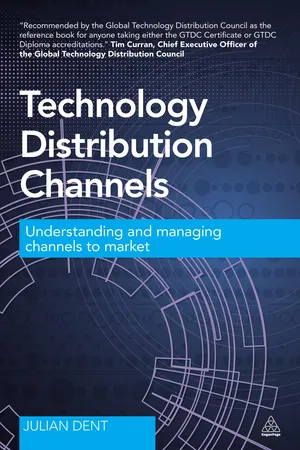
Using numerous real-life examples from global technology corporations, and with a foreword from Tim Curran the Chief Executive Officer of the Global Technology Distribution Council, Technology Distribution Channels explores the chain that makes technology products and services available for market and explains how to make the most of each step of the process. By defining the role and significance of the various partners involved, including distributors, wholesalers and final-tier channel players, it provides a clear understanding of the entire go-to-market process, whilst also explaining channel partners' business models and how to engage with them for effective market access.
Technology Distribution Channels covers both the tactical and strategic dimensions of channel economics as well as containing information on accessing and servicing markets and customers, controlling brands, integrating web and online channels, building the value proposition and creating differentiation.
As the only approved text book for the Global Technology Distribution Council's Accreditations, Technology Distribution Channels contains expert guidance for both the Certificate and the Diploma programs.
Comprehensive and clear, Technology Distribution Channels provides readers with the knowledge needed to improve their business model to ensure maximum market exposure and successful product delivery.
eBook - ePub
Technology Distribution Channels
Understanding and Managing Channels to Market
- English
- ePUB (mobile friendly)
- Available on iOS & Android
eBook - ePub
About this book
Information
Part One
Introduction
01
How to get the best out of this book
Who this book is for
This book is for anyone who wants to understand how the technology industry goes to market, whether you work in the technology sector or want to learn its lessons to apply to your own sector.
Although it may be seen as a relative newcomer to the business world, the technology sector now features throughout the public, commercial, community and personal domains of our economies. The technology sector’s distribution channels now set the benchmark for marketing impact, sales ramp-ups, geographic reach, low operating costs and logistics efficiencies. Which other sectors’ have product launches that make the main news headlines, can sell tens of millions of products in almost every part of the world within hours of launching, be relevant to the largest corporations and youngest children, while operating within cost envelopes measured in basis points and get the product to your home or office the next day, or sometimes the same day?
The term ‘technology’ as used in this book does not just apply to computers or related hardware, but to consumer electronics such as televisions or audio equipment, mobile and personal devices such as phones and tablets, software that runs businesses to the apps that you can download and use on your smartphone, services such as e-mail, photo storage and printing, or the myriad of cloud-based services that enable you to buy stuff, book concert tickets or access any of your applications and data anywhere, whether personal or corporate. It is a pretty broad sector, and one that is constantly expanding its own definition.
As you might imagine, a sector that can do all these things, and do them well, has to have many parts that interact in many different ways. The technology sector has forged these broad capabilities from the thousands of different players in the industry to meet the expectations of its customers. The one constant in the development and growth of the sector has been the need to respond to the market’s requirements with business models that work from an economic perspective. And because each player relies on other parties to make its own business model work, it pays to understand how its relationships affect the other parties’ business models too. That is why this book is really all about business models, and it has to cover the business models of all the major types of player in the technology sector’s distribution channels.
Not only are there many types of player in technology distribution channels, there are multiple roles within each player. This book is for anyone whose role touches the marketing, sales, distribution and service channels of their industry. It is for anyone whose responsibilities include generating demand and fulfilling customer needs through the provision of products and services. If any of the following terminology forms part of your job description, this book is for you:
- routes to market;
- go-to-market;
- distribution channels;
- channels to market;
- sales channels;
- account, relationship or partnership management;
- business to business;
- business to consumer;
- retail to business.
It is for the managers of the businesses that market, distribute, sell and service the products and services of other suppliers and it is for anyone who is involved in the frontline of these relationships.
If your role has any commercial element, then this book has you in mind. It is written for people who don’t consider themselves to be financial experts but recognize that they need to be masters of the economics of their business and the businesses with which they work. It aims to provide pragmatic insight into the challenges faced by each of the parties involved in the marketing and distribution of products and services (the ‘players’) and the opportunities that this insight unlocks.
Equally, if you are financially literate but are relatively new to the special dynamics of distribution, then this book should give you a fast track through many years of experience to the unique issues, measures, relationships and success factors that apply, whether you are working for a player in the midst of the value chain, a supplier at one end or a customer at the other.
It is for anyone who manages the relationship between two or more players in the distribution system, be they partner account managers, partner business managers, channel managers, sales managers, buyers, programme managers, etc. And of course it is for the managers and ultimate directors of these critical roles. Everyone involved in these roles needs to know how to demonstrate the commercial value of their relationship with another player to win and retain business. They also need to understand the way their own business works to build relationships that work for both parties, be they the ‘buyer’ or ‘seller’ in the relationship.
There are many books and courses about finance. Some are for financial people; many are for the ‘non-financial’ manager. Most of these books talk about product companies; some even include a chapter or two about service companies. There are also books about distribution channels and systems, often from a sales or marketing perspective, dealing for example with how to minimize channel conflict or increase your power in the relationship with the channel. However, we have yet to find a book that deals with the business models of companies whose role is primarily to distribute technology products and services, written for people whose job specification does not require a qualification in accountancy… so here it is!
This book does not aim to teach you how to read balance sheets and profit and loss accounts or how to explain depreciation… though we expect you will probably be able to do these things by the time you have finished it. It will help you to understand:
- why working capital management is critical to distributors;
- how to address the demands for more margin from your dealers, retailers or distributors if you are a brand leader;
- how to secure the resources you really need from a technology vendor to achieve your growth targets;
- how to increase your share of your partners’ business even if they claim that you are not as profitable to them as your competitors;
- how to punch above your weight in the distribution system if you have a tiny market share;
- how to ensure you are allocating scarce resources to the channels that will generate the highest returns;
- how to increase your leverage over partners who may not even sell or distribute your products, but whose recommendation is critical to customer preference.
What do we mean by business model?
Throughout this book we refer frequently to business models, so we had better explain what we mean by the term ‘business model’. A business model is how a business makes money from its activities. It is the financial expression of the role, positioning, strategy and execution of a business plan of a specific player in the industry. It is the logical financial result of the economics of the structure of the technology industry and its distribution infrastructure. It is both static – in the form of certain cost structures, margins, capital turns and the like, and dynamic – in the way that costs behave, key ratios change with growth or margins behave under increased competition. So the business model of, say, a distributor of components will have some predictable similarities and some predictable differences with that of a hardware distributor, and further predictable similarities and differences with a mass storage distributor. The same can be said of different players in the same channel eco-system, with their role, balance of power and strategy determining where and how they will make profits, where they have to deploy capital and the scale of both these factors relative to the size of business being done.
In this book we will show you the connection between these forces and the impact they have on the structure of the business model. We will help you to understand the inherent constraints and continual trade-offs with which the managers of each business model are wrestling. We will take you into the ways to improve the business performance of each type of player, whether you are managing it or negotiating with it. These constraints are also opportunities. For example, many retailers cannot hold much inventory on their premises owing to size or cost constraints (attractive retail locations attract a fearsome rent). An enterprising supplier with an efficient distribution logistics capability can offer to supply just in time or manage the inventory on behalf of the retailer, gaining share of category over other suppliers without this capability. The retailer knows it can’t afford to be out of stock, so will give up some of its demands for a better margin in return for assurance of full and replenished shelves. Being able to put these two aspects into proportion – or quantifying them – might not seem like selling or marketing, but it will have a much longer-lasting impact on doing business together than offering a short-term product promotion to gain share.
In this book we aim to teach you to fish, so to speak, rather than catching fish for you. We will point out the major breeds of fish, ie the dominant business models and their inherent characteristics, but more as a way to making you the complete angler. This way you should be able to assess the situation of any business model in any distribution system in any market from any perspective (managing the player or buying from or selling to it), work out the issues and opportunities available and identify the strategy that will best help you achieve your particular objectives.
How this book is set out
This book sets out the business models of all the major types of intermediary in a distribution system, in the following structure:
- The role of the player – although there are some special cases and exceptions, in most industries the roles of the key players are very consistent. However, the labels that are applied in each industry can vary confusingly and in some cases are used interchangeably and in others can carry quite specific meanings. To make sure the labels applied in the technology industry do not mislead you, we define the key roles, so you can recognize which players you are dealing with.
- How their business model works – the principal characteristics of each player’s role in the distribution system determine the fundamental shape of its business model. The business model will be subject to some well-understood economic dynamics and will have one or more ‘big issues’ that define the management team’s priorities. We orientate you to the key features of the business model and show how these are driven by each player’s role and the structure of the industry or distribution system. We explain the business model in plain English and provide a consistent framework for mapping the key numbers. We provide numerous examples of each type of business model so that you can see how the forces in its market have shaped its business profile and affected its business performance.
- The measures that matter and how to manage the business using them – we define and explain all the key measures and how and why they are used. We provide some basic benchmarks to give you a sense of the norms for each measure and help you understand what can be done to improve each measure. We show you how the measures interact so that you understand the pressures that managers of each player are under and the trade-offs they are constantly juggling. We provide some case studies and examples of how failing businesses have been turned around and how successful players have executed their strategies in detail.
- How to sell to that player – or how to sell your value proposition, because your objective is likely to be how to sell through that player. Once you understand the key objectives of the managers you are dealing with, you can ensure that you position your own company’s value proposition in terms that will mean something. You can show how your proposals will impact their business model to the good. You can demonstrate that allocating more of their resources to your products and services is good for both of you, and that attacking the segments in which you want to grow is going to deliver a higher return on investment for them. Equally, you can defend your corner, when asked to concede margin or increase market development funding, by pointing out how little this will benefit their overall performance. We aim to increase your confidence to go high in your account relationships by understanding the overall business model and taking the conversation up to the strategic level.
At the end of this book, we have provided all the useful quick reference material you might need and a glossary of technical terms.
Although we encourage you to read the entire book to learn what a powerful resource it can be for you with its hundreds of examples and insights, we also encourage you to dip into the book when confronted with specific challenges or new situations. Some of the more technical elements of the business models will not make compelling reading until you are dealing with a real issue and then you will welcome the detail of the explanations and the depth of the examples.
Although we aim to educate you through this book in the general and specific aspects of business models, with lots of practical, real examples, every so often we will express a point of view. It often seems to us that there are still some lessons that have yet to be learnt and entrenched behaviours that defy commercial logic: market share leaders employing the tactics of the new entrant, distributors and resellers discounting products that are in short supply, capital wasted without any understanding of its true cost. We aim to give you the benefit of years of hands-on management and consulting insight to help you avoid these pitfalls. Take heed, or you could find your competitor is the first to break the mould and win the business from under your nose!
02
The business of getting technology products and services to market
Distribution matters
Typically around half the price paid for a product by a customer is absorbed by the activities involved in getting that product to the customer (and the customer to the product). And this is a proportion that has increased significantly over the past 15 years as production costs have fallen while markets have segmented and media and distribution channels have multiplied. Typically, this is the proportion of costs which is least well controlled and least well understood.
Markets are fragmenting as trends in consumer and business demographics create additional and more distinct customer segments. To make matters worse, product and service innovations are multiplying the options available. Even simple, commodity-type products may now be distributed to multiple customer segments through multiple routes that differ by country or region. Many of these routes to market involve one or more types of intermediary, such as wholesalers, distributors, dealers, resellers, brokers, aggregators and retailers, or rely upon influencers who shape customer preference or act as specifiers or their behalf, such as consultants or IT strategists. Very few companies can tell you what it costs to sell through a particular route to market whether that be direct, one-tier (eg supplier to dealer to customer) or two-tier (eg supplier to distributor to reseller to customer) distribution. Fewer still can inform you of the profitability of specific intermediaries. We have found wide variation in the costs and profitability of channels and specific intermediaries in every industry and distribution system we have investigated. Companies that have invested in analysing and understanding the business models of their distribution system have been able to take signifi...
Table of contents
- Cover page
- Title page
- Imprint
- Dedication
- Table of contents
- Foreword by Tim Curran
- Preface
- Acknowledgements
- Part one: Introduction
- Part two: Distributors and wholesalers
- Part three: Final-tier trade channel players
- Part four: Retailers
- Key ratios
- Glossary of technical terms
- Index
- Full imprint
Trusted by 375,005 students
Access to over 1.5 million titles for a fair monthly price.
Study more efficiently using our study tools.
Frequently asked questions
Yes, you can cancel anytime from the Subscription tab in your account settings on the Perlego website. Your subscription will stay active until the end of your current billing period. Learn how to cancel your subscription
No, books cannot be downloaded as external files, such as PDFs, for use outside of Perlego. However, you can download books within the Perlego app for offline reading on mobile or tablet. Learn how to download books offline
Perlego offers two plans: Essential and Complete
- Essential is ideal for learners and professionals who enjoy exploring a wide range of subjects. Access the Essential Library with 800,000+ trusted titles and best-sellers across business, personal growth, and the humanities. Includes unlimited reading time and Standard Read Aloud voice.
- Complete: Perfect for advanced learners and researchers needing full, unrestricted access. Unlock 1.5M+ books across hundreds of subjects, including academic and specialized titles. The Complete Plan also includes advanced features like Premium Read Aloud and Research Assistant.
We are an online textbook subscription service, where you can get access to an entire online library for less than the price of a single book per month. With over 1.5 million books across 990+ topics, we’ve got you covered! Learn about our mission
Look out for the read-aloud symbol on your next book to see if you can listen to it. The read-aloud tool reads text aloud for you, highlighting the text as it is being read. You can pause it, speed it up and slow it down. Learn more about Read Aloud
Yes! You can use the Perlego app on both iOS and Android devices to read anytime, anywhere — even offline. Perfect for commutes or when you’re on the go.
Please note we cannot support devices running on iOS 13 and Android 7 or earlier. Learn more about using the app
Please note we cannot support devices running on iOS 13 and Android 7 or earlier. Learn more about using the app
Yes, you can access Technology Distribution Channels by Julian Dent in PDF and/or ePUB format, as well as other popular books in Business & Business Strategy. We have over 1.5 million books available in our catalogue for you to explore.