101 Learning and Development Tools is your practical guide to all the most up-to-date training techniques, organized around the classic learning and development cycle. Whether you need a quick, ready solution or some guidance on where to go for in-depth information, this is your essential reference guide. It picks up from where you are in the process of managing learning, and helps you place it in a broader context.
Each chapter is a mini guide to each tool with:
a description of the tool
analysis
resources needed
cost implications
cross-references to help you identify alternative or related tools for further study or investigation
101 Learning and Development Tools is the indispensable, all-in-one-volume reference book for both professionals in the field and students learning about the subject.
eBook - ePub
101 Learning and Development Tools
Essential Techniques for Creating, Delivering and Managing Effective Training
- 272 pages
- English
- ePUB (mobile friendly)
- Available on iOS & Android
eBook - ePub
101 Learning and Development Tools
Essential Techniques for Creating, Delivering and Managing Effective Training
About this book
Information
PART ONE
Learning needs analysis
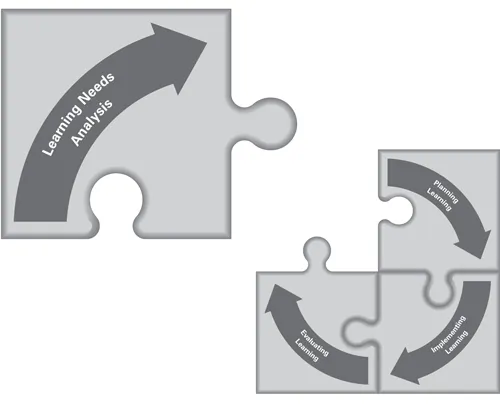
This part of the book considers a range of 27 tools that contribute to learning needs analysis.
02
Understanding learning, development, education and training
X-REF TOOLS | |
8 | Informal and non-formal learning |
21 | Knowledge management: distinguishing data, information and knowledge |
49 | Reference list of learning and development methods |
The most elementary tools we have available to us in learning and development are words themselves: the language we use helps us better understand what we are dealing with and helps us better communicate ideas. Rather than simply assuming definitions of common terms, we can benefit from developing a deeper, and hopefully shared, understanding of what the language of learning and development really means.
People often confuse the most common terms, the fundamentals, and so it helps if we can strive for a shared understanding of them. Essentially, learning and development are things that learners do; they are about acquiring knowledge, skills and capabilities. ‘Education’ and ‘training’ are terms for the inputs to learning and development provided by teachers, trainers and others, including teaching, training, instruction and coaching.
In my 2001 book A Guide to Management Development Techniques, I challenged this orthodoxy, and offered an alternative classification, in which each of these four terms is a subset of a broader term: training is one part of development, which in turn is one part of education, which in turn is one part of learning. I have since relented, and accepted the more common approach, which puts learning and development on the learners’ side of the equation, and education and training on the teachers’ and trainers’ side.
Whatever position you take, you should be able to explain and justify it, and not just use terms because everyone else is using them. If you take ‘learning’ and ‘development’ to mean the same thing, you should not use both terms together, just one of them. This is like the way ‘aims’ and ‘objectives’ are often bracketed together, when many users mean both words as the same; yet just as general learning aims and specific learning objectives may be distinguished, so may learning and development.
The waters are further muddied by the use of scientific (or would-be scientific) terms to encompass all of this. Educationalists tend to speak of ‘pedagogy’ as the science of education, as the term for their theory of learning. The origins of this, in children’s education in schools, are understandable, but when the term is used more widely, in adult education and training, it has strayed far from the original Greek definition of ‘leading the child’. Keen to retain an ancient Greek term, some have suggested alternatives: Malcolm Knowles suggested andragogy, ‘leading the man, or the person’; and Stewart Hase suggested heutagogy, ‘leading the self’, or self-directed learning. These distinctions help clarify what we are trying to accomplish in learning.
For some, all of this may be too academic. But the lesson is only to use language when it is relevant and correct; otherwise all we do is mystify and confuse, when our mission is to help and to explain.
FURTHER READING
Chapnick, S and Meloy, J (2005) From andragogy to heutagogy, Ch 3 in Renaissance eLearning, Wiley, San Francisco
Downs, S (1995) Learning at Work: Effective strategies for making learning happen, Kogan Page, London
Fee, K (2001) A Guide to Management Development Techniques, Kogan Page, London
03
L&DNA grids
X-REF TOOL | |
30 | Using the learning and development cycle to plan learning interventions |
Learning and development needs analysis (L&DNA) grids introduce quantitative methods to the analysis of learning and development needs. They are a means of plotting responses to specific questions on a grid and generating scores for each area under question.
One sort of grid is a self-assessment tool, where learners may be asked to score themselves against a set of criteria listed down the left-hand side of the grid, or the Y axis, choosing from a number of options along the horizontal dimension, or X axis, of the grid. The options could include ‘no skill’, ‘need a lot of help’...
Table of contents
- Cover
- Title page
- Imprint
- Table of Contents
- List of figures
- List of tables
- About the author
- Acknowledgements
- Introduction
- 01 The learning and development cycle
- Part one Learning needs analysis
- Part two Planning learning
- Part three Implementing learning
- Part four Evaluating learning
- 101 You
- Full Imprint
Trusted by 375,005 students
Access to over 1.5 million titles for a fair monthly price.
Study more efficiently using our study tools.
Frequently asked questions
Yes, you can cancel anytime from the Subscription tab in your account settings on the Perlego website. Your subscription will stay active until the end of your current billing period. Learn how to cancel your subscription
No, books cannot be downloaded as external files, such as PDFs, for use outside of Perlego. However, you can download books within the Perlego app for offline reading on mobile or tablet. Learn how to download books offline
Perlego offers two plans: Essential and Complete
- Essential is ideal for learners and professionals who enjoy exploring a wide range of subjects. Access the Essential Library with 800,000+ trusted titles and best-sellers across business, personal growth, and the humanities. Includes unlimited reading time and Standard Read Aloud voice.
- Complete: Perfect for advanced learners and researchers needing full, unrestricted access. Unlock 1.5M+ books across hundreds of subjects, including academic and specialized titles. The Complete Plan also includes advanced features like Premium Read Aloud and Research Assistant.
We are an online textbook subscription service, where you can get access to an entire online library for less than the price of a single book per month. With over 1.5 million books across 990+ topics, we’ve got you covered! Learn about our mission
Look out for the read-aloud symbol on your next book to see if you can listen to it. The read-aloud tool reads text aloud for you, highlighting the text as it is being read. You can pause it, speed it up and slow it down. Learn more about Read Aloud
Yes! You can use the Perlego app on both iOS and Android devices to read anytime, anywhere — even offline. Perfect for commutes or when you’re on the go.
Please note we cannot support devices running on iOS 13 and Android 7 or earlier. Learn more about using the app
Please note we cannot support devices running on iOS 13 and Android 7 or earlier. Learn more about using the app
Yes, you can access 101 Learning and Development Tools by Kenneth Fee in PDF and/or ePUB format, as well as other popular books in Business & Human Resource Management. We have over 1.5 million books available in our catalogue for you to explore.