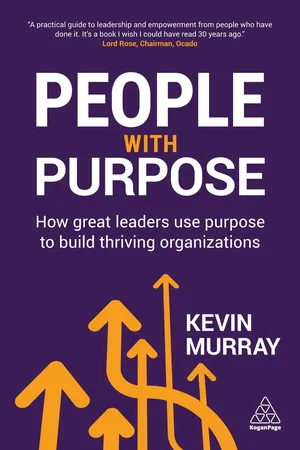
This book is about how great leaders can make purpose the beating heart of their organization and use it to power performance. Leaders who communicate a defined mission, alongside clear and genuine values, allow their employees to feel a sense of purpose in their roles and embody their company's vision. This inspires engagement, loyalty and higher performance. People with Purpose brings together a wide range of compelling research into how having a clearly defined purpose as part of business strategy is a vital element in business success, longevity and inspired teams.
People with Purpose shows leaders how to create a valuable framework that integrates purpose, values and goals on a single page in order to articulate their organization's unique vision to employees and stakeholders. Kevin Murray interviews top CEOs who have used purpose to transform performance, motivate their people, develop organizational resilience and deliver results - often from the very edge of disaster. These leaders share how they have articulated their purpose, their values and their goals. People with Purpose also looks at the work of neuroscientists, brings together the evidence from around the world that proves purpose powers performance, and shows why purpose matters more in a digitally connected and transparent world. More than 30 case studies are explored from exclusive interviews with leaders from a range of organizations, including Odeon and UCI Cinemas, Healthcare at Home, Yodel, Moss Bros and Virgin Atlantic.
eBook - ePub
People with Purpose
How Great Leaders Use Purpose to Build Thriving Organizations
- English
- ePUB (mobile friendly)
- Available on iOS & Android
eBook - ePub
About this book
Information
PART ONE
Why purpose is central to performance
‘Simple, clear purpose and principles give rise to complex, intelligent behaviour. Complex rules and regulations give rise to simple, stupid behaviour.’
dee hock, founder and former ceo of visa international
01
Effective leadership
It’s all in the mind
Leaders who put relationships and purpose before results enable their people to perform better. Why? Because having a sense of purpose and belonging, and being respected, makes you feel worthy, changes your brain chemistry and that changes everything – from your perception of pain, your ability to handle difficult and challenging environments, and even your health and well-being.
Understanding more about how our brains work will help leaders to be more inspiring.
When people find a sense of purpose, and begin to dream and chase positive goals, the benefits are limitless. They change themselves, they better their families, they improve their communities, they help their organizations and companies to perform better, they help to create wealth and prosperity, and they contribute to society in a wide range of ways.
It was for this reason that I became obsessed with the question: how is it that prisoners who spent time on The Clink’s programme were able to transform their lives so radically, and achieve such positive effects all around them?
Yes, I know it was because they had a renewed sense of purpose, and were given a lot of help. But what was it about having a purpose that had such a positive effect on these individuals? I have always understood that how we feel determines how we perform. But isn’t how we feel an emotion? And isn’t an emotional mental state a biological reaction to stimuli? Who would know more about this? Who could I go to for a better understanding?
The answer, of course, is neuroscientists – the people who study the nervous system and the brain, especially in relation to behaviour and learning. Why? Because research being done around the world in neuroscience is beginning to piece together connections between the brain and behaviour, especially at work. This research is providing valuable insights into how to be a more effective leader. Understanding how our brains function, and the chemicals they release, is vital to delivering our strategies successfully.
More specifically, what do scientists know about our brains and giving people a sense of purpose? Do they have insights that we can take into our own organizations and the teams we lead? These are the questions that led me to Dr Duncan Banks, a lifetime honorary member of the British Neuroscience Association and also director of work-based learning at the Open University in Milton Keynes. Why him? Because Dr Banks is one of Britain’s leading neuroscientists.
Dr Banks says:
‘Purpose is most often derived from a willingness to take part in activities for the greater good of the community. It is all a matter of whether you feel worthy or worthless.
Jails are places of minimal engagement and minimal enrichment, so any effort to give people a greater sense of purpose, and a greater sense of a positive role in society, will be more enriching and have a positive effect. Make them feel worthy and they will try harder.’
We are, he says, communal animals and we became even more communal as we developed communication skills:
‘We know that enrichment has a big part to play in brain development from an early stage, even for babies. Give them a rich environment in which they develop and you’ll find they develop into better individuals. If you put someone into an un-rich, worthless environment, they are very likely to go downhill and not be able to contribute, whether this is in a business or in a community.’
Purpose changes your brain chemistry
‘When you have a sense of purpose, especially a sense of common purpose, your brain chemistry changes. These chemicals change everything – from your perception of pain, your ability to handle difficult and challenging environments, and even your health and well-being’, says Dr Banks.
One such chemical is a hormone called oxytocin (released by neurons in the brain), which goes into the bloodstream following positive social interactions and has a positive effect on the whole body. Studies have shown that oxytocin has the potential to improve wound healing, by reducing inflammation. Increased levels of oxytocin can decrease feelings of anxiety and protect against stress, particularly in combination with social support. It has a powerful effect on prosocial behaviours and has also been proved to increase levels of trust and reduce levels of fear.
‘For all these reasons, leaders need to think about whether they make their employees feel worthless or worthy’, says Dr Banks:
‘Do they make their employees feel a sense of common purpose, and part of a community? Do leaders communicate in the right way, involving people and listening to them, as well as persuading and encouraging them? Only by communicating effectively, can leaders make their employees feel worthy and respected.
The positive side effect will always be an increase in performance, because people who feel worthy are much more likely to give of their discretionary effort when called on to work harder.’
Striving to find a meaning in one’s life is the most primary and most powerful motivating and driving force in humans. But how do you measure this?
In 1964, psychologists James Crumbaugh and Leonard Maholick developed a ‘Purpose-in-Life’ scale, probably the most widely used measure of purpose in the world.
Purpose – values – goals
Crumbaugh and Maholick’s Purpose-in-Life scale is based on three dimensions. First, it is about believing that life does have a purpose. Second, it is about upholding a personal value system. Third, it is about having the motivation to achieve future goals and overcome future challenges.
Questions in the Purpose-in-Life test are designed to discover whether a person has an ‘existential void’ – a lack of meaning or purpose in their life, or high levels of motivation and a strong sense of being worthy.
There are many other scales produced by psychologists to measure whether people have a sense of meaning in life, including, for example, the Ryff Scales of Psychological Well-Being, formulated by researcher Carol Ryff of the University of Wisconsin Madison. She says: ‘As a psychologist, I approach optimal ageing in terms of what key ingredients comprise healthy mental functioning. Our studies focus on six dimensions of well-being: autonomy, environmental mastery, personal growth, positive relations with others, purpose in life and self-acceptance.’
Her Purpose-in-Life scale has been demonstrated to relate consistently to a wide variety of well-being and other psychological variables, including life satisfaction, morale, happiness and self-esteem.
Why all this scientific interest in purpose?
Scientists now say that having a higher purpose in life can have dramatic effects on your health in a number of ways. It prevents strokes, reduces the risk of heart attacks and protects from Alzheimer’s and other forms of dementia. It is linked to reducing depression and has many positive health benefits including better mental health, happiness, personal growth and self-acceptance, better sleep and even longevity.
One particular study, by Dr David Bennett, director of the memory and ageing unit at the Rush Medical Centre in Chicago, found that a person with a high Purpose-in-Life score was approximately 2.4 times more likely to remain free of Alzheimer’s disease.
Purpose also matters to the young
The so-called millennial generation now rank finding work that is meaningful as one of the top three factors determining their career success, with 30 per cent of millennials ranking purpose as the most important factor. The word ‘millennials’ applies to the cohort of people born between 1980 and the mid-2000s, most of whom are at the beginning of their careers and so will be an important engine of the economy in the decades to come. They are willing to make less money and work longer, non-traditional hours, as long as their work is personally meaningful. This was the finding of a study by the career advisory board at De Vry University, an online university in the United States.
So, being happy and purposeful at work really matters. Happy and engaged people are much more productive workers and will work both harder and smarter. That’s the leader’s job – to engage people and give them a greater sense of purpose. How well are leaders doing this job?
Alarmingly, studies in the UK and the United States, backe...
Table of contents
- Cover
- Praise for People with Purpose
- Title Page
- Purpose
- Contents
- Preface
- Introduction: Lives transformed by purpose
- PART ONE Why purpose is central to performance
- PART TWO People with purpose: How leaders use purpose in their own organizations
- PART THREE Leading with purpose: What you need to do
- The resources
- Acknowledgements
- About the author
- Index
- Copyright
Trusted by 375,005 students
Access to over 1.5 million titles for a fair monthly price.
Study more efficiently using our study tools.
Frequently asked questions
Yes, you can cancel anytime from the Subscription tab in your account settings on the Perlego website. Your subscription will stay active until the end of your current billing period. Learn how to cancel your subscription
No, books cannot be downloaded as external files, such as PDFs, for use outside of Perlego. However, you can download books within the Perlego app for offline reading on mobile or tablet. Learn how to download books offline
Perlego offers two plans: Essential and Complete
- Essential is ideal for learners and professionals who enjoy exploring a wide range of subjects. Access the Essential Library with 800,000+ trusted titles and best-sellers across business, personal growth, and the humanities. Includes unlimited reading time and Standard Read Aloud voice.
- Complete: Perfect for advanced learners and researchers needing full, unrestricted access. Unlock 1.5M+ books across hundreds of subjects, including academic and specialized titles. The Complete Plan also includes advanced features like Premium Read Aloud and Research Assistant.
We are an online textbook subscription service, where you can get access to an entire online library for less than the price of a single book per month. With over 1.5 million books across 990+ topics, we’ve got you covered! Learn about our mission
Look out for the read-aloud symbol on your next book to see if you can listen to it. The read-aloud tool reads text aloud for you, highlighting the text as it is being read. You can pause it, speed it up and slow it down. Learn more about Read Aloud
Yes! You can use the Perlego app on both iOS and Android devices to read anytime, anywhere — even offline. Perfect for commutes or when you’re on the go.
Please note we cannot support devices running on iOS 13 and Android 7 or earlier. Learn more about using the app
Please note we cannot support devices running on iOS 13 and Android 7 or earlier. Learn more about using the app
Yes, you can access People with Purpose by Oh,Kevin Murray in PDF and/or ePUB format, as well as other popular books in Business & Management. We have over 1.5 million books available in our catalogue for you to explore.