Most leadership development runs on rails: courses are organized with standard content usually delivered by companies set up expressly for that purpose. Most leadership programmes fail when judged on whether they achieve lasting impact and behaviour change because what is covered is often forgotten after the programme ends. Building Leadership Development Programmes is designed to show how leadership development should work. It challenges the widely accepted notion that leadership development cannot be measured and it exemplifies how to design programmes that are in line with organizational needs and deliver lasting and measurable impact.
Building Leadership Development Programmes is structured around detailed case studies from around the world that offer unique insights into the process of building effective leadership development, looking at a range of approaches from almost zero cost options to high end investment that actually works. It helps readers think through what it is that they are actually trying to achieve, offering processes to work through to establish what is necessary for their organization and take a longer view than looking for quick fixes. It features case studies including Crotonville Leadership Centre who have worked with GE, McKinsey and the Red Cross, and interviews with world authorities on leadership and talent development. Detailed guidance will help identify the right measures to ensure impact, and to adopt the right methodologies, including looking at leadership coaching, mentoring, social learning and action learning, blowing apart the idea that expensive training courses are always required.
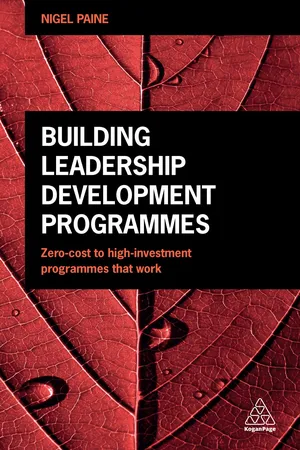
eBook - ePub
Building Leadership Development Programmes
Zero-Cost to High-Investment Programmes that Work
- English
- ePUB (mobile friendly)
- Available on iOS & Android
eBook - ePub
Building Leadership Development Programmes
Zero-Cost to High-Investment Programmes that Work
About this book
Information
PART ONE
The Leadership Challenge
01
The leadership context
When asking what is leadership, the answer depends on what one is looking for, and from where one is looking. Leadership is many things to many people.
WESTERN, 2008: CHAPTER 2
How much do we know about leadership?
Leadership is a bewildering field. It is so complex and multifaceted that it is daunting to explore. And after thousands of years’ debate, according to Grint (2010: chapter 1), we can hardly even agree what it means, let alone agree how to make better leaders in organizations. There is so much contradiction and loud shouting that ‘my way’ is the only way, that finding direction and making good decisions is hard. For example, in a random dip into Twitter in May 2016 I came across the following statements related to leadership, in rapid succession:
Most important thing for a manager? Provide clarity.
Always be curious.
Be happy for no reason.
Fight tirelessly for what we want.
Actions not words are the ultimate results of leadership.
Too many leaders disappear when times are tough.
Be optimistic
Enthusiastic
Focus forward
Joyful
Faithful
Determined
Aggressive
Energetic
Purposeful
and Loving
Leaders are visionaries with a poorly developed sense of fear and no concept of the odds against them.
When you manage focus on execution. When you lead focus on purpose and direction.
The function of leadership is to produce more leaders, not more followers. – Ralph Nader
Any day, at any time, would reveal similar complementary or contradictory sentiments. We all have strong opinions about what makes good leaders. We all have strong images in our mind of poor leadership, and fewer usually of great leadership. We have all been led, and many of us are leaders too. This means we think we know what works and what does not. We have felt the pain and frustration of terrible leadership, and admired good leadership. Many claim to know the component parts of what effective leadership comprises, and there are competence frameworks in profusion to codify those views. If you ask Google for examples of leadership competency frameworks, you get 268,000 hits. There are hundreds of diagrams of models for leadership.
This whole area buzzes with life and debate and, of course, contradiction. We need authentic leaders, leaders as teachers, humble leaders, leaders as followers, resonant leaders etc. And these frameworks and models sustain tens of thousands of courses, run internally and externally by huge corporations, as well as small boutique companies, business schools and consultants. It is a huge industry that ‘could be worth US$50 billion a year’ (Corporate Research Forum Report (Pillans), 2015). But the CRF Report asks a very interesting question. Is that industry, in spite of its obvious size and power, fit for purpose in the 21st century?
There is something strange in the way that most leadership programmes are delivered and the curriculum around which they are built. That something is the fact that they look now, for the most part, pretty much as they did 20 years ago, and yet our world and organizations have been transformed over that same period. There is a clear dislocation between ‘what is taught and what is experienced’ (CRF Report (Pillans), 2015: 11) in the world of work.
The changing climate
The major research report of the Corporate Research Forum, Leadership Development – is it fit for purpose? (2015), graphically describes the changes in the world that leaders inhabit:
Increasing complexity and ambiguity, fiercer global competition and the accelerating pace of change mean leaders need to be strong adaptive- and systems-thinkers, agile learners, self-aware and comfortable with leading through uncertainty. (CRF Report (Pillans), 2015: 11)
What is being stated is that where the environment becomes more volatile, uncertain, complex and ambiguous (the term VUCA was coined by the US military to capture the idea of that environment), how we run organizations has to change and the skills needed to run organizations in that climate has to change too. The obvious response is to focus on equipping leaders in organizations with the right skills to do a good job in a new context. And that context will not get any easier. In fact, if we believe Mervyn King, the former Governor of the Bank of England – ‘it is getting more complex and therefore leadership is getting more challenging’ (King, 2016: chapter 4). In his recent book, The End of Alchemy, King (the man who held sway at the Bank during the global financial crisis of 2008) devotes an entire chapter of his book to the concept of ‘radical uncertainty’ (King, 2016: chapter 4).
It is, for him, one of the defining forces of the age. He defines radical uncertainty as: ‘Uncertainty… so profound that it is impossible to represent the future in terms of a knowable and exhaustive list of outcomes to which we can attach probabilities.’
This means that everyone, including the most well informed leader, is unable ‘to conceive of what the future may hold’ (King, 2016: 19). This not only changes the world of finance, but the demands on any leader seeking some form of certainty. In King’s view that VUCA world of volatility, uncertainty, complexity and ambiguity becomes the VrUCA world where intelligence, agility, the ability to work with contradiction and fast reaction hold sway.
The CRF Report is based on research and an online survey of over 1,000 UK member companies of the Forum. It is this report that estimates – from collating data from a number of sources – that the global spend on leadership development is now around US$50 billion per year out of a total learning and development spend – estimated by Bersin by Deloitte – of US$130 billion (CRF Report (Pillans), 2015: 12). Leadership is the single biggest ticket item. Yet both the CRF survey, Deloitte’s Human Capital Trends (2015), and the Marshall School of Business’s ePulse survey (CRF Report (Pillans), 2015:13), show a widening gap between leadership needs and capability, satisfaction with the quality of leadership development, and overall confidence of CEOs in the leadership quality in their organizations (CRF Report (Pillans), 2015: 13).
What skills are required?
In January 2015, the McKinsey Quarterly (Feser, Mayol and Srinivasan, 2015) published some extensive research on what leadership skills really matter. This was based on the survey results of 189,000 people in 81 diverse organizations around the world. The research indicated that four types of behaviour stand out as critical in terms of leadership effectiveness. They are:
- Be supportive.
- Operate with strong results orientation.
- Seek different perspectives.
- Solve problems effectively.
The problem is, that stating these behaviours is one thing – developing them, and building them into a consistent leadership culture is a very different challenge, even if you accept that the McKinsey analysis is accurate. The article is set in the context of the opening line: ‘Telling CEOs these days that leadership drives performance is a bit like saying that oxygen is necessary to breathe’ (McKinsey Quarterly, 2015). It is axiomatic that all CEOs would want their leaders to be supportive and operate with a strong results orientation, etc. That is why so much money is invested in leadership: the impact that leaders make on an organization – good and bad – is amplified to the point where, ultimately, the success or failure of the organization is at stake. Everybody knows that good leadership makes a difference. Quoting a joint Conference Board/McKinsey report from October 2012 on the state of human capital in organizations, the authors claim that over 90 per cent of CEOs are planning to increase their investment in leadership development because ‘they see it as the single most important human-capital issue their organizations face’ (The Conference Board/McKinsey & Company, 2012).
In spite of this impressive statistic, only 43 per cent of CEOs have any confidence that the investment they make in developing their leaders will bear any fruit, and there is no consensus from academia or the leadership field about what core issues leadership development programmes should address and how to make the development stick and deliver lasting impact. And even if we can all agree that the McKinsey research puts its finger on the four key, critical leadership behaviours, there is still no consensus on how you should develop leaders to manifest those behaviours consistently or sustain that behaviour change over time.
You could conclude that leadership development is a mess, as there is no agreement on what constitutes a suitable curriculum for leaders, or how best to make any kind of development stick that actually leads to permanent and consistent changed behaviour in the workplace. As investment in leadership shoots up, confidence in its impact goes down. This is borne out by the research from the Corporate Research Forum (CRF Report (Pillans), 2015: 8). In some way the CRF Report paints a bleaker picture than even McKinsey’s analysis:
… levels of satisfaction with the quality of leaders and the effectiveness of leadership development are low. Less than one-third (31 per cent) of respondents to the CRF leadership survey rated their overall ability to develop leaders as ‘Good’ or ‘Excellent’. There is also little evidence that investments in leadership development lead to improved business performance. (CRF Report (Pillans), 2015: 8)
If this were the whole story, we could all learn its lesson, save our money, dump our leadership development programmes, and move on! There are, however, many success stories in the leadership development field, as well as many corporate transformations based around the implementation of successful leadership programmes. The investment by GE and their consistent belief over decades in performance unleashed by good leadership is undiminished. GE would argue that its consistent approach to leadership across the many different industries in which it operates is a huge strength and one of the main components of the glue that holds the company together and makes the whole more impressive than the sum of its parts (conversation with Peter Cavanaugh, head of Crotonville Centre). In fact, the company’s commitment to Crotonville (and subsequent investment in it) is stronger than ever and the brand has been expanded into local sites around the world where the Crotonville message is delivered (see Chapter 2).
The answer to what makes some leadership development so successful and much of the rest fairly ineffective is not as straightforward as simply picking the right model or focusing on the most useful areas of competence to develop. It is not about delivering appropriate content, or finding the correct delivery mode or buying in charismatic faculty, but a more complex intermeshing of need, insight, process and learning community development that leads to sustained behaviour change. This book will tease out the strands of what makes leadership development successful and suggest ways that will help those charged with making leadership more effective to gain more focus, context and direction as they work out the way forward for their organizations.
The two reports mentioned above were published in 2015. That is not the first time anyone noticed that something was wrong with how leaders behaved in organizations, or the fact that investment in leadership development appears to be a bottomless pit in terms of the resources it consumes, but a shallow trench if you look at impact. However, no one appears to assert that leadership is easy or unimportant – quite the opposite. The problem is not whether leadership development is worth doing, but how to get it right and begin to support leaders as they grapple with an increasingly difficult environment, with increasingly higher expectations imposed upon this corporate elite. This is because,...
Table of contents
- Cover
- Series Page
- Title Page
- Contents
- Acknowledgements
- Introduction
- PART ONE The Leadership Challenge
- PART TWO Improving the Paradigm
- PART THREE Changing the Paradigm
- PART FOUR Elements for Transformation
- PART FIVE Lessons Learned
- Index
- Copyright
Trusted by 375,005 students
Access to over 1.5 million titles for a fair monthly price.
Study more efficiently using our study tools.
Frequently asked questions
Yes, you can cancel anytime from the Subscription tab in your account settings on the Perlego website. Your subscription will stay active until the end of your current billing period. Learn how to cancel your subscription
No, books cannot be downloaded as external files, such as PDFs, for use outside of Perlego. However, you can download books within the Perlego app for offline reading on mobile or tablet. Learn how to download books offline
Perlego offers two plans: Essential and Complete
- Essential is ideal for learners and professionals who enjoy exploring a wide range of subjects. Access the Essential Library with 800,000+ trusted titles and best-sellers across business, personal growth, and the humanities. Includes unlimited reading time and Standard Read Aloud voice.
- Complete: Perfect for advanced learners and researchers needing full, unrestricted access. Unlock 1.5M+ books across hundreds of subjects, including academic and specialized titles. The Complete Plan also includes advanced features like Premium Read Aloud and Research Assistant.
We are an online textbook subscription service, where you can get access to an entire online library for less than the price of a single book per month. With over 1.5 million books across 990+ topics, we’ve got you covered! Learn about our mission
Look out for the read-aloud symbol on your next book to see if you can listen to it. The read-aloud tool reads text aloud for you, highlighting the text as it is being read. You can pause it, speed it up and slow it down. Learn more about Read Aloud
Yes! You can use the Perlego app on both iOS and Android devices to read anytime, anywhere — even offline. Perfect for commutes or when you’re on the go.
Please note we cannot support devices running on iOS 13 and Android 7 or earlier. Learn more about using the app
Please note we cannot support devices running on iOS 13 and Android 7 or earlier. Learn more about using the app
Yes, you can access Building Leadership Development Programmes by Nigel Paine in PDF and/or ePUB format, as well as other popular books in Business & Human Resource Management. We have over 1.5 million books available in our catalogue for you to explore.