The Inclusion Imperative showcases the inspiring commitment to inclusion the London Olympic and Paralympic Games' organizing committee espoused, and details the techniques and frameworks that enabled it to truly deliver a 'Games for everyone' at London 2012. Diversity and inclusion expert, Stephen Frost, challenges preconceived ideas and strives to inspire professionals to tackle inclusion in their organizations with courage, creativity and talent. With highly relatable examples, The Inclusion Imperative constitutes the best argument to convince sceptics that real diversity and inclusion can deliver more engaged employees and customers, improved employee recruitment and retention, increase productivity and better group decision-making processes.
Real inclusion saves money and improves efficiency in the systems of an organisation, making the world a better place as a by-product. Building on concepts that include Diversity 3.0, detailed process journeys, and procurement governance, this is a must-read for HR and diversity officers frustrated with the guidance currently available, as well as for anyone who recognizes the legacy of the 2012 Games in fostering a tolerant and diverse society.
eBook - ePub
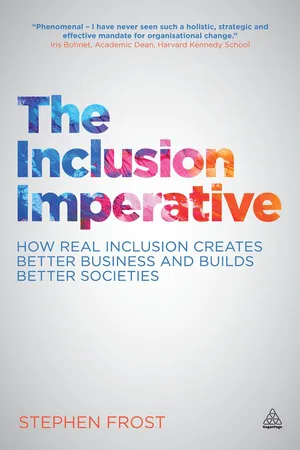
The Inclusion Imperative
How Real Inclusion Creates Better Business and Builds Better Societies
- English
- ePUB (mobile friendly)
- Available on iOS & Android
eBook - ePub
The Inclusion Imperative
How Real Inclusion Creates Better Business and Builds Better Societies
About this book
Information
PART ONE Courage
01 Inside the tent: the seven stages of life in an organising committee
Paul Deighton, the highly capable and humorous former Chief Executive Officer of the London Organising Committee (LOCOG), summarised the process of staging the Games in a seven-stage model. He was paraphrasing one of his predecessors, Sandy Holloway, the Chief Executive of Sydney 2000. The stages were, in very specific order: celebration; shock; despair; search for the guilty; persecution of the innocent; celebration (again); and, finally, the inevitable glorification of the uninvolved.
This is actually a useful framework to attempt to explain the background and context of the London 2012 Games, and specifically to articulate and explain the animal that was the London Organising Committee. The nature of the organisation appears in some ways unique: its temporary nature with an immovable deadline, the level of scrutiny and limited resources being key factors. However, for the most part, it was simply an intensified experience of what persists in most organisations. Other more mainstream organisations simply do not have to endure the level of external analysis LOCOG was subject to. Most companies are not public experiments. Since LOCOG was, we can all learn from the experience.
Introducing the organisation
There was a paradox evident in the organisation: the intense level of scrutiny encouraged a risk-averse approach, yet the force of circumstances dictated the opposite. Whereas the scrutiny did indeed encourage a risk mitigating, conservative approach to tackling problems, the immovable deadline, lack of resources and multiple other constraints forced the opposite approach. It was this latter approach that prevailed. Experimentation became a necessity, and the resulting laboratory was a wonderful learning environment in which to learn. As Tony Sainsbury, a colleague and Games veteran, observed ‘it’s the only place in professional life where you can gain 15 years of experience in 5’.1
LOCOG was a private organisation, and therefore not subject to the public sector ‘equality duties’; legally mandated action to ‘promote’ equality.2 It was a temporary organisation, growing from fifty or so individuals in 2005 to an army of 200,000 staff, volunteers and contractors in order to stage the Games in 2012. It was also the first time the Paralympic Games’ preparations had been brought into the same organisation as the Olympic Games, with both Games being prepared by the same staff under the same leadership of Chair Seb Coe and Chief Executive Paul Deighton.
LOCOG’s primary purpose was to deliver the Games; to prepare both Olympic and Paralympic Games and to stage an inspirational Games for the athletes, the Olympic and Paralympic family and the viewing public. Even though its mission was ‘to use the power of the Games to inspire change’, LOCOG’s primary purpose was explicitly not social change, it was event staging. One of the best summaries, truly, of life in an Organising Committee was parodied in the BBC Comedy series Twenty Twelve, which included incidents such as losing foreign delegations due to bus drivers not knowing routes, legacy and sustainability fighting for airtime, different interpretations of ‘Inclusion day’ and so on, many of which were, in fact, true.
When Jeremy Hunt, the Secretary of State for Culture, Media and Sport – the sponsoring government department – was asked what he thought of LOCOG, he replied ‘competent’.3 That was a fair summary of how LOCOG was perceived by many stakeholders. ‘Private sector’ was used frequently by public sector colleagues.
The reality was that LOCOG was headed by an ex-banker, with a cohort of professional corporate people in its ranks. It was also, however, extremely diverse in terms of the backgrounds and world-views of its key players. There were those from a strongly commercial background, bankers, lawyers and management consultants, who wanted to run LOCOG as a for-profit entity. There were those from a strongly public sector background, civil servants, charity personnel and government secondees, who wanted LOCOG to live up to its perceived social responsibilities as a priority. There were also those who were somewhere in-between, including international colleagues, and ‘Games junkies’ who had staffed multiple Games before, moved from host city to host city, and who felt that the focus should only be on operational delivery.
The consequence of these often wildly different world-views was a constantly contested territory in which to operate. No two meetings would be the same. In some, commercial interests would triumph. In others, social interests would dominate. In some, legacy would be front of mind, and in others it would all be about the operational here and now. As Head of Diversity and Inclusion for the Organising Committee, my responsibility was to ensure we staged a Games where, according to our own PR, ‘everyone is invited, everyone is welcome and everyone can take part’. In the job description it said ‘this role will be accountable for the development of the “Diversity strategy” and will influence across the organisation to ensure that diversity forms part of everything that we do at LOCOG’.
Re-defining success
The Olympic Games is a truly unifying event. Every four years, more countries than are members of the United Nations assemble in a global city to compete on the sporting field. It is the largest peacetime event in the world, and the most complex to organise.
The complexity of the Games derives not just from their size, but also from the sheer range and diversity of stakeholder constituents and client groups involved. The number of nations, the number of nations who have no/strained diplomatic relations and the number of athletes creates unique challenges. As does the number of media, the pressure on existing transportation and security systems, the potential for new hazards and unforeseen challenges.
The complexity of the project also derives from the need to satisfy different definitions of success. For many inside the organisation it was a technical exercise. It was possibly the largest and most complex technical exercise imaginable, but it was still a technical test. Delivering 26 simultaneous world championships for the Olympic Games over 134 venues, with a workforce of 200,000 and the entire world watching, followed by 20 more simultaneous world championships two weeks later for the Paralympic Games, was the ultimate technical challenge. The Olympic Games is comprised of 26 world championships (39 disciplines) across 34 venues, 8.8 million tickets, 10,490 athletes, 302 medal events, 21,000 media and broadcasters, 19 competition days (including football), 2,961 technical officials, 204 National Olympic Committees, 5,770 team officials and 5,000 anti-doping samples. In order to cope with this challenge, people understandably resort to technical know-how as per Table 1.1.4
Past Games had endured real technical challenges, from venue readiness at Athens 2004, terrorism at Munich 1972 and Atlanta 1996 to boycotts at Moscow 1980 and Los Angeles 1984. Given this, it is perhaps understandable that many would have relied on what we already know and have learned over the years. They would have proclaimed success as simply the successful staging of the event, as indeed happened in London in July, August and September 2012.
For others inside and outside the organisation, it was more than that. Technical excellence was a prerequisite to success, but not success in and of itself – £9 billion and the chance of a lifetime constituted too great an input to only produce a technical output, no matter how impressive. We needed to change the system, we needed to engage in adaptive work. On paper, this latter group won. ‘Legacy’ became the key word, and the mission of the organisation became ‘to use the power of the Games to inspire change’.
In some ways, this was a gift for inclusion. To use ‘the power of the Games’ to inspire social change, to make the world a better place, was in many ways the ultimate organisational mission statement. However, it was carefully worded so as to be open to multiple interpretations. The faction who lost the ‘paper war’ still remained in the technical driving seat; the most complex event in the world requires technical excellence as a precondition to any other aspiration, no matter how noble. So while the mission of the organisation was indeed ‘inspiring change’ that was a value that had to be fought for, not taken as given, in the technical race to the finishing line.
‘Success’ therefore remained open to interpretation. There was relative unanimity concerning the successful technical delivery of the event, but there was relative ignorance at the start about ‘success’ in terms of inclusion. We therefore had to create a definition of success that respected the technical prerequisite, but was sufficiently bold to justify the opportunity of a lifetime the Games had provided. Diversity and Inclusion presented an adaptive challenge of changing the system, which many people did not initially want to take on, either consciously or subconsciously, especially if ‘the system’ worked fine for them already. For one, many good people were turned off by their current perceptions of Diversity and Inclusion based on their experience to date in other organisations. In addition, time, money and lack of resources in general presented very real obstacles. This was, in a very real sense, all about achieving diversity on a deadline.
TABLE 1.1 Technical versus adaptive work
| Type of Work | What’s the Work? | Who Does the Work? |
| Technical | Apply current know-how | Authorities |
| Adaptive | Learn new ways | The people with the problem |
Adapted from Ron Heifitz and Marty Linsky, Leadership on the Line
‘Success’ for Diversity and Inclusion at LOCOG had to start with a re-definition of the subject matter and an intelligent articulation of a genuine business case for action. This is detailed in Chapters 3 and 4. We began with the mission, to use the power of the Games to inspire change, and this was translated into ‘Everyone’s 2012’, allowing everyone to take part. There were technical goals laid out at the start, with target zones for workforce and procurement diversity, for example. However, the specific definitions of success, and moreover the spirit of success, only came alive mid-way through the project when we asked the departments to define inclusion success for themselves. Their discretionary effort, courage, creativity and talent produced results that we could not have envisaged on paper five years out.
Celebration
The first stage in Paul’s model was celebration. London was not expected to win the hosting of the 2012 Games, and this is where the Diversity and Inclusion story begins – as an accident of history.
On 6 July 2005, all the media cameras in the Singapore conference hall were in front of the Paris delegation, waiting for the reaction to the announcement. Back in France, the Champs-Elysées and the square in front of the Paris town hall were packed with jubilant French citizens. President Jacques Chirac had already left Singapore for the G8 summit, confident of victory and a prize he had helped secure for the French Republic.
The British Prime Minister Tony Blair, on the other hand, stayed until the last minute, despite being the host of the G8 su...
Table of contents
- Cover
- Halftitle
- Title page
- Imprint
- Fm
- Contents
- About the author
- Acknowledgements
- Foreword Desmond Tutu
- Introduction Paul Deighton, Tanni Grey-Thompson and Jean Tomlin
- PART ONE Courage
- PART TWO Creativity
- PART THREE Talent
- PART FOUR Legacy
- Appendices
- References
- Index
- Dedication
- Full imprint
Trusted by 375,005 students
Access to over 1.5 million titles for a fair monthly price.
Study more efficiently using our study tools.
Frequently asked questions
Yes, you can cancel anytime from the Subscription tab in your account settings on the Perlego website. Your subscription will stay active until the end of your current billing period. Learn how to cancel your subscription
No, books cannot be downloaded as external files, such as PDFs, for use outside of Perlego. However, you can download books within the Perlego app for offline reading on mobile or tablet. Learn how to download books offline
Perlego offers two plans: Essential and Complete
- Essential is ideal for learners and professionals who enjoy exploring a wide range of subjects. Access the Essential Library with 800,000+ trusted titles and best-sellers across business, personal growth, and the humanities. Includes unlimited reading time and Standard Read Aloud voice.
- Complete: Perfect for advanced learners and researchers needing full, unrestricted access. Unlock 1.5M+ books across hundreds of subjects, including academic and specialized titles. The Complete Plan also includes advanced features like Premium Read Aloud and Research Assistant.
We are an online textbook subscription service, where you can get access to an entire online library for less than the price of a single book per month. With over 1.5 million books across 990+ topics, we’ve got you covered! Learn about our mission
Look out for the read-aloud symbol on your next book to see if you can listen to it. The read-aloud tool reads text aloud for you, highlighting the text as it is being read. You can pause it, speed it up and slow it down. Learn more about Read Aloud
Yes! You can use the Perlego app on both iOS and Android devices to read anytime, anywhere — even offline. Perfect for commutes or when you’re on the go.
Please note we cannot support devices running on iOS 13 and Android 7 or earlier. Learn more about using the app
Please note we cannot support devices running on iOS 13 and Android 7 or earlier. Learn more about using the app
Yes, you can access The Inclusion Imperative by Stephen Frost in PDF and/or ePUB format, as well as other popular books in Business & Human Resource Management. We have over 1.5 million books available in our catalogue for you to explore.