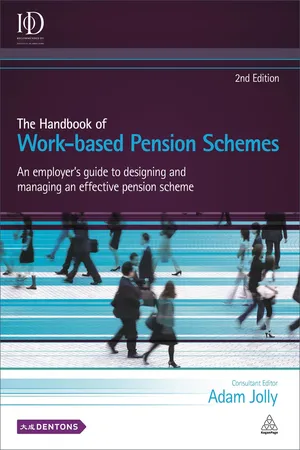
eBook - ePub
The Handbook of Work-based Pension Schemes
An Employer's Guide to Designing and Managing an Effective Pension Scheme
- English
- ePUB (mobile friendly)
- Available on iOS & Android
eBook - ePub
The Handbook of Work-based Pension Schemes
An Employer's Guide to Designing and Managing an Effective Pension Scheme
About this book
Since Autumn 2012 and under strict regulatory obligations, the biggest corporations in the UK have been offering a pension to any employee who earns more than £10,000. Now the challenge falls on smaller employers. This compulsory measure has far-reaching consequences for all players: not only have many new pension customers been brought into the market, but companies face strict deadlines and major fines if they do not comply. The Handbook of Work-based Pension Schemes takes a practical approach to the many issues and crucial decisions facing employers. Choose the right course of action and pensions can become a powerful element within a competitive package of benefits for attracting and keeping the right people, as well as opening up the potential for freeing up capital to invest back into the business. However make a mistake and the consequences can be far-reaching and expensive. Published in association with the Institute of Directors, this book will bring readers up to speed with how pensions are changing, then focus on the ways they will be able to design and manage better schemes at lower costs and at lower risk.
Information
Part one
Pension challenges
1.1
The new retirement
The rise of senior entrepreneurs reflects profound changes in how pensions now work, says Malcolm Small, chairman of the Retirement Income Alliance and former senior policy adviser at the Institute of Directors.
Directors are re-engaging with pensions. They are already taking the lead in extending pensions to all their workers and they are reimagining how their own careers might unfold. As employers, all of them are now being drawn into the process of signing up their employees to schemes at work. Over the next two years, directors in 850,000 smaller companies will find themselves facing the challenge of creating and managing schemes. It is likely to be a tougher challenge than many of them imagine.
At the same time, all directors will be working out the implications of the biggest change in pensions than any of us can remember: the freedom for anyone to take the fund they have accumulated by the time they reach 55, then spend it, invest it or pass it on, as they see fit.
All such calculations will soon be taken in light of likely changes in reliefs in tax for pension contributions. In principle, few would dispute that a country with a deficit as large as ours can keep deferring billions in revenue each year. The question is how to put an alternative in place without undermining the system as a whole.
Taken together, these three big changes in our pensions systems mean that we will all start thinking about retirement in new ways. The old model when you stopped work and went on one long holiday is disappearing fast.
For directors personally, it is how they would prefer to lead their lives anyway. As a matter of choice, few expect to stop work any time soon. They would like to scale back and control their own schedule. Many expect to start their own businesses.
A typical model is to start drawing on their pension in their late 50s and early 60s, begin perhaps two to three ventures, act as a mentor to younger talent, then start contributing to their pensions again once a business is up and running. They will only then draw on their pension again in their 70s, although many IoD members never expect to stop working at all.
To some, it might appear a risky way to retire. For many, it means that they will earn more as older entrepreneurs than they did in their earlier careers. For others, it is a way of keeping themselves sharp and engaged. No-one wants to be the executive who retires only to fall ill or die within months.
Schemes at work
Overall, retirement is changing out of all recognition. The over-65s are the fastest-growing cohort of employees in the UK and 7 per cent of the over-70s are in work. Few can stop work at 60 and then live comfortably to 95. The whole shape of retirement as we have historically understood it is changing.
Employers are waking up to the realization that if they want to have a conversation about when someone is going to retire, it has to be economically possible. The state pension is reasonable, but on its own most will choose to continue working to supplement their income.
Instead, workplace schemes can put everyone in a much stronger position. Between them, employers and employees should ideally be contributing 15 per cent of earnings year in, year out. The current standard is half that level at best.
So far, the evidence is that employees will manage the funds that they accumulate responsibly. The fear that they would buy fast cars or take exotic holidays looks largely misplaced. They realize that it is the only asset they have to support themselves for the rest of their lives. So any expenditure is generally sensible: paying off a mortgage, settling debts, supporting their children.
The experience of employers in automatically enrolling all their employees in a workplace scheme has been mixed. Large employers have progressively taken on this responsibility since 2012. The reports are that the process has been more time consuming, more expensive and more difficult than anyone originally thought. It has proved a complex task to work through the rules on who to include and what proportion of their earnings qualify.
Originally, the worry was that the volume of employees could overwhelm the system. In late 2014 a breakdown was narrowly avoided. Now the worry is about the volume of smaller employers who are due to join the system during the course of 2016–17.
Many are leaving it late and could well come to grief. Unlike larger employers, they do not have departments for HR and finance to whom they can turn. The pensions regulator is trying to simplify the process as far as possible and a number of multi-employer funds are now well established.
Nest is the government’s default fund. Other mastertrusts, such as Now, the People’s Pension, Standard Life and Legal & General, are designed to simplify the demands on how risks are governed. However, not all are in the market for smaller companies and the minimum charge for employers may prove too high.
Alternatively, smaller companies can take out a contract for a group personal pension plan through one of the insurers, although it will demand a higher level of compliance.
One option on which to exercise caution will be services from smaller mastertrusts and investment advisers. The fear is that a lack of oversight could open up the potential for extensive fraud.
Instead of doing the minimum, employers could take the initiative and create their own scheme through one of the numerous strong propositions from investment managers. They could resolve to do better than the rules and keep it simple by putting everyone who works for them into a scheme as a condition of employment. The employee could contribute 5 per cent of total earnings and employees could do the same. Such a scheme would automatically comply with the regulator and sidestep a lot of complications.
Future of relief
Even so, two further questions are fast looming. Both revolve round tax.
Pensions have long depended on the relief given to contributions. In total, it is estimated to benefit employers and employees by £52bn a year. Why not simplify the system to bring this revenue forward for the government and strengthen the confidence of those who are saving for their retirement?
So we are likely to see lower levels of relief and, more radically, a switch towards a ‘retirement ISA’, which is a model that employees already understand and which could encourage them to push up the level of their contributions. It would probably be introduced as a parallel system to test whether it could offer an alternative to existing schemes.
For most businesses, any switch would represent a simple transfer of value from schemes whose value depends on the level of contributions. In the public sector, which operates unfunded schemes based on final salaries, it would be certain to cause any outcry. So far, no-one has shown any willingness to grasp the nettle of managing the government’s £1.4 trillion in pension liabilities.
More immediately, directors are tempering their enthusiasm for their new freedom in the use of their own retirement savings by the limits on how much they can contribute. The allowance each year is down from £220,000 to £40,000 and over their career is restricted to £1m. It seems an unfortunate disincentive for those who are otherwise ready to back new ventures and future growth in their second, third and fourth careers.
For further details, see www.riaonline.co.uk
1.2
Wealth transfers
Freedom and choice in pensions is transforming personal expectations of pensions, says Steve Lewis at LV= Corporate Solutions.
The pension changes announced in the 2014 budget prompted the biggest change to pension legislation in generations. Leading economic consultant Michael Burke called it ‘the biggest financial experiment ever undertaken’. For the first time since private pensions were introduced, it is now possible for individuals to withdraw as much cash as they require from their defined contribution (DC) pensions without the legal requirement to also have a level of secured pension income that is sustainable for the rest of their life.
The budget also dramatically changed the wealth transfer opportunities. In most cases pension funds can now be passed on to any dependant or nominated beneficiary completely free of tax if the pensioner dies before age 75, or at the beneficiary’s marginal rate of tax if the pensioner dies after the age of 75. Unsurprisingly, these rules make DC pensions a very attractive saving and inheritance tax planning vehicle for many employees – and not just the very wealthy.
New challenges for members, sponsors and trustees
The significantly increased attractiveness of the DC pension is likely to result in many scheme members with benefits within defined benefits (DB) schemes to assess whether they should transfer their benefits from DB to DC. This will also inevitably lead to increased challenges for scheme trustees, who will be faced with reconciling the requests from members with their duty-of-care to ensure the best retirement outcomes.
The challenge for all responsible sponsors who operate a DB pension scheme is to have a clear and robust process that is fair to all and supports the best outcomes for the member.
The majority of members will have saved relatively small amounts in their DC arrangements and therefore the allure of a potentially large amount of money to spend as they choose and pass onto their beneficiaries free of tax will be very appealing. It has been well documented by many research bodies that human beings have a very strong inherent ‘present bias’ ie people place more value on ‘money now’ than the promise of ‘money in the future’. With current transfer values averaging at 25-30 times the pension benefit, even a relatively modest DB benefit will generate a significant transfer value. This presents the majority of people with a challenge of making the right decision over what to do with a potentially life-changing sum. For example a £5,000 DB benefit could provide a transfer value of over £100,000. These are sums of money which members could not previously have imagined being able to access and with the new rules and the government publicity promoting the DC pension as a bank account, this may be an...
Table of contents
- Cover
- Title Page
- Contents
- PART ONE Pension challenges
- PART TWO Framework for employers
- PART THREE Scheme choices
- PART FOUR Legacy and recovery
- PART FIVE Scheme design
- PART SIX Risk management
- PART SEVEN Investment strategy
- Index of advertisers
- Copyright
Trusted by 375,005 students
Access to over 1.5 million titles for a fair monthly price.
Study more efficiently using our study tools.
Frequently asked questions
Yes, you can cancel anytime from the Subscription tab in your account settings on the Perlego website. Your subscription will stay active until the end of your current billing period. Learn how to cancel your subscription
No, books cannot be downloaded as external files, such as PDFs, for use outside of Perlego. However, you can download books within the Perlego app for offline reading on mobile or tablet. Learn how to download books offline
Perlego offers two plans: Essential and Complete
- Essential is ideal for learners and professionals who enjoy exploring a wide range of subjects. Access the Essential Library with 800,000+ trusted titles and best-sellers across business, personal growth, and the humanities. Includes unlimited reading time and Standard Read Aloud voice.
- Complete: Perfect for advanced learners and researchers needing full, unrestricted access. Unlock 1.5M+ books across hundreds of subjects, including academic and specialized titles. The Complete Plan also includes advanced features like Premium Read Aloud and Research Assistant.
We are an online textbook subscription service, where you can get access to an entire online library for less than the price of a single book per month. With over 1.5 million books across 990+ topics, we’ve got you covered! Learn about our mission
Look out for the read-aloud symbol on your next book to see if you can listen to it. The read-aloud tool reads text aloud for you, highlighting the text as it is being read. You can pause it, speed it up and slow it down. Learn more about Read Aloud
Yes! You can use the Perlego app on both iOS and Android devices to read anytime, anywhere — even offline. Perfect for commutes or when you’re on the go.
Please note we cannot support devices running on iOS 13 and Android 7 or earlier. Learn more about using the app
Please note we cannot support devices running on iOS 13 and Android 7 or earlier. Learn more about using the app
Yes, you can access The Handbook of Work-based Pension Schemes by Adam Jolly in PDF and/or ePUB format, as well as other popular books in Business & Human Resource Management. We have over 1.5 million books available in our catalogue for you to explore.