The landscape of workplace learning is transforming. Organizations today understand that formal training is not always the best solution in the fast changing world of innovation and new technology. The rise of social and informal learning, gamification of training, dealing with big data and working with extended enterprise are just some challenges L&D professionals face in their work today.
The Learning Challenge helps practitioners to make sense of the latest developments in this area and the impact they have on the learning function in their organization. With the help of case studies and interviews from a range of high profile practitioners, The Learning Challenge defines the role of the new learning leader and illuminates the practical implications for creating and implementing a learning strategy for the 21st century.
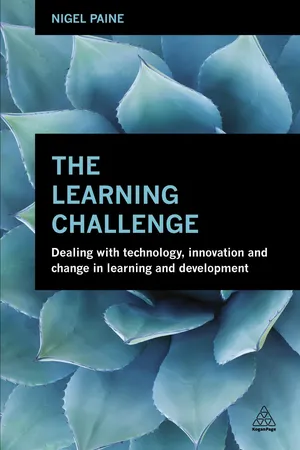
eBook - ePub
The Learning Challenge
Dealing with Technology, Innovation and Change in Learning and Development
- English
- ePUB (mobile friendly)
- Available on iOS & Android
eBook - ePub
The Learning Challenge
Dealing with Technology, Innovation and Change in Learning and Development
About this book
Information
PART ONE
The Manifesto for Change
01
The changing context for learning
Katy’s story
Katy walked into the open plan area that she was going to call home. This was her first day as head of Learning and Development (L&D) and she was excited but slightly nervous. She lifted a hand, in a general way, towards the team and they responded enthusiastically. This was a team under pressure, and a team whose value had not always been appreciated by the rest of the organization; they were looking to the new leader to help. In fact, it was more than help – her task was etched in their faces: to save them from extinction!
Katy for her part was well aware of the problems, well aware of why she had been brought in, and she saw this as a tremendous challenge which, however exciting, was extremely daunting. Her mentor had been very encouraging; he had explained that if you took over a very successful operation it was really hard to make an impact and often all your efforts were concentrated on keeping the place at precisely where it had been before you took over. On the other hand, transforming a department in difficulty meant that you could really make a difference and that your contribution would be noticed. This was her first go at running an entire L&D operation. It looked like a mountain to climb on day one, but it also felt exhilarating. She took a deep breath before completing the journey to her desk.
She did not sit there for long. There were a number of key people in the organization who wanted early meetings, and she had been scheduled in to a series of 20-minute briefings with the senior executives of the company. She had hardly had a second to introduce herself to the team or work out who was who before she was whisked away to her first appointment and that, basically, was the morning gone. More meetings in the afternoon, and then finally, an opportunity to say hello to everyone in the team before she went home. She hoped every day was not going to be this kind of whirlwind and she would get the opportunity to actually do some work.
At home she gathered her thoughts. The team clearly was looking to her to defend their position within the organization. Executives saw her as the person who would trim, focus and develop the operation into something they wanted, and that could help them with the challenges the company faced. The messages were abundantly clear: the CEO wanted action, the CFO wanted cuts, and the director of operations wanted help. She had to deliver on all three but she had no idea where to start. Her head was flooded with ideas. She had options too numerous to count, and she had to work out where to start, what pace of change she could deliver, and what promises she could make that were challenging but realistic. She knew she had to create an entirely L&D operation that reflected more accurately what the organization needed, and help deliver its business objectives. There was less clarity, however, about where to start and her timescale for action.
Katy had clearly not been employed to shore up a failing department or defend everything it did, but neither did she want to close it down and start again. The challenge for her was to make it fit for purpose, and help deliver change. She wanted to support her people as they went through some fairly dramatic modification to their operation, but she also needed to understand the company and its challenges clearly and be seen as someone who was good news for the organization as a whole and gain trust and credibility inside the top team. This, she knew, was a delicate balancing act. As she fell asleep the first ideas for action were beginning to form in her mind.
There are many like Katy out there facing similar dilemmas because work is changing and the demands of work require a new relationship with learning. This chapter sets that process in context.
The changing workplace: who cares about an engaged workforce?
What makes some companies really great places to work? And what does it mean to work in a company or organization that feels like a learning organization as opposed to any other? The answer has got very little to do with salary or perks, or qualifications obtained. It is more the sense that you belong, that you are doing useful work that is recognized and acknowledged and that you operate in an environment that embraces new ideas, where there is widespread trust and respect amongst the staff at all levels. Learning is an integral part of great workplaces. And as our world changes, continuous learning becomes not a luxury for the few but a necessity for the many.
We have known for a long time, at least since Robert Levering’s 1988 book, A Great Place to Work: What makes some employers good – and most so bad, that some employers are better than others; that some organizations encourage learning more comprehensively than others, and that some organizations are more productive and more successful than others. What we have become more aware of is that all these factors are linked.
There are indeed great employers who can turn demotivated, demoralized and switched-off staff into engaged, motivated and productive team members. However, the great place to work is pretty much the exception rather than the rule. Most workplaces are full of underused potential, unengaged and uninterested employees who care little for their customers and little for the complex processes of innovation, continuous improvement and personal development.
Both Henry Stewart in The Happy Manifesto (2011) and Gary Hamel in The Future of Management (2007) quote from a global survey which suggests that only 21 per cent of the workforce feels that they are fully engaged (Hamel, 2009). That leaves 79 per cent of wasted productivity, under-utilized human resources and general disillusionment. A huge Gallup survey in the United States in late 2013, called ‘State of the American Workplace’ reinforces this message. The Chairman’s Introduction to the survey states:
Of the approximately 100 million people in America who hold full-time jobs, 30 million (30 per cent) are engaged and inspired at work, so we can assume they have a great boss. At the other end of the spectrum are roughly 20 million (20 per cent) employees who are actively disengaged. These employees, who have bosses from hell that make them miserable, roam the halls spreading discontent. The other 50 million (50 per cent) American workers are not engaged. They’re just kind of present, but not inspired by their work or their managers. (Gallup, 2013: 2)
Julie Clow captures this sentiment in her book, The Work Revolution (2012): ‘employees have no sense of empowerment; they feel like victims in a gigantic, tragically unmovable system… Everyone gets trained… [but] absolutely nothing has changed’. This is a significant organizational deficit. Clow’s solution is to start what she calls ‘a work revolution’ to do something about it. If we want to examine why learning has to change, she believes that we need to focus, initially, on why the workplace has to change, how work is changing and so how learning has to respond.
If we want some practical steps to change the workplace, we can turn to Stewart (2011), which lists 80 ideas for creating a happy workplace. These ideas are clustered around 10 core themes:
- The imperative to trust your staff.
- Making people feel good.
- Openness and transparency.
- Recruiting for attitude and training for skill.
- Celebrating mistakes.
- Creating mutual benefit.
- Building a strong community.
- Encouraging people to love work but also have some work–life balance.
- Selecting managers because they are good at managing people rather than as an inexorable process of career development.
- Encouraging staff to play to their strengths rather than forcing them to deal with their weaknesses or work in areas in which they are unsuited and therefore unhappy.
Clow has four points in her manifesto (2012: 17), which have parallels with Stewart’s ideas. She believes:
- It is possible to love your work, your workplace, and your work colleagues.
- It is possible to find a dream job and excel at it, regardless of educational qualifications or job level.
- Every organization can thrive, generate more value for its customers and shareholders and be more successful if it hires people who belong in that organization and they stick to the things they do best.
- The workplace is not a zero-sum game where either the employees win or the organization wins. It is, in her view, in the best interests of employer and organization to build something in the best interests of the employee. That is what leads to a thriving profitable business.
Clow’s thesis is that the problem of employee engagement needs to be addressed on a grand scale rather than one organization at a time. Her idea is to change the entire world of work: in other words, she would like a complete rethink about work everywhere. But in thinking big, her view is that we should keep it simple. The method of doing this is to make as many people as possible in an organization responsible for its achievements and outcomes. This includes leadership, the workforce and even customers.
This view aligns pretty closely with Clark (2012) in his book, The Employee Engagement Mindset. He believes that the single biggest obstacle to employee engagement is the employee. ‘If you feel underused and undervalued, you can do something about it… Nobody can instil in you deep and rich and vibrant engagement. You have to do it’ (p 6). Clark focuses on individual actions to develop engagement (intrinsic factors); Henry Stewart and Julie Clow focus more on the extrinsic factors (what an organization can do to encourage engagement). Both are critical. There is also a third factor that adds to the pressure to make big changes: the economic and social shifts that are turning our world upside down. In many ways this third factor is sweeping everything aside in its wake.
So we need to take a very broad view about how and why work is changing. These are neither cosmetic changes nor temporary changes in fashion but fundamental shifts in how we work, why we work and the nature of the work space. Technology is certainly a big part of this, but there is a more fundamental economic realignment occurring that underpins and stimulates these shifts. Guillen and Ontiveros (2012) call them ‘global turning points’ that present fundamental challenges for business. These include having to cope with increasing uncertainty and complexity in the external environment, dealing with a global economy that is out of balance, the increasing quest for sustainability at every level, coupled with a world of increasing inequality and the tensions that this engenders.
The 2013 Global Trends report (Strategy Dynamics, 2013) amplifies some of these points. It highlights the shift from abundance to scarcity of resources; the rapidly falling boundaries between companies and their communities; the shift towards distributed control and distributed power in the fight for value creation; and a range of new values and beliefs that this distributed world stimulates. The report highlights five imperatives for business, and the need to rethink:
- the playing field in terms of competition;
- your relationship with the consumer;
- how you connect;
- your agenda so that it is focusing on the future rather than protecting the past; and
- your vision, values and role as a leader.
These are all massive challenges and as they impact, organizations must respond. This leads to fundamental shifts in not just what organizations do, but the way they do it. This requires a realigned workforce. So it is easy to see why the L&D operation inside any business is a significant asset in this process. If it fails to adjust, it will inevitably become irrelevant. If rightly aligned, however, it can address some of the people issues that will allow these shifts to take place quickly and smoothly. But this means that the L&D operation will also have to change radically in terms of its perspective and its focus.
CASE STUDY Anne-Marie McEwan
Some of these necessary changes impinge upon the nature of the workplace environment. As the external environment changes, the workplace environment has to be rebuilt alongside the core of the organization. To understand that relationship more clearly, I spoke to the workplace environment expert, Anne-Marie McEwan.
She is strongly of the view that workplace learning cannot survive in isolation or as a ‘nice to have’ adjunct to the main day-to-day business. It is part of the hidden, as well as the tangible, physical and cultural make-up of the organization. This is one of the core ways that people’s skills, values and behaviours impact on workplace performance. And if you want to make an impact on performance, you have to understand what drives an organization at the micro-logistical level as well as the macro-strategic level.
Her early realization that workplace and performance are inseparable, came when she and her colleagues at Cranfield University were asked to design a generic information system for the delivery of real-time operating information to the empowered teams on the shop floor, to enable and support continuous monitoring, adaptation and innovation. She believes that the learning operation should tap into the tacit knowledge from the shop floor and undertake, as a key part of its role, to make that process of knowledge exchange far more fluid and comprehensive. She believes passionately in the Japanese model that has, as a core belief, the idea that people on the shop floor are the source for solving workplace problems, and their involvement directly in that process should be a fundamental part of the way that work is organized.
She is convinced that it is possible, in manufacturing, to do things cheaply and to a very high standard. You can only do this if you tap into the knowledge of people at the sharp end of work and marry that with insights from customers. She can see no justification whatsoever for the separation of work from learning. Indeed, as organizations change, work becomes almost inseparable from learning and learning from work. When learning is separated from operations and put into HR, that barrier between learning and work defines and limits the effectiveness of the learning operation. She endorses the views of Hamel (2007) that the business of management needs to reinvent itself to best serve the needs of organizations in the 21st century, and part of that reinvention is to create a culture of continuous learning that has innovation and improvement at its heart. Learning, therefore, becomes an underpinning philosophy and an ever present process, rather than something that is done to you from time to time that gets in the way of work, and appears to be disconnected from it.
If you look at the nature of continuous improvement, it is about building up the collective intelligence and confidence of the shop floor and developing, in all staff, a critical eye that spots when things are not working, and they feel empowered to do something about putting it right. This is an alternative definition for learning that locks it in firmly with critical thinking. This is a philosophy and approach rather than ‘a thing delivered’.
This process is not something that only applies to the manufacturing sector. McEwan believes it applies broadly across all work, in all sectors. And as work invokes this logic, it becomes more deeply embedded in the culture and values of the organization. As part of this mix, McEwan sees informal learning and social networking to be important methods for sharing that tacit knowledge she believes is so critical t...
Table of contents
- Cover page
- Title page
- Imprint
- Table of contents
- Acknowledgements
- Introduction
- Part one: The Manifesto for Change
- Part two: New Ideas for Learning
- Part three: The Game Changers
- References
- Index
- Full imprint
Trusted by 375,005 students
Access to over 1.5 million titles for a fair monthly price.
Study more efficiently using our study tools.
Frequently asked questions
Yes, you can cancel anytime from the Subscription tab in your account settings on the Perlego website. Your subscription will stay active until the end of your current billing period. Learn how to cancel your subscription
No, books cannot be downloaded as external files, such as PDFs, for use outside of Perlego. However, you can download books within the Perlego app for offline reading on mobile or tablet. Learn how to download books offline
Perlego offers two plans: Essential and Complete
- Essential is ideal for learners and professionals who enjoy exploring a wide range of subjects. Access the Essential Library with 800,000+ trusted titles and best-sellers across business, personal growth, and the humanities. Includes unlimited reading time and Standard Read Aloud voice.
- Complete: Perfect for advanced learners and researchers needing full, unrestricted access. Unlock 1.5M+ books across hundreds of subjects, including academic and specialized titles. The Complete Plan also includes advanced features like Premium Read Aloud and Research Assistant.
We are an online textbook subscription service, where you can get access to an entire online library for less than the price of a single book per month. With over 1.5 million books across 990+ topics, we’ve got you covered! Learn about our mission
Look out for the read-aloud symbol on your next book to see if you can listen to it. The read-aloud tool reads text aloud for you, highlighting the text as it is being read. You can pause it, speed it up and slow it down. Learn more about Read Aloud
Yes! You can use the Perlego app on both iOS and Android devices to read anytime, anywhere — even offline. Perfect for commutes or when you’re on the go.
Please note we cannot support devices running on iOS 13 and Android 7 or earlier. Learn more about using the app
Please note we cannot support devices running on iOS 13 and Android 7 or earlier. Learn more about using the app
Yes, you can access The Learning Challenge by Nigel Paine in PDF and/or ePUB format, as well as other popular books in Business & Business Development. We have over 1.5 million books available in our catalogue for you to explore.