Population dynamics can contribute to unsustainable patterns of production and consumption, and as a consequence to water scarcity that consists of the most significant environmental challenge in the Arab region. This report endeavors to analyze the nexus between population dynamics and water scarcity and to provide recommendations on how to improve policies and programmes addressing water scarcity in order to reduce vulnerability of particular population groups and enhance resilience of populations at risk. The report looks at water scarcity through a population lens in order to enable policymakers and governments to develop targeted and people-centered policies and programmes to tackle their water scarcity issues and to address its differential impact on specific population groups which might be more vulnerable to and less capable of coping with water scarcity.
eBook - ePub
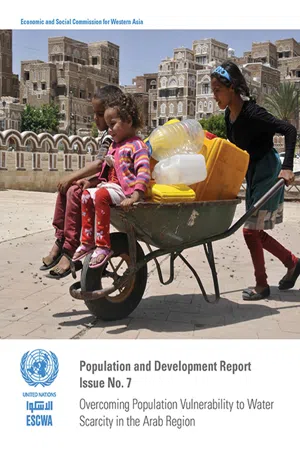
Population and Development Report. Issue 7
Overcoming Population Vulnerability to Water Scarcity in the Arab Region
- 94 pages
- English
- ePUB (mobile friendly)
- Available on iOS & Android
eBook - ePub
Population and Development Report. Issue 7
Overcoming Population Vulnerability to Water Scarcity in the Arab Region
About this book
Information
III. Case Studies

A view of a refugee camp.
© UN Photo/Evan Schneider.

“Dealing effectively with the water and sanitation crisis is fundamental to fighting disease and poverty. It is key for a life of dignity for billions of people around the globe.”
Jan Eliasson, Deputy Secretary-General, United Nations
III. Case Studies
This chapter zooms in on specific vulnerable sociodemographic and population groups living in particular geographical locations. It provides context-specific analyses of exposure, sensitivity and resilience of specified population groups to overcome vulnerability to water scarcity.
The importance of spatial analysis has been extensively described in the literature given that “vulnerability rests in multifaceted coupled systems with connections operating at different spatio-temporal scales and commonly involving stochastic and nonlinear processes”.1 Furthermore, resilience is closely linked to local processes and measures,2 and depends on vulnerability at the local level.3 The case studies endeavour to compare exposure to water scarcity and resilience developed at the local level and to identify sensitivity (as defined in chapter II), which is closely linked to both the characteristics of sociodemographic groups and to geographic location. Given that assessing vulnerability entails a predictive quality that consists of conceptualizing “what may happen” to a specific unit of concern under conditions of particular risk and hazards,4 the analysis aims to estimate the impact on vulnerable population groups in a context of scarce water resources, based on identifying mechanisms and measures that have already been put in place by local populations in different target areas.
The differentiated impact of water scarcity can be observed on various population and sociodemographic groups. For example, water scarcity that results in crop failure could affect women and men differently. Women losing their means of subsistence could be compelled to sell off such assets as livestock to respond to the needs of their families. By contrast, when losing their income streams, men might resort to migrating to other areas to seek alternative job opportunities. The impact on children could be entirely different. As school fees become unaffordable with a decreasing family income, children could be driven to drop out of school in order to support their families. A solid understanding of the roles that different users might have in ensuring access to or using water is crucial, as it allows identifying and implementing measures to reduce their vulnerability to water scarcity.
The three sites for the case studies, namely Sanaa in Yemen, and Mafraq and Jordan Valley in Jordan, were selected to focus on three sociodemographic groups that are particularly vulnerable to water scarcity: rural farmers, urban residents of informal settlements and migrants. The first case study tackles the urban population in Sana’a in Yemen, where water scarcity is mainly linked to physical scarcity and governance of the water sector. The second and third case studies concentrate on Jordan and compare the impact of water scarcity on the populations of two geographic areas, namely small and landless farmers in the Jordan Valley, and the urban population in Mafraq. The Jordan Valley case highlights the differentiated impact on landless farmers and women in rural areas as water scarcity leads to decreasing incomes, exacerbating poverty and challenges for women in terms of work load. Exposure to water scarcity in Mafraq is mainly linked to significant population growth, resulting from the influx of Syrian refugees coupled with a considerable physical water scarcity.
A. Rural-urban migrants in Sana’a, Yemen
1. Introduction
Yemen, located on the southern coast of the Arabian Peninsula, is one of the poorest countries in the world. The climate is harsh and the population of more than 25 million people faces great challenges in the light of rapidly declining water resources. The political economy of water in Yemen – defined by entwined economic realities, geopolitical developments, migration and social hierarchies – reflects the challenges of sustainable development in a country facing extreme water scarcity. Yemen is experiencing a politically and economically tumultuous period, with both the public and private sectors having failed to address food, water and energy insecurities facing the country. The goal of this case study is to understand the processes that have led to water scarcity in Yemen and, specifically, in its capital, Sana’a. Population vulnerability to water scarcity is being examined and identified, and particular focus is placed on the urban poor and those living in informal settlements within the city’s peripheries.
The opening of Yemen’s markets to international trade had a disastrous effect on subsistence farmers. Specifically, local producers could not compete with the cost and quality of subsidized food imports, which had the effect of dissuading local subsistence farmers from producing the crops needed for their survival. Similarly, without local production of staple foods, consumers came to be at the mercy of fluctuating prices in the international market. This is particularly relevant to a largely impoverished national population. The combination of these policies, with declining water resources and uncoordinated national conservation strategies, has set the stage for widespread food insecurity. A report by the World Food Programme estimated that 56 per cent of the national population experienced moderate to severe food insecurity in 2012 (map 2).5
While the excessive and unregulated production and marketing of qat is cause for concern, the current crisis of Yemen’s agricultural industry can be attributed to decades of development policies that have undermined the local subsistence agro-economy. Attributing failures in the sector to individual farmers and their “traditional” and “outdated” practices was first purported in a 1979 World Bank report. It proposed that farmers needed to adopt Western “modern” agricultural techniques and to embrace free-trade principles that opened markets to transnational competition in order to eradicate impoverishment. That strategy simply missed the mark and these policies have been nothing but a failure.6
The lack of effective policies has also been aggravated by a politically weak Government that has not found its footing since the uprising in 2011. Political instability has its roots in decades of internal political tensions and armed conflict between warring factions, as well as years of military interventions on Yemen’s territory.7 The Government’s inability to address these broader national challenges is paralleled by its inability to advocate effective development policies, including proper management of natural resources and the provision of public goods and services to marginalized populations.
2. Population indicators
These national developments have affected more than 23 million Yemenis, a majority of whom are under the age of 20.8 While the majority of the population lives in rural areas, an urbanization rate of 4.8 per cent has caused the population residing in urban areas to swell from 22 per cent in 1990 to 33 per cent of the total population in 2012.9
Map 2. Proportion of Yemeni households experiencing food insecurity by governorate

Source: World Food Programme (WFP), The State of Food Security and Nutrition in Yemen: Summary and Overview. Comprehensive Food Security Survey (Sana’a, 2012), p. 9. Available from https://www.wfp.org/content/yemen-comprehensive-food-security-survey-2012.
Yemen, which is already a resource-poor country, has an added population burden of roughly 500,000 migrants and refugees, the majority of whom have come from Somalia and the Horn of Africa in search of better economic opportunities and to escape violent conflict in their countries of origin.10 These realities on the ground have led to a highly mobile population that relocates in response to land disputes, water shortages and civil unrest.11 As of December 2014, UNHCR had registered 334,096 IDPs, and this number is constantly fluctuating.12 Water scarcity is a common reason for displacement. For example, when a village runs out of water, residents seek alternative water sources elsewhere, either staying with nearby relatives or moving to urban areas. The length of their migration may be short term or prolonged, depending on the severity of the shortage. There are similar patterns of displacement and return during periods of armed conflict. Displaced Yemenis will often return to their land once violence ceases. Water-related displacement and armed conflict over scarce water resources may become more frequent and severe owing to the environmental pressures brought on by climate change.13
Yemen’s demographic indicators are among the worst in the region, with the worst under-five and infant mortality rate in the region (table 1).14 Moreover, only 36 per cent of births are attended by a skilled professional, and only 24 per cent are held within a hospital or other institutional health facility. One quarter of Yemeni children aged 2 to 9 were reported to suffer from motor and/or mental disabilities, including delayed movements and an inability to understand instructions and to be understood.
Table 1. Health and well-being indicators in Yemen
| Notes | ||
| Life expectancy at birth for men | 62 | 2012 |
| Life expectancy at birth for women | 65 | 2012 |
| Infant mortality rate (per 1,000 live births) | 69 | For five-year period preceding 2006 survey |
| Infants underweight at birth | 8 per cent | Last two years preceding survey |
| Maternal mortality ratio (per 100,000 live births) | 270 | 2013 |
| Children aged 2-9 with at least one disability | 25 per cent | 2006 |
| Use of improved drinking water sources | 59 per cent | 2006 |
| Use of improved sanitation facilities | 52 per cent | 2006 |
| Skilled attendant at delivery | 36 per cent | Last two years preceding survey |
| Institutional delivery | 24 per cent | 2005-2006 |
| Total fertility rate | 5.2 | Last three years preceding survey |
Sources: Compiled by ESCWA, based on Ministry of Health and Population in Yemen and UNICEF, “Yemen: Monitoring the situation of children and women – Multiple Indicator Cluster Survey 2006” (2008); WHO, 2012, Regional Health Observatory. Available from http://rho.emro.who.int/rhodata/?theme=country; and WHO, 2015, Yemen: WHO statistical profile. Available from http://www.who.int/gho/countries/yem.pdf?ua=1.
Measures of educational attainment are also poor (table 2). Only 68 per cent of children attend primary schools, and the attendance rate in secondary schools is a paltry 24 per cent.15 Low school attendance rates are mirrored by other data on the under-18 population: 23 per cent of children engage in full- or part-time labour, while 14 per cent of children under the age of 15 are married and 52 per cent of children aged under 18 are marr...
Table of contents
- Cover
- Title
- Copyright
- Acknowledgements
- Contents
- Introduction
- I. Nexus between Population Dynamics and Water Scarcity
- II. Factors Impacting Vulnerability to Water Scarcity
- III. Case Studies
- IV. Conclusion
- Endnotes
Trusted by 375,005 students
Access to over 1.5 million titles for a fair monthly price.
Study more efficiently using our study tools.
Frequently asked questions
Yes, you can cancel anytime from the Subscription tab in your account settings on the Perlego website. Your subscription will stay active until the end of your current billing period. Learn how to cancel your subscription
No, books cannot be downloaded as external files, such as PDFs, for use outside of Perlego. However, you can download books within the Perlego app for offline reading on mobile or tablet. Learn how to download books offline
Perlego offers two plans: Essential and Complete
- Essential is ideal for learners and professionals who enjoy exploring a wide range of subjects. Access the Essential Library with 800,000+ trusted titles and best-sellers across business, personal growth, and the humanities. Includes unlimited reading time and Standard Read Aloud voice.
- Complete: Perfect for advanced learners and researchers needing full, unrestricted access. Unlock 1.5M+ books across hundreds of subjects, including academic and specialized titles. The Complete Plan also includes advanced features like Premium Read Aloud and Research Assistant.
We are an online textbook subscription service, where you can get access to an entire online library for less than the price of a single book per month. With over 1.5 million books across 990+ topics, we’ve got you covered! Learn about our mission
Look out for the read-aloud symbol on your next book to see if you can listen to it. The read-aloud tool reads text aloud for you, highlighting the text as it is being read. You can pause it, speed it up and slow it down. Learn more about Read Aloud
Yes! You can use the Perlego app on both iOS and Android devices to read anytime, anywhere — even offline. Perfect for commutes or when you’re on the go.
Please note we cannot support devices running on iOS 13 and Android 7 or earlier. Learn more about using the app
Please note we cannot support devices running on iOS 13 and Android 7 or earlier. Learn more about using the app
Yes, you can access Population and Development Report. Issue 7 by United Nations Economic and Social Commission for Western Asia in PDF and/or ePUB format, as well as other popular books in Politics & International Relations & Intergovernmental Organizations. We have over 1.5 million books available in our catalogue for you to explore.