Moving the Social - Journal of Social History and the History of Social Movements is a multi-disciplinary, international and peer-reviewed journal. It focuses on transnational and comparative perspectives on the history of social movements set in a wider context of social history. It appears twice yearly.Moving the Social publishes research at the cutting edge of social history, broadly defi ned. This involves in particular the analysis of the diversity of economic, social, political and mental structures of social movements, from historical and social science perspectives, and the introduction of new research that is relevant to the fi eld of social movement studies.
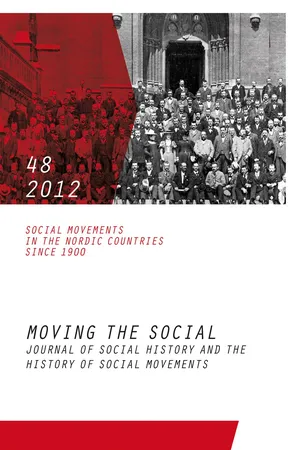
- 192 pages
- English
- ePUB (mobile friendly)
- Available on iOS & Android
eBook - ePub
About this book
Information
Eugenics as a Science and as a Social Movement
The Cases of Denmark and Norway 1900–1950
ABSTRACT
The article compares Danish and Norwegian eugenics in the first half of the twentieth century. It especially investigates sterilisation and racism, both of which are associated with the doctrine. However, it argues that the laws of 1929, 1934 and 1935 allowing sterilisation in Denmark were accepted as means to combat sexual offences. The comparative method supports such a contention, as the Norwegian sterilisation law of 1934 is found to have developed along parallel lines. Neither country had a functioning eugenics society. Therefore the doctrine was the provenance of scientists and other experts. Popularisation attempts met resistance from specialists. Eugenics could nevertheless be applied to debates about criminality or race. Similarities between the Danish and Norwegian versions outweighed differences. But in Denmark there was a greater focus on the pernicious societal effects of “feeblemindedness” than in Norway. Conversely, Norwegian eugenics was more racist than Danish.
Introduction
From its inception, the system of thought known as eugenics had a dual nature: it was both a field of scientific endeavour and an ideology.1 Francis Galton (1822–1911), its British originator, advocated eugenics being brought into the national consciousness as a new religion. He also conducted careful statistical investigations underpinning racial improvement as a science. The doctrine was global in its reach, as exemplified by the 1912 International Congress of Eugenics held in London and its follow-up in 1921 in New York. It is therefore very well-suited to transnational studies, either relating to transfers, i. e. how elements from one national context were modified and incorporated into another, or comparisons across countries. In 1990 Mark Adams called for more comparative studies of eugenics.2 Since then, work by Lucassen (2010), Mottier (2010), Porter (1999), and Weingart (1999) has appeared, answering to the description and using Scandinavian or Swedish eugenics as an analytical tool.3
Scandinavian eugenics may be treated as a single case. It was usually known as “racial hygiene”, but reform eugenists also employed the term “hereditary hygiene” or “kinship hygiene”.4 Reform eugenists were scientists who were careful about drawing social conclusions from eugenic studies or left-wing intellectuals who also believed in the power of the environment. The purpose of the following is to undertake a comparison of Denmark and Norway, covering the two contentious issues of sterilisation and racism. It will show how eugenics developed along parallel lines there. This was partly caused by many variables within each national context being the same, and partly through the examples of the other. Both countries valued the input of the other in scientific and social matters. When the Danish Foreign Office received an invitation to the aforementioned congress in New York, its reaction was to ask the Norwegian government whether it was planning to be represented there.5 The Norwegian public debate on eugenics was informed by Danish examples.6 A speech that the Danish Social Democrat politician and eugenist Karl Kristian Steincke had given in the Medical Association in Copenhagen was printed in its entirety in the Journal of the Norwegian Medical Association in 1929.7
Early Eugenics Organisations
A striking feature of Danish and Norwegian eugenics is that it had profound consequences on those societies without ever achieving a popular mandate. This is in direct contrast to Britain, where the doctrine was less influential.8 Voluntary sterilisation was rejected by the House of Commons in 1931, but Denmark enacted laws allowing sterilisation in 1929, 1934, and 1935 and Norway in 1934. The British scene witnessed the founding of the Eugenics Education Society in 1907, which, as the name implies, sought to bring the doctrine to wider attention. In the mid-1930s it instituted a special category of membership with lower dues, making it easier for working-class people to join.9 No such organisations existed in Denmark or Norway, where eugenics was almost entirely an ideology for the cognoscenti. The closest approximation would be the Anthropological Committee set up in Denmark in 1904. It was led by the police doctor Søren Hansen, and its other founders were Dr Laub, a surgeon-general, and Professor Harald Westergaard, a statistician and economist. It was a private society which did not accept members drawn from the public. At a later stage, membership was limited to the above plus high-ranking civil servant Adolph Jensen, Professor August Wimmer, a psychiatrist, medical director Johannes Frandsen, Professor Hans Clausen Nybølle, a statistician, and Dr Skot-Hansen, a surgeon-general.10 Norway had no popular eugenics organisation either, only the Consultative Committee on Eugenics, which was set up after 1913.11 The founder was Jon Alfred Mjøen, who acted as its secretary, and its other early members were Professor Nordal Wille, a biologist, Dr Alfred Eriksen, a clergyman and former Labour parliamentarian, Professor Marius Hægstad, a philologist, Haakon Løken, Governor of Oslo, and Dr Wilhelm Keilhau, an economist and historian.12 These organisations were cabals of influential people more than they were actual societies.
The officers of these clubs, Dr Hansen and Dr Mjøen, were among the institutors of eugenics in Scandinavia. Søren Hansen (1857–1946) was trained as an anthropologist, obtaining multiple grants and stipends to study with some of the leading European scientists in the discipline. An academic career was ruled out by anthropology not being a field of study in Danish universities at the time. He nevertheless wrote a number of anthropological books, which would also have advanced “racial hygiene”.13 Jon Alfred Mjøen (1866–1939) shared many of the attributes of Hansen. Because he belonged to the Eugenics Education Society in Britain, he had a higher profile in English-speaking countries and is the more well-known of the two. Mjøen studied pharmaceutics in Norway and chemistry in Germany. Like Hansen, he received several state scholarships, but did not attain an academic career. Instead, in 1906, he founded the private Vinderen Laboratory, located at his home. Both Hansen and Mjøen were occasionally criticised for getting their facts wrong by professional eugenists.14 Although a pioneer of Scandinavian eugenics, Hansen believed in the reform variant. Mjøen was a very clear mainline or orthodox eugenist and also a populariser.
In Norway the eugenic infrastructure also consisted of the Institute of Heredity at the University of Oslo, set up in 1916 with partial funding from the Rockefeller Trust. Its chair was held by the cytologist Kristine Bonnevie, the first Norwegian woman to be a professor. Bonnevie was scathing about Mjøen’s popularisation attempt, and when the Institute had been established, he had been deliberately excluded from consideration as a member of staff.15 Mjøen considered that he had launched eugenics in his home country through a paper he gave to the Medical Society (Medicinerforeningen) in 1908. This organisation was a possible outlet for scientists interested in eugenics, as were the Hereditarian Society (Arvelighetsforeningen) after 1919 and the Norwegian Medical Association (Den norske lægeforening). Of course, they did not cater for the layman who might be inspired by the doctrine. The Danish case did not entirely match the Norwegian. Its Institute of Heredity was not founded at the University of Copenhagen until 1938, but again with Rockefeller money.16 However, the Anthropological Committee collected data on heredity, which was incorporated in the new institute. The Committee received state funding and was the official wing of Danish eugenics before 1938.17 Eugenics could also be discussed in organisations such as the Danish Association of Wardens (Dansk Værgerådsforening), the Criminologists’ Association (Kriminalist...
Table of contents
- Cover
- Titel
- Impressum
- Content
- Introduction
- For Equality or Against Foreign Oppression?
- Class and Social Movements in Scandinavia since 1945
- Female Workers but not Women:
- Decade of Equality:
- Doing their own Thing:
- An Explorative Study of the Impact of Local Political Opportunity.
- Eugenics as a Science and as a Social Movement:
- Norway Then and Now:
- The Role of Non-Profit Organisations in the Development and Provision of Welfare Services in Iceland
Trusted by 375,005 students
Access to over 1.5 million titles for a fair monthly price.
Study more efficiently using our study tools.
Frequently asked questions
Yes, you can cancel anytime from the Subscription tab in your account settings on the Perlego website. Your subscription will stay active until the end of your current billing period. Learn how to cancel your subscription
No, books cannot be downloaded as external files, such as PDFs, for use outside of Perlego. However, you can download books within the Perlego app for offline reading on mobile or tablet. Learn how to download books offline
Perlego offers two plans: Essential and Complete
- Essential is ideal for learners and professionals who enjoy exploring a wide range of subjects. Access the Essential Library with 800,000+ trusted titles and best-sellers across business, personal growth, and the humanities. Includes unlimited reading time and Standard Read Aloud voice.
- Complete: Perfect for advanced learners and researchers needing full, unrestricted access. Unlock 1.5M+ books across hundreds of subjects, including academic and specialized titles. The Complete Plan also includes advanced features like Premium Read Aloud and Research Assistant.
We are an online textbook subscription service, where you can get access to an entire online library for less than the price of a single book per month. With over 1.5 million books across 990+ topics, we’ve got you covered! Learn about our mission
Look out for the read-aloud symbol on your next book to see if you can listen to it. The read-aloud tool reads text aloud for you, highlighting the text as it is being read. You can pause it, speed it up and slow it down. Learn more about Read Aloud
Yes! You can use the Perlego app on both iOS and Android devices to read anytime, anywhere — even offline. Perfect for commutes or when you’re on the go.
Please note we cannot support devices running on iOS 13 and Android 7 or earlier. Learn more about using the app
Please note we cannot support devices running on iOS 13 and Android 7 or earlier. Learn more about using the app
Yes, you can access Social Movements in the Nordic Countries by in PDF and/or ePUB format, as well as other popular books in Social Sciences & Sociology. We have over 1.5 million books available in our catalogue for you to explore.