Psycholinguistics explores the anchoring of language in cognition. The Slavic languages are an attractive topic for psycholinguistic studies since their structural characteristics offer great starting points for the development of research on speech processing. The research of these languages with experimental methods is, however, still in its infancy. This book provides an insight into the current research within this field. On one hand, central topic is the question of how Slavic languages can contribute to psycholinguistic findings. On the other hand, all chapters introduce their respective psycholinguistic method and discuss it according to its usefulness and transferability to the Slavic languages. The researched languages are mainly Russian and Czech, however, other languages (e.g., Polish, Belarusian or Bulgarian) are touched upon as well. Main topics are the characteristics of the mental lexicon, multilingualism, word recognition, and sentence comprehension. Furthermore, several contributions address the issue of verbal aspect and aktionsarten as well as other grammatical categories.
eBook - PDF
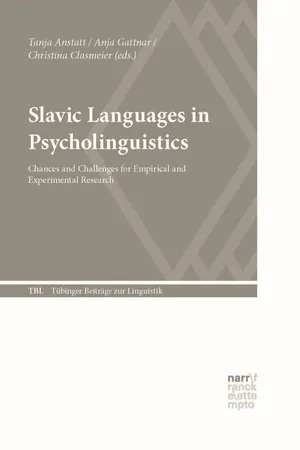
Slavic Languages in Psycholinguistics
Chances and Challenges for Empirical and Experimental Research
- 318 pages
- English
- PDF
- Available on iOS & Android
eBook - PDF
Slavic Languages in Psycholinguistics
Chances and Challenges for Empirical and Experimental Research
About this book
Information
Table of contents
- Contents
- Introduction
- The use of experimental methods in linguistic research: advantages, problems and possible pitfalls: Barbara Mertins
- How to investigate interpretation in Slavic experimentally?: Roumyana Slabakova
- Does language-as-used fit a self-paced reading paradigm? (The answer may well depend on how you model the data.): Dagmar Divjak, Antti Arppe & Harald Baayen
- One experiment — different languages: A challenge for the transfer of experimental designs. Examples from cross-linguistic and inner-Slavic research: Anja Gattnar
- Variation in Russian verbal prefixes and psycholinguistic experiments: Anastasia Makarova
- Reaction time methodology in psycholinguistic research: An overview of studies on Czech morphology: Denisa Bordag
- Some “cases of doubt” in Russian grammar from different methodical perspectives: Elena Dieser
- How to study spoken word recognition: evidence from Russian: Julija Nigmatulina, Olga Raeva, Elena Riechakajnen, Natalija Slepokurova & Anatolij Vencov
- Are Schalter and šapka good competitors? Searching for stimuli for an investigation of the Russian-German bilingual mental lexicon: Christina Clasmeier, Tanja Anstatt, Jessica Ernst & Eva Belke
- Measuring lexical proficiency in Slavic heritage languages: A comparison of different experimental approaches: Bernhard Brehmer, Tatjana Kurbangulova & Martin Winski
- Psycholinguistic aspects of Belarusian-Russian language contact. An ERP study on code-switching between closely related languages: Jan Patrick Zeller, Gerd Hentschel & Esther Ruigendijk
- Influence of spatial language on the non-linguistic spatial reasoning of sign language users. A comparison between Czech Sign Language users and Czech non-signers: Jakub Jehlička
- Index
Trusted by 375,005 students
Access to over 1.5 million titles for a fair monthly price.
Study more efficiently using our study tools.
Frequently asked questions
Yes, you can cancel anytime from the Subscription tab in your account settings on the Perlego website. Your subscription will stay active until the end of your current billing period. Learn how to cancel your subscription
No, books cannot be downloaded as external files, such as PDFs, for use outside of Perlego. However, you can download books within the Perlego app for offline reading on mobile or tablet. Learn how to download books offline
Perlego offers two plans: Essential and Complete
- Essential is ideal for learners and professionals who enjoy exploring a wide range of subjects. Access the Essential Library with 800,000+ trusted titles and best-sellers across business, personal growth, and the humanities. Includes unlimited reading time and Standard Read Aloud voice.
- Complete: Perfect for advanced learners and researchers needing full, unrestricted access. Unlock 1.5M+ books across hundreds of subjects, including academic and specialized titles. The Complete Plan also includes advanced features like Premium Read Aloud and Research Assistant.
We are an online textbook subscription service, where you can get access to an entire online library for less than the price of a single book per month. With over 1.5 million books across 990+ topics, we’ve got you covered! Learn about our mission
Look out for the read-aloud symbol on your next book to see if you can listen to it. The read-aloud tool reads text aloud for you, highlighting the text as it is being read. You can pause it, speed it up and slow it down. Learn more about Read Aloud
Yes! You can use the Perlego app on both iOS and Android devices to read anytime, anywhere — even offline. Perfect for commutes or when you’re on the go.
Please note we cannot support devices running on iOS 13 and Android 7 or earlier. Learn more about using the app
Please note we cannot support devices running on iOS 13 and Android 7 or earlier. Learn more about using the app
Yes, you can access Slavic Languages in Psycholinguistics by Tanja Anstatt, Anja Gattnar, Christina Clasmeier in PDF and/or ePUB format, as well as other popular books in Literature & European Literary Criticism. We have over 1.5 million books available in our catalogue for you to explore.