Seit fast 200 Jahren wird Erziehung auch schon in der frühen Kindheit immer mehr von Institutionen geprägt. In diesem Buch werden in einer historisch-systematischen Gesamtschau die Gründe für den beispiellosen Erfolg der Institution Kindergarten rekonstruiert und dessen wechselvolle Geschichte im Spannungsfeld von sozialer Veränderung, Wandel von Familie und öffentlicher Politik im In- und Ausland nachgezeichnet. Neben der sozial- und der institutionengeschichtlichen Dimension, der Herausbildung des Berufs und der rechtlichen Entwicklung - um nur einige Themen beispielhaft zu nennen - wird ein besonderes Gewicht auf die Vorstellung der jeweils in ihrer Zeit dominierenden vorschulpädagogischen Modelle gelegt - von der christlichen Kleinkinderschule über die Fröbelpädagogik bis hin zu Situationsansatz und Reggio-Pädagogik.
eBook - PDF
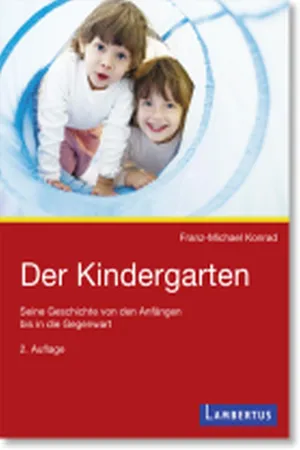
Der Kindergarten
Seine Geschichte von den Anfängen bis in die Gegenwart
- 314 pages
- English
- PDF
- Available on iOS & Android
eBook - PDF
About this book
Information
Table of contents
- Der Kindergarten
- Inhalt
- 1 Die sozial- und geistesgeschichtlichen Voraussetzungen der öffentlichen Kleinkinderziehung in Deutschland
- 2 Die Anfänge im europäischen Ausland
- 3 Von der Kinderbewahranstalt zur Kleinkinderschule (1800 bis 1850)
- 4 Idee und Praxis des Kindergartens: Fröbel und die Fröbelbewegung (1840 bis 1914)
- 5 Öffentliche Kleinkinderziehung bis zum Ende des Kaiserreichs (1850 bis 1918)
- 6 Der Kindergarten in der Weimarer Republik (1918 bis 1933)
- 7 Der Kindergarten im nationalsozialistischen Staat (1933 bis 1945)
- 8 Vom Kindergarten zur vorschulischen Erziehung: die Bundesrepublik (1945/49 bis 1990)
- 9 Der Kindergarten im einheitlichen sozialistischen Bildungssystem der DDR (1945/49 bis 1990)
- 10 Aspekte der Vorschulpädagogik nach der „Wende“ (1990 bis in die Gegenwart)
- 11 Literatur
- 12 Anhang
- Der Autor
Trusted by 375,005 students
Access to over 1.5 million titles for a fair monthly price.
Study more efficiently using our study tools.
Frequently asked questions
Yes, you can cancel anytime from the Subscription tab in your account settings on the Perlego website. Your subscription will stay active until the end of your current billing period. Learn how to cancel your subscription
No, books cannot be downloaded as external files, such as PDFs, for use outside of Perlego. However, you can download books within the Perlego app for offline reading on mobile or tablet. Learn how to download books offline
Perlego offers two plans: Essential and Complete
- Essential is ideal for learners and professionals who enjoy exploring a wide range of subjects. Access the Essential Library with 800,000+ trusted titles and best-sellers across business, personal growth, and the humanities. Includes unlimited reading time and Standard Read Aloud voice.
- Complete: Perfect for advanced learners and researchers needing full, unrestricted access. Unlock 1.5M+ books across hundreds of subjects, including academic and specialized titles. The Complete Plan also includes advanced features like Premium Read Aloud and Research Assistant.
We are an online textbook subscription service, where you can get access to an entire online library for less than the price of a single book per month. With over 1.5 million books across 990+ topics, we’ve got you covered! Learn about our mission
Look out for the read-aloud symbol on your next book to see if you can listen to it. The read-aloud tool reads text aloud for you, highlighting the text as it is being read. You can pause it, speed it up and slow it down. Learn more about Read Aloud
Yes! You can use the Perlego app on both iOS and Android devices to read anytime, anywhere — even offline. Perfect for commutes or when you’re on the go.
Please note we cannot support devices running on iOS 13 and Android 7 or earlier. Learn more about using the app
Please note we cannot support devices running on iOS 13 and Android 7 or earlier. Learn more about using the app
Yes, you can access Der Kindergarten by Franz Michael Konrad in PDF and/or ePUB format, as well as other popular books in Education & Early Childhood Education. We have over 1.5 million books available in our catalogue for you to explore.