- 128 pages
- English
- ePUB (mobile friendly)
- Available on iOS & Android
eBook - ePub
The Alton Bus Crash
About this book
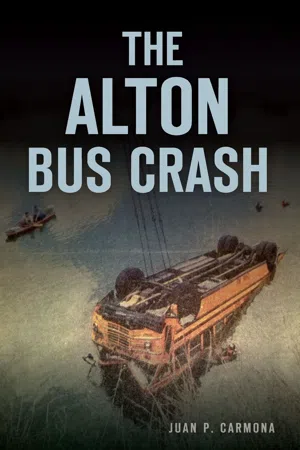
A September morning in 1989 changed Alton's history forever. At 7:34 a.m., a Dr Pepper truck collided with Mission School Bus no. 6. After the bus and its occupants plunged into a water-filled caliche pit, twenty-one students lost their lives. The resulting investigation flooded the small South Texas community with reporters and lawyers. The heavily scrutinized legal battle divided the city, but it did ultimately produce changes in school bus safety that continue to save lives today. Juan Carmona navigates the complicated legacy of the tragic accident and its aftermath.
Information
Subtopic
Global Development StudiesIndex
Social SciencesPART I
THE ACCIDENT
THE MEN
September 21, 1989, was a crisp, cool morning—the type of morning Valley residents enjoy because temperatures like eighty degrees are rare even in September. The border region known as the Rio Grande Valley of South Texas is situated in a subtropical climate, and the weather consists of what seems like an eternal summer of high heat and high humidity, with some cooler days in the spring and short bursts of cold winds during the winter. Consequently, eighty degrees for people in the Valley was time for a light sweater, or for some a thicker one (depending on the child and the parent). However, one thing that eighty degrees in the Rio Grande Valley meant was that on a school bus, most of the windows would be shut. In 1989, most school buses did not have air conditioning or heat, so the windows were the only way to attempt to regulate the temperature inside the vehicle. Students who felt cold and found their window to be open could reach over and pull them up. Closing a window on a school bus required engaging the latches on both ends of the window at the same time. This would release the window and allow you to slide it up. This maneuver would prove to be very difficult for the students involved in the accident.
The morning of the accident, forty-six-year-old bus driver Gilberto Pena woke up at his usual 5:30 a.m. According to the National Transportation Safety Board (NTSB) report, Mr. Pena had a Class A driving license with no restrictions, which allowed him to drive all types of large vehicles, including a school bus. Also in the report was the fact that he had a relatively safe driving record, with a speeding ticket and one minor traffic citation for a failure to yield. However, on September 21, he would be on the receiving end of someone else who failed to yield, with deadly consequences. Pena was prescribed glasses but never wore them and was not wearing them the day of the accident. He stated to the investigators that the reports stating the need for glasses “were an error.”15

The Monitor newspaper’s front page from the day of the accident. From The Monitor, September 21, 1989.
September 21 began as a normal day for Gilberto; he got up and took a shower to wake himself up and get going for the day. As he showered, his wife prepared him some breakfast so that he could eat before he started his long day. Mr. Pena did not live far from the bus barn, and when he finished his breakfast, his wife drove him the four blocks to the Mission Consolidated Independent School District’s bus depot. He arrived at the bus barn at 6:45 a.m. Once there, he followed his usual duties, which included a pre-trip inspection of the bus to ensure that it was safe to take out on the road. This was the same bus he had been assigned that year, and he was quite familiar with it. He then took time to give the bus a cleaning, picking up whatever may have been left behind or the errant wrapper or paper that kids tucked into the seats or threw into a corner. With his daily maintenance duties done, he prepared to head out on his route.16
His route took him on two morning and two afternoon trips, due to the size of the district and the number of buses. A bus driver’s trips consisted of his or her first run to pick up the elementary students and the second run to pick up the middle and high school students. This is why different grade level schools have different start and end times, to maximize and facilitate the picking up and dropping off of students.
The driver of the Dr Pepper truck owned by Valley Coca-Cola Distributors was twenty-six-year-old Ruben Perez. Mr. Perez’s driving record stands in stark contrast to that of Mr. Pena. Much like Mr. Pena, Ruben possessed a Class A driver’s license that was also unrestricted. His driving record reveals that he had a speeding ticket in 1984, and on February 5, 1987, he was cited for property damage while driving a truck for Valley Coca-Cola. According to the report, he was on a divided highway that was wet from some recent rains, and he “failed to control his speed,” causing him to strike another vehicle. His failure to control his speed would play a part in his collision with the school bus as well. He would go on to be cited again for speeding and twice for not having liability insurance on his automobile.17
His employment history with Valley Coca-Cola has him beginning as a loader in August 1984. Every distribution truck has two employees, the driver and the loader who assists the driver in unloading the beverages and delivering to the various businesses on their route. Perez eventually was promoted to driver, but after the accident in February 1987, he was demoted back to loader. There he remained until he was eligible to return to driving on May 11, 1989. His promotion was delayed due to his license being suspended for the failure to have liability insurance citation along with a failure to appear citation, an issue he promptly corrected and was allowed back on as a driver. One additional note in the NTSB report is that he had no real formal driver’s training. His father was a truck driver, and he went on to teach his son his trade.18
COLLISION
Gilberto Pena was on his second run to pick up students from the small town of Alton who attended school at the nearby Mission Consolidated Independent School District. His first trip consisted of sleepy-eyed kindergarteners who were still adjusting to leaving their parents and their homes to head to a strange new place, filled with other children their age and a new parental figure in the teacher. They were accompanied by other older elementary students who were still adjusting to their new school year. These young students met at a pickup point located one block shy of Bryan Road and Business Highway 83. He boarded the children and took them to Bryan Elementary. The trip went by uneventfully, and he left the elementary school to his second pickup route, which consisted of the older kids, middle and high school students. This route would take the bus along Farm to Market Road 676 and Bryan Road.19
The area where the students were being picked up was a rural spot with unpaved streets. In fact, the streets were “paved” using the caliche, which the early residents of Alton had quarried as one of the earliest industries in the city. The morning routine for many of the students was to meet outside one another’s houses and then walk the quarter mile to the nearby paved road where the bus would stop to pick them up.20 This was due to the fact that the bus could not navigate well through the dirt roads and in times of rain might even get itself stuck in the mud or be unable to see the large potholes that riddled the streets.

Texas Department of Public Safety diagram of the accident. From The Monitor, September 22, 1989.
Early morning temperatures caused the students to have most of the twenty-eight- by thirty-one-inch windows closed; survivors stated that only two or three were open.21 The bus was filled with the chatter, laughter, giggling and banter of its young occupants. The sunny sky above reflected the sunny dispositions of the students; although they might not have been happy about going to school, for the moment they were with their peers, siblings, cousins, friends and neighbors. Any time and any day these youths got to spend with their friends outside of having to learn was a good time. For some, this was the whole reason to go to school, to spend time with their friends, make new friends, joke around, find love and live the classic American dream with football games, homecoming, prom and graduation.
At 7:34 a.m., Mission Consolidated school bus no. 6 picked up the last two passengers, bringing the total number of occupants to eighty-one students.22 Meanwhile, the Dr Pepper truck driver, Ruben Perez, and his loader, Ruben Pena (no relation to bus driver), completed their first stop for Valley Coca-Cola at the Circle K convenience store. The clerk reported that they left at about 7:20 a.m. These students were just beginning their lives, and for far too many, their lives would end that day. Truly, the lives of everyone on board that bright yellow bus—and for those who survived, those who had never been exposed to death or tragedy of any kind—would never be the same. Additionally, those who participated in this event—rescuers, nurses, witnesses, law enforcement and members of the media who covered the incident—would all see their old lives end. What would be left was a new life that would be forever shaped by that day and the compounded tragedy that ensued from it.
Perez’s Dr Pepper truck left the convenience store and then continued north on Bryan Road toward Alton.23 At the same time, the atmosphere in Mission bus no. 6, as described by survivor Virginia Flores, was normal, with groups of kids “chit-chatting” with their friends, passing the time as they made their way to another school day.24 Those who were lucky enough to find a seat were sitting with their friends, while others were standing. The bus itself was very crowded. Eighty-one occupants placed it just under the eighty-three-passenger limit for which the bus was designed. The bus was manufactured by the Blue Bird Bus Company and was part of the “All American” series of buses. Each side of the bus had fourteen rows of seats designed for three passengers, with the seat directly behind the driver smaller, affording space for two.
It is important to point out that at the time of the accident, the school bus was built to code and was in compliance with the specifications and regulations of the time. As a result, the events that unfolded could have happened with any other school bus in Texas, and from this tragedy some good would come regarding the manufacturing of safer buses.

NTSB illustration of which windows were opened and which were closed on the bus at the time of the accident.
Courtesy of the National Transportation Board Accident Report HAR-90-02.
Courtesy of the National Transportation Board Accident Report HAR-90-02.
Although the bus’s specifications dictated that all students should have a seat, there were kids standing at the time of the accident, whether it was to visit with their friends or because they did not want to sit on the seat that was directly over the tires because there was a large hump on the floor of the seat. Also, like school buses today, there were no safety belts for the passengers, only the driver. Exiting the bus was accomplished through the front side door, and in case of emergencies, the emergency door in the rear of the bus opened through the use of a lever that would be lifted up. For most of the victims of the accident, there were the aforementioned twenty-eight- by thirty-one-inch windows.25
Today, the area where the crash happened, the corner of Bryan Road and FM 676, contains a stoplight and a fenced enclosure around the caliche pit into which the bus fell. The pit was large, with a width of 385 feet, a length of 610 feet and a maximum depth of 40 feet. On the day of the accident, the pit was filled with about 10 feet of water, just enough to cover the bus as it came to rest on its side. On September 21, 1989, there was no fence surrounding this huge pit. It was completely open to the road. It was an accident waiting to happen, and sadly, one had already occurred in a nearby pit that was open to the road as well.26
On May 28, 1989, two Alton teenage boys crashed their car into this other open caliche pit, leaving a sixteen-year-old passenger dead. Their car swerved into the pit and flipped, landing on its top; both of the passengers were ejected from the vehicle. The accident led the people of Alton to begin pressuring their local authorities to do something about this hazard. One Alton resident described the pit as “a man-made hazard that had been around so long that it was taken for granted as a natural hazard.” Hidalgo County officials’ response was to point out to the residents that it was the state that had the authority to make improvements to the road in question, and so the state would need to be the one to put forth a bill to build a barrier. Accordingly, Texas State Representative Juan Hinojosa (Democrat out of nearby McAllen, Texas) did attempt to introduce a bill on this important issue, but it never made it out of the House.27 Unfortunately, like other serious yet unaddressed issues, it would take an unimaginable calamity to finally force authorities and legislators into action.

Picture of the current intersection where the accident occurred. Photo by author.
Shortly after picking up his last two passengers, Gilberto Pena took bus no. 6 onto FM 676, his passengers talking and laughing and some of them looking out the window. These students could see the fast approach of the Dr Pepper truck.28 In the truck, Ruben Perez was traveling north on Bryan Road toward FM 676. According to his testimony to the National Transportation Safety Board (NTSB), this was the farthest north he had ever been on this particular road. The upcoming stop sign at the intersection with FM 676 was slightly bent, and Perez testified that it was also covered by the leaves and branches of a tree, preventing him from seeing it. As he approached the stop sign at forty-five miles per hour, his assistant, Ruben Pena, warned him that there was a stop sign up ahead.29 Pena would later state to the court at Ruben Perez’s trial, “As we were getting close to the stop sign, I noticed some yellow to the right.” He yelled in Spanish to Ruben to “watch out.” “When we got closer I noticed the yellow was a school bus, that’s when we collided.”30 He was not the only one to see a collision about to unfold.
Virginia pointed out that even she and her schoolmates could see the truck approaching the stop sign at a high rate of speed and came to the frightening realization that it was going too fast to stop.31 Some of the students who witnessed the truck speeding toward the stop sign yelled warnings to the bus driver, who immediately began to brake and turn to the right in a desperate attempt to avoid the collision. One can only imagine the bus driver’s state of mind knowing that sitting behind him and relying solely on him for their safety were eighty-one young souls.
Too often, bus drivers are faceless in their communities, but to the student who climbs up the steps to get into the bus, he or she is the first face they see as they transform from just being a kid to being a student at a school. They are the first school representatives the children see and the last at the end of the year. In some regards, the driver knows aspects of the students’ lives that no educator ever sees, like the home they leave and go back to at the end of the day. It was especially true for these students, who came from a neighborhood where some did not have a floor in thei...
Table of contents
- Front Cover
- Half Title
- Title Page
- Copyright
- Dedication
- Contents
- Acknowledgements
- Prologue: Walking Home from School
- Introduction
- PART I: THE ACCIDENT
- PART II: THE COURTS
- PART III: AFTERMATH
- Conclusion
- Notes
- Bibliography
- About the Author
Trusted by 375,005 students
Access to over 1.5 million titles for a fair monthly price.
Study more efficiently using our study tools.
Frequently asked questions
Yes, you can cancel anytime from the Subscription tab in your account settings on the Perlego website. Your subscription will stay active until the end of your current billing period. Learn how to cancel your subscription
No, books cannot be downloaded as external files, such as PDFs, for use outside of Perlego. However, you can download books within the Perlego app for offline reading on mobile or tablet. Learn how to download books offline
Perlego offers two plans: Essential and Complete
- Essential is ideal for learners and professionals who enjoy exploring a wide range of subjects. Access the Essential Library with 800,000+ trusted titles and best-sellers across business, personal growth, and the humanities. Includes unlimited reading time and Standard Read Aloud voice.
- Complete: Perfect for advanced learners and researchers needing full, unrestricted access. Unlock 1.5M+ books across hundreds of subjects, including academic and specialized titles. The Complete Plan also includes advanced features like Premium Read Aloud and Research Assistant.
We are an online textbook subscription service, where you can get access to an entire online library for less than the price of a single book per month. With over 1.5 million books across 990+ topics, we’ve got you covered! Learn about our mission
Look out for the read-aloud symbol on your next book to see if you can listen to it. The read-aloud tool reads text aloud for you, highlighting the text as it is being read. You can pause it, speed it up and slow it down. Learn more about Read Aloud
Yes! You can use the Perlego app on both iOS and Android devices to read anytime, anywhere — even offline. Perfect for commutes or when you’re on the go.
Please note we cannot support devices running on iOS 13 and Android 7 or earlier. Learn more about using the app
Please note we cannot support devices running on iOS 13 and Android 7 or earlier. Learn more about using the app
Yes, you can access The Alton Bus Crash by Juan P. Carmona in PDF and/or ePUB format, as well as other popular books in Social Sciences & Global Development Studies. We have over 1.5 million books available in our catalogue for you to explore.