- 249 pages
- English
- ePUB (mobile friendly)
- Available on iOS & Android
eBook - ePub
About this book
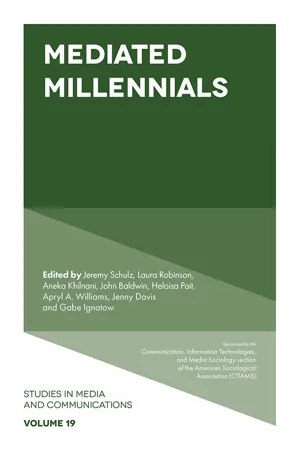
Sponsored by the Communication, Information Technologies, and Media Sociology section of the American Sociological Association (CITAMS), Volume 19 of Emerald Studies in Media and Communications draws on global case studies that examine media use by millennials. By bringing together contributors and case studies from four continents to examine millennial digital media practices, the volume charts out multiple dimensions of Gen Y's digital media engagements: smartphone use among Israelis, the activities of Brazilian youths in LAN houses, selfies in the New Zealand context, and American millennials engaged in a variety of digital pursuits ranging from seeking employment, to content creation, to gaming, to consuming news and political content. Through these case studies we see parallels in the mediated millennial experience across key digital venues including Twitter and YouTube, and MMOs. None-the-less, contributors also prompt us to keep in mind the importance of those millennials without equal access to resources who must rely on public venues such as libraries and LAN Houses. Across these venues and arenas of practice, the research provides an important collection of research shedding important light on the first generation growing up with the normative expectation to perform digital identity work, create visual culture, and engage in the digital public sphere.
Information
PART I
MILLENNIALS AND MEDIA
INTRODUCTION TO VOLUME 19: “MILLENNIALS AND MEDIA”
MILLENNIALS AND MEDIA
Among the most studied and scrutinized generations, Generation “Y” or “Millennials,” defined as those reaching young adulthood in the early twenty-first century, now account for a substantial proportion of the global population. Volume 19 of Emerald Studies in Media and Communications draws on international case studies that examine media use by millennials in New Zealand, Israel, Brazil, Ireland, and the United States. Together, these case studies highlight the common media experiences of this generation, whose formative years were marked by the proliferation of digital technologies. The first section, The Millennial Social Self, probes digital interactions through two revealing case studies: Israeli smartphone phone use and engagement with massive multiplayer online games (MMOs). The next section, Visual Culture and Creation of the Self, offers insights into two key millennial activities: the creation of digital content and the selfie. Next, the third section, Millennials, News, and the Digital Public Sphere, explores the nexus between Twitter use and presidential elections in the United States, as well as post-millennial news media consumption habits. Finally, the volume would not be complete without the final section, Un-Mediated Millennials and Inequalities. The contributions in this section remind all of us that, despite the hype of Gen Y’s supercharged media consumption, there are real economic and social divides impacting a significant part of this generation’s access to media. The authors perform a valuable service by highlighting the importance of those public institutions and safe public spaces which make it possible for digitally disadvantaged members of Generation Y to avail themselves of digital resources.
The volume opens with author Deb Aikat’s panoramic view of this generation’s media practices in his work: “Millennials Usher a Post-digital Era: Theorizing How Generation Y Engages with Digital Media.” Aikat synthesizes the most relevant literature in the field across multiple disciplines and perspectives. According to Aikat’s six pronged analysis, millennials are arguably the first generation with normative access to digital technologies embedded across their life course. Millennials have a taste for multiple platforms, as Aikat argues, “millennials consume news with a somewhat promiscuous preference for platforms ranging from mobile to television.” Aikat also contends that Generation Y both prefers and is adept at multifaceted content creation and digital storytelling to communicate. Fifth, the power of Generation Y as a consumer group continues to influence industry-wide shifts in news content, entertainment, marketing, and political communication. Somewhat paradoxically, despite high levels of media consumption and use of different modalities, this generation distrusts the veracity of the information and content that it consumes. Finally, Aikat closes his chapter by revealing three important concepts: (1) the news-finds-me mindset that “occurs when passive news consumers rely and expect active news consumers to share important news and information”; (2) the Incidental news exposure (INE) “the moniker for stumbling upon news” that “has become the dominant mode of information acquisition for millennials and other population groups”; and (3) INE “spawns bumpers who involuntarily bump into news items, as opposed to seekers who actively search or seek news content.”
THE MILLENNIAL SOCIAL SELF
The first section opens with “A Story of Love and Hate: Smartphones in Students’ Lives” by Vered Elishar-Malka, Yaron Ariel, and Ruth Avidar. Targeting smartphone and mobile phone use by Israeli millennials, their study skillfully unpacks in-depth interview data. According to the authors: “Our findings indicate that – for good or bad – smartphones have become an indispensable medium among these Israeli millennials, playing an extremely meaningful role in their lives.” The results suggest that most users utilize their smartphones to satisfy both interaction- and cognitive-related gratifications such as interacting with friends and family, searching for news and interesting content, and managing their information. Elishar-Malka, Ariel, and Avidar employ the uses and gratifications approach to reveal how Gen Y understands the personal and social implications of smartphone use in daily life. Their work sheds light on the “love–hate” relationship many millennials have with their smartphones from the many gratifications of connectivity – emotional, cognitive, instrumental, and integrative – to the rise in FOMO (fear of missing out) and addiction.
Next, Juan G. Arroyo-Flores examines “Online–Offline Social Ties in Massive Multiplayer Online Games.” His study provides insights into how MMO millennial gamers construct and maintain social ties. In so doing, he bridges two literatures in new ways: the study of MMOs and the study of digital selfing. In his words:
Most online gaming research has only addressed one side of the equation, i.e., the online aspect of social interaction, omitting the offline context. The primary objective is to look at both offline and online social contexts of gamers.
For Arroyo-Flores, it is imperative to understand the new rules of the game governing how millennials manage their social interactions. Significantly, his analysis indicates that offline ties are slightly more important than online ties even for this mediated generation. In addition, he shows how gaming as an activity provides a window onto interaction in other life realms: “Time spent with online relationships stemming from online gaming and a cooperative environment is more likely to be considered higher quality time.”
The section closes with “Do No Harm Lest Others Do Harm to You: Self-Protection and Risk Management by Generation Y on Social Media” by Katarzyna Wodniak and Anne Holohan. The authors map out the interactive norms that they call “Do No Harm Lest Others Do Harm to You.” In their words: “This norm, rather than being driven by the Hippocratic Code of principled awareness, is an expression of an acute consciousness of audience segregation and the need for self-protection in online interaction.” Based on data from Irish college students, Wodniak and Holohan make the case that millennials, “in their everyday and intensive use of digitally mediated technologies have begun to observe a new social contract.” While at first glance this may appear to be a form of increased civility, the authors make it clear that: “Millennials seem to be closing down the scope of online interaction which in the long run can limit the function of the internet as a social sphere.”
VISUAL CULTURE AND CREATION OF THE SELF
This section opens with “I Want My YouTube!: Trends in Early Youth-created Music Videos (2007–2013)” by Steven Kendrat and Charisse L’Pree Corsbie-Massay. Their analysis explores the emergence and evolution of youth-created music videos on YouTube at two different time intervals. Their research shows:
… significant changes in production strategies, narrative content, and demographics during this time period; youth-created music videos become shorter, increasingly complex both technically and narratively, more focused on the individual, and less diverse overall.
Of particular significance to this volume, they find “a significant shift towards individualism in the youth-created music video … videos were more likely to feature single actors and celebrate the self.” Their work allows us to understand the importance of video content creation on YouTube as a creative act giving millennials agency in terms of “reducing barriers to entry and providing a virtual space for youth-oriented content communities that thrive on engagement and social networking as strategies of identity development.”
From YouTube we turn to “Digital Photography and the Morselization of Communicative Memory” by Barry King. King’s work draws a vivid portrait of the selfie in relationship to the larger history of digital photography. He argues that we should understand the ubiquitous spread of the selfie “as a central feature of millennial digital practices.” According to King, “The affordances of digital photography and social media lead to a transformation of the snapshot into the selfie.” King’s work indicates the performative affordances of selfie culture including the imperative to mold the social self for inspection by the other. He links this imperative to celebrity culture:
The resultant shift from notions of the gift economy implicit in practices of family photography leads to the personal snapshot becoming a proto-commodity form in which the competitive logic of Celebrity culture pervades the social exchange of the photograph.
Through King’s work, we see the ramifications of celebrity culture driven selfies as a central millennial experience in identity construction, as well as the impacts on intimate and familial relationships.
MILLENNIALS, NEWS, AND THE DIGITAL PUBLIC SPHERE
“The First Twitter Handle(s) of the United States: An Information Processing Perspective on Twitter Use by the President of the United States and its Effect on Millennials” is authored by John Xeller and David Atkin. Their work captures the use of Twitter as a news source for millennials based on an important millennial political moment in Obama’s presidency. Analyzing data from Twitter, they evaluate linkages between use of Twitter and millennials’ perceptions of Obama. In particular their results “suggest that message orientation (or perceived favorability) predicted source credibility, which stems from message content as well as the Twitter medium by which the message was delivered.” They build a model based on information processing theory that sheds light on both millennials’ interest and likelihood to participate in the political process, as well as “optimal strategies employed by politicians to cultivate social media use and image impressions” in that “certain types of computer mediated interactions between politicians and their constituents motivate young people to engage in the political process more actively.” Specifically, they state that:
A highly rated politician might use Twitter to reinforce their standing with constituents, and in the event constituents perceive a politician unfavorably, it is possible they may use Twitter to begin the process of attitude change and image reclamation.
This section continues with “Embracing the Visual, Verbal and Viral Media: How Post-millennial Consumption Habits are Reshaping the News” by Chris Gentilviso and Deb Aikat. This research provides important insight into the millennial media legacy vis-á-vis news consumption and the reshaping of news. They offer a generational view of the Silent Generation, Boomers, Gen X, Millennials, and Gen Z to highlight radical shifts away from traditional news sources:
Unlike Generation X and boomers, the post-millennials or Generation Z sparsely engage with traditional news sources they deem as nearly extinct, including print media such as newspapers and magazines. They rarely watch television news or listen to radio. They report different news values with less concern about accuracy and more attention toward entertainment and interaction.
The research outlines the preferences and habits driving millennials and post-millennials away from traditionally credible news sources towards digital news consumption, which is bringing dramatic changes in the production of news. In their words: “Generation Z or the post-millennials, comprising people born in 1997 or after, will inherit the millennial legacy. Generation Z has embraced the visual, verbal, and viral aspects of digital and social media platforms.
UN-MEDIATED MILLENNIALS AND INEQUALITIES
Beginning the fourth and final section of the volume is “Poverty and the Shadow of Utopian Internet Theory: Insights from Interviews with Unemployed Internet Users Living Below the Poverty Line” by David J. Park. This section underscores the importance of studying socio-economically disadvantaged millennials. Park’s study draws attention to this silent population through in-depth interviews with millennials relying on the public library. His work offers an important challenge to new technological theorists who fail to see the costs and disenfranchisement occurring to millennials who do not share in the perceived economic benefit of the internet. According to Park, his respondents “primarily use the internet to train and educate themselves in areas where they would like to work while they apply to online jobs.” Significantly, Park’s respondents “held on to the belief that internet held substantial ability to uplift economically” despite the fact that:
… participants struggled to find concrete examples showing the immediate benefit of the internet outside of socialization and easier job application processes compared to in-person physical job application processes requiring transportation.
Showing this profound disconnect, Park’s work is emblematic of the growing digital and economic divides in the United States related to the greater economic uncertainty experienced by millennials regarding their economic futures.
The volume closes with “The LAN House Phenomenon: Exploring the Uses and Symbolic Functions of the Internet among Low-income Brazilian Youth” by Juliana Maria (da Silva) Trammel. Trammel’s work explores the trajectory of public services in the form of LAN Houses dur...
Table of contents
- Cover
- Title
- Part I Millennials And Media
- Part II The Millennial Social Self
- Part III Visual Culture And Creation Of The Self
- Part IV Millennials, News, And The Digital Public Sphere
- Part V Un-Mediated Millennials And Inequalities
- Index
Trusted by 375,005 students
Access to over 1.5 million titles for a fair monthly price.
Study more efficiently using our study tools.
Frequently asked questions
Yes, you can cancel anytime from the Subscription tab in your account settings on the Perlego website. Your subscription will stay active until the end of your current billing period. Learn how to cancel your subscription
No, books cannot be downloaded as external files, such as PDFs, for use outside of Perlego. However, you can download books within the Perlego app for offline reading on mobile or tablet. Learn how to download books offline
Perlego offers two plans: Essential and Complete
- Essential is ideal for learners and professionals who enjoy exploring a wide range of subjects. Access the Essential Library with 800,000+ trusted titles and best-sellers across business, personal growth, and the humanities. Includes unlimited reading time and Standard Read Aloud voice.
- Complete: Perfect for advanced learners and researchers needing full, unrestricted access. Unlock 1.5M+ books across hundreds of subjects, including academic and specialized titles. The Complete Plan also includes advanced features like Premium Read Aloud and Research Assistant.
We are an online textbook subscription service, where you can get access to an entire online library for less than the price of a single book per month. With over 1.5 million books across 990+ topics, we’ve got you covered! Learn about our mission
Look out for the read-aloud symbol on your next book to see if you can listen to it. The read-aloud tool reads text aloud for you, highlighting the text as it is being read. You can pause it, speed it up and slow it down. Learn more about Read Aloud
Yes! You can use the Perlego app on both iOS and Android devices to read anytime, anywhere — even offline. Perfect for commutes or when you’re on the go.
Please note we cannot support devices running on iOS 13 and Android 7 or earlier. Learn more about using the app
Please note we cannot support devices running on iOS 13 and Android 7 or earlier. Learn more about using the app
Yes, you can access Mediated Millennials by Jeremy Schulz, Laura Robinson, Aneka Khilnani, John Baldwin, Heloisa Pait, Apryl A. Williams, Jenny Davis, Gabe Ignatow, Jeremy Schulz,Laura Robinson,Aneka Khilnani,John Baldwin,Heloisa Pait,Apryl A. Williams,Jenny Davis,Gabe Ignatow in PDF and/or ePUB format, as well as other popular books in Social Sciences & Media & Communications Industry. We have over 1.5 million books available in our catalogue for you to explore.