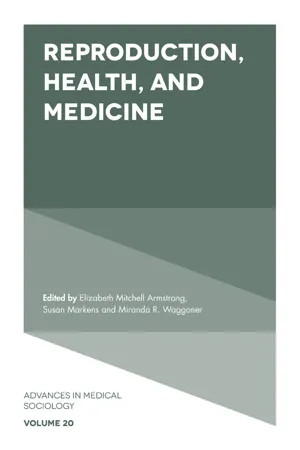
Reproduction, Health, and Medicine elucidates the tensions and contradictions between the normal physiologic processes of pregnancy and birth and the sociocultural beliefs, values, and arrangements that shape how we experience these biological phenomena. Investigating a range of reproductive events and experiences, including pregnancy, birth, abortion and fertility planning, the volume advances our understanding of how lay people and professionals make cultural meaning out of these processes in diverse settings. The chapters highlight how studies of reproduction, health, and medicine interface with core sociological concepts such as stratification, inequality, intersectionality, family and kinship, risk, and social control, and how experiences of reproduction are shaped by gender, race, class, sexuality and citizenship, as well as culture, health care systems, and health politics.
eBook - ePub
Reproduction, Health, and Medicine
- 350 pages
- English
- ePUB (mobile friendly)
- Available on iOS & Android
eBook - ePub
Reproduction, Health, and Medicine
About this book
At a moment when reproduction is increasingly politicized, this volume explores the breadth of contemporary research on reproduction from the perspective of medical sociology, illuminating the lived experience of reproduction and offering insights to inform sociology and health policy.
Information
MEDICAL TECHNOLOGY AS PERIL OR PROMISE
POST-ABORTION CARE IN SENEGAL: A PROMISING TERRAIN FOR MEDICAL SOCIOLOGY RESEARCH ON GLOBAL ABORTION POLITICS
ABSTRACT
To explore the politics of gender, health, medicine, and citizenship in high-income countries, medical sociologists have focused primarily on the practice of legal abortion. In middle- and low-income countries with restrictive abortion laws, however, medical sociologists must examine what happens when women have already experienced spontaneous or induced abortion. Post-abortion care (PAC), a global reproductive health intervention that treats complications of abortion and has been implemented in nearly 50 countries worldwide, offers important theoretical insights into transnational politics of abortion and reproduction in countries with restrictive abortion laws. In this chapter, I draw on my ethnography of Senegal’s PAC program to examine the professional, clinical, and technological politics and practices of obstetric care for abortions that have already occurred. I use the sociological concepts of professional boundary work and boundary objects to demonstrate how Senegalese health professionals have established the political and clinical legitimacy of PAC. I demonstrate the professional precariousness of practicing PAC for physicians, midwives, and nurses. I show how the dual capacity of PAC technologies to terminate pregnancy and treat abortion complications has limited their circulation within the health system, thereby reducing quality of care. Given the contradictory and complex global landscape of twenty-first-century abortion governance, in which pharmaceutical forms of abortion such as Misoprostol are increasingly available in developing countries, and as abortion restrictions are increasingly enforced across the developed world, PAC offers important theoretical opportunities to advance medical sociology research on abortion politics and practices in the global North and South.
Keywords: Boundary work; boundary object; professional precariousness; abortifacient technologies; global abortion politics; Senegal
INTRODUCTION
During the early 1990s, a group of reproductive health experts from international nongovernmental organizations (NGOs) and United Nations (UN) agencies developed the concept of post-abortion care (PAC) to address the global health problem of unsafe abortion. PAC included emergency treatment for complications of induced or spontaneous abortion, contraceptive services to prevent unwanted pregnancy, and links to other reproductive health services. The PAC model called for replacing sharp curettage with safer, more effective technologies like Manual Vacuum Aspiration (MVA), and since the 2000s, Misoprostol (Curtis, 2007; Huber, Curtis, Irani, Pappa, & Arrington, 2016), which could be used by clinicians at lower levels of the health system. Additionally, PAC called for a new ethic in the treatment of abortion complications in which health workers were obligated to provide quality care regardless of whether a PAC patient had illegally terminated a pregnancy or miscarried (Corbett & Turner, 2003; Greenslade, McKay, Wolf, & McLaurin, 1994).
PAC was incorporated into the 1994 Programme of Action of the UN International Conference on Population and Development (ICPD), which defines reproductive health as a human right (UNFPA, 1994). Although the ICPD does not require governments to legalize abortion, it urges them to offer quality PAC as part of their commitment to the principle of reproductive rights. Some scholars have referred to PAC as a “harm reduction” approach (Erdman, 2011), in which stakeholders conceptualize unsafe abortion as a public health problem to be managed by medical professionals rather than law enforcement or religious authorities. Put differently, PAC permits health authorities to “medicalize” the consequences of unsafe abortion: to define abortion complications as a medical problem (Conrad, 1992) deserving of clinical treatment and prevention (through family planning) in health facilities.
PAC entails the treatment of abortion complications, rather than the termination of pregnancy, thus rendering it compatible with the United States (US) Mexico City Policy (also known as the Global Gag Rule), an anti-abortion policy first enacted by President Reagan in 1984 and recently reactivated in 2017 by President Trump. The Global Gag Rule prohibits NGOs from receiving aid if they are engaged in abortion-related activities (including service provision, research, referral, and legal advocacy), even in countries where abortion is permitted under limited circumstances (Starrs, 2017). Although the Global Gag Rule aims to reduce the incidence of abortion in countries that receive US family planning aid, it has led to increases in abortion in developing countries through restricting women’s access to reproductive health care more generally (Van der Meulen Rodgers, 2018).1 The US is among the most generous donors of family planning aid and thus exerts enormous influence on global reproductive health care: between 2003 and 2013, more than two-thirds of disbursements for family planning came from the US (Grollman et al., 2018).
At a time when the Global Gag Rule had prohibited US support of abortion services, referrals, research, and advocacy, PAC offered a politically acceptable, evidence-based solution to the global problem of abortion mortality and morbidity. The United States Agency for International Development (USAID) has supported the intervention in at least 40 countries since 1994 and participates in the global PAC Consortium, a collection of NGOs and UN agencies that promotes PAC. In 2003, the USAID selected seven countries to evaluate its global PAC approach: Bolivia, Cambodia, Haiti, Kenya, Nepal, Senegal, and Tanzania (Curtis, 2007).
More than 20 years after PAC’s introduction to the global landscape of reproductive health care, global estimates of abortion incidence, practice, and safety reveal the continuing public health relevance of this intervention in the global South. Almost all (98%) global unsafe abortion and abortion mortality happens in the global South, where laws tend to be more restrictive than the global North (Faúndes & Shah, 2015). While declines in abortion incidence have been observed in developed countries, rates of abortion remain the same across much of the developing world. Up to 96 million women of reproductive age live in countries where abortion is completely prohibited (Sedgh et al., 2016).
Given the continuing global public health problem posed by unsafe abortion, the dearth of sociological research on the political and professional dimensions of abortion politics and practices in the global South is puzzling. With the exception of a few sociological studies on global abortion politics and practices (Boyle, Longhofer, & Kim, 2015; McReynolds-Pérez, 2017a, 2017b; Suh, 2014, 2015, 2018, 2019a, 2019b), medical sociology scholarship on abortion remains preoccupied with the study of legal abortion in wealthy countries in the global North (Clarke & Montini, 1993; Freedman, 2010; Halfmann, 2011; Joffe, 1996, 2010; Joffe & Weitz, 2003; Kimport, Weitz, & Freedman, 2016; Luker, 1985). In contrast, anthropologists have studied abortion politics and practices in low-, middle-, and high-income countries in the global South such as Burkina Faso (Rossier, 2007; Storeng & Ouattara, 2014), Mexico (Singer, 2018), Brazil (De Zordo, 2016), China (Greenhalgh, 1994), and Cameroon (Johnson-Hanks, 2002) and throughout Europe (De Zordo, Mishtal, & Anton, 2016; Mishtal, 2015).
Certainly, the disproportionate distribution of unsafe abortion and abortion mortality in developing countries provides a compelling epidemiological imperative for medical sociologists to turn their attention to the politics and practices of abortion in these regions. But there is also a disciplinary incentive: by exploring configurations of policies, professionals, institutions, and technologies that shape the regulation and practice of abortion in the global South, medical sociologists will theoretically advance the field. Attention to the complex political, technological, and professional dimensions of abortion in the global South will facilitate more nuanced investigations of disparities in women’s abortion experiences and health outcomes along the lines of class, age, race, ethnicity, residence, and religious identity. Incorporating perspectives from the developing world will permit the field of medical sociology to contribute meaningfully to global conversations about ethical and effective reproductive health policies, strategies, and programs.
What might medical sociology studies of global abortion politics look like? First, they would account for the influence of global aid donors and NGOs in defining the boundaries of legitimate reproductive health care (Shiffman, 2014; Storeng, Palmer, Daire, & Kloster, 2019). Although the Global Gag Rule offers a clear and longstanding example of how the United States has “gagged” abortion advocacy, research, technologies, and services in developing countries (van der Meulen Rodgers, 2018), medical sociologists should investigate more closely the role of donors in establishing scientific claims about the effectiveness of maternal and reproductive health policies and interventions (Storeng & Béhague, 2014, 2017). Additionally, they should study how health authorities in developing countries accept, resist, and adapt to these parameters of legitimate care in the management and evaluation of reproductive health services and programs according to their interpretations of population needs, national laws, global accords, and donor requirements and targets (Palmer & Storeng, 2016; Robinson, 2017).
Second, medical sociologists must explore how health workers navigate the precarious personal and professional dilemmas of providing reproductive health care not only against a backdrop of neoliberal restructuring that has stripped health systems of staff and equipment (Sommer, Shandra, Restivo, & Reed, 2019), but also in which health workers’ obligations to care for and protect their patients’ privacy may conflict with the parameters of legitimate care as defined by national laws and global funding policies (Suh, 2014). While studies of abortion in the global North have focused primarily on physicians, studies in the global South must pay attention to the experiences of midwives and nurses who provide a great deal of reproductive health care in the face of physician migration or “brain drain” to wealthier countries (Zimbudzi, 2013). Third, medical sociologists must explore how the “double lives” (De Zordo, 2016) of abortion technologies like MVA and Misoprostol (devices that can treat complications of abortion and terminate pregnancy) shape their integration into or isolation from routine obstetric care. In particular, they should trace the contradictory ways in which these technologies simultaneously facilitate and constrain access to affordable, quality reproductive health care for low-income women in the global South (Suh, 2015, 2019b).
For these reasons, PAC offers a theoretically promising area of medical sociology research on abortion in the global South that captures many of the social, economic, political, professional, technological, and clinical complexities described above. While abortion is legally restricted across much of the developing world, many governments have accepted PAC as a harm reduction approach to the public health problem of unsafe abortion. In 2012, approximately 50 countries had active PAC programs (PAC-Consortium, 2012). Over half of these programs were located in sub-Saharan Africa, and many have received funding from the USAID (Curtis, 2007). Additionally, it is precisely the political, scientific, and professional legitimacy of PAC throughout the global South that renders it an important methodological entry point into examining abortion practices and politics in countries with restrictive abortion laws. Unlike induced abortion, PAC is a legitimate form of obstetric care in such countries. Consequently, it offers an indirect, less professionally and politically threatening approach to studying perceptions, practices, and experiences related to abortion.
In this chapter, I offer theoretical insights drawn from an ethnographic study of PAC conducted between 2010 and 2011 in Senegal (a description of my study methods appears in the Appendix), a West African country where abortion is forbidden under any circumstance and the USAID has been a generous donor of family planning aid since the early 1980s. One of seven countries selected by the USAID to institutionalize its global PAC approach (Curtis, 2007), Senegal received special funds to scale up PAC services in five regions of USAID intervention between 2003 and 2006 (Thiam, Suh, & Moreira, 2006). Precisely because of the restrictive abortion law, Senegalese women seek clandestine abortion services from a range of practitioners, including medical personnel and lay practitioners. A 2013 study estimated that almost two-thirds (63%) of abortions are performed by unskilled practitioners and therefore unsafe (Sedgh, Sylla, Philbin, Keogh, & Ndiaye, 2015). Similar to other countries with restrictive abortion laws, Senegalese women who seek care for abortion complications risk being reported to the police by health workers (Suh, 2014, 2018, 2019a). The threat of criminalization may discourage some women from seeking care: up to 42% of women experiencing complications of unsafe abortion do not receive medical treatment (Sedgh et al., 2015).
The Senegalese Ministry of Health (MOH) introduced PAC through a series of pilot projects starting in 1997 with support from the USAID, the UN Population Fund (UNFPA), and several international NGOs. These projects trained midwives to use MVA and to incorporate contraceptive services during or after treatment. By the early 2000s, the MOH began to decentralize PAC from tertiary hospitals in large cities to district hospitals in rural zones (Thiam et al., 2006). Despite the expansion of PAC, recent estimates suggest significant gaps in access to care for low-income and rural women: up to 41% of low-income rural women and 32% of low-income urban women do not receive care for complications of abortion (Sedgh et al., 2015).
Drawing on illustrative examples from my research in Senegal, I demonstrate the importance of soc...
Table of contents
- Cover
- Editorial Advisory Board
- Introduction: Reproduction through the Lens of Medical Sociology
- PART I MEDICAL TECHNOLOGY AS PERIL OR PROMISE
- PART II KNOWLEDGE AND ITS CONSEQUENCES
- PART III REPRODUCTIVE EXPERIENCES AND DECISION-MAKING
Trusted by 375,005 students
Access to over 1.5 million titles for a fair monthly price.
Study more efficiently using our study tools.
Frequently asked questions
Yes, you can cancel anytime from the Subscription tab in your account settings on the Perlego website. Your subscription will stay active until the end of your current billing period. Learn how to cancel your subscription
No, books cannot be downloaded as external files, such as PDFs, for use outside of Perlego. However, you can download books within the Perlego app for offline reading on mobile or tablet. Learn how to download books offline
Perlego offers two plans: Essential and Complete
- Essential is ideal for learners and professionals who enjoy exploring a wide range of subjects. Access the Essential Library with 800,000+ trusted titles and best-sellers across business, personal growth, and the humanities. Includes unlimited reading time and Standard Read Aloud voice.
- Complete: Perfect for advanced learners and researchers needing full, unrestricted access. Unlock 1.5M+ books across hundreds of subjects, including academic and specialized titles. The Complete Plan also includes advanced features like Premium Read Aloud and Research Assistant.
We are an online textbook subscription service, where you can get access to an entire online library for less than the price of a single book per month. With over 1.5 million books across 990+ topics, we’ve got you covered! Learn about our mission
Look out for the read-aloud symbol on your next book to see if you can listen to it. The read-aloud tool reads text aloud for you, highlighting the text as it is being read. You can pause it, speed it up and slow it down. Learn more about Read Aloud
Yes! You can use the Perlego app on both iOS and Android devices to read anytime, anywhere — even offline. Perfect for commutes or when you’re on the go.
Please note we cannot support devices running on iOS 13 and Android 7 or earlier. Learn more about using the app
Please note we cannot support devices running on iOS 13 and Android 7 or earlier. Learn more about using the app
Yes, you can access Reproduction, Health, and Medicine by Elizabeth Mitchell Armstrong, Susan Markens, Miranda R. Waggoner, Elizabeth Mitchell Armstrong,Susan Markens,Miranda R. Waggoner in PDF and/or ePUB format, as well as other popular books in Ciencias sociales & Teoría, práctica y referencia médicas. We have over 1.5 million books available in our catalogue for you to explore.