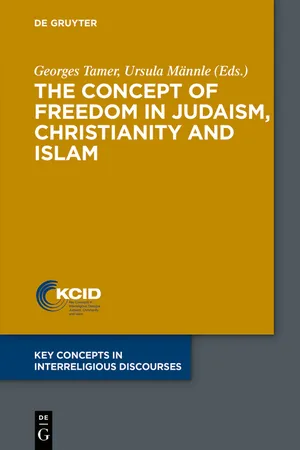
The Concept of Freedom in Judaism, Christianity and Islam
eBook - ePub

The Concept of Freedom in Judaism, Christianity and Islam

  1. 174 pages
  2. English
  3. ePUB (mobile friendly)
  4. Available on iOS & Android
eBook - ePub

The Concept of Freedom in Judaism, Christianity and Islam

About this book

The third volume of the series "Key Concepts of Interreligious Discourses" investigates the roots of the concept of freedom in Judaism, Christianity and Islam and its relevance for the present time.

The idea of freedom in terms of personal freedoms, which include freedom of conscience, freedom of speech and bodily integrity, is a relatively new one and can in some aspects get into conflict with religious convictions. At the same time, freedom as an emancipatory power from outer oppression as well as from inner dependencies is deeply rooted in Judaism, Christianity and Islam. It is still a vital concept in religious and non-religious communities and movements. The volume presents the concept of freedom in its different aspects as anchored in the traditions of Judaism, Christianity and Islam. It unfolds commonalities and differences between the three monotheistic religions as well as the manifold discourses about freedom within these three traditions. The book offers fundamental knowledge about the specific understanding of freedom in each one of these traditions, their interdependencies and their relationship to secular interpretations.

Trusted by 375,005 students

Access to over 1.5 million titles for a fair monthly price.

Study more efficiently using our study tools.

Information

Publisher
De Gruyter
Year
2019
Print ISBN
9783110560558
eBook ISBN
9783110560633

Index of Subjects

  • Apostasy
  • AshÊżarite school
  • Bondage
  • Christ
  • Commandment
  • Consent
  • Covenant
  • Criticism
  • Divine foreknowledge
  • Divine sovereignty
  • Eastern Orthodox
  • Emancipation
  • Ethical monotheism
  • Fall
  • fiáč­ra
  • Gospel
  • Human agency
  • ikhtiyār
  • Indepence
  • Islam
  • Law
  • Liberalism
  • Liberation
  • Messiah
  • Messianism
  • Moral ideal
  • MuÊżtazilite School
  • Natural law
  • Natural right
  • Necessity
  • Pelagianism
  • Polygamy
  • Redemption
  • Reformation
  • Repentance
  • Roman Catholicism
  • Sabbath
  • Salvation
  • Scholasticism
  • SharÄ«Êża
  • ShiÊża
  • Sin
  • Slavery
  • Sunni
  • taklÄ«f
  • taqlÄ«d
  • tawងīd
  • Torah
1
Note that Judaism normally parses the Ten Commandments differently than Christianity. For Jewish thinkers, “I am the Lord thy God 
” is usually taken as a commandment to accept the sovereignty of God even though it is not expressed in the form of an imperative. Cf., for example, Maimonides, Moses, Mishneh Torah 1, trans. E. Touger, New York/Jerusalem: Moznaim Publishing, 1989, Basic Laws, 1. 1 – 6.
2
Walzer, Michael, Exodus and Revolution, New York: Basic Books, 1985, 7.
3
Ibid., 3 – 7.
4
It is unclear whether the Jubilee year was an aspiration or a report of an actual practice.
5
Kant, Immanuel, Religion within the Boundaries of Mere Reason, trans. Allen Wood/George Di Giovanni, Cambridge: Cambridge University Press, 1998, 6:125 – 27.
6
The paidagogos was someone assigned to look after young boys for the purpose keeping them out of trouble.
7
Cf. his Commentary on the Mishnah, “Sanhedrin, Chapter Ten.” For a readily available English translation, cf. Maimonides, Moses, A Maimonides Reader, Isadore Twersky (ed.), New York: Behrman House, 1972, 402 – 23. For discussion of Maimonides’ principles as well as their reception by other Jewish thinkers, cf. Kellner, Menachem, Dogma in Medieval Jewish Thought, New York: Littman Library, 1986 and idem, Must a Jew Believe Anything?, New York: Littman Library, 2006. Even in Maimonides’ lifetime, a controversy arose over how deeply he himself was committed to these principles, especially Number 13: belief in resurrection. For Moses Mendelssohn’s critique of Maimonides, cf. Jerusalem, trans. Alan Arkush, Hanover, N.H.: University Press of New England, 1983, 100 – 1.
8
Kant, Religion within the Boundaries of Mere Reason, 6:166, footnote.
9
Albo, Joseph, Sefer ha-Ikkarim, trans. Isaac Husik, Philadelphia: Jewish Publication Society of America, 1929, Book 1, Ch. 2, 55.
10
The origin of this distinction can be traced at least to Kant’s distinction between Wille and Wilkur and before that to Plato’s conception of boulesis at Gorgias 466b ff. The question raised by Plato is whether I can really be said to do as I wish if my action runs counter to what is in my own best interest. Contemporary philosophers often begin their discussion of this issue by citing Isiah Berlin's famous essay ...

Table of contents

  1. Title Page
  2. Copyright
  3. Contents
  4. Preface
  5. The Concept of Freedom in Judaism
  6. The Concept of Freedom in Christianity
  7. The Concept of Freedom in Islam
  8. Epilogue
  9. List of Contributors and Editors
  10. Index of Persons
  11. Index of Subjects

Frequently asked questions

Yes, you can cancel anytime from the Subscription tab in your account settings on the Perlego website. Your subscription will stay active until the end of your current billing period. Learn how to cancel your subscription
No, books cannot be downloaded as external files, such as PDFs, for use outside of Perlego. However, you can download books within the Perlego app for offline reading on mobile or tablet. Learn how to download books offline
Perlego offers two plans: Essential and Complete
  • Essential is ideal for learners and professionals who enjoy exploring a wide range of subjects. Access the Essential Library with 800,000+ trusted titles and best-sellers across business, personal growth, and the humanities. Includes unlimited reading time and Standard Read Aloud voice.
  • Complete: Perfect for advanced learners and researchers needing full, unrestricted access. Unlock 1.5M+ books across hundreds of subjects, including academic and specialized titles. The Complete Plan also includes advanced features like Premium Read Aloud and Research Assistant.
Both plans are available with monthly, semester, or annual billing cycles.
We are an online textbook subscription service, where you can get access to an entire online library for less than the price of a single book per month. With over 1.5 million books across 990+ topics, we’ve got you covered! Learn about our mission
Look out for the read-aloud symbol on your next book to see if you can listen to it. The read-aloud tool reads text aloud for you, highlighting the text as it is being read. You can pause it, speed it up and slow it down. Learn more about Read Aloud
Yes! You can use the Perlego app on both iOS and Android devices to read anytime, anywhere — even offline. Perfect for commutes or when you’re on the go.
Please note we cannot support devices running on iOS 13 and Android 7 or earlier. Learn more about using the app
Yes, you can access The Concept of Freedom in Judaism, Christianity and Islam by Georges Tamer, Ursula MĂ€nnle, Georges Tamer,Ursula MĂ€nnle in PDF and/or ePUB format, as well as other popular books in Theology & Religion & Jewish History. We have over 1.5 million books available in our catalogue for you to explore.