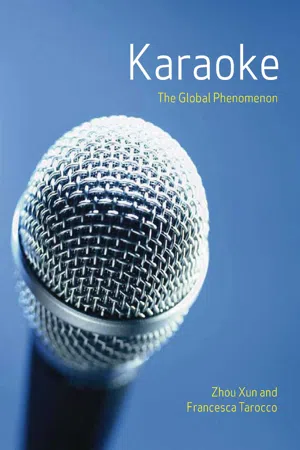
In Japanese the term Karaoke means, literally, ‘empty orchestra’. One definition disparagingly describes it as the ‘social sensation from Japan where sufficiently inebriated people embarrass themselves in public by singing along to a music track with the lyrics displayed on a TV screen’. In recent years the world has been witnessing a massive worldwide karaoke explosion.
In Karaoke, Zhou Xun and Francesca Tarocco address the complexity of this social craze, exploring its emergence in post-war Japan, its development and spread across the world to become a phenomenon that constantly evolved to keep pace with changes in technology and culture. Drawing on extensive research and travels around the world, the authors chart the varied manifestations of karaoke, from karaoke taxis in Bangkok to nude karaoke in Toronto, to the role of karaoke in prostitution. Extensive personal anecdotes reveal the dramatic range of social experiences made possible by karaoke and how the obsession with performance and song has touched politics, history and pop culture throughout global society. Karaoke bars are at the heart of rich escapist fantasies, and the authors - in readable fashion and using vibrant illustrations - document this unpredictable fantasy world and the people who inhabit it.
A fascinating and highly informative read, Karaoke will delight all those who have had the courage to take the mike and front the ‘empty orchestra’.
- English
- ePUB (mobile friendly)
- Available on iOS & Android
eBook - ePub
About this book
Information
 | Who Invented Karaoke? |
Del Rosario versus Inoue
In January 1993 Roberto del Rosario filed a complaint to the Regional Trial Court at Makati, Philippines, for patent infringement against the Janito Corporation, the Chinese firm that claimed to have invented the Miyata Karaoke™ machine. Del Rosario alleged that he was a patentee of audio equipment and had improved what was commonly known as the sing-along system or karaoke. He described his sing-along system as a handy, multi-purpose, compact machine that incorporated an amplifier, speaker, one or two tape mechanisms, an optional tuner or radio and a microphone mixer with features to enhance one’s voice, such as echo or reverb to simulate opera or a studio sound. The whole system was then encased in a cabinet. He stated that he had developed the system in 1975 and began to market it in 1978. On 15 March 1996 the Supreme Court in the Philippines ruled in favour of Del Rosario, making him the world’s sole patent holder for the karaoke system.1
Del Rosario’s claim further muddled the already complicated origins of karaoke. As with the Bible, there are many accounts regarding the genesis of karaoke. The most common belief is that karaoke originated in Japan, since the term is an abbreviated compound of two Japanese words: ‘kara’, from karappo (‘empty’), and ‘oke’, an abbreviation for okesutura (‘orchestra’). Toru Mitsui, however, explains that the original term karaoke in Japanese does not mean ‘empty orchestra’, but instead should be understood as ‘the orchestra on the recording is void of vocals’, referring to the karaoke machine as well as to the singing.2
In 1996, about the time the Supreme Court in the Philippines was anointing Del Rosario as the inventor of the karaoke system, a Singapore-based all-karaoke TV channel ‘discovered’ an amiable-looking character named Inoue Diasuke, from Nishinomiya in Hyogo prefecture, Japan, and made him the ‘Grand Daddy’ of karaoke.
In 1971 Inoue was a none-too-successful 30-year-old keyboard and vibraphone back-up player in a bar in Kobe. He was, however, much loved by many amateur singers since he seemed to possess a magic touch: his ability to make even a poor singer sing in tune, which later earned him the nickname of a ‘human karaoke machine’. Inoue was in such high demand that he had to clone himself. One day a customer asked him to go on a company trip and play for him during a party. Inoue was too busy to go, so he recorded the backup music on a tape and gave it to his customer. According to Inoue, ‘That guy was worse than your typical bad singer. He couldn’t hit the notes, couldn’t even hold a beat. So I purposely recorded the song off-beat. And you know what? He was very happy with the results!’ The businessman delivered an emotional rendition of Frank Nagai’s ‘Leaving Haneda Airport on a 7.50 pm Flight’, Inoue collected his money in absentia and came up with another brilliant idea: ‘As for me, I couldn’t play well without looking at the sheet music, and new songs kept coming out one after the other, so I thought maybe a machine could make things easier for me. In a sense, my invention came about because I was too lazy to learn new songs!’ Inoue asked for help from three friends: an electronics specialist, a woodworker and a furniture finisher. Within three months they made him a karaoke machine, a more sophisticated clone of Inoue, complete with microphone and echo effect. They called it the ‘8-Juke’. By depositing a 100-yen coin into the machine, the backup music would start playing in just five seconds. Initially they made only eleven machines, but they quickly became so popular that they had to produce another ten thousand.3
In 1999 Time magazine astonishingly named Inoue one of the twentieth century’s most influential Asians, arguing that he ‘had helped to liberate legions of the once unvoiced: as much as Mao Zedong or Mohandas Gandhi changed Asian days, Inoue transformed its nights.’4 In 2004, described in similar terms as ‘thereby providing an entirely new way for people to learn to tolerate each other’, he was presented at Harvard University with the Ig Nobel Peace Prize, a semi-serious award presented by real Nobel Prize winners.5 Inoue has also been the subject of films, the most recent one of which, simply called Karaoke, features a much better-looking actor than the plump, shortish Inoue. ‘At least they got someone tall to play me’, he laughs. As for his monumental contribution to the human race, Inoue is less enthusiastic. ‘I’m not an inventor’, he told journalist David McNeill in a recent interview, ‘I simply put things that already existed together, which is completely different. I took a car stereo, a coin box and a small amp to make the karaoke. Who would even consider patenting something like that?’
Inoue now makes a living by selling an eco-friendly detergent and a cockroach repellent for karaoke machines: ‘Cockroaches get inside the machines, build nests, and chew on the wires . . . this is the reason why more than 80 per cent of the machines break down.’ This is not the first time he has partly profited from the revenues produced by the karaoke industry. In the 1980s he ran a company that successfully persuaded dozens of small production firms to lease songs for 8-Juke karaoke machines, but the introduction of new laser and dial-up technology left him jobless until he discovered that cockroaches, too, love karaoke.6
In order to make karaoke into an authentic Japanese story, Wikipedia has attributed its origin to the long tradition of singing and dancing in rural Japan, which dates back to ancient times, or to Noh, a major form of musical drama that has been performed since the fourteenth century. The emphasis on singing and dancing in a samurai’s training is also thought to have contributed to the development of karaoke. During the Taisho period (1912–26) the Utagoe Kissa (song coffee shop), where customers often sang to a live band, became popular.7 Another popular story claims that, years later, when a strolling guitarist failed to appear, a snack bar owner in Kobe put on tapes of music and asked people if they wanted to sing.8
The Welsh revival
Then there are other stories: even the Welsh have jumped on the bandwagon, insisting that they are the inventors of karaoke. The webmaster of a colourful website called ‘Wales, The Land of Song’ makes bold claims about the ‘true’ origins of karaoke:
[W]hat makes Wales really famous for being the Land of Song is that if you gather two or three Welsh people together, in a few minutes there will be talk of singing, even if the singing hasn’t started already! The Japanese are the ones who invented the Karaoke Machine, but it is the Welsh that invented Karaoke itself, hundreds and hundreds of years ago! Singing heartily in public is a new thing in Japan, but a very old tradition in Wales! Furthermore, the Welsh feel no need for alcoholic stimulants to induce the courage to start singing!9
While one might find such a statement dubious, it is certainly true that Welsh people love to sing in public. By the seventeenth century public hymn singing had already emerged in Wales, largely due to the effort of Nonconformists such as William Wroth, Walter Cradock and Vavasor Powell. All three were travelling evangelists, who advocated hymn singing in Welsh chapels as a useful tool in building fellowship within the community and a means of witnessing to others outside. Some even called public hymn singing ‘the most dynamic preacher and recruiter of them all’. Singing hymns in public was also believed to help believers focus on their faith.
Until the end of the Second World War the Methodist hymns became practically the only form of music known to much of the population in parts of Wales. Other traditional forms of music, folk dancing, games and customs effectively vanished, except in North Wales, where they were preserved by a few gypsy families.10
From carol singing to the music hall
While public hymn singing was an integral part of the Methodist Revival, which became a defining aspect of Welsh life, across the border in Puritan England public hymn singing, or any forms of music except for metrical psalms, was officially banned in church. It was not until 1820 that the Church of England officially authorized hymn singing. Although public singing and music were not allowed, it is believed that during this time the Elizabethan tradition of singing Christmas carols survived in secret in some remote villages in England. In the 1830s William Sandys and Davies Gilbert travelled around collecting these survivors and published them in a series of volumes. They included such later favourites as ‘God rest you merry, gentlemen’, ‘The first Nowell’ and ‘I saw three ships’, the last of which has a very optimistic tone and is considered to be one of the most upbeat and celebratory melodies of the winter season.11
As a matter of fact, centuries ago people in Europe began to celebrate the winter solstice with public singing and dancing. Most of songs were joyful in tone, intended to raise the spirits. Early Christians took on this essentially pagan practice from around AD 129 and introduced the ‘Angel’s Hymn’ (‘Gloria in excelsis’), replacing the pagan festivities with their own celebrating Christ’s birth. These early Christmas hymns were mostly sung in Latin, however, and held little attraction for the general public, most of whom did not understand their words. It was not until after 1223, when St Francis of Assisi introduced nativity plays in Italy, that Christmas carols began to spread across Europe to France, Spain, Germany and elsewhere. Normally, the actors in such plays would tell the story in songs and many of the choruses were in a language the audience could understand. Most of the early Christmas carols in the Elizabethan period were loosely based on the Christmas story and were seen as a form of entertainment rather than as specifically religious. They were mostly performed by travelling singers and minstrels, who often changed the words to suit the local audience.
When Cromwell and the Puritans came to power during the 1640s, Christmas carols were banned, together with other forms of music, although this did not suppress people’s desire to sing. Post-Puritan England saw a proliferation of mass singing in public. An early demonstration of this phenomenon came during the Handel festival in 1791, when hundreds of singers gathered together in Westminster Abbey for a performance of Messiah. The Halifax Choral Society was founded in 1817, followed by the Bradford Choral Society in 1821 and the Huddersfield Choral Society in 1836. All three were formed in local public houses, and since then British pubs have become a favourite venue for public singing. Meanwhile, from London to the remote English countryside, every village and every town formed its own choral group. There is no doubt singing in public was a much loved pastime in the nineteenth century. The Crystal Palace, built for the London Great Exhibition of 1851, soon became one of the grandest and most popular venues for choral concerts.12
As an alternative to pubs, beer halls and gin palaces, many mass music halls were erected for the entertainment of ‘respectable’ audiences in urban cities. A typical music hall song consists of a series of verses, sung by the performer alone, and a repeated chorus carrying the principal melody, and the audience is encouraged to join in. By the turn of the twentieth century it was claimed that the population of England was divided into two categories: ‘Those who sing and those who do not.’ As Nigel Fountain has shown in his recent book on mass entertainment in Edwardian England, by 1899, when the New Bedford Palace of Varieties first opened its doors in Camden Town, Britain was literally an empire of music halls stretching from Shoreditch to Sunderland.13
Originally a working-class entertainment, by the first decade of the twentieth century, the music hall had become a cultural norm in Britain with royal approval: in 1912 King George V attended the first Royal Variety Performance (then styled the Royal Command Performance) at the Palace Theatre on Cambridge Circus in London. While the peak of the music hall era was probably during the First World War, its type of entertainment remained popular into the 1950s. Other forms of popular entertainment, however, rose to prominence from the 1920s and ’30s, its biggest competitor being the cinema, but the spread of television in the early 1950s sealed the fate of the music hall.
Even after music halls lost their appeal, public singing did not. The rise of cinema provided a new media for public singing, from which came a form of sing-along. Long before the days of ‘Sing-along-a Sound of Music’ screenings or the appearance of karaoke, cinema audiences in Chengdu, the largest city in China’s southwest frontier region, were already singing along with their favourite stars during the late 1930s. Partly owing to its geographical isolation, Chengdu was largely a backward-looking city, where people had a very reserved attitude towards anything new. From 1937, however, the Sino-Japanese War changed this forever. Surrounded by steep mountains – the famous Chinese poet Li Bai once wrote that to reach Chengdu and its surrounding areas was as impossible as to reach heaven – the city was spared the Japanese invasion. War refugees flooded into the city and China’s leading universities relocated to Chengdu. The many students brought with them new fashions, tastes and novelties from the coastal cities, and turned Chengdu into an entertainment hub. Until the end of the Second World War the city was the most happening place in China. A number of cinemas, still a relatively new entertainment in China, sprang up. In order to lure the public, the cinemas had constantly to innovate their offerings. The Daguanming cinema, for example, invited local translators to give spontaneous translations of foreign films, often using humorous expressions or local slang to make the audience laugh: translation was part of the show. The Guomin cinema in the city centre provided a sing-along facility by projecting the words of popular tunes onto the screen. This was popular with young people who wanted to emulate famous stars such as Zhou Xuan, Li Lihua and Bai Guang.14 Decades later, Chengdu was to become one of the first cities outside Japan to embrace karaoke. This was partly because anything from Japan was seen as prestigious, and partly because it fitted right into an existing local culture where people love to socialize.
It would be arbitrary to suggest that karaoke has evolved from the hymn-singing culture in Wales or the public singing culture in England, although as a modern medium it has helped to revive the British passion for singing, much as it speeded up social bonding in Chengdu. Today karaoke has become part of the local cultural traditions and a way of life. While one might claim that it is a quintessentially Japanese product, it has, however, struck a chord with audiences worldwide. As Pico Iyer observes:
Signs for ‘Karaoke nights’ appear outside mom-and-pop stalls in Third World villages and on the glittery billboard of the Hollywood Park Casino in California. Global icons practice it in films like My Best Friend’s Wedding, and steelworkers howl away in English towns, where ‘carry-okie’ sounds like a...
Table of contents
- Front Cover
- Half Title
- Title Page
- Copyright
- Contents
- Introduction
- 1 Who Invented Karaoke?
- 2 ‘Karaoke Fever’: Japan and Korea
- 3 Karaoke Wonderland: South-east Asia
- 4 The Disneyland of Karaoke Palaces: China
- 5 Karaoke for the Soul: Karaoke and Religion
- 6 ‘Naked Karaoke’ and the Cowboys: North America
- 7 A Karaoke People: Britain
- 8 ‘Karaoke Forever’: Europe
- 9 Karaoke in Brazil: The Nikkeijin Story
- 10 Karaoke Revolution: Karaoke Technologies
- Epilogue: Karaoke at the Frontiers
- Select List of Karaoke Venues Worldwide
- References
- Select Bibliography
- Photos and Acknowledgements
- Index
Trusted by 375,005 students
Access to over 1.5 million titles for a fair monthly price.
Study more efficiently using our study tools.
Frequently asked questions
Yes, you can cancel anytime from the Subscription tab in your account settings on the Perlego website. Your subscription will stay active until the end of your current billing period. Learn how to cancel your subscription
No, books cannot be downloaded as external files, such as PDFs, for use outside of Perlego. However, you can download books within the Perlego app for offline reading on mobile or tablet. Learn how to download books offline
Perlego offers two plans: Essential and Complete
- Essential is ideal for learners and professionals who enjoy exploring a wide range of subjects. Access the Essential Library with 800,000+ trusted titles and best-sellers across business, personal growth, and the humanities. Includes unlimited reading time and Standard Read Aloud voice.
- Complete: Perfect for advanced learners and researchers needing full, unrestricted access. Unlock 1.5M+ books across hundreds of subjects, including academic and specialized titles. The Complete Plan also includes advanced features like Premium Read Aloud and Research Assistant.
We are an online textbook subscription service, where you can get access to an entire online library for less than the price of a single book per month. With over 1.5 million books across 990+ topics, we’ve got you covered! Learn about our mission
Look out for the read-aloud symbol on your next book to see if you can listen to it. The read-aloud tool reads text aloud for you, highlighting the text as it is being read. You can pause it, speed it up and slow it down. Learn more about Read Aloud
Yes! You can use the Perlego app on both iOS and Android devices to read anytime, anywhere — even offline. Perfect for commutes or when you’re on the go.
Please note we cannot support devices running on iOS 13 and Android 7 or earlier. Learn more about using the app
Please note we cannot support devices running on iOS 13 and Android 7 or earlier. Learn more about using the app
Yes, you can access Karaoke by Xun Zhou,Francesca Tarocco,Zhou Xun in PDF and/or ePUB format, as well as other popular books in Social Sciences & Popular Culture. We have over 1.5 million books available in our catalogue for you to explore.