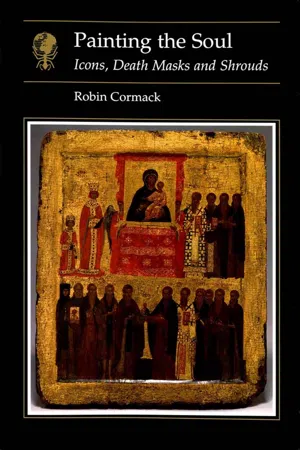
Icons are among the most elusive subjects in the history of art, but at the same time their study constitutes possibly its fastest expanding field, and with the opening-up of the former Soviet Union many new objects are being discovered, studied and exhibited. In this book, Robin Cormack considers the icon as an integral document of society and gives us new insights into the nature of Byzantine art.
Painting the Soul explores both the creation and the development of the icon. After the early Christians - like the pagans before them - had come to expect their god to be visually present among them, endless questions confronted both the artist and the Church. What did Christ look like? How should Christ be represented? Should Christ be represented (as he is for example on the Turin Shroud)?
Appropriately, Cormack’s study ends with Venetian Crete, where the icon underwent its final development and transformation into the art of the Renaissance. Here, established Byzantine forms of religious art confronted developing Renaissance modes of expression: the first ‘icons’ of El Greco were painted in Crete.
Painting the Soul is beautifully illustrated, featuring many little-known works of art. Even so, Cormack treats the icon not as a mere artistic product, but as the symbolic face of medieval Europe. He shows how this new field within the history of art - the study of the icon - will transform our understanding of European art and culture.
- English
- ePUB (mobile friendly)
- Available on iOS & Android
eBook - ePub
About this book
Information
Topic
ArtSubtopic
Art General1 Conception
Athenian society was shaped by its male citizens and the dominant ideology, the ideology that guided painters in their choices and defined their view in a system that left little room for individual initiative or what we call inspiration, was chiefly masculine. Thus the images which we will examine bear a double imprint. They are not an objective transcription of reality, but the product of a gaze that reconstructed the real – and that gaze was masculine.
François Lissarrague, ‘Figures of Women’, in P. S. Pantel, ed., A History of Women in the West: From Ancient Goddesses to Christian Saints
As art history changes, so do introductions. When there was a consensus about the nature of art history, introductions – and even the text itself – could be anecdotal and narrative. But with fewer art historians depending without question on that bygone but familiar discourse of artists and patrons, challenge and response, creativity and originality, or progressiveness and retrogression, now everyone needs a preface to evoke (or spell out) their individual ‘methodology’. To have opening sentences like ‘There really is no such thing as art. There are only artists’ now acts less as an insight and more as a critical milestone.1 More familiar now are statements – there is one by Lissarrague at the head of this page – which signal an approach which seeks explanations for the history of art through the analysis of viewers and the interaction of art with society. This book too was envisioned as a study of a complex culture’s response to its art. By means of this approach, one could hope to be more discriminating than if we saw one form of art as an unchanging entity over the period of a thousand years or more. To someone who said all icons look the same, one could show that the viewers differed.
But viewers turn out to be as complicated and speculative as artists, because viewers as a group include artists, patrons, and the audience. Worse still conceptually, viewers include not simply the original audience of art, but its whole historical audience – even us, its living audience. And ‘we’ have a further divisive factor, when treating a form of art produced for a religion; some are believers, some are not. In the case of the icon, this means that for some viewers we are dealing with ‘art’; for others, this medium is not art at all, but part of the charged mechanisms of worship, materials holy in themselves.
When art historians focus on viewing, their priorities change. If art is seen in terms of ‘responses’, both intellectual and spiritual, questions about the circumstances and processes of the act of production of each object may begin to lose their relevance. The notion of using the viewer as a channel for understanding how art works can easily undercut interest in some of the traditional (and often speculative) questions of art history; attribution, assigning provenance, and dating, once seen as the prime tasks of the art historian, as activities worthy in their own right, are not always of clear value at all. In this book, while dating and assigning provenance will not be regarded as obligatory exercises, it will become clear that these factors may be of crucial importance in understanding the viewer’s response. If someone in the fourteenth century kissed an icon, our historical analysis will be crucially affected by an empirical knowledge of that icon. Did the viewer believe that the panel dated from the time of Christ and had been painted by the evangelist Luke? Was this belief correct? Was the icon old and hallowed in the fourteenth century? Or had it just been painted in Constantinople? Did the artist copy a venerated ‘model’ or invent a new type? Did the power of the model reside in copies of any later period? This book will attempt to maintain the delicate balance between the historical and ahistorical treatment of viewing that these questions require when dealing with a religious art which goes through a set of radical changes, while at the same time declaring to its audience that art represents unchanging truth.
Another problematic area for any study which deals with viewers and which emphasises the functions and powers of images is how to handle the ‘art appreciation’ of those images. For there can be no rule that religious veneration will limit itself to ‘good art’; indeed, art history has often ignored the material imagery which has been at the intense centre of religious devotion and dismissed it as kitsch. It might even be thought daring to focus on the popular imagery of western art rather than the works of accepted quality. Writing on Medieval art has regularly emphasised, and frequently agreed, a canon of the significant works of quality – although the untutored eye more familiar with twentieth-century art may admire less crafted imagery. The scholarly literature on Byzantine art too has been remarkably consistent about where quality lies; the implicit rule of thumb has been that the more ‘Classical’ it looks, the greater the approval of the work of art. The consequence of such a partiality for the Classical has been that any period which looks to have favoured the formal values of classicism has been enthusiastically marked as a renaissance, and so a cyclical pattern has been identified of periodic renaissance and periodic divergence. This periodisation of Byzantine art into a succession of significant moments of renaissance does not fit the stages of change emphasised in this book. And there are other consequences if the pursuit of classicism is reined in. Of course, one can accept that Byzantine culture had infinite links with its Greco-Roman past, and that various individuals at different periods responded in changing ways to that past, sometimes with greater interest in imitating the illusionist forms which we designate as ‘classical’. But as a continually renewed religious art, Byzantine art operates as much more than a stage in the recreation of Antiquity, producing a sort of weak renaissance before the real Renaissance took over. We shall need to see beyond the classicism of Byzantine art if we want to begin to see the range and power of its imagery. Yet, while one might question whether classicism is the gauge of quality in Byzantine works of art, it would be superficial to imagine that icons were treated wholly as religious objects and not contemplated as objects of beauty, too. Whether Byzantine society had a scale of aesthetic values and how it related to ours remains a major issue.
Such remarks in an introductory chapter are likely to appear both commonplace and too general. But anyone who works in the Middle Ages is acutely conscious that this is a (very long) period of time with a label formulated in negative terms – it is not the Renaissance, not Antiquity, but what fills the centuries ‘in-between’. No doubt, other periods are equally gloomily defined, but few suffer the ambivalence which has haunted the study of the Middle Ages. Should it be studied within the framework of other periods and follow the aims and patterns of later European art history? Or is it a deviant period requiring different methods? If the discourse of artists and renaissance was formulated in the study of the Italian Renaissance, could and should it be applied to the circumstances of Medieval art? What in any case is the difference between Late Medieval spirituality and the Renaissance?
The study of Byzantine art has its own further obstacles. ‘Medieval studies’, it soon transpires, do not necessarily include Byzantium. While it may not actually be ostracised, Byzantine art can all too frequently be relegated to the margins.2 Although the art of Byzantium (as the Middle Ages in the ‘Greek East’) is sometimes given a walk-on part, more often than not it is seen as an entity apart, opportunely offering explanations for changes in western Medieval art: it becomes a ‘source’ or an ‘influence’.3 The ‘Byzantine Question’ is conceived as the role of Byzantine art in the reconstruction of western European art at the beginning of the Italian Renaissance. This is not the ‘question’ which this book will recognise. In any case, once Byzantine art is conceived in the way the old question encourages – as a separate organism – then the temptation is to describe it as a ‘non-western’ phenomenon, and so to give it an identity beyond the European norm. This reaction is not entirely without its merits, but if followed to an extreme, it may do no more than set up new polarities and new problems of interpretation. As the argument in this book unfolds, it will become even clearer that any such simple dichotomy of east and west is more a distortion than a help in the study of Byzantine art.
Here, then, emerges one of the aims of this book: to discover how far we can explore the self-identity of Byzantium through Byzantine art itself. How do the objects which we categorise as art work in the construction of that identity? This is not, of course, the same question as the traditional one, ‘What is Byzantine art?’ The interpretative shift comes as a natural consequence of the move in attention away from the producer of Byzantine art to the viewer. In this culture, the best materials to choose for studying the whole range of society and its experiences are surely in the medium of the Byzantine icon – that at least is the claim made in this book.
The icon as a form of visual representation was developed early on in the history of Byzantium. But its early success and popularity carried the seeds of its possible downfall; the reliance of the people on icons as a window to heaven was gradually seen as a subversive threat to the authority and control of the state. Iconoclasm, interpreted this way, was a concerted politicised attempt by the ruling establishment to eradicate the figurative imagery of the icon from Byzantine Christianity. Iconoclasm was orchestrated from the capital, Constantinople, from the 720s; but by 842, the movement had failed – the iconophiles had triumphed. From the ninth century onwards, it was irrevocably the prominent parading of the icon in public and private that defined Byzantium. Everyone after iconoclasm had to conform with the agreed church dogma, expressed as a council decision and displayed in art by one of the iconophile saints of the period of iconoclasm, St Stephen the Younger: ‘If anyone does not reverence our Lord Jesus Christ and his pure Mother depicted on an icon, let them be anathema’ (illus. 1).4 To declare oneself a Christian in Byzantium was from the ninth century not simply to claim membership of the ‘Orthodox’ church; it was to be part of a community which had learned through the refutation of the iconoclast heresy that God expected his church to be framed by icons. One could not both claim to be Orthodox and criticise the icon. To be a citizen of Byzantium was to live in a community shared by people and icons, a community of the visible living and the visible dead. Hence the awesome power of the visual icon, which was confirmed forever in Constantinople in the year 843 and which means that even the modern viewer belongs either to the community of Orthodox viewers of this ‘art’ or does not. To look at the icon is to enter the highly loaded world of active religious art – a field of emotive art history for committed viewers!
1 Detail of illus 7, showing the Panagia and Child on an icon held by St Stephen. |  |
If we understand icons as an integral document of a society, their study involves a method for the study of both that society and its objects – the interdisciplinary situation. This sounds prosaic enough, but what will emerge in this book is that icons remain among the most elusive subjects in the history of art. Icons also constitute perhaps the fastest expanding field in the history of art, for nowhere else, at least in the European context, are so many new materials being discovered, exhibited, and studied. Literally thousands of unknown icons are being found in monasteries, collections, and museum vaults and await investigation. Thus, one challenge of the icon at this time is to react to a whole new range of material and find and justify ways of approach. There is, of course, a current scholarly discourse about icons, but we need to assess its adequacy and ways of developing it. We have, in other words, an awesome situation: a marginal world of art-historical study that is moving into the centre of the arena. How can we cope with so much new material from a cultural world which was defined before its central production, the icon, was recognised as important?
While icons may be seen as a domain waiting for extensive exploration, they hardly constitute a new subject. Others have been here before, and they have offered their various approaches and conclusions. They present us with established ways of describing panel paintings, but often give considerable attention, for example, to the dating of icons. The spotlight on dating reflects a common tradition that this activity is at the centre of art history. But it is the case that for the Orthodox culture in which icons were produced, the date of production of any icon was manifestly of little importance – the majority carry no date, and the precise moment of production presumably would seem of little importance when set against the eternity of the subject matter. Since the changing nature of the art and its roles will be treated in this book, we do need to work within a chronological framework. While it was clearly an intention to make icons look ‘timeless’, and while this was indeed achieved, this very success may make the contexts of production necessary to find. How was timelessness achieved at different times? This was not just a matter of suppressing fashion. Was an icon regarded as an old and venerated object actually ‘old’? How far is the instant impression that Byzantine art gives of an unchanging culture maintaining the eternal values of Christian truth an impression that was created in the society or through hindsight? Why do icons appear to be stereotyped productions? Does the recognition of a chronology offer a key to answering such questions?
Although the value of finding a chronology for icons ought to be a subject of controversy and debate, this book does intend to identify both changes and continuities in the functions of icons over the course of time. Its structure is therefore chronological, and dates will be given for icons, since they are the props which illuminate change and development. There is, of course, no agreed way of dating icons – or, indeed, agreement on many of the details of chronology, and this is not a handbook on dating. No doubt, more objective ways will be developed in future – more technical information, such as databanks of pigments and media, would certainly help. Since icons are painted on wood, one might also expect dendrochronology to offer a sequence of dated panels based on the analysis of tree rings – a profile of the Byzantine period has already been painstakingly constructed from the collection of samples from the wooden tie-beams of Byzantine churches.5 At present, the normal strategy followed in dating icons is traditional stylistic analysis (which always privileges experience and intuition over reasoned justification). One must surely be sceptical about the sentiments on the dating of icons expressed by David and Tamara Talbot Rice (in 1974) in an apparently didactic book – Icons and Their Dating – in which they say that dating depends ‘on a feeling for style which, in its turn, is the result of long practice’, and in which they appeal to ‘that intangible element which determines a style’ in order to date any specific icon.6 From our perspective, these are the old mystifications of style and iconography, but no doubt the decision not to produce a primer in dating icons will result in equally unjustifiable decisions.
It seems only yesterday that no one used the word icon. Today, it is one of the commonest (misused?) words in the media. This book will take you behind this façade into the ‘real’ world of icons. This means entering the early centuries of Christianity before it was agreed how God was to be worshipped and how a universal religion could express truth and convert the unbeliever. But while these images may have been developed in a momentous Christian context, the solutions for the uses of art are not unique to Byzantium. To confront the icon is to examine the use of symbolism by any society.
This book also has a purely empirical intention: to show the opportunities and values of this field. Suddenly, we can all encounter great hoards of icons, not just in the remote monastery of St Catherine’s on Sinai, but equally in monasteries and churches all over Greece and on Cyprus. Crete in particular has been the site of major discoveries. As knowledge of icons develops, so the extensive collections in museums in Russia are becoming more conspicuous; these are collections not just of icons from Russian churches, often brought into museums during the Soviet period, but also large collections made in the west in the nineteenth and early twentieth century by private individuals. Today, due to restoration for the first time since their original production, we can also see paint surfaces in all their brightness and subtlety. These surfaces may not, of course, be in exactly the same condition as at the time of production; pigments may have changed their appearance, and worm infestation and other damage and deterioration of the wood may have taken their toll. Yet new restoration work has suddenly presented us with literally hundreds of fresh icons which have emerged from a covering of dirt, candle grease, and old varnish. And this work differs from the norm of restoration work done before around 1970. Until then, to restore an icon typically meant to repaint and slick it up. Expectations of restoration are now much changed; we are prepared to accept the sight of an icon in the state in which it has survived, not the state we might have preferred or imagined (see illus. 8). The consequence of this work and changed taste is that we can view icons as never...
Table of contents
- Front Cover
- Title Page
- Copyright
- Contents
- Preface
- Chronology of Byzantine History
- 1 Conception
- 2 Birth
- 3 God/Man
- 4 Maturity and Identity
- 5 Rebirth
- References
- General Bibliography
- List of Illustrations
Trusted by 375,005 students
Access to over 1.5 million titles for a fair monthly price.
Study more efficiently using our study tools.
Frequently asked questions
Yes, you can cancel anytime from the Subscription tab in your account settings on the Perlego website. Your subscription will stay active until the end of your current billing period. Learn how to cancel your subscription
No, books cannot be downloaded as external files, such as PDFs, for use outside of Perlego. However, you can download books within the Perlego app for offline reading on mobile or tablet. Learn how to download books offline
Perlego offers two plans: Essential and Complete
- Essential is ideal for learners and professionals who enjoy exploring a wide range of subjects. Access the Essential Library with 800,000+ trusted titles and best-sellers across business, personal growth, and the humanities. Includes unlimited reading time and Standard Read Aloud voice.
- Complete: Perfect for advanced learners and researchers needing full, unrestricted access. Unlock 1.5M+ books across hundreds of subjects, including academic and specialized titles. The Complete Plan also includes advanced features like Premium Read Aloud and Research Assistant.
We are an online textbook subscription service, where you can get access to an entire online library for less than the price of a single book per month. With over 1.5 million books across 990+ topics, we’ve got you covered! Learn about our mission
Look out for the read-aloud symbol on your next book to see if you can listen to it. The read-aloud tool reads text aloud for you, highlighting the text as it is being read. You can pause it, speed it up and slow it down. Learn more about Read Aloud
Yes! You can use the Perlego app on both iOS and Android devices to read anytime, anywhere — even offline. Perfect for commutes or when you’re on the go.
Please note we cannot support devices running on iOS 13 and Android 7 or earlier. Learn more about using the app
Please note we cannot support devices running on iOS 13 and Android 7 or earlier. Learn more about using the app
Yes, you can access Painting the Soul by Robin Cormack in PDF and/or ePUB format, as well as other popular books in Art & Art General. We have over 1.5 million books available in our catalogue for you to explore.