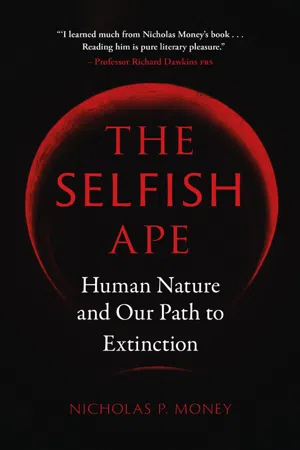
Weaving together stories of science and sociology, The Selfish Ape offers a refreshing response to common fantasies about the ascent of humanity. Rather than imagining modern humans as a species with godlike powers, or Homo deus, Nicholas P. Money recasts us as Homo narcissus, paragons of self-absorption. This exhilarating story takes in an immense sweep of modern biology, leading readers from earth's unexceptional location in the cosmos, to the story of our microbial origins, and the workings of the human body. It explores human genetics, reproduction, brain function and ageing, creating an enlightened view of humans as a brilliantly inventive, yet self-destructive animal.
This is a book about human biology, the intertwined characteristics of human greatness and failure, and the way that we have plundered the biosphere. Written in a highly accessible style, it is a perfect read for those interested in science, human history, sociology and the environment.
- English
- ePUB (mobile friendly)
- Available on iOS & Android
eBook - ePub
About this book
Information
ONE
GLOBE
How Life Lends Itself to Earth
We spend most of our lives on the surface of the Earth, in contact with the ground and breathing in the atmosphere. We walk, run, sit and sleep on land. We inhale and exhale a mixture of gases from first breath to last gasp. All of our companions, from the largest whales to the smallest viruses, exist in the 20-km-thick (12-mi.) skin of Earth’s biosphere.1 High above, in the upper atmosphere, even the most resilient organisms dry out and are burned to crisps by the Sun. Below the biosphere, in the depths of the crust, life is extinguished by heat radiating from the underlying mantle.
Oodles of physical peculiarities support the biological activity here. Earth traces a Goldilocks orbit, at a distance from the Sun which allows water to be liquid: not too close to make it boil away and not too far to make it freeze. The Sun is a medium-sized, middle-aged star, classified as a yellow dwarf by cosmologists. Yellow dwarfs are nuclear reactors that fuse atoms of hydrogen into helium and release a lot of energy. Our star is 4.6 billion years old. It will continue to burn for another 5 billion years before it runs out of its hydrogen fuel and swells into a weaker type of star called a red giant. Long before then, in a billion years or so, the ageing Sun will turn brighter and its awful incandescence will sterilize the biosphere for good.
What good fortune, then, to be born when the Sun is glowing just right. Also, because our galaxy – the Milky Way – is almost as old as the universe, it contains the chemicals needed for life. Atoms of carbon that form the skeletons of our proteins, and other organic molecules, could not have formed until the first stars created after the Big Bang detonated to form supernovae. Three billion years into the history of the universe, these firework displays began recycling stardust to fertilize the next generation of suns that contained the heavier elements. The reason that there is plenty of carbon and other ‘metals’ to go around now is that the galaxy has entertained multiple cycles of collapsing and exploding stars to flood itself with these elements.2
Without the Sun behaving as it does, and without the galaxy being as old as it is to have formulated the chemical ingredients for building living things, we would not be here. Delving further into the workings of physics and chemistry, some scientists argue that the universe is fine-tuned in a fashion that supports life. The force of gravity is an example of one of these fortunate characteristics. If gravity were slightly weaker, matter would never become compressed into stars in the first place. Conversely, a stronger gravitational force would have prevented the expansion of the universe and ended the festivities in a Big Crunch soon after the Big Bang.
These musings about the fortunes of the physical world are weakened when we see that they depend upon a circular argument. Rather than believing that the universe is organized for our benefit, it makes much more sense to consider the ways that biology has fitted itself to the available circumstances. Every feature of every animal, plant and microbe is superbly adapted for living on this planet. And, in support of this interpretation, we have known exactly how this has been brought about for more than 150 years – ever since Charles Darwin explained the mechanism of natural selection. Evolution does not require any circular reasoning to make sense.
The mechanism of evolution is so pervasive that it may whip up life of some kind on every Goldilocks planet. The anthropic principle, which is related to the fine-tuning argument, suggests that the universe has to be compatible with some form of consciousness and could not exist without someone appreciating it. This is another circular argument that is as impossible to refute as it is to take seriously. Consciousness among animals like us is a product of evolution. We may regard it as a fortunate characteristic, but it does not take much imagination to view it instead as a widespread curse. Would the prisoner, aware that something unpleasant is about to happen in the dungeon, prefer to be blessed by obliviousness?3 And as for not looking life and other gift horses in the mouth, it is useful to remember that nobody ever asked to be born. Indeed, some modern philosophers argue that the worst possible thing that anyone can do is to become a biological parent. The problem here, and it is a big one, is that the birth of ever more beings with the capacity for suffering adds to the collective horror in the universe.4 This psychic concern overlaps with the more practical issue of the environmental damage caused by billions of humans.
Putting aside the questionable virtues of parenthood, the notion of a universe privileged for us and by us exposes the astonishing arrogance of our species. With or without humans, Earth will spin about its polar axis at 1,600 km (1,ooo mi.) per hour and fly around the Sun at 108,000 km (67,000 mi.) per hour, while the entire solar system sweeps around the centre of the Milky Way.5 All this orbital motion originated in clouds of interstellar dust and gas that became spotted with concentrations of mass. As more and more material swirled towards these nuggets under the pull of gravity, islands of density grew into new stars. Each star is accompanied by circulating planets and each planet spins around its own axis. Planets are the remnants of the disc of dense gas from which their sun was born; they continue to orbit their stars and entire galaxies whizz around at great speeds because their motion is unopposed by anything in space.
And here we walk, run, sit and sleep, on the third planet from our star, on the Orion Arm of the Milky Way galaxy, in the middle of the observable universe. There is nothing special about our apparent position. It is just that we can only peer so far in any direction and by sight or radio telescope any resident will always find itself in the dead centre of a sphere. Think about being at sea in a kayak, too far from land to glimpse any coastlines. You can paddle around a good deal out there, while seeming to remain in the middle of a big circle. The circle of sea and the sphere of the universe move with the observer. It is, however, always possible that the Milky Way is close to one end of an egg-shaped universe. We would not know otherwise.
If we contemplated our cosmic placement more frequently, I wonder if we might feel agoraphobic? Or, perhaps claustrophobia could be a more natural cause of a species-wide panic attack? Stephen Hawking seemed influenced by claustrophobia when he recommended that we work on an interstellar escape plan with some urgency.6 Unfortunately, he did not suggest how we might propel ourselves over trillions of kilometres of space without being blown to smithereens by radiation from supernovae. Really supportive universes would have less in the vein of cosmic rays, and restaurants for interstellar astronauts would be a nice touch too. As things stand, it is almost as if we are not the intended beneficiaries of all this creative work on the part of gravity.
Until science began to displace the classical cosmology of Aristotle, we imagined that the stars were painted on a crystal sphere, bleached by sunbeams during the day and revealed as lesser lights when the Sun dropped below the horizon. We might have supposed that this decorative vault was quite close to us, not far above the clouds. Hamlet considered the ‘brave o’erhanging firmament’ as ‘a foul and pestilent congregation of vapours’ (Act II, Scene 2), whereas Milton rejoiced in the galaxy, ‘Which nightly as a circling zone thou seest/ Powdered with stars’ (Paradise Lost, Book VII, 580–81). The slow transit of a bright comet was a cause for misgivings, with its fiery tail streaking the roof above the stationary Earth. There was certainly a lot going on up there. Some of the stars showed up in the same position relative to one another, while others moved from place to place each night: Mercury, Venus, Mars, Jupiter and Saturn – Milton’s ‘five other wandering Fires, that move/ In mystic dance’ (Paradise Lost, Book V, 177–8). Everything seemed to be arranged for us and forces that we could not hope to understand animated this clockwork sky. We were, at once, subjugated by gods and empowered by their interest in everything we did.
Humanity began to cross ‘the vast gulf of the monkish and deluded past’ towards the modern era of the objective exploration of nature in the seventeenth century.7 Cosmology became a subject of intense scientific inquiry, bookended by Galileo’s Dialogue Concerning the Two Chief World Systems, published in 1632, and Isaac Newton’s Principia of 1687. Galileo made an impassioned case for the revolution of the Earth around the Sun, rather than vice versa, and Newton derived the laws of motion and gravity that maintained the orbits of planets. Four centuries on, we have a firm grasp on the physics of the universe in the aftermath of the Big Bang. The workings of matter in the instant of the beginning of time, called Planck time, are baffling, but we have certainly come a long way.8 Far enough, I think, for most of us to make sense of life without worrying about the details of the birth of the universe. It is here and we live in it.
We have established that Earth is a good place to live – or would be, without all the mistakes made by humans. Environmental conditions vary a good deal on top of the crust. Seventy-one per cent of the surface is submerged by salty water. Most of the rest of the real estate is above water and is greened by forests and grasslands, or browned and yellowed as deserts. We do not thrive in polar climates, or in hot desert temperatures much above 120 degrees Fahrenheit (approaching 50 degrees Celsius). Continuous hydration can keep the fittest going in places like Death Valley, in California, during a day hike, but this environment tests the limits of human resilience. Ultraviolet rays from the Sun are another hazard, and we rely on a 3-mm (0.12-in.) sliver of ozone in the stratosphere for protection. Without this benevolent gas, the DNA in our skin would be scrambled beyond repair unless we sought refuge in caves. The presence of ozone might be viewed as a further example of the fine-tuning of this best of all possible worlds.9 Sidestepping wishful thinking, the scientific truth is that the ozone layer was here and we evolved under it, becoming as tolerant of the incoming radiation as we needed to be – at least before we weakened the shield with refrigerants – and not a jot more.
Biology happens in biomes, which are categories of vegetation and associated wildlife. Ecologists recognize more than a dozen kinds of biome, including tropical broadleaf forests, temperate grasslands and mangrove swamps. A good deal of Earth’s natural vegetation has been supplanted by cereal agriculture, which tends to work best in places that had once supported an abundance of wildlife. Major cities have flourished in natural oases too, although plenty of humans live in hot deserts where fresh water is furnished by irrigation and desalination.
Our well-being depends on access to clean – or at least cleanish – water and air, and to a variety of fruits and vegetables. The consumption of animals has been an invariable feature of human history, but we can adopt a vegetarian diet if no meat is available, or for ethical, economic and environmental reasons. With or without meat, we are nothing without botany. Plants are so overwhelmingly important in human affairs that their study deserves the reverence afforded to business and accountancy in modern colleges and universities. The intellectual underpinning of a business degree is gossamer thin. ‘Knowledge is Power’ is chiselled on the stone gateway leading to the School of Business at my university. The phrase is attributed to Thomas Hobbes, the political philosopher, and first appeared in the 1668 Latin edition of his Leviathan, as scientia potentia est.10 In this great work, Hobbes suggested that the importance of science, or objective knowledge, lies in its practical applications. He would chuckle at the association of his aphorism with the rather miserable aspirations of investment bankers.
In any case, educated citizens of the twenty-first century should have some appreciation of the botanical foundations of our existence. Everyone should be able to take a stab at explaining where food comes from, and the correct answer should not stop with ‘grocery store’ or ‘supermarket’. The process begins with entropy and ends with sugar. Entropy is the term for the physical process that makes a mess of everything. It applies to the transformation of a library with books stacked on shelves into a pile of rubble after an earthquake, as well as to the future scattering of my ashes across the shortgrass prairie of eastern Colorado. On a broader scale, the amount of disorder, or entropy, has been increasing throughout the universe ever since the Big Bang. If entropy is increasing with the passage of time, ask some devotees of divine creation, how do we explain something as complex as a squirrel? The answer lies in the wider level of chaos in the universe. A squirrel is an island of order whose liveliness is balanced by the increasing disorder in the Sun. Rodent and star are connected by photosynthesis.
Photons streaming from the Sun are the fruits of its decay. These packets of energy reach us in eight minutes and nineteen seconds, Jupiter in 43 minutes and fifteen seconds, and the next nearest star, Proxima Centauri, in a few days short of four years and three months. Around one-third of the thin shaft of light that shines on Earth is reflected back into space, making us visible to the rest of everywhere, and the rest bathes the atmosphere, land and sea. Plants on land and microorganisms in seawater use visible light for photosynthesis using chlorophyll.
The chlorophyll molecule is shaped like a kite, with a flat face that intercepts light and a long tail that keeps it in place inside the cell. Green wavelengths of light are reflected by chlorophyll, which is why plants look green. Chlorophyll is excited by blue and red light and uses the energy conveyed through its structure to blast water molecules apart. This process does two brilliant things. First, it releases the oxygen that we breathe. Second, it generates energized particles called electrons which the plant uses to fuel the capture of carbon dioxide and the assembly of sugars. Sugar molecules are the stuff of life. Plants consume a portion of the sugars that they make by photosynthesis to meet their energy requirements. Some are stored in a sweet form as sucrose, in plants like sugar beet and sugar cane, and others are combined to form bigger and tasteless molecules called polysaccharides that support the body of the plant. Animals eat plants and turn their substance into animal tissues. This is how the wheel of life turns.
Aquatic microorganisms that also perform the marvel of photosynthesis include algae and certain kinds of bacteria. Marine and freshwater animals depend on these microbes in the same way that the fauna on land relies on plants. The majority of species on land and at sea are tied to sunlight through interactions between the organisms that make sugars and those that eat them. Wildebeests, also called gnus, eat grass, and lions butcher wildebeests. Sun→grass→gnu→lion is a simple chain of custody for the energy originating in the Sun, and is comparable to Sun→algae→krill→baleen whale. Fungi, and many of the kinds of bacteria that do not do photosynthesis, digest the post-mortem remains of plants and animals. But whether the meal is living or dead, its energy came originally from the absorption of sunlight by chlorophyll. Prometheus stole fire from Mount Olympus; chlorophyll takes it from our star.
Nature has also come up with microorganisms that are perfectly content without sunlight. These are called chemotrophs. Chemotrophs make their living by grabbing energy from single atoms of sulphur and iron and simple molecules including ammonia and hydrogen sulphide. They live in great numbers around hotwater chimneys on the deep seafloor called hydrothermal vents, and in less exotic places like animal intestines. Intestinal microbes are interesting because they complicate the transfer of calories from plant to herbivore, and herbivore to carnivore. Wildebeests rely on their gut microbes to digest grasses, and lion intestines cultivate gardens of bacteria that help break down the flesh of wildebeests.
Humans play an outsize role in this terrestrial circus because there are so many of us and because our technological prowess has allowed us to alter the biosphere in ways unavailable to other species. With dominion comes responsibilities, but we have been falling short in our job as custodians. A failure to change our habits will ensure our passage to the thinnest smear in the fossil record. Yet the biosphere will persist. Even if we insist on making conditions inhospitable for all the larger plants and animals, Earth will be cleansed and repopulated by its microbes. We could not extinguish microbiology if we tried. With more than 1 billion years of grace before the Sun starts glowing too bright, there is plenty of time for our home to be remade by the children of the evolutionary future. That would put us in our place.
TWO
GENESIS
How We A...
Table of contents
- Front Cover
- Half Title
- Title Page
- Copyright
- CONTENTS
- PREFACE
- 1 GLOBE: How Life Lends Itself to Earth
- 2 GENESIS: How We Arrived
- 3 GUTS: How Our Bodies Work
- 4 GENES: How We Are Programmed
- 5 GESTATION: How We Are Born
- 6 GENIUS: How We Think
- 7 GRAVES: How We Die
- 8 GREATNESS: How We Make Things Better
- 9 GREENHOUSE: How We Make Things Worse
- 10 GRACE: How We Should Leave
- REFERENCES
- ACKNOWLEDGEMENTS
- INDEX
Trusted by 375,005 students
Access to over 1.5 million titles for a fair monthly price.
Study more efficiently using our study tools.
Frequently asked questions
Yes, you can cancel anytime from the Subscription tab in your account settings on the Perlego website. Your subscription will stay active until the end of your current billing period. Learn how to cancel your subscription
No, books cannot be downloaded as external files, such as PDFs, for use outside of Perlego. However, you can download books within the Perlego app for offline reading on mobile or tablet. Learn how to download books offline
Perlego offers two plans: Essential and Complete
- Essential is ideal for learners and professionals who enjoy exploring a wide range of subjects. Access the Essential Library with 800,000+ trusted titles and best-sellers across business, personal growth, and the humanities. Includes unlimited reading time and Standard Read Aloud voice.
- Complete: Perfect for advanced learners and researchers needing full, unrestricted access. Unlock 1.5M+ books across hundreds of subjects, including academic and specialized titles. The Complete Plan also includes advanced features like Premium Read Aloud and Research Assistant.
We are an online textbook subscription service, where you can get access to an entire online library for less than the price of a single book per month. With over 1.5 million books across 990+ topics, we’ve got you covered! Learn about our mission
Look out for the read-aloud symbol on your next book to see if you can listen to it. The read-aloud tool reads text aloud for you, highlighting the text as it is being read. You can pause it, speed it up and slow it down. Learn more about Read Aloud
Yes! You can use the Perlego app on both iOS and Android devices to read anytime, anywhere — even offline. Perfect for commutes or when you’re on the go.
Please note we cannot support devices running on iOS 13 and Android 7 or earlier. Learn more about using the app
Please note we cannot support devices running on iOS 13 and Android 7 or earlier. Learn more about using the app
Yes, you can access The Selfish Ape by Nicholas P. Money in PDF and/or ePUB format, as well as other popular books in Biological Sciences & Science General. We have over 1.5 million books available in our catalogue for you to explore.