
eBook - ePub
Indianapolis
The True Story of the Worst Sea Disaster in U.S. Naval History and the Fifty-Year Fight to Exonerate an Innocent Man
- 592 pages
- English
- ePUB (mobile friendly)
- Available on iOS & Android
eBook - ePub
Indianapolis
The True Story of the Worst Sea Disaster in U.S. Naval History and the Fifty-Year Fight to Exonerate an Innocent Man
About this book
NEW YORK TIMES BESTSELLER * “GRIPPING…THIS YARN HAS IT ALL.” —USA TODAY * “A WONDERFUL BOOK.” —The Christian Science Monitor * “ENTHRALLING.” —Kirkus Reviews (starred review) * “A MUST-READ.” —Booklist (starred review)
A human drama unlike any other—the riveting and definitive full story of the worst sea disaster in United States naval history.
Just after midnight on July 30, 1945, the USS Indianapolis is sailing alone in the Philippine Sea when she is sunk by two Japanese torpedoes. For the next five nights and four days, almost three hundred miles from the nearest land, nearly nine hundred men battle injuries, sharks, dehydration, insanity, and eventually each other. Only 316 will survive.
For the first time Lynn Vincent and Sara Vladic tell the complete story of the ship, her crew, and their final mission to save one of their own in “a wonderful book…that features grievous mistakes, extraordinary courage, unimaginable horror, and a cover-up…as complete an account of this tragic tale as we are likely to have” (The Christian Science Monitor). It begins in 1932, when Indianapolis is christened and continues through World War II, when the ship embarks on her final world-changing mission: delivering the core of the atomic bomb to the Pacific for the strike on Hiroshima.
“Simply outstanding…Indianapolis is a must-read…a tour de force of true human drama” (Booklist, starred review) that goes beyond the men’s rescue to chronicle the survivors’ fifty-year fight for justice on behalf of their skipper, Captain Charles McVay III, who is wrongly court-martialed for the sinking. “Enthralling…A gripping study of the greatest sea disaster in the history of the US Navy and its aftermath” (Kirkus Reviews, starred review), Indianapolis stands as both groundbreaking naval history and spellbinding narrative—and brings the ship and her heroic crew back to full, vivid, unforgettable life. “Vincent and Vladic have delivered an account that stands out through its crisp writing and superb research…Indianapolis is sure to hold its own for a long time” (USA TODAY).
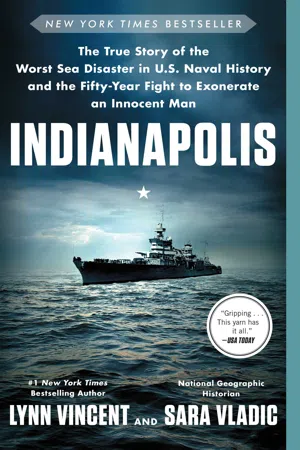
A human drama unlike any other—the riveting and definitive full story of the worst sea disaster in United States naval history.
Just after midnight on July 30, 1945, the USS Indianapolis is sailing alone in the Philippine Sea when she is sunk by two Japanese torpedoes. For the next five nights and four days, almost three hundred miles from the nearest land, nearly nine hundred men battle injuries, sharks, dehydration, insanity, and eventually each other. Only 316 will survive.
For the first time Lynn Vincent and Sara Vladic tell the complete story of the ship, her crew, and their final mission to save one of their own in “a wonderful book…that features grievous mistakes, extraordinary courage, unimaginable horror, and a cover-up…as complete an account of this tragic tale as we are likely to have” (The Christian Science Monitor). It begins in 1932, when Indianapolis is christened and continues through World War II, when the ship embarks on her final world-changing mission: delivering the core of the atomic bomb to the Pacific for the strike on Hiroshima.
“Simply outstanding…Indianapolis is a must-read…a tour de force of true human drama” (Booklist, starred review) that goes beyond the men’s rescue to chronicle the survivors’ fifty-year fight for justice on behalf of their skipper, Captain Charles McVay III, who is wrongly court-martialed for the sinking. “Enthralling…A gripping study of the greatest sea disaster in the history of the US Navy and its aftermath” (Kirkus Reviews, starred review), Indianapolis stands as both groundbreaking naval history and spellbinding narrative—and brings the ship and her heroic crew back to full, vivid, unforgettable life. “Vincent and Vladic have delivered an account that stands out through its crisp writing and superb research…Indianapolis is sure to hold its own for a long time” (USA TODAY).
Frequently asked questions
Yes, you can cancel anytime from the Subscription tab in your account settings on the Perlego website. Your subscription will stay active until the end of your current billing period. Learn how to cancel your subscription.
No, books cannot be downloaded as external files, such as PDFs, for use outside of Perlego. However, you can download books within the Perlego app for offline reading on mobile or tablet. Learn more here.
Perlego offers two plans: Essential and Complete
- Essential is ideal for learners and professionals who enjoy exploring a wide range of subjects. Access the Essential Library with 800,000+ trusted titles and best-sellers across business, personal growth, and the humanities. Includes unlimited reading time and Standard Read Aloud voice.
- Complete: Perfect for advanced learners and researchers needing full, unrestricted access. Unlock 1.4M+ books across hundreds of subjects, including academic and specialized titles. The Complete Plan also includes advanced features like Premium Read Aloud and Research Assistant.
We are an online textbook subscription service, where you can get access to an entire online library for less than the price of a single book per month. With over 1 million books across 1000+ topics, weâve got you covered! Learn more here.
Look out for the read-aloud symbol on your next book to see if you can listen to it. The read-aloud tool reads text aloud for you, highlighting the text as it is being read. You can pause it, speed it up and slow it down. Learn more here.
Yes! You can use the Perlego app on both iOS or Android devices to read anytime, anywhere â even offline. Perfect for commutes or when youâre on the go.
Please note we cannot support devices running on iOS 13 and Android 7 or earlier. Learn more about using the app.
Yes, you can access Indianapolis by Lynn Vincent,Sara Vladic in PDF and/or ePUB format, as well as other popular books in History & Military & Maritime History. We have over one million books available in our catalogue for you to explore.
Information
BOOK 1
THE KAMIKAZE

WORLD WAR II
PACIFIC THEATER OF OPERATIONS
SPRING 1945
1
MARCH 18, 1945
USS Indianapolis (CA-35)
The Northern Pacific
A CRY WENT UP from the gun crew range-finders aboard the heavy cruiser Indianapolis: âJudy! Port side! Close aboard!â
It was a Japanese dive-bomberâa âJudyââthe third bogie of the day. The plane plunged from a slab of clouds, its long, glazed canopy glinting softly in the filtered morning light.
On the cruiserâs bridge, Captain Charles McVay had the conn, with Admiral Raymond Spruance tracking the action from his high bridge chair. Both men wore khaki shirts, tieless, and soft garrison caps. Through the bridge wings, McVay, who was forty-six, could see the ships of the task group surrounding Indy in a rough ring, prows cutting cobalt seas along the same axis. Sailing closest were sixteen aircraft carriers, including Bunker Hill, Essex, Enterprise, Yorktown, Hancock, and Franklin. Farther out, the battleships and cruisers steamed, with the whole task group making way inside the sheltering embrace of a destroyer screen. A fighter CAP (combat air patrol), about thirty-two planes, fanned out over the task group.
Indy was at Condition I, general quarters, with all hands at battle stations. Bugler Glenn Morgan stood near McVay, headphones clamped over his ears, ready to relay data from critical combat stations around the ship.
The Judy kept coming, a dark-winged pill swelling against the pale dawn. Morgan watched its approach and wondered if it was another suicider. The Japanese had been crashing their planes into U.S. ships for five months, since Leyte Gulf. Most of the fellows thought they were bonkers. What kind of nut would do that, Morgan wondered, intentionally crash himself into a ship?
The Judy hurtled in, its engine thrumming past Indyâs port beam toward a juicier target off her bow, the carrier Bunker Hill. Staccato gunfire burst like black popcorn flung across the sky as Indyâs 20 mm gun crews arced their barrels with the planeâs flight path. But the Judy snapped through the flak unscathed, and the pilot released a bomb. It whistled close to Bunker Hill but missed and pierced the sea close astern. The carrier returned fire, chewing into the plane with her antiaircraft battery. Morgan watched the bomberâs shredded carcass cartwheel into the sea.
It was âL-14 Day,â two weeks before the American landing at Okinawa. Task Force 58 was maneuvering at Emperor Hirohitoâs doorstep, just a hundred miles off Kyushu, southernmost in the slim scythe of islands that formed Japan. A land of sacred pagodas and active volcanoes, Kyushu was also home to the Japanese naval arsenal and shipyard at Sasebo, as well as major steel and arms works in the city of Nagasaki.
So far, the Empireâs air reaction to Task Force 58 had been wildly aggressive. Attacks developed so swiftly that U.S. task force radar gave little if any warning. The clouds themselves seemed to spawn enemy planes, and a visual sighting by a close screenâquick, agile destroyers protecting the fleetâwas often the first sign of menace. A day earlier, Japanese bombers had hit three carriers, but crews were able to patch the holes and keep their planes flying.
For the men of Indianapolis, fighting off single planes had become ordinary work. Since Spruance hoisted his flag aboard Indy in 1943, the crew of nearly a thousand had earned eight battle stars, not counting their last stop, Iwo Jima, where theyâd helped tenderize the beach for the landing Marines.
Since his battle station was on the bridge, Morgan, a twenty-one-year-old Oklahoman, was always in the middle of the actionâwhich is to say, the calm at the eye of the storm. Captain McVay and Admiral Spruance ran a quiet bridge, unlike the previous skipper, Captain Einar âJohnnyâ Johnson, a bantamweight officer who cursed loudly, cheerfully, and often.
Morgan had liked Johnson, but he wasnât so sure about McVay, whoâd taken command in November. Sure, heâd just won a Silver Star for courage under fire in the Solomon Islands. But Morgan still felt that McVay didnât know much, and with his leading-man eyes and Pepsodent smile, the skipper also seemed a little snooty. The gossip was, heâd dated a movie star and married a princess.
Morning dawned in full. The air on the bridge tasted briny and cool, spring in the Northern Pacific. Morgan watched as the carriers went on offense, volleying waves of planes to strike enemy air bases at Kyushu. Launched singly, the planes formed up in swarms and arrowed toward the horizon, their props generating a low hum like venomous bees.
⢠⢠â˘
At intervals through the day, McVay reviewed the action report for Iwo Jima, which Yeoman Second Class Vic Buckett had typed up for his signature. The size and power of the force arrayed against Iwo Jima represented American naval power at its zenith. Buckett had recorded the bombardment of the island, which began in mid-February, as well as the weather: heavy rains had provided excellent cover for the surface fleet but played hell with the aviators. By February 19, the day of the landing, though, a high-pressure system had swept the squalls aside, and the Marines sloshed ashore under blue skies with a light northerly breeze.
McVay remembered watching hundreds of landing craft churn toward the beach. His sailors lined the rails, shouting, âGive âem hell, boys!â Parked a few thousand yards offshore at Spruanceâs order, Indianapolis supported the landing and subsequent infantry battle with more shore bombardment, which the action report showed in detail. What the report did not show was how the fighting ashore collapsed into chaos, the Marines mired to their knees in sludgy volcanic ash and mowed down by heavy machine-gun fire. Nor could it show the moment those saltwater cowboys staked the Stars and Stripes on Mount Suribachi in full view of the attacking U.S. fleet.
McVay remembered the moment vividly: the whole fleet blasting horns, ringing bells, sailors cheering and clapping and waving their Dixie cup caps. Some men said that when they saw that flag go up they thought of home and how it surely wouldnât be long until they could sail back to their moms and sweethearts and the good old U.S.A.
The captain continued flipping through the thick sheaf of pages. The report noted that Indianapolis had taken no casualties at Iwo Jima and that the performance of her crew had been excellent. Satisfied, the captain scribbled his customary signature on the document: Chas. B. McVay, III.
⢠⢠â˘
Later in the day, Admiral Raymond Spruance emerged from the flag quarters for his daily laps around the forecastle, or âfoâcâsle,âI a superstructure just aft of the bow. Slim and tan, the admiral transmitted serenity, but his lucent blue eyes concealed an inward turbulence. At fifty-eight, Spruance vented his intensity as he had all his life, with physical exercise, usually dragging junior officers along, breathless. Sometimes he wore his khaki trousers, sometimes shorts and a T-shirt. Once, his chief of staff wrote home from the Marshall Islands that Spruance was ârigged out in a new pair of gaudy Hawaiian bathing panties.â
Alone this time, Spruance charged forward along the port side, passing the No. 1 turret. Indyâs crew was accustomed to his walks, and as he passed sailors polishing brass, painting, and swabbing decks, they greeted himââSirâ or âAdmiralââwith a respectful nod. He did not require that they snap to and render a hand salute. This was a ship at war, not a berthing inspection. While he insisted on efficiency, Spruance loathed commanders who burdened their men with ticky-tack formalities when there was important work to be done. On some ships, there was tension between an admiralâs staff and the shipâs company, with the staff seen as privileged intruders who made more work for the regular crew. There was none of that aboard Indianapolis. Spruance got on well with the reserved McVay just as he had with the more colorful Captain Johnson. He knew McVay to be the son of a rather difficult admiral, Charles B. McVay, Jr., a veteran of the Spanish-American War.
Today, Spruance was not content with hitting just the Kyushu airfields. He also wanted to hit Kure naval base on the island of Honshu, where an attractive chunk of the enemyâs remaining surface fleet swung at anchor. Some considered such tactics overkill, and Spruance had developed a reputation for it. An aide once objected that the admiral was going to âcrack a walnut with a sledgehammer.â Spruance had peered over his reading glasses and said, âRoscoe, thatâs the way to win wars.â
The admiral was famously unflappable, but found the attack on Pearl Harbor a shattering experience. Spruance revealed this only to his wife and daughter, then waited anxiously for Admiral Chester Nimitz to take over as CincPacâCommander in Chief Pacific Fleet. After the obscenity at Pearl, Americaâs Pacific Fleet leadership was demoralized. Spruance sensed that Nimitz would inject some sorely needed fighting spirit, and he was right. Nimitz proved bold, aggressive, confident. Energized, the Pacific fleet began to sortie out and fight back. Spruance was elated.
When he reached the foredeck, the admiral turned right and passed under the eight-inch gun barrels. A sea breeze ruffled his khakis and cooled his way. As he crossed the foâcâsle forward, he saw a pair of sailors sitting near the gunwale. They wore Dixie cup hats, chambray shirts, and dungarees faded nearly sky-blue by a combination of sun and shipboard detergent. Spruance saw that the younger of the two men wore a cast on his right hand. Something odd protruded from the top. It looked like a wire. The admiral passed the men, hung another right, and walked aft along the starboard rail.
In June 1942, after Spruance engineered the surprise American victory at Midway, Nimitz lassoed him and made him CincPac chief of staff, then deputy commander, Pacific Fleet. Spruance quickly presided over a series of firsts: the first night carrier landing in naval history; the first to establish a rotation system for aviators in combat; the first to realize that the westward push toward Japan would require the creation of the most advanced logistics apparatus in the history of warfare. For Spruance, working for Nimitz had been an inspiration. Spruance considered the elder man one of the finest and most human characters heâd ever met. He was also the only man Spruance ever met who did not know what it meant to be afraid.
Now, with only Okinawa between his fleet and mainland Japan, Spruance saw no reason to alter his doctrine of overwhelming force. Shore bombardment of Okinawa was about to begin, with Indianapolis in the thick of it. The size of the landing force would be second only to D-Day at Normandy. Meanwhile, the Nazis were on the run in Europe, the Brits on the move in Burma, and General Douglas MacArthurâwhose effectiveness, Spruance agreed with Navy Secretary James Forrestal, was mortgaged to his vanityâwas rapidly recapturing the Philippines. The end of the Pacific war seemed just over the horizon.
Spruance completed a full lap of the forward superstructure and arrived again at the bow, where the two sailors were still sitting. Curious about the cast with the strange hardware, he detoured and walked over. Since they were at leisure, the men jumped to their feet and rendered hand salutes. Spruance glanced at the name stenciled on the younger manâs shirt. âCelaya, is it?â
âYes, sir. Adolfo Celaya, sir.â
Celaya, who was seventeen, had joined the Navy out of the tiny, dust-swept desert town of Florence, Arizona. Heâd seen a lot of brass aboard and had observed Spruance doing laps for nearly a whole year. But Celaya had never spoken to him, and he was a little nervous.
Spruance nodded toward Celayaâs hand. âWhat happened there?â
âBroke my hand, sir.â Celaya glanced at his buddy, Seaman First Class Mike Quihuis, who pressed his lips into a thin line to keep from smiling. He knew Celaya was hoping the admiral wouldnât ask how he broke his hand.
On closer inspection, Spruance could see that the wire, about the gauge of an ordinary coat hanger, originated in the area of the boyâs thumb. It rose more than eight inches from the cast and ended in a loop, resembling nothing so much as an antenna.
Spruance caught Celayaâs eye and smiled. âYou picking up Tokyo Rose on that thing?â
Celaya shook his head and laughed. âNo, sir.â
The admiral smiled again, then turned away and resumed his course to starboard.
That evening, Spruance received updates on Admiral Marc Mitscherâs air strikes on the Japanese mainland. Mitscher commanded the fast carrier force known as Task Force 58. By dayâs end, his pilots had bested 102 enemy flyers in dogfights over Kyushu and destroyed another 275 aircraft on the ground. The fighter CAP, or combat air patrol, shot down a dozen planes over the task force, and antiaircraft batteries splashed another twenty-one. The enemy had managed to score hits on two American carriers, Yorktown and Enterprise, but damage to Yorktown was minor, and the bomb that hit Enterprise failed to detonate.
Meanwhile, the American sorties had yielded a bonus. Over the Japanese naval base at Kure, Mitscherâs pilots spotted the battleship Yamato in the harbor. Designed as a âsupership,â Yamato was capable of fighting multiple enemy vessels at once. Lithe and muscular with minimal freeboard, th...
Table of contents
- Cover
- Dedication
- Prologue: The Ship
- Book 1: The Kamikaze
- Book 2: The Mission
- Book 3: The Deep
- Book 4: Trial and Scandal
- Book 5: An Innocent Man
- Final Log Entry: August 19, 2017
- Final Sailing List
- Appendix A: Rescue Ships
- Appendix B: Journey with
- Methodology
- Photographs
- Acknowledgments
- About the Author
- Notes
- Bibliography
- Index
- Photo Credits and Information
- Copyright