Smoketown
eBook - ePub

Smoketown

The Untold Story of the Other Great Black Renaissance

  1. 432 pages
  2. English
  3. ePUB (mobile friendly)
  4. Available on iOS & Android
eBook - ePub

Smoketown

The Untold Story of the Other Great Black Renaissance

About this book

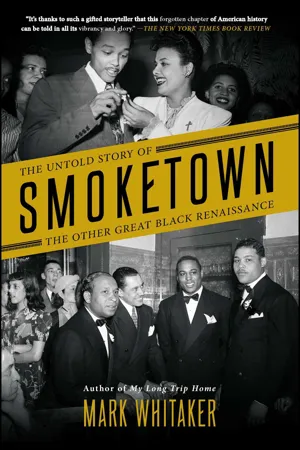
A brilliant, lively account of the Black Renaissance that burst forth in Pittsburgh from the 1920s through the 1950s—" Smoketown will appeal to anybody interested in black history and anybody who loves a good story…terrific, eminently readable…fascinating" ( The Washington Post ). Today black Pittsburgh is known as the setting for August Wilson's famed plays about noble, but doomed, working-class citizens. But this community once had an impact on American history that rivaled the far larger black worlds of Harlem and Chicago. It published the most widely read black newspaper in the country, urging black voters to switch from the Republican to the Democratic Party, and then rallying black support for World War II. It fielded two of the greatest baseball teams of the Negro Leagues and introduced Jackie Robinson to the Brooklyn Dodgers. Pittsburgh was the childhood home of jazz pioneers Billy Strayhorn, Billy Eckstine, Earl Hines, Mary Lou Williams, and Erroll Garner; Hall of Fame slugger Josh Gibson—and August Wilson himself. Some of the most glittering figures of the era were changed forever by the time they spent in the city, from Joe Louis and Satchel Paige to Duke Ellington and Lena Horne. Mark Whitaker's Smoketown is a "rewarding trip to a forgotten special place and time" ( Pittsburgh Post-Gazette ). It depicts how ambitious Southern migrants were drawn to a steel-making city on a strategic river junction; how they were shaped by its schools and a spirit of commerce with roots in the Gilded Age; and how their world was eventually destroyed by industrial decline and urban renewal. " Smoketown brilliantly offers us a chance to see this other Black Renaissance and spend time with the many luminaries who sparked it…It's thanks to such a gifted storyteller as Whitaker that this forgotten chapter of American history can finally be told in all its vibrancy and glory" ( The New York Times Book Review ).

Frequently asked questions

Yes, you can cancel anytime from the Subscription tab in your account settings on the Perlego website. Your subscription will stay active until the end of your current billing period. Learn how to cancel your subscription.
No, books cannot be downloaded as external files, such as PDFs, for use outside of Perlego. However, you can download books within the Perlego app for offline reading on mobile or tablet. Learn more here.
Perlego offers two plans: Essential and Complete
  • Essential is ideal for learners and professionals who enjoy exploring a wide range of subjects. Access the Essential Library with 800,000+ trusted titles and best-sellers across business, personal growth, and the humanities. Includes unlimited reading time and Standard Read Aloud voice.
  • Complete: Perfect for advanced learners and researchers needing full, unrestricted access. Unlock 1.4M+ books across hundreds of subjects, including academic and specialized titles. The Complete Plan also includes advanced features like Premium Read Aloud and Research Assistant.
Both plans are available with monthly, semester, or annual billing cycles.
We are an online textbook subscription service, where you can get access to an entire online library for less than the price of a single book per month. With over 1 million books across 1000+ topics, we’ve got you covered! Learn more here.
Look out for the read-aloud symbol on your next book to see if you can listen to it. The read-aloud tool reads text aloud for you, highlighting the text as it is being read. You can pause it, speed it up and slow it down. Learn more here.
Yes! You can use the Perlego app on both iOS or Android devices to read anytime, anywhere — even offline. Perfect for commutes or when you’re on the go.
Please note we cannot support devices running on iOS 13 and Android 7 or earlier. Learn more about using the app.
Yes, you can access Smoketown by Mark Whitaker in PDF and/or ePUB format, as well as other popular books in History & North American History. We have over one million books available in our catalogue for you to explore.

Information

image
On one of his many Pittsburgh visits, Joe Louis (left) and boyhood friend Freddie Guinyard met at the Courier with Joe’s favorite sportswriter, “Ches” Washington (center).

SPORTS

1

THE BROWN BOMBER’S CORNERMEN

SEVENTY THOUSAND SPECTATORS THRONGED Yankee Stadium, and the summer air was thick with cigar smoke, cologne, and the smell of history in the making. A boxing ring floated above second base, flanked by rows of seats reserved for the celebrated and the powerful. Clark Gable grinned for the cameras. Gary Cooper scribbled autographs. J. Edgar Hoover surveyed the raucous scene. It was the night of June 22, 1938, and Joe Louis was about to fight Max Schmeling for the second time. Months of breathless anticipation in the press had built it into more than a boxing bout, more than a rematch between the American champ and the German challenger who had dealt him his lone defeat in a charmed march to the heavyweight title. Set against the backdrop of Hitler’s rise in Europe, the fight had taken on a metaphorical dimension, as a symbol of the struggle between Fascism and Freedom. “The Brown Bomber” versus “the Hun,” the newspapers called it.
For weeks, Schmeling had issued racist taunts. “The black dynasty of pugilism must come to an end,” he declared. As if to underscore the swaggering talk, Schmeling had set up training camp in a town called Speculator, in the Adirondack Mountains of New York. Two days earlier, a telegraph message had arrived there from the Führer himself. “To the coming World’s Champion, Max Schmeling,” the cable read. “Wishing you every success, Adolf Hitler.” That spring, Louis had received his own blessing from on high while attending a Negro Elks Club convention in Washington, D.C. President Franklin Roosevelt invited him to the White House and squeezed his powerful biceps. “Joe, we’re depending on those muscles for America,” FDR said.
The irony of a grandson of Alabama slaves serving as the poster boy for Liberty wasn’t lost on three of the men at ringside. They were out-of-towners, from Pittsburgh, the industrial city they called “Smoketown,” on the western edge of Pennsylvania. Few of the East Coast or Hollywood swells would have recognized them, or perhaps even guessed that all three men were black. Robert L. Vann looked like a man of South Asian lineage, with his lanky frame, light reddish skin, and angular features. Chester Washington had straight, slicked-back hair and a round, handsome face that was so fair he could have passed for white. Of the three, only Bill Nunn fit the movie stereotype of a black male in the 1930s: a stocky, jovial man with dark skin, a wide-jawed smile, and a booming, basso profundo voice.
Yet of all the expectant boxing fans present that night, the three men had special reason to feel a mixture of excitement and anxiety. As the publisher, sports editor, and city editor for The Pittsburgh Courier, the nation’s most widely read Negro newspaper, they had done as much as any journalists in America to make Joe Louis a hero to his own people and a sympathetic champion to the rest of the country.
Bill Nunn was the first of the three to meet Joe Louis. In the summer of 1934, Nunn traveled to Chicago to cover the black baseball all-star game known as the East-West Classic. He put himself up at the Grand Hotel, a Negro-owned establishment on the South Side, and one day Louis walked out of the lobby. The Courier’s Chicago stringer, P.L. Prattis, recognized Louis and introduced him to Nunn. Prattis had been following Joe’s first pro fights since the boxer had moved to Chicago from Detroit a few months earlier, and he was impressed. “He’s going to be the next champion,” Prattis predicted.
No one had a better nose for a good sports story than Bill Nunn. Although he had been promoted to city editor, sports were his first love. “Nunny,” as he was known around the Courier, had grown up in Pittsburgh, the son of a plasterer who migrated from North Carolina to make a better life for his family. They lived in a neighborhood called Homewood, and just as Bill was entering his teens the city of Pittsburgh erected a huge new high school there to educate talented students from across the city. Nunn became one of the first black students at Westinghouse High School, and the first to earn three varsity letters, in football, basketball, and baseball. A bit too short and slow to play sports for a living, he channeled his passion into writing about the subject. He submitted his first story to the Courier while he was still in high school, and at twenty he quit a job as a storeroom clerk in a toy factory to work at the paper full-time.
Along with his love for athletics, Nunn was known for thinking big. As sports editor in the 1920s, he pushed to add more pages to the Courier’s coverage, and to create a separate entertainment section. He started sending reporters to black colleges across the country to compile an annual “Courier All-American Team” list of their best football players. He had also played a role in the creation of the first Negro League all-star game—the event that brought him to Chicago that summer. Those popular features had helped the Courier grow from a small local paper in the 1920s, when Nunn first joined, to a national publication that by the early 1930s was nipping at the heels of the country’s largest black paper, The Chicago Defender.
Now Nunn was in Chicago, meeting a new rising star in the Defender’s backyard. Had he looked into it (which he likely did), he would have seen that the Defender had already published several short stories on Louis. So Nunn knew that if the Courier was going to win the competition to cover him, it would have to move fast.
When Nunn returned to Pittsburgh, to the Courier’s tiny, cramped newsroom in the neighborhood called the Hill District, he mentioned his encounter with Louis to publisher Robert L. Vann. Although Vann was consumed with the paper’s business affairs—and with exercising his own political influence in Washington—he, too, was an avid sports enthusiast. As it happened, Vann also knew one of the men managing Louis, a Chicago businessman and part-time numbers racket operator named Julian Black.
Three years earlier, a Detroit numbers king named John Roxborough had discovered Louis boxing at a local youth center. Roxborough bought Joe his first pair of proper boxing gloves, and oversaw his rise through the amateur ranks, where he compiled a record of 50–4, with 43 knockouts. When Joe turned twenty, he told Roxborough he wanted to box professionally. Roxborough responded that if Joe hoped to survive in the white-run boxing world, he would need to rely on black men who wouldn’t sell him cheap. To train Louis, Roxborough hired Jack Blackburn, a crafty former lightweight. To arrange for professional fights in Chicago, he brought in Julian Black.
Before the Courier invested in covering Louis, however, one more man needed to be convinced: sports editor Chester Washington. Like Nunn, “Ches,” as everyone called him, was a hometown boy, from Pittsburgh’s North Side, who had started working at the paper as a stenographer at the age of seventeen. His father was a postman with only an eighth-grade education, but Washington saved up to attend college, at Virginia Union University. When he returned to Pittsburgh, he moved into a rooming house at the YMCA across the street from the Courier and began working his way up from reporting on church sermons to earning a weekly sports column, called “Ches Sez.”
When Washington started looking into Louis’s record, he wasn’t much impressed. In his first pro fight in Chicago that summer—on the 4th of July—Joe had knocked out a Norwegian-born journeyman who went by the name of Jack Kraken. By October, he had won seven more fights. But in Washington’s opinion, Joe’s opponents were all “paloozas,” as he called them, or “damaged produce” from “Cauliflower Lane” picked by Roxborough and Black to make their man look good. His next bout, however, was against a fighter named Jack O’Dowd whom Washington respected. In his prime, O’Dowd had gone four rounds with Jack Dempsey. So in late October, Washington hopped a train to Chicago to have a look at Louis for himself.
The fight took place on the night before Halloween, 1934, and no one on the streets of Chicago seemed to know or care much about the boxing match taking place at the Arcadia Gardens. As Washington watched the boxers climb through the ropes, he thought Louis, who weighed 190 pounds, looked like a kid compared to the 210-pound O’Dowd. Then the bell rang, and Washington’s “eyes popped,” as he put it later. Louis weaved like a graceful cat, while O’Dowd pawed like an oversized mutt. Suddenly Joe threw a right that knocked the veteran to the mat for a nine count. O’Dowd staggered to his feet and began backpedaling as fast as he could. He survived the first round, but in the middle of the second Louis faked a right to his midsection, O’Dowd lowered his fists to block it, and Joe jolted him in the jaw with a punch with his left that put him on the mat for good.
Jack O’Dowd was finished—and Ches Washington was sold. Louis may have looked like a kid, but in only a round and a half he had exhibited the qualities that Washington looked for in a potential champion. He had quick feet, power on the right and the left, and punches that were deceptively short and fast. Under the tutelage of Jack Blackburn, the wily trainer Joe called “Chappie,” Louis had also started to think like a contender. He worked O’Dowd’s body until he had a shot at his head, and jabbed from one side while waiting for a chance to land a knockout blow from the other.
Washington became even more of a believer the next month when Louis finished off one of Pittsburgh’s finest fighters, a body puncher named Charlie Massera, in the third round. Two weeks later, he knocked out one of the West Coast’s top contenders, Lee Ramage, in the eighth. Then in January of 1935, Joe came to Pittsburgh for the first time, to take on a bruiser named Hans Birkie.
Chappie Blackburn had done a lot of fighting in Pittsburgh in his days in the ring, and he had fond memories. So he brought Louis to town a week early to train at the YMCA on Centre Avenue, across the street from the Courier offices. As Hill residents gathered to watch Joe work out, they couldn’t believe the power in his fists. Within days, he had shredded two punching bags. But Blackburn had a new strategy for this fight: he wanted to test Louis’s skills as a boxer. Don’t try for an early knockout, Chappie told Joe; let Birkie wear himself out before going in for the kill.
Sure enough, Birkie didn’t go down easily on the night of the fight at Pittsburgh’s Duquesne Gardens. For nine rounds, he shielded his body so that Louis couldn’t land hard punches. Finally, in the tenth, he lowered his guard and gave Joe an opening. Louis pounded Birkie to the canvas with three swift left jabs and a hard blow from the right. The referee took one look at the downed man’s battered face and declared a TKO.
During this time in Pittsburgh, his managers paraded Louis through the Hill District to meet their friends in the city. Julian Black introduced him to Robert Vann and his wife, Jesse. Roxborough’s pal Gus Greenlee, the king of Pittsburgh’s numbers game, threw a dinner at his nightclub, the Crawford Grill, where everyone raised toasts of champagne and whiskey while Joe sipped a glass of milk. Bill Nunn and Ches Washington escorted him through the Courier newsroom, where he met Ira Lewis, the managing editor, and Julia Bumry Jones, the author of a society column called “Talk O’ Town” that was read by black women across America. In his autobiography, Louis would say that he had never shaken so many hands before, and that the week in Pittsburgh was his “first test of being a public hero.” It made him think: “Joe, you got to make good. You got to keep punching and winning. People all over the country are watching you and pulling for you.”
Everyone on the Hill was struck by Joe’s baby-faced looks and soft-spoken manner, so different from the ruthless figure he cut in the ring. They also noticed how much his managers talked about Joe’s humble personality and clean-living ways. No one had to ask why. They could tell that Roxborough and Black were already preparing to see white people compare their man to Jack Johnson, the last great Negro heavyweight. Johnson had dominated the sport and won the title a quarter century earlier; but his swagger and unapologetic pursuit of white women scandalized the public and cast a shadow of suspicion over the next generation of black fighters. If Louis was going to get a shot at the title one day, his managers knew, it would involve more than besting a string of white contenders. It would require showing the public and the white moneymen who controlled the boxing game that Joe Louis wasn’t another Jack Johnson.
At the Courier, the editors and reporters loved nothing more than a good crusade on behalf of their people. They had fought for unionizing Pullman car porters, for taking Amos ’n’ Andy off the radio airwaves, and for the acquittal of the Scottsboro Boys in their rape trial in Alabama. Now they saw the chance to become the public champions—and defenders—of the best and most likable Negro fighter to come down the pike in a long time. Robert L. Vann was also a shrewd businessman, and he could already sense that Joe Louis had the goods to make a lot of money, for boxing and for newspapers. Having seen the kid’s potential up close, Vann wanted to get in on the action early.
• • •
LESS THAN A MONTH later, the Courier began publishing “The Life Story of Joe Louis,” an exhaustive profile that would run in weekly installments for the next five months. Coauthored by Ches Washington and Bill Nunn, it described the upbringing of the child born Joe Louis Barrow and his seven brothers and sisters on a farm outside Montgomery, Alabama. As a boy, Joe helped his mother, Lillie, with chores and accompanied her to church every Sunday. (The story didn’t mention that his father, Munroe Barrow, suffered a breakdown when Joe was two years old and was confined to a mental institution.) The profile followed Joe to Detroit, where his mother moved the family when he was twelve years old, and described how he fell in love with boxing and was taken under John Roxborough’s wing. Then the story took Louis to Chicago, describing every detail of his first pro fights, including how much he made for knocking out Jack Kraken—$51.37.
In April 1935, Washington and Nunn traveled to Detroit to see Louis take on his toughest opponent yet. He was a scrappy Jewish boxer named Natie Brown who hadn’t lost in eighteen months and had never been knocked down. The bout took place in Olympia Stadium, the city’s largest indoor arena, and nearly fourteen thousand fans showed up to cheer on the hometown boy. In the crowd were dozens of East Coast sportswriters who had gotten wind of Joe Louis and had come to take his measure. Many of them arrived on a Pullman car chartered by Mike Jacobs, a New York boxing promoter who was in negotiations with Roxborough and Black to promote Joe’s bouts. Although Brown managed to go the distance, he did little more than hang on after Joe floored him with a savage left in the first round. By the time he lost a unanimous eight-round decision, Natie’s face was a bloody pulp.
To strengthen its claim to be “the Joe Louis paper,” the Courier held its presses to splash the fight on the front page. The paper was printed o...

Table of contents

  1. Cover
  2. Dedication
  3. Epigraph
  4. Preface
  5. Cast of Characters
  6. The Neighborhoods of Pittsburgh
  7. 1. The Brown Bomber’s Cornermen
  8. 2. The Negro Carnegies
  9. 3. The Calculating Crusader
  10. 4. The Rise and Fall of “Big Red”
  11. 5. Billy and Lena
  12. 6. The Double V Warriors
  13. 7. The Complex Mr. B
  14. 8. “Jackie’s Boswell”
  15. 9. The Women of “Up South”
  16. 10. The Bard of a Broken World
  17. Photographs
  18. Acknowledgments
  19. About the Author
  20. Notes
  21. Index
  22. Copyright