The Secret Life of Houdini
eBook - ePub

The Secret Life of Houdini

The Making of America's First Superhero

  1. 604 pages
  2. English
  3. ePUB (mobile friendly)
  4. Available on iOS & Android
eBook - ePub

The Secret Life of Houdini

The Making of America's First Superhero

About this book

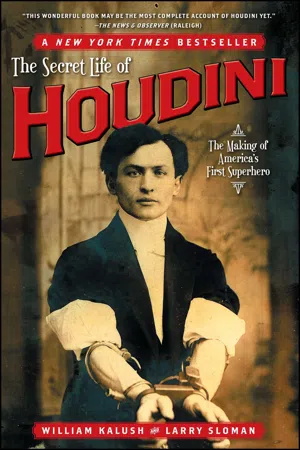
Handcuff King. Escape Artist. International Superstar. Since his death eighty-eight years ago, Harry Houdini's life has been chronicled in books, in film, and on television. Now, in this groundbreaking biography, renowned magic expert William Kalush and bestselling writer Larry Sloman team up to find the man behind the myth. Drawing from millions of pages of research, they describe in vivid detail the passions that drove Houdini to perform ever-more-dangerous feats, his secret life as a spy, and a pernicious plot to subvert his legacy. The Secret Life of Houdini traces the arc of the master magician's life from desperate poverty to worldwide fame—his legacy later threatened by a group of fanatical Spiritualists led by esteemed British author Sir Arthur Conan Doyle. Initiating the reader along the way into the arcane world of professional magic, Kalush and Sloman decode a life based on deception, providing an intimate and riveting portrayal of Houdini, the man and the legend.
Frequently asked questions

Yes, you can cancel anytime from the Subscription tab in your account settings on the Perlego website. Your subscription will stay active until the end of your current billing period. Learn how to cancel your subscription.
At the moment all of our mobile-responsive ePub books are available to download via the app. Most of our PDFs are also available to download and we're working on making the final remaining ones downloadable now. Learn more here.
Perlego offers two plans: Essential and Complete
  • Essential is ideal for learners and professionals who enjoy exploring a wide range of subjects. Access the Essential Library with 800,000+ trusted titles and best-sellers across business, personal growth, and the humanities. Includes unlimited reading time and Standard Read Aloud voice.
  • Complete: Perfect for advanced learners and researchers needing full, unrestricted access. Unlock 1.4M+ books across hundreds of subjects, including academic and specialized titles. The Complete Plan also includes advanced features like Premium Read Aloud and Research Assistant.
Both plans are available with monthly, semester, or annual billing cycles.
We are an online textbook subscription service, where you can get access to an entire online library for less than the price of a single book per month. With over 1 million books across 1000+ topics, we’ve got you covered! Learn more here.
Look out for the read-aloud symbol on your next book to see if you can listen to it. The read-aloud tool reads text aloud for you, highlighting the text as it is being read. You can pause it, speed it up and slow it down. Learn more here.
Yes! You can use the Perlego app on both iOS or Android devices to read anytime, anywhere — even offline. Perfect for commutes or when you’re on the go.
Please note we cannot support devices running on iOS 13 and Android 7 or earlier. Learn more about using the app.
Yes, you can access The Secret Life of Houdini by William Kalush, Larry Sloman in PDF and/or ePUB format, as well as other popular books in History & Historical Biographies. We have over one million books available in our catalogue for you to explore.

Information

1

The Oath

THE FIRST SHOVEL-LOAD MISSED HIS TORSO and struck his neck, sending soil flying up his nostrils and into his mouth. He started choking and coughing.
ā€œSorry, boss,ā€ Collins said, looking down into the hole. ā€œI guess the wind took it.ā€
Stay calm. Conserve energy. Keep the heart rate down.
Collins and Vickery continued to fill the cavity with moist Santa Ana soil. They had been at this since a little past dawn and their arms were beginning to ache with fatigue. They could only imagine how he must feel. Subconsciously, they moved into a rhythm, one scraping his shovel into the mounds of dirt piled high around them, the other sending his payload straight down into the dank hole. Vickery thought of how his friends would react when he told them of Harry’s latest stunt. Of course, that would have to wait until after it was performed. He’d never forget that oath of secrecy that he’d sworn and how seriously Harry seemed to take it.
Am I pushing myself too hard? I’m forty-one but I look fifty. I’m so gray.
Vickery began to admit to himself his concern. He had expected his boss to have no problem with the one-and even the two-foot ā€œplantings,ā€ as he called them, and he didn’t. But the four-and five-foot escapes seemed to really have taken something out of him. What if he hurt himself now, like the time he did in Buffalo? Ever since Harry had burst that blood vessel getting out of those chains, he was in such intense chronic pain he’d had to sleep with a pillow under his left kidney. Vickery never forgave himself for allowing those bastards to pull the chains so tight.
It’s so much hotter down here. How can a few feet make such a difference? I’m starting to feel faint. Stay calm.
By now the dirt had almost completely covered Houdini’s body. The shackles that held his ankles together were completely buried, and the content of two or three more shovelfuls would obscure the last traces of the handcuffs. He knew that his head would be covered next so he braced for the assault of the heavy soil, so as not to eat some again.
This would be so much easier if I did it in a coffin. We could gimmick a plank. I’d be able to disperse so much more soil using that instead of my bare hands. I’d be out in half the time.
As soon as he was completely covered by the soil, he began to go to work. Even though his assistants were still filling in the last of the grave, he swiftly slipped out of the cuffs, crouched into a fetal position, and began working on the leg irons. Within seconds, he was free of them too. Now all he had to do was work his way up against the loose earth, slowly, methodically, timing it so that he would be just below the ground when they had finished filling in the hole. Then he’d claw through the loose topsoil and literally escape the grave. But he didn’t figure on panicking.
It wasn’t the eerie darkness or the complete silence down there that horrified him; he had grown accustomed to that. It was the sudden realization that he was six feet underground—the legal requirement for corpses—that sent a chill up his spine.
What if I die here? What a field day they’d have in the papers. Houdini Digs His Own Grave. I’d be a laughingstock.
He gasped involuntarily. Now he began to claw and knee the soil without any concern that he’d get out before they had finished filling in the hole. But that momentary scare—the irretrievable mistake of all daredevils—had wasted a fraction of his breath, when every last fraction was needed to get out of the hole. Up above, Collins and Vickery and the others in the party had no idea of the drama that was unfolding four feet below them.
No! This can’t be! Out! Get out!GET OUT!
All of a sudden the weight of the earth above him felt like a thousand tons. His body stiffened and for one quick second he smelled the acrid odor of death. And then, for the first time in his life, he screamed for help. But that just made it worse. There was no way they could hear him, and now he was squandering what little air and energy he had left. He started pawing at the dirt above him like a wild animal, scratching his hands and arms on the coarse soil. He had long abandoned his slow, steady rhythmic breathing and now he was operating on pure instinct, swallowing and inhaling as much soil as air in one last desperate attempt to escape.
On the ground, Collins put down his shovel and took out his watch. When it passed the ten-minute mark, he looked at Vickery with concern.
ā€œIf he’s not up in thirty seconds, we better go get him,ā€ he said. Vickery nodded grimly. The clock slowly ticked off the requisite seconds, and then, just as Collins and Vickery grabbed their shovels and started to frantically dig, the earth suddenly burst open and expelled a bloody, battered, and filthy Houdini, grateful for that measure of fresh, cool, California air.
ā€œCome, come. Push, push. It’s almost over.ā€
Anne Fleischmann was urging Cecilia Weisz on, alternately wiping her brow and giving her some ice chips to suck on. On March 24, 1874, the small room at RĆ”kosĆ”rok utca 1. sz. had been emptied, the three young boys sent out to play. Only a few neighbors were there as Anne expertly cradled the baby’s head and turned it slightly to allow the shoulders to emerge. She gently grabbed the baby’s chest as the rest of the bloody body was expelled from the womb.
ā€œAnother boy!ā€ Anne said, expertly clipping the umbilical cord and swathing the child in a clean sheet. Then she presented little Erik to his mother, who immediately nestled him to her bosom, where her heartbeat seemed to have a soothing effect on the newborn. It was a sanctuary to which he would often return, that steady heartbeat and her warm caress, a place where the woes of the world could be forgotten.
Of course, a newborn meant another mouth to feed, and another warm body to share this typically small ā€œroom-and-kitchenā€ flat in the predominately Jewish section of Pest, part of the newly consolidated town of Budapest, Hungary. That made four sons now for Mayer Samuel Weisz, who had recently graduated law school. One could only assume that Mayer Samuel would make a very eloquent solicitor if the story of the courtship of his future wife was any indication.
Weisz had been a recent widower, his first wife having died during or shortly after giving birth to their son Armin. Perhaps to escape the memories, he moved from the Hungarian countryside to Budapest, a thriving, tolerant, cosmopolitan city destined to become one of the great showpieces of Europe. In Pest a friend of his, in obvious homage to his charisma, asked him to intervene for him in an affair of the heart. His friend was in love with a pretty young maiden, Cecilia Steiner, but he was too shy to make his intentions known to her. Mayer Samuel, who knew Cecilia’s mother and her three daughters well, took on this assignment and called upon Cecilia at the small apartment that she shared with her family. Somewhere in the middle of his loquacious address, he realized that he was no proxy; he was expressing his own heartfelt sentiments. And Cecilia, moved, reciprocated. This verbal expression was followed with a formal written marriage proposal, a letter in which, according to family legend, Mayer Samuel documented his whole life history, ā€œtelling Her everything, so no one could ever come to Her and relate things.ā€
Rabbi Mayer Samuel Weisz, Houdini’s father. From the collection of Tom Boldt
They married in 1863 and by 1876 Mayer Samuel Weisz had set off for a new life in America. With Weisz already overseas, Cecilia and the five children sailed from Hamburg for New York on June 19, 1878. They traveled on the Frisia, a six-year-old 364-foot, three-and-a-half-thousand-ton steamship that was powered by a single screw propeller with its one smokestack supplemented by two masts. One could only imagine what memories the young boys had of this fateful trip to America. Armin, fifteen by now, was charged to help Cecilia mind the other boys for she had her hands full with little four-year-old Erik and the two-year-old Dezso. The family traveled in steerage. Cecilia’s ticket cost $30 and that afforded her and her sons the privilege of being packed like cattle below the deck in a fetid, poorly lit and ventilated dormitory that held 620 people. Luckily, on this particular voyage the ship was less than half full, which allowed Cecilia to spread out over several cots instead of just one.
A young Erik Weisz poses with baby brother Dezso in Hungary before the family migrated to the United States. From the collection of Roger Dreyer
They arrived in New York on July 3 and were processed at the Castle Garden immigration building, where each of them received a new name. Since Cecilia didn’t speak English, her responses to the officials were in German. So their names became English variants of German names. Armin became Herman, eight-year-old Natan just had an ā€œhā€ added, six-year-old Gottfried Vilmos was dubbed William, Erik turned into Ehrich, and Ferencz Dezso was officially named Theo—later to be nicknamed Dash—and the family name became Weiss. Cecilia was reunited in New York with her mother and two sisters, who had emigrated earlier, but by September, the entire Weiss family was together again in Appleton, Wisconsin.
Appleton was a stark contrast to the cramped tenement buildings of New York. Only in existence for twenty-five years, it still had the feel in some ways of a frontier outpost. For the first three years of the Weisses’ residence there, livestock were allowed to run free in the streets of the city. It took an additional year for a sewer system to be built and another year to get municipal water flowing (although the system was too primitive to be used above the ground floor of buildings). On the other hand, with a long established college, Lawrence University, a soon-to-open Opera House, and as a regular stop on the lecture circuit, there was a sense of culture that set Appleton apart from its sleepy farm-based small Midwestern town counterparts.
And for Mayer Samuel Weiss, it had one advantage. He was a friend of one of the town’s most prominent businessmen. David Hammel was a clear example of the assimilationist spirit of many Eastern European Jews. He ran several businesses, including a lumberyard, a mill, and a wheat farm. But most of all, he was connected in local politics. Mayer Samuel Weiss came to Appleton with no knowledge of English but with a craving for respectability. Back home he had been a soap maker, but by the time they left the country he had taken law courses and was a practicing solicitor. But this was a different world, and when his friend Hammel told him that the town needed a rabbi, he didn’t hesitate.
ā€œOkay, that’s me,ā€ said Mayer Samuel.
So he donned his robes and began conducting services in a makeshift temple, earning $750 a year. At first ā€œthe Hebrews of this city,ā€ as a local newspaper called them, seemed pleased with the services of their ā€œableā€ rabbi and hoped that he would ā€œremain permanently among us.ā€ His particular forte seemed to be wise words of counsel at milestone events like weddings and funerals. Even though he conducted all his ceremonies and homilies in German, his addresses commanded ā€œthe most profound respect.ā€
Morality lessons weren’t just reserved for the pulpit. When Ehrich was only five years old, his father noticed his son playing with some large iron spikes. Further inquiries disclosed that Ehrich had taken them from a local construction site where a bridge was being built.
ā€œThis is theft!ā€ the rabbi thundered. ā€œTheft cannot be tolerated, especially in this household, especially by the son of a rabbi.ā€
Ehrich’s schoolhouse in Appleton. From the collection of Dr. Bruce Averbook
Ehrich was ushered back to the scene of the crime, where he was forced to replace the spikes and confess his guilt to the foreman. He was a decent child, ready to learn from his mistakes and to accept the wisdom of his elders. And he certainly had a winning personality. When Ehrich was about seven, he happened upon his teacher on the streets of Appleton. She smiled and wished him ā€œgood morning,ā€ but the boy just mumbled in embarrassment. The teacher looked him square in his steel-blue eyes. ā€œWhen a gentleman meets a lady, Ehrich, he should take off his hat and bow.ā€ With that he took off, sprinted around the block, timing it so he would meet her at the next corner, where, to her astonishment, he doffed his cap and bowed reverentially.
With its open spaces, parks, and woods, Appleton was the ideal playground for a young child, and it was here that Ehrich began to display an athletic prowess that would blossom later in his life. It started when he was barely seven and went to see a traveling street circus that was passing through A...

Table of contents

  1. Cover
  2. Half Title Page
  3. Title Page
  4. Copyright
  5. Dedication
  6. Contents
  7. Foreword
  8. Introduction
  9. 1. THE OATH
  10. 2. STARVING FOR A LIVING
  11. 3. THE CELEBRATED CLAIRVOYANTS
  12. 4. QUID PRO QUO
  13. 5. THE KING OF HANDCUFFS
  14. 6. M
  15. 7. POLICE STATE
  16. 8. TAMING THE BEAR
  17. 9. THE CHALLENGE OF THE MIRROR
  18. 10. LEAP OF FAITH
  19. 11. KILL THY FATHER
  20. 12. DEATH VISITS THE STAGE
  21. 13. ABOVE THE DOWN UNDER
  22. 14. THE EMPEROR OF SYMPATHY-ENLISTERS
  23. 15. CHINESE WATER TORTURE
  24. 16. FORGIVE
  25. 17. FIGHTING OUR WAY TO THE GRAVE
  26. 18. DEATH BY MISADVENTURE
  27. 19. ART IMITATES LIFE
  28. 20. SAUL AMONG THE PROPHETS
  29. 21. LITTLE SISTER WILL DO EXACTLY AS BIG BROTHER SAYS
  30. 22. MARGERY’S BOX
  31. 23. MY OWN SECRET SERVICE
  32. 24. I…AM A FAKE
  33. 25. AN EYE FOR AN EYE
  34. 26. THERE IS NO DEATH
  35. Epilogue
  36. Acknowledgments
  37. Index
  38. About the Authors
  39. The Secret Life of Houdini