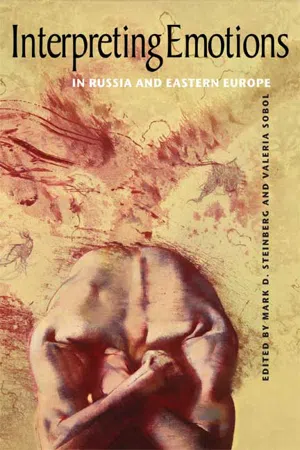
Bringing together important new work by an international and interdisciplinary group of leading scholars, Interpreting Emotions in Russia and Eastern Europe approaches emotions as a phenomenon complexly intertwined with society, culture, politics, and history. The stories in this book involve sensitive aristocrats, committed revolutionaries, aggressive nationalists, political leaders, female victims of sexual violence, perpetrators and victims of Stalinist terror, citizens in the former Yugoslavia in the wake of war, workers in post-socialist Romania, Balkan Romani "Gypsy" musicians, and veterans of the Afghan and Chechen wars. These essays explore emotional perception and expression not only as private, inward feeling but also as a way of interpreting and judging a troubled world, acting in it, and perhaps changing it. Essential reading for those interested in new perspectives on the study of Russia and Eastern Europe, past and present, this volume will appeal to scholars across the social sciences and humanities who are seeking new and deeper approaches to understanding human experience, thought, and feeling.
eBook - ePub
Interpreting Emotions in Russia and Eastern Europe
- 311 pages
- English
- ePUB (mobile friendly)
- Available on iOS & Android
eBook - ePub
Interpreting Emotions in Russia and Eastern Europe
About this book
Trusted by 375,005 students
Access to over 1.5 million titles for a fair monthly price.
Study more efficiently using our study tools.
Information
Subtopic
Eastern European HistoryIndex
HistoryIndex
Boldface indicates principal treatment of a topic.
1840s. See generation of 1840s
1860s. See Russian radicals of 1860s
1989. See postsocialism; revolution of 1989
Abdul Hamid II (Ottoman sultan), 121
abstraction, 31, 64, 251; rejected by 1860s radicals, 66, 69, 71
Abu-Lughod, Lila, 5, 225, 226
acoustic gesture, 254–55, 273n18
Adevărul, 212
Adorno, Theodor, 250
affect: defined, 104–6; and event coding, 44; shame defined as, 95, 98n14
affection, 27, 111, 113, 183
affective communities, 12, 109–10, 111. See also emotional communities
affective disposition, 10; and 1860s radicals, 62, 63, 66, 67–68, 70, 73; and Communist hermeneutics of soul, 129, 137, 140, 146n6; defined, 105–6; and genocide, 110, 117, 123
affective links. See affective ties
affective medium: songs as, 250, 272. See also affective ties
affective orientation, 106
affective states: defined, 105–6; importance to 1860s radicals, 62, 63, 65, 66, 71, 80n35; radicals criticize manipulation of, 9, 67–68, 78n19; radicals rank according to usefulness, 73–74
affective ties: as basis for nation, 12–13, 108–10, 111; Communist control of, 206; created through song, 256, 263, 272; and place attachment, 178, 186, 187; Russian monarchy fails to create, 13, 110, 116, 123
affective turn, 3, 4, 102, 123n1, 129, 144
Afghan War, 11, 15, 252fig, 256, 258, 267, 276n62; and Altai Veterans’ ceremony, 251–53; song connects to other wars, 271
Agamben, Giorgio, 95–96, 101n71
Age of Melancholy, 19, 24, 39n6
Age of Reason, 14, 23, 39
agitaţie, 205, 206
agitation trials, 131, 132
Ahmed, Sara, 5, 11, 98n13, 99n32
Akhmatova, Anna, 158
Aksakov, Konstantin, 114
Albanians, 122, 182, 183; and conflicting claims over Kosovo, 184–87; in relation to Janjevci, 188
Alexander I (Tsar of Russia), 49, 53, 58, 59, 112, 113
Alexander II (Tsar of Russia), 62–63
alienation, 13, 75, 210, 213
Almond, Gabriel, 106
Along the Main Street with an Orchestra (Po glavnoi ulitse s orkestrom; Todorovskii), 267
Altai Committee of Soldiers’ Mothers, 263
Altai Veterans of the Afghan War, 251, 252fig
Althusser, Louis, 179
Amanet (Testament), 235
ambivalence, 9, 53, 169, 230, 236; toward postsocialist era, 217, 219
American Revolution, 107, 111
Anatolia, 116–19, 122
Ancient Hatreds theory, 181
Anderson, Benedict, 108, 114
anger, 201–21; and Bolshevik hierarchy of emotions, 131, 133; and class consciousness, 203–5, 206; as dangerous to state, 205–7; delegitimized, 11, 202, 212, 221; and de-Stalinization, 10, 15, 160, 161, 173n47; and entitlement, 12, 201–2, 209, 210, 213, 215, 219–21; and event coding, 45, 54; and hedging, 216, 219–20; and Ifaluk song, 221n3; in interviews with miners, 201–2, 213–16, 218–20; lack of words for, 213; of medieval peasants, 212; as nationalist, 208–9; and prolet-cultism, 209–10; and Roma, 226, 232; separates postsocialist intellectuals from workers, 13–14, 209–10, 221n3; and Soviet apology rituals, 141, 142–43; in Tishina, 157–58, 160–61, 163–65, 166–67. See also agitaţie; entitled anger; mineriade; strikes
anti-communist rhetoric, 209
anti-cosmopolitan campaign, 156, 164, 166
Antonovich, Maxim, 62; argues against “second self,” 65, 78n11; denounces Bazarov, 75, 81n64; and physiology, 65, 68, 78n9
anxiety, 9, 10, 51, 82, 91, 92, 207; and Central Committee rituals, 130, 131, 139, 143; and de-Stalinization, 15, 154, 169, 171; and Dubrovnik siege, 198; and genocide, 106, 117; of postsocialist workers, 15, 213, 215, 218; and pragmatic faith, 193; and shame, 95
apology rituals: Bukharin disobeys, 128, 130, 135, 141; defined, 134, 146n17; example of, 148n38; and hermeneutics of soul, 129, 131, 144; significance of, 142–45. See also performance; ritual
appraisals. See event appraisals
Arakcheev, Count Aleksei, 112
architecture: and theories of space, 178, 179–80. See also churches; statues; walls
Aristotle, 4, 37, 104, 109
Armenians, 13, 116–23, 19...
Table of contents
- cover
- title
- copyright
- contents
- Acknowledgments
- introduction
- chapter_one
- chapter_two
- chapter_three
- chapter_four
- chapter_five
- chapter_six
- chapter_seven
- chapter_eight
- chapter_nine
- chapter_ten
- chapter_eleven
- bibliography
- contributors
- index
Frequently asked questions
Yes, you can cancel anytime from the Subscription tab in your account settings on the Perlego website. Your subscription will stay active until the end of your current billing period. Learn how to cancel your subscription
No, books cannot be downloaded as external files, such as PDFs, for use outside of Perlego. However, you can download books within the Perlego app for offline reading on mobile or tablet. Learn how to download books offline
Perlego offers two plans: Essential and Complete
- Essential is ideal for learners and professionals who enjoy exploring a wide range of subjects. Access the Essential Library with 800,000+ trusted titles and best-sellers across business, personal growth, and the humanities. Includes unlimited reading time and Standard Read Aloud voice.
- Complete: Perfect for advanced learners and researchers needing full, unrestricted access. Unlock 1.5M+ books across hundreds of subjects, including academic and specialized titles. The Complete Plan also includes advanced features like Premium Read Aloud and Research Assistant.
We are an online textbook subscription service, where you can get access to an entire online library for less than the price of a single book per month. With over 1.5 million books across 990+ topics, we’ve got you covered! Learn about our mission
Look out for the read-aloud symbol on your next book to see if you can listen to it. The read-aloud tool reads text aloud for you, highlighting the text as it is being read. You can pause it, speed it up and slow it down. Learn more about Read Aloud
Yes! You can use the Perlego app on both iOS and Android devices to read anytime, anywhere — even offline. Perfect for commutes or when you’re on the go.
Please note we cannot support devices running on iOS 13 and Android 7 or earlier. Learn more about using the app
Please note we cannot support devices running on iOS 13 and Android 7 or earlier. Learn more about using the app
Yes, you can access Interpreting Emotions in Russia and Eastern Europe by Mark D. Steinberg, Valeria Sobol, Mark D. Steinberg,Valeria Sobol in PDF and/or ePUB format, as well as other popular books in History & Eastern European History. We have over 1.5 million books available in our catalogue for you to explore.