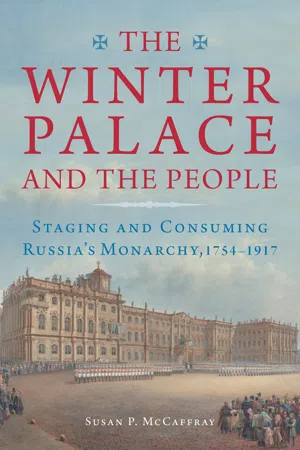
St. Petersburg's Winter Palace was once the supreme architectural symbol of Russia's autocratic government. Over the course of the nineteenth and early twentieth centuries, it became the architectural symbol of St. Petersburg itself. The story of the palace illuminates the changing relationship between monarchs and their capital city during the last century and a half of Russian monarchy. In The Winter Palace and the People, Susan McCaffray examines interactions among those who helped to stage the ceremonial drama of monarchy, those who consumed the spectacle, and the monarchs themselves. In the face of a changing social landscape in their rapidly growing nineteenth-century capital, Russian monarchs reoriented their display of imperial and national representation away from courtiers and toward the urban public. When attacked at mid-century, monarchs retreated from the palace. As they receded, the public claimed the square and the artistic treasures in the Imperial Hermitage before claiming the palace itself. By 1917, the Winter Palace had come to be the essential stage for representing not just monarchy, but the civic life of the empire-nation. What was cataclysmic for the monarchy presented to those who staffed the palace and Hermitage not a disaster, but a new mission, as a public space created jointly by monarch and city passed from the one to the other. This insightful study will appeal to scholars of Russia and general readers interested in Russian history.
eBook - ePub
The Winter Palace and the People
Staging and Consuming Russia's Monarchy, 1754–1917
- 288 pages
- English
- ePUB (mobile friendly)
- Available on iOS & Android
eBook - ePub
About this book
Information
PART I
A NEW STAGE FOR THE THEATER OF MONARCHY
1
“A DIFFERENT WINTER PALACE”
Before monarchs ruled nations they presided over royal courts, and it was to such courts that the theater of monarchy was originally directed. In early modern times a ruler’s court was an interlocking assemblage of powerful entities: his or her own household, including immediate and extended family as well as honor attendants and actual servants; the administrators of justice and finance; and the powerful nobles of the land, whom the monarch needed to enlist and subdue. The age of enlightenment added to these court entities a set of cultural institutions such as academies of sciences and arts. In learning to preside over courts rulers acquired the skills and resources to become the chief executives of consolidated national governments.1 For a long time royal courts were peripatetic, but at the end of the Middle Ages monarchical courts gradually grew less mobile. Settling themselves within long established cities of special significance, monarchs eventually mastered the arts of central administration. These arts included the display and propagation of ruling scenarios.
The establishment of the ruler’s court inside a principal or “capital” city was critical for the project of establishing a centralized national state. It gave the monarch a place of residence that was detached from the territorial claims of his own and rival clans. At the same time it allowed him to consolidate in space the several reins that a national ruler needed to grasp simultaneously: household mastery, administrative order, military command, ecclesiastical precedence, and eventually, mercantile wealth. Even as centralizing monarchs aspired to rule great territorial states, they attended to the older project of presiding over their courts. By the eighteenth century, court politics were complicated not only by the ongoing rivalries of grandees but also by the insertion of resident foreign emissaries into domestic intrigues. In order to rule, and sometimes in order to stay alive, monarchs had to master their own households, administrators, and nobles. Gathering the court entities inside their capitals made this task easier.
Peter the Great faced many of these challenges, and his strategies for addressing them were not so different from those of his brother monarchs. But when he founded a new capital city for Russia at the beginning of the eighteenth century and transferred the seat of power from Moscow to St. Petersburg, he did something unprecedented. By this gesture he meant for all to understand that he was reinventing the nation, among other things recasting it as an empire, proclaiming its essentially European character, and giving it a new center of his own making.2 The riskiest part of the gambit was his effort to dislodge the Muscovite court from its ancient city. He succeeded, forcing the leading men of the realm to build new houses on the banks of the Neva River in what was barely a city, but resentment lingered. For Peter’s successors even more than for other monarchs it proved necessary to display imperial mastery to this large cohort of restive courtiers who managed to dislodge several rulers from the Russian throne, sometimes with foreign assistance. Thus the principal display of Russia’s eighteenth-century monarchy was toward the nobles and foreign emissaries of its own imperial court. The locus of this display was St. Petersburg, a purpose-built late baroque capital city. As such, its growth for the first century of its existence was connected almost entirely to the care and feeding of the Romanovs’ expanding monarchical court, and this made for a particularly strong link between city and monarchy.
In practice, though, St. Petersburg resembled older capital cities. The technologies of centralization mastered by Peter and his successors meant that the country, however large, was increasingly represented by its capital.3 These capitals housed the expanding apparatus of national states, including offices, parade grounds, military barracks and stables, as well as ceremonial spaces for increasingly splendid displays of monarchical courts such as grandiose churches, palaces, and public squares. Ceremonially, these capital cities were designed or retrofitted to display majestically the putatively all-powerful monarchies that represented them.
If Peter bequeathed St. Petersburg’s skeleton, it was his daughter Elizabeth (1741–1761) who bestowed upon it a layer of gorgeous flesh. Falling between the pivotal reigns of Russia’s two great eighteenth-century monarchs, the twenty-year rule of Empress Elizabeth Petrovna has begun to receive scholarly attention. The monarch herself has often been characterized as a vain and sybaritic spendthrift, and recent research documents the great expansion of her court expenses.4 However, the mark Elizabeth left on St. Petersburg cannot be overstated. The city her father had founded would be the backdrop for a European style monarchical court and, if possible, a court that surpassed all others in elegance and wealth.
Her great collaborator in creating Russia’s imperial capital was the chief architect of her court, Bartolomeo Francesco de Rastrelli. Rastrelli received the greatest commission of his long, illustrious career when Elizabeth decreed on January 1, 1753, that she would build a new “winter home” on the banks of the Neva. In so doing Elizabeth imparted a unique feature to the monarchy of late eighteenth- and nineteenth-century Russia: at a time when most other European courts were decamping for the suburbs, the principal formal residence of the Romanovs would stand in the very heart of town, unprotected from passersby by either fences or gardens. The empress and her architect meant for the new palace to house and host the imperial court, but their great project also planted Russia’s monarchy firmly in what became the center of a booming capital city.5
The result of their collaboration was a grand stage for the court-oriented monarchy of late eighteenth-century Russia. They did not clearly foresee that their long and ultimately unresolved debate about how to treat the undeveloped stretch of land on the southern flank of the Winter Palace inadvertently laid the foundation for Palace Square, a new and vital city center. For Russia’s eighteenth-century monarchs “the people” remained in the background, performing supporting roles in a scenario oriented primarily toward courtiers and foreigners. As it happened, the central stage they built proved adaptable for the public, urban monarchy of nineteenth-century Russia, something Catherine the Great pointed toward near the end of her reign.6
BUILDING THE BAROQUE CITY
Elizabeth, a notable beauty in her youth, is remembered now as a woman of lavish tastes who spent enormous sums on her wardrobe and, above all, on her endless building projects. Her taste for luxurious residences contrasted with the relatively simple accommodations created for her father, but though their tastes differed, Elizabeth was a founder and a builder, as Peter had been. She did invest in Moscow’s imperial residences and presided over the founding of Russia’s first university there in 1755. The empress also established schools and arts academies in towns all across Russia. However, St. Petersburg and its environs consumed most of her attention and the lion’s share of her funds, as when she established the Imperial Academy of Arts there in 1757, for example. The most enduring imprint of Elizabeth’s tastes and political thought lies in the buildings she commissioned in the capital city. Although the daughter was both less adept and less visionary than the father, she shared his instinct for deploying the symbols and architecture of power, and in the first three-quarters of the eighteenth century that architecture was, quite literally, baroque.
“The baroque” is one of those plastic European descriptors marked almost as much by diversity as by unity, a fact illustrated in St. Petersburg itself by two nominally baroque buildings that face each other across the Neva River: the Dutch-inspired Cathedral of Saints Peter and Paul, with its spire rising above the eponymous fortress, and Rastrelli’s masterpiece, the Winter Palace. These buildings represent the different national traditions of their designers as well as different periods, but they share the underlying purposes of the baroque, which were the purposes of ambitious national rulers who exhibited military, political, and cultural power through urban design and architecture.
According to architectural historian Victor-L. Tapié, Renaissance principles gave way to a new tendency in the aftermath of the Council of Trent (1545–1563). Reinvigorated by its own reformation, the Catholic Church and its leaders initiated great changes in the city of Rome itself, where “the Popes were determined to give her a dignity which would be worthy of a ‘country common to all Christian peoples,’ as Pius V put it in 1565.”7 The triumphalist message written in the new stones of the eternal city was saying “more about celebrating victories over heresy than about penitence and meditation.”8 Long the fountainhead of European architecture and the inspiration of building designers across the continent, Rome henceforth dispatched to every corner of Europe architects able to produce monuments to the majestic power of triumphant centralizing monarchs.
For Lewis Mumford the roots of the baroque city lay in two overlapping tendencies. One was the gradual success of centralizing monarchs whose stationary courts took root in “absolute” capital cities that attracted commerce, craft, and wealth while curbing the multiplication of provincial cities. The second tendency was intimately connected to the first: the steadily increasing size of professional standing armies whose cannons brought to a close the age of independent cities that could withstand royal assault. By the eighteenth century the great armies that supported centralized monarchies required barracks, arsenals, and gigantic parade grounds inside capital cities.9 The baroque city conveyed absolute political power symbolically, but it also accommodated the mechanisms of power spatially. Elizabeth’s St. Petersburg was one of the classic examples of baroque city planning and design.
When Elizabeth chose to retain Rastrelli as the chief architect of the Russian court after seizing power in 1741, she extended Russia’s tradition of employing Italian building masters. In fact, courts all over Europe had employed Italian architects since the late Middle Ages. Particularly strong ties had connected fifteenth-century Muscovy and Renaissance Italy, with Italian masters continuously at work in Russia between 1475 and 1539, “revolutionizing” Russian architecture.10 Aristotele Fioravanti built the Kremlin Cathedral of the Assumption in the 1470s, and the Lombard brothers Marco and Onton Fryazin built new fortifications in Moscow’s fortress (or kremlin) wall. The greatest extant monument to the impact of Italian masters in Muscovy is the Palace of Facets, which is all that remains of a palace complex built for Ivan III by Pietro Antonio Solari and Marco Ruffo in the late 1480s.11
Like his contemporaries, Peter the Great employed building masters from all over Europe. He assigned a leading role in St. Petersburg to the Swiss Italian Domenico Trezzini, who had arrived in Russia by way of Copenhagen. Trezzini was responsible for several of the chief buildings of Peter’s time, the Cathedral of Saints Peter and Paul, Peter’s Summer Palace, and the Twelve Colleges.12 Peter also took advantage of the death of Louis XIV in 1715 to recruit talented builders who had been freed up from service at the court of the Sun King. The most famous such figure was Jean-Baptiste Alexandre Le Blond, a noted architect and garden designer, who arrived in St. Petersburg in 1716, where Peter bestowed upon him the new title of chief architect of the court. In the three years left to Le Blond before his death, he produced several city plans, none of which was ultimately approved.
A few months before Le Blond arrived in the city another émigré from the French court had already settled into his post. This was the Florentine sculptor, Bartolomeo Carlo de Rastrelli. Carlo Rastrelli had been inspired by the beauty of baroque Rome as a young man, but failing to find sufficient work there he had accepted a post at the court of Louis XIV and moved to Paris with his family before his son Bartolomeo Francesco was born there in 1700.13 In 1716 Carlo Rastrelli accepted the invitation of Peter’s agents and traveled with his teenaged son to St. Petersburg, where Rastrelli senior hoped to make a name for himself. One scholar characterized the elder Rastrelli as an inferior talent who had “purchased the title of Count in Paris” and whose efforts in St. Petersburg disrupted the design plans of the far more talented Le Blond.14 However, if LeBlond’s name would be forever linked to a (never implemented) plan to center the capital city on Vasilevskii Island, the name Rastrelli would be indissolubly linked to the place that did become its heart: the stretch of Admiralty Island that faces the Neva River, known simply as the palace embankment. Rastrelli senior helped to build two of the buildings that preceded his son’s masterpiece on the same site.
For Peter the Great, the focal point of his new city was made of water: it was the great watery “square” of the Neva bounded by the fortress, the spit of Vasilevskii Island, and the Admiralty, with its busy ship-building wharves. What appears in retrospect as Peter’s indecisiveness about where to concentrate cultural and governmental buildings might have been more clearly perceived in his own time as an effort to focus determinedly on the city’s maritime character. Thus the first two great institutions, the fortress and the Admiralty, gaze at each other across an expanse that was alternately navigable and frozen. The tsar and his city planners considered the tip of Vasilevskii Island to offer the best prospect from which to view both of these architectural masterpieces, and they consequently launched important projects there, including the building that housed the governing Twelve Colleges as well as the Kunstkamera, built to contain the tsar’s collection of scientific and artistic oddities. Nearby the city governor and chief arbiter of affairs, Prince A. D. Menshikov, built his own lovely Dutch baroque palace facing the water.
Peter, himself, erected quarters on both sides of the river. His first house—according to lore the very first built in St. Petersburg—was a wooden cabin (painted to look as though it were made of brick) on the Petrograd embankment, known as “the city side” in the vicinity of the Peter and Paul Fortress. By settling there as early as 1703 the tsar spawned residential building on Petrograd Island, particularly for the workers and craftsmen being concentrated in the new city in great numbers. By 1708, however, he apparently concluded that the separation of the workers from the Admiralty during the two annual seasons of the freezing and thawing of the Neva was too inconvenient. Peter decided to have workmen’s quarters built on the southern embankment, and he similarly ordered a winter house for himself on the Admiralty side. This building, no longer extant, has been designated as the first winter home, or winter palace, on the general site where the Rastrelli building now stands.15 The tsar’s winter home separated the shipbuilders’ settlement from the homes of the ranking naval officers and associates of the tsar. It was situated at the narrowest point between the Neva and the Moika (or M’ia) Rivers, today the site of the Winter Canal.
Living in the vicinity of the Admiralty soon proved so convenient that in 1708 Peter commissioned Trezzini to build him a summer palace a bit further east, within the fashionable summer garden that was taking shape along the river. This elegant building still stands. It included a system for providing running water inside the house as well as an up-to-date drainage system. Like other wealthy grandees across Europe and Asia, Peter was able to have both a winter and a summer residence. The latter was intended to house people only from the late spring through the middle of the fall, so it could be constructed with thinner walls and single -glazed windows. Even humble folk moved into summer quarters when they were able to do so, because the absence of monumental heating stoves rendered the interiors far cleaner and roomier than the winter quarters. Although Russia’s rulers had cleaning staffs sizeable enough to deal with soot an...
Table of contents
- Cover Page
- Title Page
- Copyright Page
- Contents
- Illustrations
- Acknowledgments
- Dedication
- Preface
- Introduction
- Part I: A New Stage for the Theater of Monarchy
- Part II: Enacting Urban Monarchy
- Part III: The Audience Takes the Stage
- Conclusion
- Notes
- Select Bibliography
- Index
Trusted by 375,005 students
Access to over 1.5 million titles for a fair monthly price.
Study more efficiently using our study tools.
Frequently asked questions
Yes, you can cancel anytime from the Subscription tab in your account settings on the Perlego website. Your subscription will stay active until the end of your current billing period. Learn how to cancel your subscription
No, books cannot be downloaded as external files, such as PDFs, for use outside of Perlego. However, you can download books within the Perlego app for offline reading on mobile or tablet. Learn how to download books offline
Perlego offers two plans: Essential and Complete
- Essential is ideal for learners and professionals who enjoy exploring a wide range of subjects. Access the Essential Library with 800,000+ trusted titles and best-sellers across business, personal growth, and the humanities. Includes unlimited reading time and Standard Read Aloud voice.
- Complete: Perfect for advanced learners and researchers needing full, unrestricted access. Unlock 1.5M+ books across hundreds of subjects, including academic and specialized titles. The Complete Plan also includes advanced features like Premium Read Aloud and Research Assistant.
We are an online textbook subscription service, where you can get access to an entire online library for less than the price of a single book per month. With over 1.5 million books across 990+ topics, we’ve got you covered! Learn about our mission
Look out for the read-aloud symbol on your next book to see if you can listen to it. The read-aloud tool reads text aloud for you, highlighting the text as it is being read. You can pause it, speed it up and slow it down. Learn more about Read Aloud
Yes! You can use the Perlego app on both iOS and Android devices to read anytime, anywhere — even offline. Perfect for commutes or when you’re on the go.
Please note we cannot support devices running on iOS 13 and Android 7 or earlier. Learn more about using the app
Please note we cannot support devices running on iOS 13 and Android 7 or earlier. Learn more about using the app
Yes, you can access The Winter Palace and the People by Susan McCaffray in PDF and/or ePUB format, as well as other popular books in History & 19th Century History. We have over 1.5 million books available in our catalogue for you to explore.