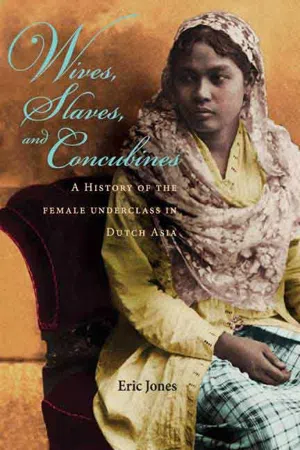
Wives, Slaves, and Concubines argues that Dutch colonial practices and law created a new set of social and economic divisions in Batavia-Jakarta, modern-day Indonesia, to deal with difficult realities in Southeast Asia. Jones uses compelling stories from ordinary Asian women to explore the profound structural changes occurring at the end of the early colonial period—changes that helped birth the modern world order. Based on previously untapped criminal proceedings and testimonies by women who appeared before the Dutch East India Company's Court of Alderman, this fascinating study details the ways in which demographic and economic realities transformed the social and legal landscape of eighteenth-century Batavia-Jakarta. Southeast Asian women played an inordinately important role in the functioning of the early modern Asia Trade and in the short- and long-term operations of the Dutch East India Company (VOC). Southeast Asia was a place where most individuals operated within an intricate web of multiple, fluid, situational, and reciprocal social relationships ranging from dependence to bondedness to slavery. The eighteenth century represents an important turning point: the relatively open and autonomous Asia Trade that prompted Columbus to set sail had begun to give way to an age of high imperialism and European economic hegemony. How did these changes affect life for ordinary women in early modern Dutch Asia, and how did the transformations wrought by Dutch colonialism alter their lives? The VOC created a legal division that favored members of mixed VOC families, those in which Asian women married men employed by the VOC. Thus, employment—not race—became the path to legal preference, a factor that disadvantaged the rest of the Asian women. In short, colonialism created a new underclass in Asia, one that had a particularly female cast. By the latter half of the eighteenth century, an increasingly operational dichotomy of slave and free supplanted an otherwise fluid system of reciprocal bondedness. The inherent divisions of this new system engendered social friction, especially as the emergent early modern economic order demanded new, tractable forms of labor. Dutch domestic law gave power to female elites in Dutch Asia, but it left the majority of women vulnerable to the more privileged on both sides of this legal divide. Slaves fled and violence erupted when traditional expectations of social mobility collided with new demands from the masters and the state.
eBook - ePub
Wives, Slaves, and Concubines
A History of the Female Underclass in Dutch Asia
- 204 pages
- English
- ePUB (mobile friendly)
- Available on iOS & Android
eBook - ePub
About this book
Information
Subtopic
Asian HistoryIndex
History4
Batavia and Its Runaway Slavinnen
One day in the early months of 1793, authorities became suspicious when they noticed a man carrying what appeared to be a bloody axe (in Malay, gollok). When they approached him about the axe (which turned out only to have rust on the blade), they discovered that he was in fact a fugitive slave. The runaway, named Augusto van Sumbauwa, revealed to them a complex of safe houses and runaway accomplices. Augusto had been on the run with his girlfriend, Sapia van Sumbauwa, moving from safe house to safe house. They had first rented a back room in the house of a “free non-Christian woman” called Ma (or Nyai) Sauwa, partially in exchange for repairing her roof.1 Then they moved to a large plantation mansion with other runaways. The mansion belonged to the captain of the Moors, Mochamat Alie, and one of the foremen (mandor) on his sprawling estate, Djemal, was using the mansion to house fugitive slaves, primarily couples.2 Sapia and several of her slavin friends had chosen to run away from their owners. They had done so when denied the opportunity to move ahead in life and start a family each with their would-be spouse. For example, one of the slavinnen, Serana van Batavia (alias Ma Abas) ran away “for no good reason,” according to her master, the Moor Dauod Aboe Bakar. However, Serana did have reasons. She fled in order to have a child with her new boyfriend after her master sold her former husband.3
As these examples suggest, the slavinnen and their masters represented competing notions of slavery and dependence in Batavia. As long as slavery has existed, so too have fugitive slaves, and the reasons behind both phenomena are as varied as the nature of human bondage itself. In Batavia, some ran away because of physically abusive mistresses, while others fled less blatant torments. Forms of slavery and human bondage existed in Southeast Asia long before and long after the arrival of the Europeans in the archipelago. Whereas a Western presence in Africa and the Americas set in motion new modes of slavery and introduced unprecedented numbers of people to the practice, the early modern European presence in Asia had neither of these effects but, instead, fed off an existing slave trade, with the newcomers cornering slave markets much as they did the clove markets. The age of commerce in Southeast Asia—commerce in both humans and fine spices—predated the joint stock companies, but with the coming (and, most important, with the record keeping) of the VOC, not only are we able to keep a head count of slave traffic and population in the colony, we are also given access to the courtroom dramas giving narrative content to a population that was previously nameless and faceless. Equally important, the slave narratives taken in criminal proceedings also provide windows into the slowly changing relationship between Europe and Asia in the early modern era.
Crimes of every sort and severity could land one of Batavia’s lesser individuals in jail and on trial. In Batavia’s Court of Aldermen, slaves and slavinnen stood alongside non-slaves accused of many of the same crimes—but the statutes reserved one offense in particular for them, running away (weglopen). Here we’ll be looking at the criminal cases dealing with Batavian slavinnen who ran away from their masters and mistresses and were obviously unsuccessful, because they were captured and had to stand trial.
Why did they run? Part of the answer, I argue, has to do with the colonial capital itself. First, Roman Dutch law compromised an important pillar of the Southeast Asian society—social mobility. On the one hand, this may seem contradictory given that many Asian women used the law, through marriage and remarriage, to ascend to the ranks of Batavia’s elite. However, for underclass women outside the Company, Batavia’s Roman Dutch statutes set up a firm partition between free and slave. The codification of slave versus free substituted a rigid dichotomy for fluid abstract conceptions of social hierarchy, in effect clogging up the flow of underclass mobility.4 In addition, the growing plantation economy around Batavia, presaging things to come throughout the archipelago, eroded the previous filial relationship between mistress and slavin into a mere money relationship. So Batavia itself helped to create the phenomenon of the runaway slavin. Second, if the colonial capital created conditions for slavinnen to want to run away, it also provided opportunities for them to do so. The relative anonymity of the city and its extensive underclass community opened up avenues and connections for flight, even as it left slavinnen on the run vulnerable to deception, abduction, and abuse.
Southeast Asian Social Systems
Scholars have often described the status of individuals within Southeast Asian social systems as historically interdependent and mobile, and here the question of slavery is of particular importance.5 Rather than finding themselves in a strict and permanent categorization of human beings as either independent free individuals or enslaved subjects, Southeast Asians typically found themselves both acting as patrons, with their own network of clients, and at the same time serving in relationships of dependence toward others. Slaves and slavinnen purchased at auction, for example, themselves could command bondservants partially beholden to them.6 Rather than freedom forming one side of an either/or dichotomy opposed to slavery, in Southeast Asia freedom and slavery were more accurately defined as abstract and opposite ends of a sliding social continuum. To further complicate matters, “freedom” was situational and not something necessarily reducible to a final sum on a balance sheet. At certain times of the year, an individual might be subject to onerous, even slave labor while in other contexts he or she might enjoy a remarkable degree of autonomy. This high level of social interdependence was rooted largely in geographic realities that also influenced the shape of political systems in Southeast Asia.
As Reid (among others) has pointed out, “the key to Southeast Asian social systems was the control of men,” not land.7 Relatively low population density throughout the region conspired with an extremely mobile populace, especially in the archipelago, to create a pattern of reciprocal rule. People sought the protection and prosperity afforded by a given ruler’s circle of influence (mandala), and that ruler’s power and prestige expanded as more and more people attached themselves to the realm. Moreover, peasants were not perpetually tied to the land as were their contemporaries in Europe. In Southeast Asia, should a ruler’s yoke become too onerous, the lure of a neighboring kingdom, easy seaborne transport, low population density, and cheap and abundant building materials allowed families and populations the opportunity to move and seek their fortunes elsewhere. In Southeast Asia “power” was “manpower,” and nowhere is this idea more clearly demonstrated than in the nature of warfare among rival kingdoms. Contests were seldom about conquering territory but were frequently about capturing rival armies and populations. So as not to damage the prized human capital, battles were often symbolic and relatively little blood would be spilled on the field. Captured armies and peoples were taken by the victors, quickly assimilated by the conquerors, and eventually allowed social mobility.8
Furthermore, borders between principalities and sultanates were porous or nonexistent. As Benedict Anderson described the situation on Java: “kingdoms were not regarded as having fixed and charted limits, but rather flexible, fluctuating perimeters. In a real sense, there were no political frontiers at all, the Power of one ruler gradually fading into the distance and merging imperceptibly with the ascending Power of a neighboring sovereign.”9 More than any other factor, the possibility of mobility held a sovereign’s power in check. On a societal level, this potential mobility functioned in much the same way that the threat of divorce did in Southeast Asian marriages. Knowing that women had extramarital social and economic opportunities forced men to share power in the relationship and to work for their spouses’ affection. Southeast Asian sovereigns knew that their “subjects” also had options outside the realm, and this had a mitigating effect on any royal aspirations to absolute authority, giving people power to vote with their feet. But just because people could relocate did not mean they necessarily exercised the privilege. For an underling, a simple appraisal of costs and benefits might show that the dangers of the unknown outweighed the benefits of relocation. Defaulting on a perceived social obligation was undoubtedly a major decision and one not to be taken lightly. The point is that the potential for flight and social mobility, the dependence of clients on their patrons, and most important the reliance of patrons on their clients modified the way people interacted with each other to such an extent that one’s circumstances seldom came to flight.10
This negotiated relationship between sovereign and subject was replicated all along the social scale from the ruling class down to the underclass. Swidden farmers taken in a slave raid or soldiers captured in warfare might find themselves incorporated into some household’s domestic service or into the wet rice agricultural complex, or adopted directly into a family. In order to bury a parent, raise a bride price, or pay a gambling debt, people would also willingly incur debt bondage or enter into concubinage (we find a particularly stunning example of this among our court cases, the case of Nio Kinnio in Chapter 3). Rather than suffering permanent juridical slave status, they could move within the social hierarchy as they intermarried, worked off their debt, and took on clients of their own. As the historian Michael Aung Thwin has stated, “the important question was to whom you were bonded rather than the abstract legal quality of your bondage.”11 In turn, their masters would probably be financially and socially beholden to others, and so these “stratified clusters of patron-client relationships” continued on up to the sovereign.12
Southeast Asia’s cultural matrix was not only complex and its society interconnected, but it was also extremely open and adept at assimilating outsiders and their ideas, which allowed for a high degree of individual social mobility. For centuries Southeast Asia (and especially Indonesia) has been a crossroads for traffic in commerce and ideas. Java’s massive, millennium-old Hindu and Buddhist monuments testify to the region’s ancient connection with the Indian Ocean world, just as Java’s wayang tells of the Indonesianization of those traditions and their epics. Onion-domed mosques and cross-shaped cathedrals tell of more recent encounters with ideologies from beyond the archipelago and of the incorporation of these worldviews into Indonesia’s cultural fabric.
Commercial traffic has been just as brisk—and probably ultimately responsible for or at least the bearer of—the traffic in intellectual and spiritual property. Already in the fifteenth century, the Indonesian archipelago stood at the center of a great international trading network connecting India and the Middle East to China through Southeast Asia, with Europe receiving small but valuable quantities of the Asian goods. Each year by the thousands, foreign merchants would sail the monsoon winds to, from, and through maritime Southeast Asia, selling their various cargoes of rice, salt, aromatic woods, precious stones and metals, furs and silks and other textiles, porcelain, pepper, and fine spices to other traders gathered there, buying their goods in return. Powerful early modern Malay trading states with urban populations of one or two hundred thousand such as Melaka on the Malay peninsula and Makassar in South Sulawesi attracted Arab, Indian, Chinese, and Southeast Asian merchants by providing essentially free-market ports, warehouse facilities, an adequate legal system, and by policing the waterways for pirates. State and local interdependence within the region combined with trade and traffic from outside the region to allow for great social mobility in Southeast Asia. Society did not fix status and rank at birth; they were always subject to a person’s fortunes in the market of mutual obligation and in the making and breaking of patron-client relationships.
Historian Oliver Wolters has cited individual charisma as an important feature of the Southeast Asian “cultural matrix.”13 His notion of the “man of prowess” is a critical component in the self-made nature of pre- and early modern status in the region. People chose to follow a given leader based not solely on his or her lineage but more on the self-made qualities of prowess, pluck, and prescience. On a popular level, bilateral or cognatic kinship was one manifestation of how the man or woman of prowess could play out in Southeast Asian kinship structures. Rather than inheritance or dominion being passed automatically through the eldest son (primogeniture), it passed to the most “worthy” child, male or female, or it could also be divided among all the siblings. Bravery in battle, grace under pressure, rhetorical skill, and financial acumen were all characteristics with which individuals could distinguish themselves, thus increasing the odds of attracting important patrons, clients, and social ties.
Civil Law and the Colonial Capital
The traditional practices and implicit understandings of debt bondage and obligation were insufficient for some foreign merchants, not only the Dutch, who needed statutory legal assurances that the slaves whom they viewed as their property would behave as such.14 Batavia’s cosmopolitan populace, hailing from every corner of the world, did not share an unspecified set of cultural assumptions among them; some commercial assumptions, however, were mutual and held dear. Reid and others have pointed to the lack of safeguards for private property, with the requisite legal and governmental apparatus to support it, as a crucial factor marking Southeast Asia’s early modern divergence from the West. In the areas under its control, the VOC labored to establish a place where financial institutions and markets could flourish and where merchants would not hesitate to accumulate and develop fixed capital. Ultimately the fluidity and easy flight inherent in the Southeast Asian social system proved too dangerous for the Company’s fixed and hard commercial interests. Roman Dutch law provided those firm boundaries and clear distinctions; it also left an otherwise mobile slave underclass with few choices but to run away. Batavian statutory law collapsed this complicated network of Southeast Asian vertical bonding into the simple dichotomy of slave versus free, concretized what had been fluid, temporary social arrangements, and closed off avenues for social mobility.
The nature of the colonial legal system itself, in addition to the substantive content of its statutes, was ant...
Table of contents
- cover
- title_page
- copyright
- dedication
- contents
- acknowledgments
- introduction
- chapter_one
- chapter_two
- photo_gallery
- chapter_three
- chapter_four
- chapter_five
- conclusion
- notes_to_introduction
- notes_to_chapter_one
- notes_to_chapter_two
- notes_to_chapter_three
- notes_to_chapter_four
- notes_to_chapter_five
- notes_to_conclusion
- bibliography
- index
Trusted by 375,005 students
Access to over 1.5 million titles for a fair monthly price.
Study more efficiently using our study tools.
Frequently asked questions
Yes, you can cancel anytime from the Subscription tab in your account settings on the Perlego website. Your subscription will stay active until the end of your current billing period. Learn how to cancel your subscription
No, books cannot be downloaded as external files, such as PDFs, for use outside of Perlego. However, you can download books within the Perlego app for offline reading on mobile or tablet. Learn how to download books offline
Perlego offers two plans: Essential and Complete
- Essential is ideal for learners and professionals who enjoy exploring a wide range of subjects. Access the Essential Library with 800,000+ trusted titles and best-sellers across business, personal growth, and the humanities. Includes unlimited reading time and Standard Read Aloud voice.
- Complete: Perfect for advanced learners and researchers needing full, unrestricted access. Unlock 1.5M+ books across hundreds of subjects, including academic and specialized titles. The Complete Plan also includes advanced features like Premium Read Aloud and Research Assistant.
We are an online textbook subscription service, where you can get access to an entire online library for less than the price of a single book per month. With over 1.5 million books across 990+ topics, we’ve got you covered! Learn about our mission
Look out for the read-aloud symbol on your next book to see if you can listen to it. The read-aloud tool reads text aloud for you, highlighting the text as it is being read. You can pause it, speed it up and slow it down. Learn more about Read Aloud
Yes! You can use the Perlego app on both iOS and Android devices to read anytime, anywhere — even offline. Perfect for commutes or when you’re on the go.
Please note we cannot support devices running on iOS 13 and Android 7 or earlier. Learn more about using the app
Please note we cannot support devices running on iOS 13 and Android 7 or earlier. Learn more about using the app
Yes, you can access Wives, Slaves, and Concubines by Eric Jones in PDF and/or ePUB format, as well as other popular books in History & Asian History. We have over 1.5 million books available in our catalogue for you to explore.