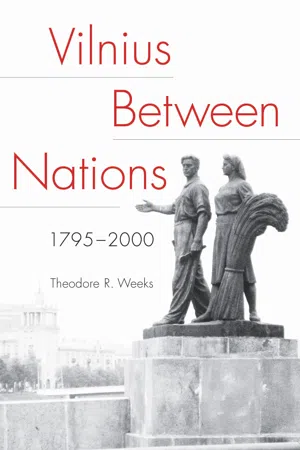
Vilnius between Nations, 1795–2000
eBook - ePub

Vilnius between Nations, 1795–2000

  1. 366 pages
  2. English
  3. ePUB (mobile friendly)
  4. Available on iOS & Android
eBook - ePub

Vilnius between Nations, 1795–2000

About this book

The inhabitants of Vilnius, the present-day capital of Lithuania, have spoken various languages and professed different religions while living together in relative harmony over the years. The city has played a significant role in the history and development of at least three separate cultures—Polish, Lithuanian, and Jewish—and until very recently, no single cultural-linguistic group composed the clear majority of its population.

Vilnius between Nations, 1795–2000 is the first study to undertake a balanced assessment of this particularly diverse city. Theodore Weeks examines Vilnius as a physical entity where people lived, worked, and died; as the object of rhetorical struggles between disparate cultures; and as a space where the state attempted to legitimize a specific version of cultural politics through street names, monuments, and urban planning. In investigating these aspects, Weeks avoids promoting any one national narrative of the history of the city, while acknowledging the importance of national cultures and their opposing myths of the city's identity. The story of Vilnius as a multicultural city and the negotiations that allowed several national groups to inhabit a single urban space can provide lessons that are easily applied to other diverse cities. This study will appeal to scholars of Eastern Europe, urban studies, and multiculturalism, as well as general readers interested in the region.

Frequently asked questions

Yes, you can cancel anytime from the Subscription tab in your account settings on the Perlego website. Your subscription will stay active until the end of your current billing period. Learn how to cancel your subscription.
No, books cannot be downloaded as external files, such as PDFs, for use outside of Perlego. However, you can download books within the Perlego app for offline reading on mobile or tablet. Learn more here.
Perlego offers two plans: Essential and Complete
  • Essential is ideal for learners and professionals who enjoy exploring a wide range of subjects. Access the Essential Library with 800,000+ trusted titles and best-sellers across business, personal growth, and the humanities. Includes unlimited reading time and Standard Read Aloud voice.
  • Complete: Perfect for advanced learners and researchers needing full, unrestricted access. Unlock 1.4M+ books across hundreds of subjects, including academic and specialized titles. The Complete Plan also includes advanced features like Premium Read Aloud and Research Assistant.
Both plans are available with monthly, semester, or annual billing cycles.
We are an online textbook subscription service, where you can get access to an entire online library for less than the price of a single book per month. With over 1 million books across 1000+ topics, we’ve got you covered! Learn more here.
Look out for the read-aloud symbol on your next book to see if you can listen to it. The read-aloud tool reads text aloud for you, highlighting the text as it is being read. You can pause it, speed it up and slow it down. Learn more here.
Yes! You can use the Perlego app on both iOS or Android devices to read anytime, anywhere — even offline. Perfect for commutes or when you’re on the go.
Please note we cannot support devices running on iOS 13 and Android 7 or earlier. Learn more about using the app.
Yes, you can access Vilnius between Nations, 1795–2000 by Theodore R. Weeks in PDF and/or ePUB format, as well as other popular books in History & Baltic History. We have over one million books available in our catalogue for you to explore.

Information

Table of contents

  1. Contents
  2. Acknowledgments
  3. Abbreviations
  4. Illustrations
  5. Intoduction-Nationality, Politics, Culture, Urban Space
  6. 1-Historical Background
  7. 2-A Center of Polish and Jewish Culture, 1795–1862
  8. 3-The Period of Russification, 1863–1914
  9. 4-World War I, 1914–1922
  10. 5-Vilnius as a Polish City, 1919–1939
  11. 6-The Destruction of Multinational Vilnius, 1939–1955
  12. 7-Socialist Normalcy in Vilnius, 1955–1985
  13. 8-Building a Lithuanian Capital City, 1985–2000
  14. Conclusions
  15. Notes
  16. Select Bibliography
  17. Index
  18. Gallery