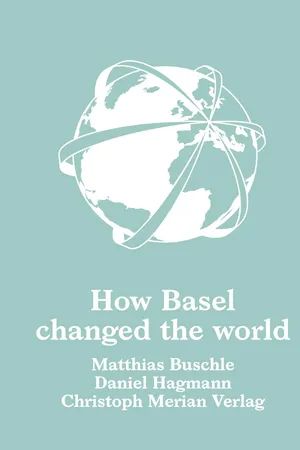
This book is all about events, discoveries and ideas which may have seemed small and insignificant at the time but later changed the world. DDT and LSD, Frick & Frack, the Basel Mission and the Zionist World Congress, Tadeus Reichstein and Friedrich Nietzsche, the first printed edition of the Koran and much else provide the stuff of which exciting stories are made in Basel, the hub of the universe.
- 176 pages
- English
- ePUB (mobile friendly)
- Available on iOS & Android
eBook - ePub
How Basel changed the world
About this book
Trusted by 375,005 students
Access to over 1.5 million titles for a fair monthly price.
Study more efficiently using our study tools.
Information
Subtopic
European HistoryIndex
HistoryNietzsche’s
First Book.
The tragedy at
the birth of his
philosophy
“In Basel steh ich unverzagt
Doch einsam da – Gott sei’s geklagt,
Und schrei ich laut Homer! Homer!
So macht das Jedermanns Beschwer.
Zur Kirche geht man und nach Haus
Und lacht den lauten Schreier aus.
Jetzt kümmr’ ich mich nicht mehr darum:
Das allerschönste Publikum
Hort mein homerisches Geschrei
Und ist geduldig still dabei.
Zum Lohn für diesen Ueberschwank
Von Gute hier gedruckten Dank.”
Doch einsam da – Gott sei’s geklagt,
Und schrei ich laut Homer! Homer!
So macht das Jedermanns Beschwer.
Zur Kirche geht man und nach Haus
Und lacht den lauten Schreier aus.
Jetzt kümmr’ ich mich nicht mehr darum:
Das allerschönste Publikum
Hort mein homerisches Geschrei
Und ist geduldig still dabei.
Zum Lohn für diesen Ueberschwank
Von Gute hier gedruckten Dank.”
Friedrich Nietzsche’s dedication in the private printing
of his inaugural lecture, given on 28 May 1869
of his inaugural lecture, given on 28 May 1869
“In Basel I stood undaunted / Yet solitary there – God have pity, / and I cried out: Homer! Homer! / Thus annoying everyone. / They go to church and then go home / And laugh at the loud crier. / But now I no longer mind it; / The finest audience / Hears my Homeric cries / And is quietly patient withal. / As a reward for this exuberance / Of kindness, here my printed thanks.” (Friedrich Nietzsche)
The Call of the Caller. On 10 February 1869, the 24-year-old philology student Friedrich Nietzsche (1844 – 1900) was appointed extraordinary professor of Classical Philology at the University of Basel. The appointment was on the recommendation of his teacher, Friedrich Ritschl, the Leipzig professor for Ancient Greek and doyen of Ancient Philology in Germany at the time. As Nietzsche had written neither a doctorate nor a habilitation treatise at the time – prerequisites for a professorship – the University of Leipzig granted him an honorary doctorate on 23 March 1869, without an examination or a disputation. The papers he had published up till then, some of them in Latin, were considered to be sufficient grounds for offering him the chair.
So Friedrich Nietzsche became a professor before having published a book of his own. He was a shooting star whose reputation was based on very promising short papers. It is only right, however, that a professor should publish works of his own, which is why the young philologist, to justify his appointment, had to set about writing his first one alongside his teaching duties.
Fears and misunderstandings in Basel. In 1870 Nietzsche held two lectures for the Voluntary Academic Society in the hall of the Museum on Augustinergasse. These two lectures constituted the preparatory work for his first book. The topic he dealt with on 18 January was “The Greek Music Drama”, on 1 February “Socrates and Tragedy”. Both lectures already touched on the core theses of his Birth of Tragedy. Nietzsche referred to his second lecture in a letter: “I held a lecture here about ‘Socrates and Tragedy’ that evoked fears and misunderstandings. By contrast, it has forged an even closer bond with my friends in Tribschen.”
Tribschen and friends. The aforementioned friends in Tribschen were Cosima and Richard Wagner, who at the time (from 1866 to 1872) were living in the country manor Tribschen near Lucerne. Nietzsche had got to know Wagner while studying in Leipzig, but now a close friendship developed thanks to their close proximity in Switzerland. Indeed, Nietzsche belonged to Wagner’s inner circle of disciples for a time. Whenever he travelled to the Vierwaldstättersee, he was a guest of the Wagners.
The young professor also sent copies of his lectures to the young couple. Richard Wagner was most impressed but also concerned. He wrote to Nietzsche: “And yet I’m worried about you and sincerely hope that you won’t get yourself into serious trouble. Which is why I would like to advise you against treating these highly provocative views in short essays aimed disastrously at dealing with them lightly, but rather to save them for a larger, more comprehensive treatise, considering how much they obviously mean to you.” Here Wagner – as usual – was not being modest. After all, one of Nietzsche’s hypotheses was that Wagner’s art was the rediscovery and reawakening of the Greek “Gesamtkunstwerk”. A considerable part of the Birth of Tragedy was to be devoted entirely to Wagner’s music.
The Birth of Tragedy. On New Year’s Day 1872 Nietzsche’s first book, The Birth of Tragedy from the Spirit of Music, was published in Leipzig by Ernst Wilhelm Fritzsch, the same publishing house that also listed Wagner as one of its authors. On the cover of the book the author’s title was printed as “Friedrich Nietzsche ordentl. Professor der classischen Philologie an der Universität Basel”, revealing a dilemma that caused misunderstandings and lack of comprehension at the time: Nietzsche was a professor of philology, but his book was about philosophy. It may well be based on ancient Greek sources, but the Birth of Tragedy is a work about aesthetics.
The Birth of Tragedy today. The book’s thesis is already heralded in the opening sentence: “We will have achieved much for the study of aesthetics when we come, not merely to a logical understanding, but also to the immediately certain apprehension of the fact that the further development of art is bound up with the duality of the Apollonian and the Dionysian, just as reproduction depends upon the duality of the sexes, their continuing strife and only periodically occurring reconciliation.”
The work thus takes an aesthetic approach, with Nietzsche regarding the world as an aesthetic problem that can only be grasped and interpreted through experience and artistic expression. For this purpose he had discovered two principles among the ancient Greeks: the Apollonian and the Dionysian; the first represents the ordering spirit, distance and peace; the second intoxication, enthusiasm, the eruption of a dark primal force. Nietzsche saw these two energies united in Attic tragedy – or in art per se. He believed that “existence and the world are only justified as an aesthetic phenomenon” – and herein lies the misunderstanding, respectively, the “fruitful annoyance”.
The Birth of Tragedy as annoyance. The concern Wagner expressed in his letter was not unfounded, for in the Birth of Tragedy Nietzsche undertook something that was totally unexpected at that time: he mixed the disciplines; the book is a philosophical work written by a philologist. His core theses are judgements about the present and not about ancient Greece. Seen this way, it is possible to understand why his colleagues responded so vehemently to the publication.
In specialist circles the Birth of Tragedy largely provoked head-shaking and silence, or else damning reviews. Nietzsche’s teacher Ritschl covertly referred to the work as “intellectual art-mystery-religion-crap” and as “megalomaniacal”. For philologists Nietzsche’s way of thinking and writing, without references such as footnotes, but full of conjectures and interpretations, was confusing. In May 1872 another young star of the philologists’ guild, 23-year-old Dr. Ulrich von Wilamowitz-Moellendorff of the University of Berlin, published his negative review in the form of a rebuttal entitled “Zukunftsphilologie! eine erwidrung auf Friedrich Nietzsches, ord. professors der classischen philologie zu Basel, ‘geburt der tragödie’” (Philosophy of the Future! In response to Friedrich Nietzsche’s, full professor of classical philology in Basel, “Birth of Tragedy”). The polemical title was an allusion to Wagner’s “Music of the Future”. The text by Wilamowitz-Moellendorff culminated in the appeal: “Let Mr. Nietzsche be true to his word, grasp the thyrsus, move from India (like Dionysus) to Greece, but step down from the rostrum at which he is employed to teach, gather tigers and panthers at his knees instead of Germany’s young philologists, who, through the asceticism of self-denying work ought to learn to seek everywhere only the truth.” In other words, Nietzsche should resign and not pervert the youth.
But Nietzsche too was a polemicist and took up the gauntlet. For the ensuing battle he mobilised his old friend, colleague and swashbuckler Erwin Rohde, professor in Kiel. The latter wrote a counter-diatribe entitled “Afterphilologie! Zur Beleuchtung des von dem Dr. phil. Ulrich von Wilamowitz-Möllendorff herausgegebenen Pamphlets ‘Zukunftsphilologie!’: Sendschreiben eines Philologen an Richard Wagner” (Missive by a philologist to Richard Wagner). In the to-and-fro of the polemics, however, Nietzsche’s reputation as an excellent philologist and as a hope for the future was lost sight of. The battle also impacted his university teaching: the students stayed away. Nietzsche wrote to Rohde in Kiel: “I just about succeeded in holding a course of lectures on the rhetoric of the Greeks and Romans, for two students, one of German studies, the other of jurisprudence.”
Nietzsche’s assumption about how his work would be received, that is to say, who would not read it, was thus confirmed: “I’m always afraid that the philologists will not want to read it because of the music, the musicians because of the philology, the philosophers because of both the music and the philology …”
Use and abuse of history. Today, the Birth of Tragedy is considered to be the birth of Nietzsche’s philosophy. In it he sounds the keynotes that would accompany him his whole life long, particularly the Dionysian tone. Later he rejected much of what he wrote in his first book – Nietzsche would not be Nietzsche if he did not criticise and contradict himself, as he did in a preface to a new edition, which he organised himself. Particular mention should be made in this connection of his rift with Wagner.
Nietzsche’s fame as a philosopher of global stature is undisputed today. He is regarded as one of the most influential thinkers in the philosophy of the 20th and 21st centuries. His open, fragmented way of thinking began in Basel. One can only laud the appointment practice of Basel University at the time – and admire the fact that it was so generous as to pay the still young but very ill professor (Nietzsche suffered from unspeakable pains in his head and eyes) a pension from the age of 34, thus enabling him to continue working.
That is why Nietzsche’s dedication to his friend Franz Overbeck, in the latter’s copy of the Birth of Tragedy, is also part of an agenda: “Schaff, das Tagwerk meiner Hände / Großer Geist, daß ich’s vollende! F. N.” (Grant that the day’s labour of my hands, Great Spirit, I may complete!) Bu.

Explosive!
Christian Friedrich
Schönbein
and guncotton
“Timely progress. Strauss Jr will play an explosive cotton polka during Fasching, the Viennese carnival. We hope it is a hit!” This was proclaimed by the Viennese newspaper Der Wanderer in February 1847. And that “timely progress” really was “explosive”. The term “explosive” is said to have been fashionable in Vienna at the time, being used to describe a chic dress or a good joke. The premiere of Johann Strauss’ “Explosion Polka” took place at the benefit concert called “Lust Explosionsfest” (Joyful explosions festival) held at the ballroom “Zum Goldenen Strauss” in Josefstadt on 8 February 1847; to this very day, the work is still played as part of the New Year’s Concert given by the Wiener Philharmoniker.
Explosive chemicals. What did the Viennese dance festival have to do with Basel? In 1846, Christian Friedrich Schönbein (1799 – 1868), a Swabian professor of chemistry and physics at Basel University, discovered what he called guncotton and what today is usually referred to as cellulose nitrate. The discovery was a great success – undoubtedly promoted by its spectacular and popular epithet. The substance was not only tested a...
Table of contents
- Cover
- Titel
- Inhalt
- Introduction
- “Sugar … spinach … haemoglobin.” The measurements of Gustav von Bunge
- “This is such stuff as dreams are made of.” The discovery of LSD
- Freidorf and Bauhaus. Global architecture on Basel foundations
- Ice-skaters, Idioms, Slang and Erasmus of Rotterdam
- The Art of Art Dealing. Art Basel
- The Bells of Basel. The modern woman and world peace
- Excuse me, but where is Basel III? The city and the Bank for International Settlements
- A “painting to dream about”. Die Toteninsel
- Love of Animals, Bone Screws, IPOs. The boom in accident surgery
- Cortisone and Vitamin C. Tadeus Reichstein, a master of the tiniest substances
- A Bitter-Sweet Success Story. The missions, slave liberation and the cocoa trade
- Habent sua fata libelli. The Civilizing Process
- A Bad Leg. Paracelsus and the reform of modern medicine
- Romantic Matriarchy. Johann Jakob Bachofen and mother right
- The Stumbling Block. The origins of global nature conservation
- Poison for the World. Dichlorodiphenyltrichloroethane becomes DDT
- A Song for Peace. Mediating between revolution and monarchy in Basel
- SPQB instead of SPQR. Conclave and papal coronation in Basel
- Nietzsche’s First Book. The tragedy at the birth of his philosophy
- Explosive! Christian Friedrich Schönbein and guncotton
- A Clash of Cultures. The commotion caused by the first printing of the Koran
- New Early Music. The Schola Cantorum Basiliensis and Paul Sacher
- “In Basel I founded the Jewish State.” The Zionist Congress in Basel
- A Typeface travels the World. How the Haas Grotesk became Helvetica
- The Bernoulli Century. Eight representatives of one family influence the world.
- Russian Reverse. Yet another change
- Impressum
Frequently asked questions
Yes, you can cancel anytime from the Subscription tab in your account settings on the Perlego website. Your subscription will stay active until the end of your current billing period. Learn how to cancel your subscription
No, books cannot be downloaded as external files, such as PDFs, for use outside of Perlego. However, you can download books within the Perlego app for offline reading on mobile or tablet. Learn how to download books offline
Perlego offers two plans: Essential and Complete
- Essential is ideal for learners and professionals who enjoy exploring a wide range of subjects. Access the Essential Library with 800,000+ trusted titles and best-sellers across business, personal growth, and the humanities. Includes unlimited reading time and Standard Read Aloud voice.
- Complete: Perfect for advanced learners and researchers needing full, unrestricted access. Unlock 1.5M+ books across hundreds of subjects, including academic and specialized titles. The Complete Plan also includes advanced features like Premium Read Aloud and Research Assistant.
We are an online textbook subscription service, where you can get access to an entire online library for less than the price of a single book per month. With over 1.5 million books across 990+ topics, we’ve got you covered! Learn about our mission
Look out for the read-aloud symbol on your next book to see if you can listen to it. The read-aloud tool reads text aloud for you, highlighting the text as it is being read. You can pause it, speed it up and slow it down. Learn more about Read Aloud
Yes! You can use the Perlego app on both iOS and Android devices to read anytime, anywhere — even offline. Perfect for commutes or when you’re on the go.
Please note we cannot support devices running on iOS 13 and Android 7 or earlier. Learn more about using the app
Please note we cannot support devices running on iOS 13 and Android 7 or earlier. Learn more about using the app
Yes, you can access How Basel changed the world by Matthias Buschle, Daniel Hagmann in PDF and/or ePUB format, as well as other popular books in History & European History. We have over 1.5 million books available in our catalogue for you to explore.