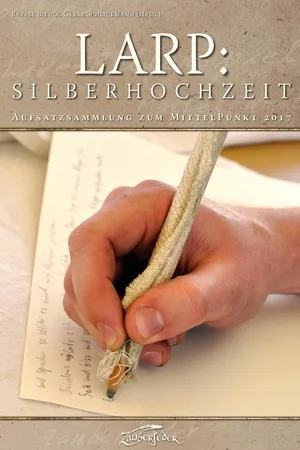
Seit mehr als 25 Jahren wird Live-Rollenspiel in Deutschland betrieben, aber für viele markiert der Draccon 1992 den Beginn der offiziellen Larp-Zeitrechnung – damit können wir spätestens jetzt das 25. Jubiläum feiern!Larp entwickelt sich weiter, Neues wird aufgenommen, Bewährtes wird ausgebaut, und es lässt auch außerhalb der eigentlichen Veranstaltungen die Menschen nicht los. In sechs ausgewählten Beiträgen stellt die diesjährige Aufsatzsammlung Gedanken über den gegenwärtigen Stand des Live-Rollenspiels vor, zeigt neue Denkweisen und Ideen, wie sich Larp in den nächsten 25 Jahren noch weiter entwickeln könnte.Zusammengestellt und aufbereitet anlässlich der Live-Rollenspiel-Konferenz MittelPunkt 2017.
eBook - ePub
LARP: Silberhochzeit
Aufsatzsammlung zum MittelPunkt 2017
- 106 pages
- English
- ePUB (mobile friendly)
- Available on iOS & Android
eBook - ePub
LARP: Silberhochzeit
Aufsatzsammlung zum MittelPunkt 2017
About this book
Information
TRANSLATING RESEARCH INTO LARP
VILLAGE, SHELTER, COMFORT
INTRODUCTION
Larp (live-action role-play) makes it possible to experience life worlds different from one’s own, and many describe larping as an immersive experience, as a way of changing perspectives and becoming other.1 Larp as a practice “does realities” much the same way other practices do and thus can be used to make things visible we usually take for granted.2 Some larps, particularly those designed for an educational purpose or associated with the school of thought known as “Nordic Larp,”3 seek to give their participants insights into other realities or to make them think about a given issue. One of the bestknown examples, the political larp “Halat Hisar,”4 offers players the chance to experience life under occupation. Because learning (a specific message) does not just happen through larping alone,5 Nordic and educational larps heavily rely on workshops before and debriefings after the experience itself.
Echoing the tenet “show, don’t tell” these forms of larp speak to the qualitative research paradigm named “performance ethnography.”6 This pedagogically inclined approach seeks to give people a voice by staging events, plays, and exhibitions together with those under study. Going beyond the usual modes of scholarly communication — which arguably lean towards telling — performance ethnography allows the audience a more qualitative engagement with research. Still, this putative audience remains just that, gains experience only second-hand.
Contrastingly, we argue that larps provide first-hand experience. Building on performance ethnography and taking the limits of an “experimental anthropology” into account (that is, to be able to offer only glimpses of another reality and not complete, 100% accurate, “authentic” experiences),7 this paper showcases a larp that was designed together with former hikikomori from Japan to make their life worlds experienceable to others. Hikikomori in Japanese refers to people in long-term, social withdrawal and to the phenomenon itself.8 What counts as hikikomori and what characterises this form of withdrawal has varied over the years and continues to be debated in medical and public discourse since the late 1990s.9 The Ministry of Health, Labour, and Welfare lists criteria, such as a life-style centred on the home, an unwillingness or inability to attend school or work, a duration of at least six months, and no diagnosed mental illness.10 At first mostly addressed as a youth issue, today the number of hikikomori aged 40 or older increases constantly, who have stayed inside their homes and had no social contact beyond the immediate family for ten or more years.11 Decreasing birth rates since the late 20th century and an ongoing recession furthered a social climate in Japan, that is very much concerned with reproduction (in the biological and economic sense), so that media portrayals of hikikomori appear rather unsympathetic and depict them as lazy brats who should just get a job and a spouse.12 Despite governmental and regional support campaigns, hikikomori remains a media stereotype and the only image many are familiar with. Further, hikikomori being handier than “social withdrawal,” the term has also crossed borders and is used in other languages as well.13
The larp under consideration, “Village, Shelter, Comfort,” co-designed with former hikikomori, seeks to go against the stereotype of laziness by raising awareness of the dilemmas some hikikomori are confronted with. The larp is part of an ongoing research project on the learning effects of larping and the search for an evaluation method for such effects. After further discussing hikikomori and introducing the larp and its background, the last part of this paper discusses this evaluation method by outlining player responses from five runs of “Village, Shelter, Comfort.” Adjusting the multi-method approach of PAC-Analysis14 for the purpose of evaluating larps, the aim is to fill the gap of an analytical tool for studying learning effects through larping.
PERFORMING HIKIKOMORI
“Village, Shelter, Comfort” (VSC) evolved out of a research project at Kyoto University,15 which investigates fore and foremost the hitherto neglected potential of translating research results, in this case concerning hikikomori, into an experienceable format to de-construct the phenomenon’s discourse and practices in Japan. In this regard, it seeks to raise awareness for applications of role-playing to re-construct new ways of engaging with stereotypes beyond the classic mode of presenting “correct” information about the stereotyped.16
Less as a stereotype but as a matter of continued concern, the phenomena named hikikomori gained again in attention in recent years, especially from not medically trained scholars,17 and in non-Japanese journalism,18 but also from (already involved) medical practitioners.19 Including anthropological studies of the afflicted persons’ life worlds or media representations of hikikomori, the former theses focus on discursive and societal contexts, describing hikikomori as one element of a cascade of youth issues “undermining the traditional [sic!] Japanese value system”20 and ranging from school refusal, otaku (“nerds”), Internet addiction, furītā (“freeter,” the non-regularly employed) to social withdrawal and NEETs (“Not in Education, Employment, or Training”). Here, hikikomori is imagined as an example for alienation in modern, post-high-growth era Japan, a symbol for an increased loss of social cohesion, and a path to egoistic individualism. Attempts to include hikikomori as a culture-bound psychiatric syndrome (contrastingly seen as induced by Japanese culture not undermining it)21 into the Diagnostic and Statistical Manual of Mental Disorders (DSM-5), the global standard for classifying patients into categories of mental illness to administer therapy and treatment, however, failed.
A remarkable feature of the Japanese psychiatric d...
Table of contents
- Cover
- Titel
- Impressum
- Inhalt
- Danksagung
- Vorwort
- Musik im Larp – Aus der Werkstatt eines Barden (Matthias Keidel)
- Kampfphilosophie – Kontroverse Kampfstile und ihre Anhängerschaft (Selena Freitag)
- Translating Research into Larp – Village, Shelter, Comfort (Björn-Ole Kamm)
- Larp im Kopf – Gedanken zur Psychologie des Live-Rollenspiels (Katharina Munz)
- Larp im privaten und beruflichen Umfeld (Jeremias Weber und Michael Engelhardt)
- Kunst und Bürokratie – Theaterwissenschaftliche Einschätzung zur Frage, ob Live-Rollenspiel als Theater zu sehen ist (Gerke Schlickmann)
- Literatur: Lesenswert
Trusted by 375,005 students
Access to over 1.5 million titles for a fair monthly price.
Study more efficiently using our study tools.
Frequently asked questions
Yes, you can cancel anytime from the Subscription tab in your account settings on the Perlego website. Your subscription will stay active until the end of your current billing period. Learn how to cancel your subscription
No, books cannot be downloaded as external files, such as PDFs, for use outside of Perlego. However, you can download books within the Perlego app for offline reading on mobile or tablet. Learn how to download books offline
Perlego offers two plans: Essential and Complete
- Essential is ideal for learners and professionals who enjoy exploring a wide range of subjects. Access the Essential Library with 800,000+ trusted titles and best-sellers across business, personal growth, and the humanities. Includes unlimited reading time and Standard Read Aloud voice.
- Complete: Perfect for advanced learners and researchers needing full, unrestricted access. Unlock 1.5M+ books across hundreds of subjects, including academic and specialized titles. The Complete Plan also includes advanced features like Premium Read Aloud and Research Assistant.
We are an online textbook subscription service, where you can get access to an entire online library for less than the price of a single book per month. With over 1.5 million books across 990+ topics, we’ve got you covered! Learn about our mission
Look out for the read-aloud symbol on your next book to see if you can listen to it. The read-aloud tool reads text aloud for you, highlighting the text as it is being read. You can pause it, speed it up and slow it down. Learn more about Read Aloud
Yes! You can use the Perlego app on both iOS and Android devices to read anytime, anywhere — even offline. Perfect for commutes or when you’re on the go.
Please note we cannot support devices running on iOS 13 and Android 7 or earlier. Learn more about using the app
Please note we cannot support devices running on iOS 13 and Android 7 or earlier. Learn more about using the app
Yes, you can access LARP: Silberhochzeit by Matthias Keidel, Selena Freitag, Björn-Ole Kamm, Katharina Munz, Jeremias Weber, Michael Engelhardt, Gerke Schlickmann, Gerke Schlickmann, Rafael Bienia in PDF and/or ePUB format, as well as other popular books in Didattica & Teatro europeo. We have over 1.5 million books available in our catalogue for you to explore.