A comprehensive history of film lighting, from its earliest origins to the heyday of Hollywood dominance - and beyond. This is a book about the art of lighting, "the relevance of pictures, and the responsibility of all those who take pictures of the world and show them". In an age of constant digital snapshots, with their mercilessly artless recording of everything around us, the award-winning director and scriptwriter Richard Blank makes a compelling case for this increasingly neglected art, and for sustaining "the awareness of its responsibility".In Film & Light, Richard Blank draws on examples from a century of pioneering filmmakers - from Griffith to Buñuel, Ophüls to Altman, Rossellini to Scorsese, Eisenstein to Wong Kar-Wai - to trace the historical development of lighting technology, analyse the changing "rules" and techniques of film lighting, and define the key terms surrounding the technical innovations of its art. The close attention he brings to bear on these modern masters - from DeMille to De Sica to Lars von Trier, Niblo to Murnau to Siodmark, via Maurice Tourneur and Fritz Lang, Charlie Chaplin and Orson Welles - brilliantly illuminates the hidden art of these past masters, as well as the troubled social context by which they each variously came to shine.
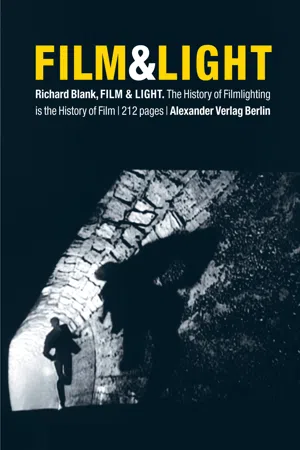
- 212 pages
- English
- ePUB (mobile friendly)
- Available on iOS & Android
eBook - ePub
About this book
Information
Subtopic
Film & VideoEXPLANATORY NOTES
Subject matter
1 Peter Baxter, “On the History and Ideology of Film Lighting”, Screen 16/3, 1975, pages 83–106.Wolfgang Samlowski, Hans J. Wulff, “Vom Sichtbarmachen zur kunstvollen Gestaltung: Geschichte des Filmlichts”, in: Licht und Leitung, edited by Lorenz Engell, Bernhard Siegert und Joseph Vogl. Archiv für Mediengeschichte, Weimar, 2002, pages 169–184.
2 Film-Dienst, Das Filmmagazin, 25th October 2007.
3 Stephan and Nandy Ronart, Lexikon der Arabischen Welt. Ein historisch-politisches Nachschlagewerk, Zurich and Munich 1972, page 25.
The Rules
1 Hilmar Mehnert, Filmfotographie, Fernsehfilmfotographie, Leipzig 1971, page 298.
2 Ibid.
3 Kris Malkievicz, Filmlighting, Talks with Hollywood’s Cinematographers and Gaffers, New York, 1986, page 100.
4 Vilmos Zsigmond, interview in: ibid., page 102.
5 Allen Daviau, in: ibid., page 104.
6 Kris Malkievicz, ibid., page 100.
7 Allen Daviau, in: ibid., page 104.
8 Richmond Aguilar, in: ibid., page 105.
9 Ibid.
10 Hilmar Mehnert, in: loc. cit., page 328.
11 Ibid, page 298.
12 Achim Dunker, Die chinesische Sonne leuchtet immer von unten. Licht und Schatten-Gestaltung im Film, Munich 1993, page 40.
13 Ibid., page 39.
14 Hilmar Mehnert, in: loc. cit., page 300 ff.
15 Ibid., page 338 ff.
16 John Alton, Painting with Light, New York 1949, Reprint Berkeley, Los Angeles, London 1995.
17 Ibid., page 1.
18 Ibid., page 30.
19 Ibid., page 40.
20 Ibid., page 41.
21 Ibid., page 51.
22 Achim Dunker, loc. cit., page 19 f.
23 Ibid., page 18.
24 Ibid., page 7.
25 Ibid., page 36 f.
26 Hilmar Mehnert, loc. cit., page 328.
27 Jordan Cronenweth, Interview Kris Malkievicz, loc.cit., page 161.
28 James Wong Howe, in: ibid., page 159.
29 James Crabe, in: ibid., page 161.
30 James Wong Howe, in: ibid., page 162.
31 Achim Dunker, ibid., page 10 f.
32 Ibid., page 11.
33 Jost Vacano, interview in: Achim Dunker, loc. cit., page 133.
34 Axel Block, interview in: ibd., page 101.
35 Jost Vacano, ibid., page 133.
36 Eduardo Serra in: Filmbulletin, 3.06., Werkstattgespräch mit Gerhard Midding und Robert Müller: “Der Film trifft die Entscheidung.”
37 Thomas Gans, Filmlicht, Handbuch der Beleuchtung im dramatischen Film, Aachen 1999, page 191 ff.
38 W. Solm, Die Beleuchtung der Filmszene, Vienna 1972, page 113 f.
39 Gernot Roll, Interview in Achim Dunker, loc. cit., page 114.
40 Cf. Achim Dunker, ibid.
41 Wolfgang Samlowski, Hans J. Wulff, ibid.
42 Peter Baxter, loc. cit.
43 Barry Salt, Film Style and Technology, History and Analysis, London 1983. One has to resort to Salt due to lack of literature on the subject. Although his design of a “strictly scientifi...
Table of contents
- Cover
- Titel
- Copyright
- Inhalt
- Subject matter
- Dilettantism
- The Rules
- The glass studio – Hollywood before 1915
- Ways to the “classical style” – Hollywood from 1915 to 1925
- Irritation
- Failure
- Emigrants
- Television – Aristotle, Hollywood, Appia, television and other intolerances
- Everything is new
- Mavericks
- Conclusion
- Explanatory Notes
- Index
- The Author
- Back Cover
Trusted by 375,005 students
Access to over 1.5 million titles for a fair monthly price.
Study more efficiently using our study tools.
Frequently asked questions
Yes, you can cancel anytime from the Subscription tab in your account settings on the Perlego website. Your subscription will stay active until the end of your current billing period. Learn how to cancel your subscription
No, books cannot be downloaded as external files, such as PDFs, for use outside of Perlego. However, you can download books within the Perlego app for offline reading on mobile or tablet. Learn how to download books offline
Perlego offers two plans: Essential and Complete
- Essential is ideal for learners and professionals who enjoy exploring a wide range of subjects. Access the Essential Library with 800,000+ trusted titles and best-sellers across business, personal growth, and the humanities. Includes unlimited reading time and Standard Read Aloud voice.
- Complete: Perfect for advanced learners and researchers needing full, unrestricted access. Unlock 1.5M+ books across hundreds of subjects, including academic and specialized titles. The Complete Plan also includes advanced features like Premium Read Aloud and Research Assistant.
We are an online textbook subscription service, where you can get access to an entire online library for less than the price of a single book per month. With over 1.5 million books across 990+ topics, we’ve got you covered! Learn about our mission
Look out for the read-aloud symbol on your next book to see if you can listen to it. The read-aloud tool reads text aloud for you, highlighting the text as it is being read. You can pause it, speed it up and slow it down. Learn more about Read Aloud
Yes! You can use the Perlego app on both iOS and Android devices to read anytime, anywhere — even offline. Perfect for commutes or when you’re on the go.
Please note we cannot support devices running on iOS 13 and Android 7 or earlier. Learn more about using the app
Please note we cannot support devices running on iOS 13 and Android 7 or earlier. Learn more about using the app
Yes, you can access Film & Light by Richard Blank in PDF and/or ePUB format, as well as other popular books in Media & Performing Arts & Film & Video. We have over 1.5 million books available in our catalogue for you to explore.