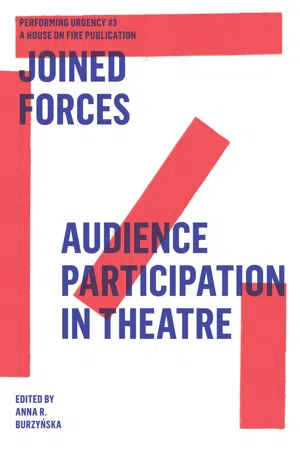
Band 3 der von Florian Malzacher herausgegebenen englischsprachigen Reihe Performing Urgency.Im Kontext heutiger Politik, Wirtschaft und sich permanent verändernden kulturellen Trends kommt das traditionelle Theater mit seiner Trennung von aktiven Darstellern und passiven Zuschauern immer mehr aus der Mode. Zeitgenössische Künstler emanzipieren ihr Publikum, laden es auf die Bühne und in die Performance ein, beleidigen und provozieren es und erproben verschiedenste Techniken der Teilhabe. Das Buch verbindet zahlreiche Beispiele von Publikumsbeteiligung mit Problemen der Partizipation in Demokratie und sozial engagierter Kunst.The nineteenth century was a century of actors. The twentieth century was a century of directors. The twenty-first century is a century of spectators. With Jacques Rancière's The Emancipated Spectator (2009) being the most discussed theatre-related text of the last decade, there is an increase in scholarly and curatorial interest in the most mysterious, potentially dangerous and, in fact, most important participant of the performance, who stays silent, motionless, and hidden in darkness: the audience. And similarly, artists desire to finally 'meet the spectators': to let them speak, get into a dialogue with them, invite them to involve themselves in pursuing the performance.
eBook - ePub
Joined Forces
Audience Participation in Theatre. Performing Urgencies #3
- 200 pages
- English
- ePUB (mobile friendly)
- Available on iOS & Android
eBook - ePub
Joined Forces
Audience Participation in Theatre. Performing Urgencies #3
About this book
Information
Subtopic
Acting & AuditioningEXPERIENCES
Tobi Müller in conversation with Helgard Haug, Stefan Kaegi and Daniel Wetzel (Rimini Protokoll)
Spectator Reincarnated

TOBI MÜLLER (TM): How do you cast your everyday experts, and how do you get them properly involved?
DANIEL WETZEL (DW): One of the differences to professional ensembles is that our people don’t always feel like acting. They have no interest in learning performance techniques. They take part because they feel that we have an interest in a specific matter and it’s about working on it together. Sometimes we notice: hey, we do now give them stage directions! But in fact it’s more about being on equal terms.
TM: So not all experts or actors want to become co-authors on equal terms? Do some of them wish more direction?
STEFAN KAEGI (SK): In the 1970s, actors in fringe ensembles for sure also called themselves co-authors. But it’s different if you take part in an improvisation with your creative potential or with your identity. Experts communicate very directly about what they have experienced. And some are sensitive, with good reason, as it’s about their own lives. It’s like a collective writing process during rehearsals, a negotiation, not like in a documentary, where the author edits without the protagonists. While preparing our project Staat I for December 2016 at Kammerspiele in Munich, a project on secret services and surveillance, it occurs that experts edit themselves completely out of the piece.
TM: What role does video play in rehearsals? Do you show it to the experts?
HELGARD HAUG (HH): There are protagonists who refuse to even watch the documentary of finalised performances. They don’t want to watch themselves with their eyes.
DW: The fear of embarrassment about one’s own image is widespread, especially with non-actors. Funnily enough, even with people who are used to performing in public – teachers for instance.
HH: We rarely document during the rehearsals. If at all, we do it to discuss something again in the production team or to clarify technical processes. The basis for cooperation is mutual trust, having experts think: ‘it’ll be fine – it’ll work out!’. Otherwise, you won’t get far.
SK: We had this trust in Situation Rooms (2013). It was very important, because for a long time each of the 20 protagonists only their own part, and the positions were totally opposed to each other regarding their contents. It was a piece in several spaces, with visitors stepping with earphones and tablet into the role of experts, who had partly filmed themselves and were now talking.
TM: In Situation Rooms, there is for instance the former child soldier Yaoundé from Congo. Do you provide room for a story, no matter if it is believed as it is or not?
HH: Of course.
DW: Yes, but you need to trust yourself in front of the mirror in the morning. I know this as well [laughs].
TM: But the ‘documentary theatre’ category in which you still operate also suggests authenticity of the stories, doesn’t it?
SK: The mirror is an excellent metaphor, particularly with Yaoundé. I think we really see his memories, though they are certainly, well, edited or shortened, probably very distant from what actually happened. The reenactment reconstructs what he wants or is able to remember. I think it is interesting to step through such a mirror.
DW: To a certain extent we all invent, according to the situation, and we all know it. This is why we don’t talk of authenticity. In an interview on our first joint piece I was quoted in the headline speaking about ‘moments of truth’, and the colleagues were teasing me for weeks with the pathetic slip-up the Frankfurter Allgemeine Zeitung printed in bold.
TM: In the end, you always tell stories of success…
DW: … you mean survival stories, don’t you?
TM: Yes, success stories and not failure stories. Overcoming traumas…
DW: In most cases, we can only work with the people if they are in control of these stories.
TM: Whereas municipal theatres are obsessed with failure, because of the tradition of tragedy.
DW: Oh, I had forgotten that, German municipal theatres. We do notice if the one or the other wants to show off or not. But we don’t do any parallel research, we don’t send out any detectives or journalists.
HH: The protagonists look back on a tragic situation. Perhaps they reconstruct it, but they have escaped from it, that’s true. Yet it’s not finished; even if we don’t invite anybody who is still mourning, there are fragile moments that are also extremely important and valuable for theatre. I can think for instance of the scene in Situation Rooms, where a doctor talks about his trauma in a way that makes you feel very close to him. He takes his experiences during the civil war in Sierra Leone to his flat in Berlin, he observes himself as he is unable to get rid of what he witnessed, as how they continue into his nights. By describing this, the audience gets involved in a very private moment – a shock – it’s not over.
TM: Failure marks the tragedy, and according to my thesis, it only works if you don’t talk to people. Just like Jelinek. You always need to be able to reproduce the diagnosis of failure.
DW: You mean that when asking people about different positions, tragedy gets lost as a form of description?
TM: Yes. Perhaps it is because the protagonists in your pieces become more complex. Visitors reenact something instead of the protagonists in both Situation Rooms and the World Climate Summit, when you played the real 2014-15 Climate Summits in a theatre with the audience. Could we say that the visitor becomes an avatar?
SK: Who would be controlling?
TM: In Situation Rooms you are clearly driven through the earphones and the tablet.
DW: You take the place of the actor telling something, well. Avatars are digital, I as a visitor am real. That’s interesting: avatars of flesh and blood!
HH: The organisational and logistical corset in Situation Rooms is much stronger than usual. It’s all about precision: the audience is guided or seduced into a sort of clockwork of actions, roles, and experiences and bit by bit becomes a part, a protagonist of it. The more simultaneously you repeat the actions with the film on the template you see on the tablet, the better. With World Climate Summit (2014) we try to set a sort of beat to suggest time and content-related urgency and how the spectators as delegation members can still reach the climate goals. And yet this is more relaxed than in Situation Rooms. Because you can also say: leave me alone, I’m off to the bar for a while. You don’t cause any big damage, as there are several people in each delegation. If a single audience member decides to step out Situation Rooms it has a big impact on the show and can partly destroy it.
TM: I have the impression that you are becoming increasingly masters of illusion. Immersive spaces, technical perfection, visitors as part of different simulations they can completely dip into…
DW: Yes, but all this needs to be shown within its limitations. Everything is shaking. You don’t move any three metres without feeling how everything is constructed in Situation Rooms.

Rimini Protokoll, World Climate Summit (2014)
TM: It works incredibly seamlessly in the timeline though…
DW / HH: It does.
TM: There are empathic experiences for the visitors and actors in these immersive spaces and scripts. The tear in Friedrich Schiller is in your case the emotion about being part of another, often shockingly different world. Like in Call Cutta in a Box, where a video conference di...
Table of contents
- Cover
- Titel
- Impressum
- Inhalt
- INTRODUCTION
- LANDSCAPES
- Places
- ANTI-MANIFESTOS
- EXPERIENCES
- House on Fire
- Authors
Trusted by 375,005 students
Access to over 1.5 million titles for a fair monthly price.
Study more efficiently using our study tools.
Frequently asked questions
Yes, you can cancel anytime from the Subscription tab in your account settings on the Perlego website. Your subscription will stay active until the end of your current billing period. Learn how to cancel your subscription
No, books cannot be downloaded as external files, such as PDFs, for use outside of Perlego. However, you can download books within the Perlego app for offline reading on mobile or tablet. Learn how to download books offline
Perlego offers two plans: Essential and Complete
- Essential is ideal for learners and professionals who enjoy exploring a wide range of subjects. Access the Essential Library with 800,000+ trusted titles and best-sellers across business, personal growth, and the humanities. Includes unlimited reading time and Standard Read Aloud voice.
- Complete: Perfect for advanced learners and researchers needing full, unrestricted access. Unlock 1.5M+ books across hundreds of subjects, including academic and specialized titles. The Complete Plan also includes advanced features like Premium Read Aloud and Research Assistant.
We are an online textbook subscription service, where you can get access to an entire online library for less than the price of a single book per month. With over 1.5 million books across 990+ topics, we’ve got you covered! Learn about our mission
Look out for the read-aloud symbol on your next book to see if you can listen to it. The read-aloud tool reads text aloud for you, highlighting the text as it is being read. You can pause it, speed it up and slow it down. Learn more about Read Aloud
Yes! You can use the Perlego app on both iOS and Android devices to read anytime, anywhere — even offline. Perfect for commutes or when you’re on the go.
Please note we cannot support devices running on iOS 13 and Android 7 or earlier. Learn more about using the app
Please note we cannot support devices running on iOS 13 and Android 7 or earlier. Learn more about using the app
Yes, you can access Joined Forces by Jan Sowa,Dominique Nduhura,Antoine Pickels,Justine Boutens,Elena Basteri,Miriam Tscholl,Roger Bernat,Roberto Fratini Serafide,Ophelia Patricio Arrabal,Tobi Müller,Helgard Haug,Stefan Kaegi,Daniel Wetzel,Rimini Protokoll,Lotte van den Berg,Tom Sellar,Adelheid Roosen,Wojtek Ziemilski,Adam Czirak,Johan, Anna R. Burzynska,Florian Malzacher in PDF and/or ePUB format, as well as other popular books in Media & Performing Arts & Acting & Auditioning. We have over 1.5 million books available in our catalogue for you to explore.