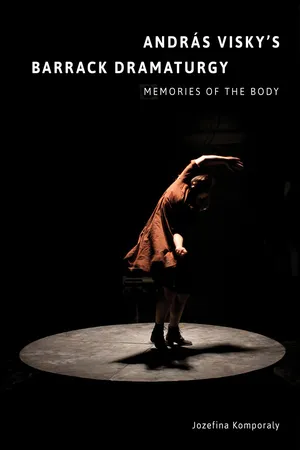
Widely considered one of the most innovative voices in Hungarian theatre, András Visky has enjoyed growing audiences and increased critical acclaim over the last fifteen years. Nonetheless, his plays have yet to reach a wider English-language audience. This volume, edited by Jozefina Komporaly, begins to correct this by bringing together a translated collection of Visky's work.
The book includes the first English-language anthology of Visky's best known plays – Juliet, I Killed My Mother, and Porn – as well as critical analysis and an exploration of Visky's 'Barrack Dramaturgy', a dramaturgical theory in which he considers the theatre as a space for exploring feelings of cultural and personal captivity. Inspired by personal experience of the oppressive communist regime in Romania, Visky's work explores the themes of gender, justice and trauma, encouraging shared moments of remembrance and collective memory. This collection makes use of scripts and director's notes, as well as interviews with creative teams behind the productions, to reveal a holistic, insider's view of Visky's artistic vision. Scholars and practitioners alike will benefit from this rare, English-language collection of Visky's work and dramaturgy.
eBook - ePub
András Visky’s Barrack Dramaturgy: Memories of the Body
Memories of the Body
- 313 pages
- English
- ePUB (mobile friendly)
- Available on iOS & Android
eBook - ePub
András Visky’s Barrack Dramaturgy: Memories of the Body
Memories of the Body
About this book
Information
Introduction to Juliet: Confinement as Embodied Experience in András Visky’s Juliet
Works of art about human tenacity notwithstanding unbearable circumstances or explorations of the limit experience tend to resonate with readers and spectators by sheer virtue of their subject matter. Yet András Visky’s award-winning Júlia/Juliet (2002), addressing the dissolution of a family and a mother’s extraordinary strength in the face of deportation to the Romanian Gulag in the 1950s, stands out hands down: as it is a true story rooted in the plight of the playwright’s family. Directly inspired by his own mother’s experience, Visky goes beyond the boundaries of intergeneric adaptation and fashions a strikingly original text that ‘is as human and honest as it is literary and at times lyrical’, and that emerges so compelling due to whom the character of Juliet is talking to, ‘as much as what she is saying’ (Zarris 2010). In the course of the play, Juliet reflects on her own and her family’s past, and examines a range of brutal incidents leading to and following on from their forced captivity. Yet Juliet is not discussing her story with her numerous children or addresses the audience witnessing her plight, but rather she is involved in a conversation of sorts with seemingly absent partners that determine her destiny: God and Death.
By structuring his play in this way, Visky makes the pertinent point that the representation of captivity as trauma has to interrogate, on the one hand, the limits of this experience, and, on the other, challenge the patterns and boundaries of our understanding. In addition, such attempts at representation have the mission to also offer a platform for braiding questions about ethics and aesthetics, and instigate a reconsideration of spectatorship, by means of repositioning the audience from distant spectator to involved participant. In his contribution to the 2015 Venice Biennale, Visky notes:
The social media age and the post-totalitarian societies confront theatre makers with the challenge of defining the unique and distinct identity of their art. The real presence in a shared space of both the audience and players: probably this is the uniqueness of the theatrical experience. The value of that bodily presence in the real time of the participants, and the specific ephemerality of the event, might offer a valuable and real encounter of individuals, breaking the false and romantic hierarchy of mystically blessed creators and passive receivers. There is an increasing need for a ‘new intimacy’, the closeness of the other and the event of anagnorisis (recognition), when the Other is recognized as an obvious and dramatic component of one’s own identity; the audience as a participative presence and partner, instead of a faceless and well-domesticated consumer.
(Visky 2015: 114)
Rooted in this belief in theatre’s live and participatory qualities, Visky creates a communal context for remembering, and utilizes dramatic representation as an extended mode of testimony. Reminiscent of Elie Wiesel’s claim that ‘if the Greeks invented tragedy, the Romans the epistle and Renaissance the sonnet our generation invented a new literature, that of testimony’, Visky draws on personal experience in order to tell urgent stories of trauma experienced under totalitarianism (Wiesel 1977: 9). Like Wiesel’s, Visky’s testimony is that of a survivor (albeit not of the Holocaust but of the Communist Gulag), and they have in common an unbearable experience that can only be told in fragmentary fashion, from multiple perspectives. The case studies Visky dramatizes in his plays, be it his landmark Juliet or more recent work, are inspired by the post-war history of Romania, although Visky himself is an ethnic Hungarian living and working in Transylvania who writes in his native language.1 Thus, his work is simultaneously affiliated to two cultural contexts and theatre traditions, and has been embraced with equal interest by directors and companies in both Hungary and Romania. Juliet is perhaps the best exemplar in the playwright’s oeuvre to date regarding the process of reconciliation between these two nations, due to its claims on the universality of evil (Visky in Bodnár 2008), and on the fact that there is no place for inter-ethnic tension in the face of genuine vulnerability and terror. To this end, for instance, Juliet traces the mutual interdependence of various ethnicities in Romania through a most potent symbol: a Romanianized German shepherd dog owned by a Hungarian family, whom they are forced to give up at the point of their abrupt deprivation of freedom.
Visky argues for an acute need to nuance the victim-victimizer dichotomy, in terms of ethnic, class and indeed social opposition, and stresses the necessity of sharing a much broader variety of stories in order to get a fuller picture of actual events. In this sense, he hails the widely controversial Augustinian confession of celebrated Hungarian novelist Péter Esterházy (1950–2016), Javított kiadás/Revised Edition (2002) – in which the author confronts his formerly idolized father’s past as a secret police informer (Esterházy stems from one of the most illustrious Hungarian aristocratic families, who have been dispossessed by the socialist regime) – as a landmark event in post-Communist Hungarian literature for its attempts at coming to terms with the past. Visky was hoping for this work, published following Esterházy’s well-received memoirs Harmonia Caelestis (2000) written unaware of his father’s collaboration with the totalitarian regime, to act as a bridge between the discordant voices on the Hungarian cultural and political spectrum, and was disappointed by the negative reception that mainly concentrated on the various parties defending their position and absolving their respective informers (Visky in Bodnár 2008). Such attitudes, of course, only confirm the validity of Cathy Caruth’s argument according to which ‘through the notion of trauma […] we can understand that a re-thinking of reference is not aimed at eliminating history, but at resituating it in our understanding, that is, of precisely permitting history to arise where immediate understanding may not’ (Caruth 1991: 182). Visky endorses this process of rethinking through his entire body of work, and urges not merely a re-evaluation of history but also of our ethical and political connections to it.
Until the fall of the Iron Curtain in December 1989, in Romania as well as in Hungary (and indeed in other countries in the Eastern bloc), censorship in literature meant that potential voices were in effect silenced before they could speak out. In other words, artists were forced to forget, and as a result, for survivors of Communist atrocities, remaining silent was not simply an ethical decision. Dragan Klaić has classified serious playwrights under Communism into three groups: ‘exiles, dissidents and boundary pushers’ – as the rest were mere entertainers and opportunists with little concern today (Klaić 2010: xii). Exiles were very few and were practically banned from cultural memory in their native country (see the case of Eugène Ionesco in Romania), with the rare exception of Slawomir Mrožek who was produced both in the Eastern bloc and in the West. Dissidents included most famously the Czech Vaclav Havel, but also the Hungarian István Eörsi and Árpád Göncz, and were also relatively inaccessible to the general public. The boundary pushers attempted to find ways of disguising their political message in such a way that censorship did not interfere, and made use of an elaborately coded language including allusion, insinuation and innuendo, and the resulting work was highly symbolic and metaphoric. As a general rule, however, due to the vigilance of theatre censorship, new work was particularly closely scrutinized and any ambiguity not to mention challenge to the system led to banning the play and silencing the playwright. In this situation, the Romanian theatre scene did not produce an indigenous Vaclav Havel, although not all playwrights were comfortable with practicing their craft under Party guidelines that instituted socialist realism as an essential trend in Romanian culture. Adopting an allegorical tone, playwrights with an agenda of contestation such as Marin Sorescu and (the ethnic Hungarian) András Sütő would opt for historically distant plots to explore current issues and thus deter or avoid censorship. Crucially, however, playwrights very rarely attempted to overtly reveal the trauma of Communism during the time when the regime was in power, and those who did, such as Géza Páskándi, risked imminent retaliation. In the changed political circumstances post-1989 and the disappearance of censorship, theatre found itself in a new context. In the early 1990s, it lost its appeal almost entirely, as patrons preferred the spectacle of political protests but also the pleasure of consumerism yielding to the temptations of around the clock television (in the 1980s Romanian television only emitted programmes for about two hours a day). From the mid-1990s onwards, however, theatres have started to regain their audiences, and younger writers also opted for this genre, often with an aim to revolutionize the former norm of realistic dramatic language (see the work of Vlad Zografi, Alina Mungiu, Saviana Stănescu, Stefan Peca, Gianina Cărbunariu, Csaba Székely).
András Visky also became a playwright at this juncture, continuing his career as a poet, theatre critic and dramaturg. He writes his theatrically innovative plays with mise-en-scène in mind, and transmits the urgency of addressing the atrocities of totalitarianism, not only at a time when this is possible, but also at a moment when – as a dramatist and witness of the era – he has come to terms with the facts of the trauma and negotiated a period of self-imposed silence. Despite regularly writing in other genres, Visky opts for the dramatic form as the most suitable vehicle for providing a context for the traumatic experience, due to the communal and live qualities of theatre. Visky is a vocal advocate for the absolute necessity of bringing dramatic texts alive through performance, and states that the script of Juliet only contained the seeds of theatre in a dormant fashion, and it needed Gábor Tompa’s directorial intervention to reveal its potential as a ‘text inscribed into space’ (György 2007: 132). Through performance, the act of remembrance becomes a public and communal ritual that invites spectators to take account of events that may have also shaped their destinies. For the playwright, taking stock of the legacy of the Communist era is a political as well as spiritual act that has not yet been completed with the regime change and transition to a new economic order.
Visky wrote Juliet commissioned by Timothy Bentch on behalf of the Song for the Nations Cultural Foundation, who had previously read the memoirs of Júlia Visky published in the United States, and wanted to produce a stage version based on the extraordinary story of an exceptional woman who took the hostility of Communism on the chin and survived the Stalinist Gulag with seven underage children in tow. Opting for András Visky himself to be responsible for this intergeneric adaptation seemed like a natural choice; however, the process turned out to be a consuming act for both playwright and son. Not only did he have to re-live his own early childhood trauma of deportation and orphanhood of sorts, but he was also confronted with the challenging task of writing a text based on someone else’s life. In fact, he found that it was impossible for him to write another person’s story because ‘one is compelled to write one’s own story under the guise of other people’s’ (Visky in Kovács 2011). Indeed, Juliet is Visky’s most overtly autobiographical play to date and, perhaps for this reason, he finds it the hardest to edit its Hungarian original, although the play has been performed in numerous textual variants and translations. Unusually for contemporary European theatre practice, Gábor Tompa’s production utilized the entire text of the play and ran in this shape for years in Cluj and Budapest.
Although Juliet is written for one performer, it does not aim to continue the lineage of historical monodramas favoured by the Hungarian theatre in Transylvania in the 1970s and 1980s. Many of the latter excelled as important cultural and political acts of protest against totalitarianism, but as Visky recalls, they did not propose to establish an immediate connection with their audience as the ‘presence of spectators was not integral to their productions’ (Visky in Kovács 2011). For Visky theatre is not so much a platform for telling stories, old or new, but an opportunity for intimacy, communion and mutually valid experiences. Through the application of Barrack Dramaturgy, performers and audience sign up for a shared experience: being enclosed into a claustrophobic space in which the performer-spectator proximity is crucial. The performance commences with this joint act of being locked in, and finishes with an equally communal exit or liberation, the latter b...
Table of contents
- Cover Page
- Title Page
- Copyright
- Contents
- Acknowledgements
- Preface: In Search of Lost Reality
- Introductory Texts
- Part 1
- Part 2
- Part 3
- Interviews
- Afterword
- Notes on Contributors
- Back Cover
Trusted by 375,005 students
Access to over 1.5 million titles for a fair monthly price.
Study more efficiently using our study tools.
Frequently asked questions
Yes, you can cancel anytime from the Subscription tab in your account settings on the Perlego website. Your subscription will stay active until the end of your current billing period. Learn how to cancel your subscription
No, books cannot be downloaded as external files, such as PDFs, for use outside of Perlego. However, you can download books within the Perlego app for offline reading on mobile or tablet. Learn how to download books offline
We are an online textbook subscription service, where you can get access to an entire online library for less than the price of a single book per month. With over 1.5 million books across 990+ topics, we’ve got you covered! Learn about our mission
Look out for the read-aloud symbol on your next book to see if you can listen to it. The read-aloud tool reads text aloud for you, highlighting the text as it is being read. You can pause it, speed it up and slow it down. Learn more about Read Aloud
Yes! You can use the Perlego app on both iOS and Android devices to read anytime, anywhere — even offline. Perfect for commutes or when you’re on the go.
Please note we cannot support devices running on iOS 13 and Android 7 or earlier. Learn more about using the app
Please note we cannot support devices running on iOS 13 and Android 7 or earlier. Learn more about using the app
Yes, you can access András Visky’s Barrack Dramaturgy: Memories of the Body by Jozefina Komporaly, Patrick Duggan in PDF and/or ePUB format, as well as other popular books in Art & Art General. We have over 1.5 million books available in our catalogue for you to explore.