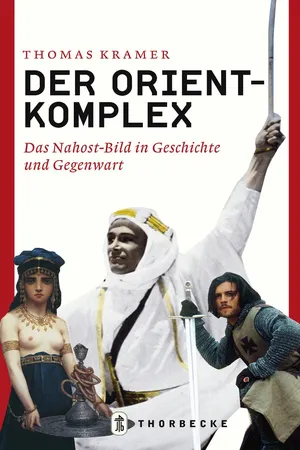
Der Orient-Komplex
eBook - ePub

Der Orient-Komplex

Das Nahost-Bild in Geschichte und Gegenwart

  1. 248 pages
  2. English
  3. ePUB (mobile friendly)
  4. Available on iOS & Android
eBook - ePub

Der Orient-Komplex

Das Nahost-Bild in Geschichte und Gegenwart

About this book

Autoren wie Karl May, Thomas Mann oder T. E. Lawrence, der legendĂ€re »Lawrence von Arabien«, Komponisten wie Wolfgang Amadeus Mozart, Regisseure wie Ridley Scott oder Pop-Gruppen wie Boney M. haben alle etwas gemeinsam - sie beeinflussten und beeinflussen unser Orient-Bild mehr, als dies wissenschaftliche Berichte oder Dokumentationen je könnten. Thomas Kramer entwirft ein Panorama medialer Wahrnehmung des Nahen Ostens in der abendlĂ€ndischen Kultur zwischen Antike und Gegenwart. Er beschrĂ€nkt sich dabei nicht auf den akademischen Bereich und die Produkte des "literarischen Höhenkamms", sondern erweitert den Blickwinkel um das breite Spektrum der PopulĂ€rkultur. Der Leser wird ĂŒberrascht sein, wie sehr Unterhaltungsmedien wie Abenteuerromane, Filme oder Computerspiele landlĂ€ufige Orientbilder auch heute noch im Zeitalter der aktuellen Berichterstattung prĂ€gen.

Frequently asked questions

Yes, you can cancel anytime from the Subscription tab in your account settings on the Perlego website. Your subscription will stay active until the end of your current billing period. Learn how to cancel your subscription.
At the moment all of our mobile-responsive ePub books are available to download via the app. Most of our PDFs are also available to download and we're working on making the final remaining ones downloadable now. Learn more here.
Perlego offers two plans: Essential and Complete
  • Essential is ideal for learners and professionals who enjoy exploring a wide range of subjects. Access the Essential Library with 800,000+ trusted titles and best-sellers across business, personal growth, and the humanities. Includes unlimited reading time and Standard Read Aloud voice.
  • Complete: Perfect for advanced learners and researchers needing full, unrestricted access. Unlock 1.4M+ books across hundreds of subjects, including academic and specialized titles. The Complete Plan also includes advanced features like Premium Read Aloud and Research Assistant.
Both plans are available with monthly, semester, or annual billing cycles.
We are an online textbook subscription service, where you can get access to an entire online library for less than the price of a single book per month. With over 1 million books across 1000+ topics, we’ve got you covered! Learn more here.
Look out for the read-aloud symbol on your next book to see if you can listen to it. The read-aloud tool reads text aloud for you, highlighting the text as it is being read. You can pause it, speed it up and slow it down. Learn more here.
Yes! You can use the Perlego app on both iOS or Android devices to read anytime, anywhere — even offline. Perfect for commutes or when you’re on the go.
Please note we cannot support devices running on iOS 13 and Android 7 or earlier. Learn more about using the app.
Yes, you can access Der Orient-Komplex by Thomas Kramer in PDF and/or ePUB format, as well as other popular books in Historia & Historia de Oriente Medio. We have over one million books available in our catalogue for you to explore.

Information

Anhang

Anmerkungen

1 Johann Wolfgang von Goethe, Faust I. In: Projekt Gutenberg, http://gutenberg.spiegel.de/?id=5&xid/id=3448&kapitel=4&cHash=f2061be284chap004 (20.08.08)
2 Vgl. z. B. Todd Kontje, German Orientalisms. Ann Arbor 2004; Robert Irwin, Dangerous Knowledge. Orientalism and its discontents. New York 2006
3 Vgl. Heinz Nissel, Vom Kulturteil Orient zur Islamischen Welt. In: Ilja Steffelbauer; Khaled Hakami (Hg.), Vom Alten Orient zum Nahen Osten. Eine geographische Spurensuche. Essen 2006, S. 11–27
4 Ferdinand Ossendowski, Unter dem Gluthauch der WĂŒste. Berlin 1922, S. 129
5 Will Durant; Ariel Durant, Kulturgeschichte der Menschheit. Band 2: Will Durant, Der Ferne Osten und der Aufstieg Griechenlands. Köln 1985, S. 498
6 Vgl. Robert E. Howard, Conan. MĂŒnchen 2003
7 Tom Holland, zitiert in: Katharina Wesselmann, Herodot als Meister: Viele kleine Konflikte. In: Frankfurter Allgemeine Zeitung, 17.10.2007, S. N 5
8 Adolf Hitler, Mein Kampf. MĂŒnchen 1930, S. 742
9 Vgl. Felix Dahn, Ein Kampf um Rom. 616.–645. Tausend. Leipzig o. J., S. 424–428
10 Vgl. Herodot, Historien. Hg. von Josef Feix. DĂŒsseldorf 2004
11 Vgl. u. a. Will Durant; Ariel Durant, Kulturgeschichte der Menschheit. Band 3: Will Durant, Das klassische Griechenland. Köln 1985, S. 300–303; auch: Arno Schmidt, Alexander oder Was ist Wahrheit. In: Ders., Bargfelder Ausgabe. Werkgruppe I. Studienausgabe Band I. Bargfeld 1987, S. 103
12 Jakob Wassermann, Alexander in Babylon. Berlin 1990, S. 80
13 Arno Schmidt, S. 103
14 T. E. Lawrence, Die sieben SĂ€ulen der Weisheit. MĂŒnchen/Leipzig 1991, S. 4f.
15 Karl May, Von Bagdad nach Stambul. KARL MAYS HAUPTWERKE IN 33 BÄNDEN. ZĂŒricher Ausgabe. Hg. von Hermann Wiedenroth und Hans WollschlĂ€ger (i. F. stets ZĂŒrich 1992). ZĂŒrich 1992, S. 23
16 Johann Gottfried Herder, Ideen zur Philosophie der Geschichte der Menschheit. Textausgabe. Frankfurt a. M. 1966, S. 307. So zitiert in: Hans-Joachim Gehrke, Gegenbild und Selbstbild. Das europĂ€ische Iran-Bild zwischen Griechen und Mullahs. In: Tonio Hölscher (Hg.), Gegenwelten zu den Kulturen Griechenlands und Roms in der Antike. MĂŒnchen/Leipzig 2000, S. 89
17 Hans-Joachim Gehrke, Gegenbild und Selbstbild: Das europĂ€ische Iran-Bild zwischen Griechen und Mullahs. In: Tonio Hölscher (Hg.): Gegenwelten zu den Kulturen Griechenlands und Roms in der Antike. MĂŒnchen/Leipzig 2000, S. 91
18 Vgl. ebenda, S. 98
19 Friedrich Schlegel, GesprĂ€che ĂŒber die Poesie. In: KSA. Band 2. MĂŒchen 1967, S. 319f.
20 Edward W. Said, Orientalism. 25th Anniversary Edition. New York 2003, S. 98 (Übersetzung des Autors)
21 Robert Weixlbaumer, Digitaler Opfergang. In: tipp 8/2007, S. 34
22 Walter Gehl, Deutsche Geschichte in Stichworten. Breslau 1940, S. 3f.
23 So zitiert bei Gehrke, S. 99
24 Arno Schmidt, Aus dem Leben eines Fauns. In: Ders., Bargfelder Ausgabe. Werkgruppe I. Studienausgabe Band I. Bargfeld 1987, S. 307
25 So zitiert bei Gehrke, S. 100–102
26 Edward Gibbon, Der Sieg des Islam. Frankfurt a. M. 2003, S. 241
27 Thomas R. P. Mielke, Karl Martell. Der erste Karolinger. Bergisch Gladbach 2002
28 So zitiert in: Bernard Lewis, Die Welt der UnglÀubigen. Wie der Islam Europa entdeckte. Frankfurt a. M. 1983, S. 17
29 Dimitri S. Merezkovskij, Ewige GefĂ€hrten. MĂŒnchen 1915, S. 167. So zitiert in: Gabriel 1990, S. 45
30 Hans Dominik, Der Brand der Cheopspyramide. MĂŒnchen 1998, S. 313
31 Tom Clancy, Ehrenschuld. Hamburg 1996
32 Ders., Befehl von oben. Hamburg 1997
33 Lion Feuchtwanger, Die JĂŒdin von Toledo. Berlin (O.)/Weimar 1979, S. 6–8
34 Pidal MenĂšndez Ramon, Das Spanien des Cid. MĂŒnchen 1936
35 Vgl. Peter Feldbauer; Michael Mitterauer, Die KreuzzĂŒge. HintergrĂŒnde und Auswirkungen. In: Ilja Steffelbauer; K...

Table of contents

  1. NAVIGATION
  2. HAUPTTITEL
  3. INHALT
  4. Vorwort
  5. Orientbilder der Antike – Perser, Griechen und der Beginn der Angst 

  6. Das frĂŒhe Mittelalter: Islam ante portas?
  7. KreuzzĂŒge und populĂ€re Medien
  8. TĂŒrkenĂ€ngste
  9. »Tausendundeine Nacht« und die kulturellen Folgen
  10. Die deutsche Oper und ihr Orient
  11. Die orientalische Frage und die antisemitischen Antworten des 19. Jahrhunderts
  12. Exkurs: Polen, »Araboneger« und der erwartete Mahdi
  13. Radebeuler Orient
  14. Kara Ben Nemsi vs. Lawrence von Arabien
  15. Orientalisieren im Nationalsozialismus
  16. Antiimperialismus und Antizionismus
  17. »  gut durchgebratener, toter Hadschi«: Kein Happy End
  18. Anhang
  19. ÜBER DEN AUTOR
  20. ÜBER DAS BUCH
  21. IMPRESSUM
  22. HINWEISE DES VERLAGS