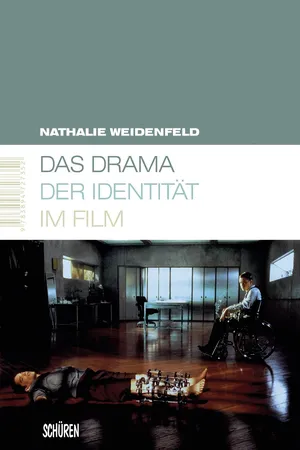
Die Autorin beschäftigt sich mit dem Problem der Identität im narrativen Film. Das klassische Hollywood-Kino funktioniert nach festen dramaturgischen Regeln, die sich von denen des modernen europäischen Arthouse Film unterscheiden, insbesondere sind die "Helden" der Filme weniger klar bestimmte Charaktere, sondern eher solche, die unbestimmt sind und sich treiben lassen. Diese theoretische Dichotomie löst die Autorin mit einem neuen Ansatz auf. Das filmtheoretische Konzept stützt sich dabei auf zwei Thesen. Die erste betrifft die Figuren eines Films, die sich in einem beständigen Spannungsverhältnis zwischen zwei Arten von idealtypischen Identitäten befinden, die mit den Begriffen homo agens und homo performans zu erfassen sind. Beide entsprechen zwei konträren Menschenbildern, die sich als unterschiedliche anthropologische Paradigmen auch in der zeitgenössischen Philosophie abbilden. Die zweite These beruht auf einer Revision neoformalistischer Ansätze in Richtung eines umfassenden narratologischen Schemas. Im ersten Teil des Buches werden die theoretischen Grundlagen erläutert, die dann im zweiten Teil an Hand von sieben Filmbeispielen erprobt werden. Dabei wurden Filme bewusst aus einem breiten Spektrum ausgewählt: zwei Hollywood-Blockbuster wie Matrix und Gattaca, ein postklassischer Film wie Memento, ein asiatischer Film wie Frühling, Sommer, Herbst, Winter... und Frühling, zwei Klassiker des Art Film-Genres wie Außer Atem und 8 sowie - als Beispiel für einen Art Film neueren Datums - den dänischen Film Antichrist.
- 171 pages
- English
- PDF
- Available on iOS & Android
eBook - PDF
Das Drama der Identität im Film
About this book
Trusted by 375,005 students
Access to over 1.5 million titles for a fair monthly price.
Study more efficiently using our study tools.
Information
Subtopic
Film ScreenwritingTable of contents
- Die Autorin
- Impressum/Abbildungsnachweis
- Inhalt
- Einführung
- Teil I Theoretische Überlegungen
- Teil II Filmanalysen
- Bibliografie
Frequently asked questions
Yes, you can cancel anytime from the Subscription tab in your account settings on the Perlego website. Your subscription will stay active until the end of your current billing period. Learn how to cancel your subscription
No, books cannot be downloaded as external files, such as PDFs, for use outside of Perlego. However, you can download books within the Perlego app for offline reading on mobile or tablet. Learn how to download books offline
We are an online textbook subscription service, where you can get access to an entire online library for less than the price of a single book per month. With over 1.5 million books across 990+ topics, we’ve got you covered! Learn about our mission
Look out for the read-aloud symbol on your next book to see if you can listen to it. The read-aloud tool reads text aloud for you, highlighting the text as it is being read. You can pause it, speed it up and slow it down. Learn more about Read Aloud
Yes! You can use the Perlego app on both iOS and Android devices to read anytime, anywhere — even offline. Perfect for commutes or when you’re on the go.
Please note we cannot support devices running on iOS 13 and Android 7 or earlier. Learn more about using the app
Please note we cannot support devices running on iOS 13 and Android 7 or earlier. Learn more about using the app
Yes, you can access Das Drama der Identität im Film by Nathalie Weidenfeld in PDF and/or ePUB format, as well as other popular books in Media & Performing Arts & Film Screenwriting. We have over 1.5 million books available in our catalogue for you to explore.