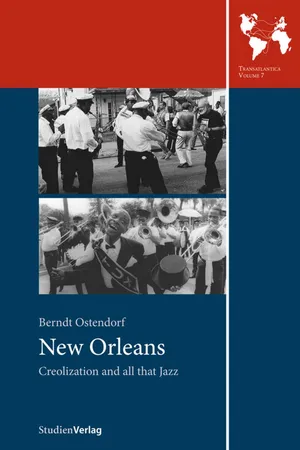
Ralph Ellison once wrote that the rules of performance in American culture are jazz-shaped. This book explores the Afro-creole core culture of New Orleans as the mainspring of this energizing music. Much of the cultural capital of the city is buried in a complex, tripartite racial history, which threatens the binary logic of North American racism with all sorts of sensual transgressions.Its jazz-derived culture combines elements of African, French, Spanish and Anglo-American cultural practices which in their fusion have created a unique propulsive energy: Second line parades, jazz funerals, Mardi Gras Indians, Cajun and creole foodways, minstrelsy, dance, ragtime and jazz will be interpreted as the result of a set of historical circumstances unique to this Caribbean metropolis of the senses.Including a preface by Günter Bischof and pictures by Michael P. Smith
- 204 pages
- English
- ePUB (mobile friendly)
- Available on iOS & Android
eBook - ePub
About this book
Information
Chapter 1
New Orleans:
A Caribbean Metropolis of the Senses
When on August 29, 2005 Hurricane Katrina destroyed large parts of New Orleans prominent Americans suggested giving up the city for good, particularly the low-lying, mostly black neighborhoods. At the time forty-seven percent of Americans polled by CNN shared this view. Certain state legislators reasoned that God had finally intervened to eliminate the sores of poverty and crime in the Black projects. Religious leaders interpreted Katrina as God’s punishment for a sensuous, hedonistic, and homosexual city.1 Sin City, America’s version of Sodom and Gomorrha,“had it coming.” It was pointed out to those who held this view that something must have gone wrong. For God destroyed the houses of church-going Blacks and of white Catholics in St. Bernard, but spared the houses of gay whites in the French quarter and the Garden District. This raises the serious question of whether God is just or, as one wag put it, “whether she is gay.” Mayor Ray Nagin came up with yet another topical explanation: Katrina was God’s punishment of George W. Bush for starting the Iraq war. But he also reminded his countrymen: “Whenever anywhere in the world New Orleans is mentioned eyes light up.” His boosterism was well taken: While the cultural heritage of New Orleans remains largely invisible to the North American public and sometimes even to local citizens, it is appreciated throughout the world. Most of it, food, sex, music, dance, and religion, belongs to the world of the senses and is embedded in the popular expressive arts. Hence it lacks moral legitimacy or prestige at home. New Yorkers and Bostonians of “property and standing” are falling over each other trying to “save Venice”, yet few of these would lift a finger to save New Orleans. This tacit habit of the heart is due to the negative role New Orleans had acquired in the nation’s libidinal economy. For many Americans (including George W. Bush) New Orleans had become the metropolis of transgressions: the Big Easy.2 While before Katrina Americans loved to sow their wild oats in the city “that care forgot”, they did so clandestinely and always with a bad conscience. Admittedly New Orleans has over time also become a symbol of graft and corruption and it clearly lacks the civic tradition of say Seattle or Minneapolis. Long before Katrina the city had gone into economic decline. And in this coincidence of material neglect, civic decline and sensual attraction lies the problem of judging its merits. The cultural capital of the city that might help to compensate for the lack of a civic culture is deeply compromised; for it lies buried in a complex history of satisfying the senses. This conflict-ridden tradition needs to be rescued from benign neglect and defended against moral censure; for it treasures those sedimentations, which give New Orleans its spectacular urban aura, a synaesthesia of sight, sound, taste, smell and touch which is felt most keenly when it is gone. The anthem of New Orleans captures the sensory quality of this deprivation well:
Do you know what it means to miss New Orleans
And miss it each night and day
I know Im not wrong … this feelings gettin stronger
The longer, I stay away
Miss them moss covered vines … the tall sugar pines
Where mockin birds used to sing
And I’d like to see that lazy Mississippi … hurryin into spring
The moonlight on the bayou … a creole tune … that fills the air
I dream … about magnolias in bloom … and I’m wishin I was there
And miss it each night and day
I know Im not wrong … this feelings gettin stronger
The longer, I stay away
Miss them moss covered vines … the tall sugar pines
Where mockin birds used to sing
And I’d like to see that lazy Mississippi … hurryin into spring
The moonlight on the bayou … a creole tune … that fills the air
I dream … about magnolias in bloom … and I’m wishin I was there
(Harry Connick with Dr. John. Harry Connick Jr. “20” CBS 1988.)
What would world culture be like without New Orleans? It would lack some of our best jazz-derived popular music, its joie de vivre and multi-sensory richness. Not only American culture, as Ralph Ellison suggested tongue in cheek, is “jazz-shaped,” but that of many other countries as well. And yet, the signs are multiplying that in the age of suburban malls and urban sprawl not only New Orleans, but many classic cities and their cosmopolitan centers are shrinking or disappearing.3 The collusion of the five senses which constitutes a functioning urban ecology is scattered with urban sprawl and is most certainly banished from the fastest growing real estate venture: gated communities. Sight, sound, smell, taste, touch – all five senses tend to atrophy in the suburban desert. During the last two decades there has been a race among endangered cities to be included in the UNESCO world heritage list. Currently there are 1500 applicants waiting to be so protected from decline. Let us briefly look at the criteria for acceptance. Among these are an active oral tradition (including diverse dialects or languages), performing arts such as music, dance and theatre, the realm of public rituals, festivals and celebrations, social practices, specific foodways, knowledges and crafts. The ensemble of these traditions represents the source of urban cultural diversity and of continued creativity which deserve to be protected, in short, the urban cultural exchange with the senses. As will become abundantly clear in what follows, pre-Katrina New Orleans met all of the UNESCO qualifications. And yet, the question remains wide open whether post-Katrina New Orleans can be saved in an MBA-driven, neo-liberal, ecologically challenged United States. Seven years after Katrina the record is decidedly mixed.
In order to appreciate the special qualities of New Orleans as an urban space of the senses it is essential to first comprehend the historical layering that went into the making of New Orleans culture and then grasp their continued dynamic synergy until Katrina destroyed its basis.4 To do this we must understand the historical fusion, or rather indigenization, of the city’s unique sets of multiple components that come together to form a rich cultural gumbo. With a nod to its principal agents, the New Orleans Creoles, I would call the overall process creolization, a process that is deeply rooted in the senses and in what one might call libidinal urban exchange. Many cities of this world may have any single one of the eleven characteristics mentioned below, but it is their collusion, their symbiosis and dogged rootedness over three centuries that makes New Orleans truly unique.
Three Colonial Empires
New Orleans was founded and grew in the contact zone of three major empires: France, Spain and Anglo-America. Founded by France in 1718, it was ceded to Spain in 1766. The town was Spanish during a crucial period of growth, the early charter period, when many cultural habits gelled. New Orleans burnt down twice, in 1788 and again in 1794, and was rebuilt under Spanish control. Therefore the so-called French Quarter may just as well be called Spanish Quarter. The three most impressive buildings, St. Louis Cathedral, the Cabildo and the Presbytère date from this period. Finally the territory was bought by the United States in the most spectacular real estate transaction in modern history: The Louisiana Purchase of 1803 engineered by Thomas Jefferson cost the United States a mere $ 15 million. For that sum the young republic received Louisiana territory, that is the Western part of the continent up to the Rockies. As a result of its history there are three layers of colonial practice that form a palimpsest of public space, customs, habits, and laws. By virtue of their coexistence a triple liminality is at work: For each of the three centers of colonial power, France, Spain, and England, the city served as a colonial outpost and as a periphery. Three systems of slavery, three racial (and sexual) etiquettes, three legal systems, three governmental bureaucracies, three traditions of architecture with specific traditions of public space and urban governance, three culinary and several religious traditions thrived at the periphery of three colonial empires and are now layered in a rich cultural memory.5 What we end up with is a typically Caribbean ensemble, a bricolage of contradictory cultural practices. Because of this tricultural genesis New Orleans is not so much the Southernmost North-American city, but the Northernmost city of the Caribbean oikumene. New Orleans is part of an urban archipelago that connects Veracruz, Havana, Port au Prince, Port of Spain and Kingston. And in that historical setting it is also one of the first cosmopolitan cities of early modernity.6
Economy: seaport and river port
New Orleans’ dual role as a seaport and a river port had important economic and cultural ramifications. The seaport served the Atlantic and made hemispheric networking with Europe, Africa and the Caribbean possible. The harbor connected the American colonies with the Atlantic rim and became the meeting place for multicultural sailors as carriers of culture. One example may suffice: Urban slaves in Havana had formed a system of cofradias for the purposes of mutual aid and for the protection of their cultural capital, one typical example being the “Sociedad de Protección Mutua y Recreo del Cultura Africana Lucumí”. The Social Aid and Pleasure Clubs of New Orleans were inspired by this Cuban tradition, probably transported there by merchant marines. In Cuba the Buena Vista Social Club is a belated heir to this tradition. The economy of New Orleans harbor was always dominated by a single commodity: Sugar in the eighteenth, cotton in the nineteenth and oil in the twentieth centuries. Hence New Orleans began as an early captive of globalization. Each commodity created its attendant urban ecology and sensory spectrum. It is often forgotten, that before the Civil War New Orleans was the second largest port of the United States. The river port connected with the Mississippi, the Missouri, the Mid-Western hinterland, and Canada. A total of 41 percent of the continental United States is drained through the Mississippi and its tributaries. Immigrants who wanted to get to the Midwest sought out ships that went to New Orleans, not to New York. Ships brought manufactured goods or immigrants from Europe and returned with cotton. It is an indication of the importance of New Orleans that before the Civil War two Hanseatic ports, Bremen and Hamburg, maintained consular offices in the city. The bad news is that the Mississippi port had gone into a steep decline long before Katrina since its location on the Mississippi river made access for supertankers and container ships increasingly more difficult. The good news is that Katrina did not affect the port as badly as the city. Most of the business is back to pre-Katrina levels.
Rule of Law: Three revolutions
New Orleans was deeply affected by three world revolutions: the French, the Haitian and the American. First, there were material after-effects of these revolutions. The French revolution drove a number of Foreign French to New Orleans and the Haitian revolution caused the population to double between 1810 and 1820. Both augmented a francophone professional class at the very moment when the Americans were trying to improve and modernize the city (Lachance). As the city governance became more Americanized, French or Creole cultural traditions were stubbornly and defensively reaffirmed. This accounts for the edge of resentment in Creole identity. Second, the cultural impact of Saint Domingue on New Orleans needs to be studied in greater detail. The Haitian and French revolutionary utopias are alive in the population and continue to affect voting behavior. To this day New Orleans’ Black Creoles cherish the radical universalism of the Haitian and French revolutions. The recognition that the Haitian revolution was the only successful one by slaves has made Toussaint L’ Overtoure a revered figure of New Orleans folklore. Each of the three revolutions introduced a different spin on civil rights. The American Revolution and its Constitution on the other hand held a promise only in theory for the gens de couleur libres. In practice civil rights were displaced by the protection of property and chattel slavery, and as a consequence New Orleans became the most important entrepôt of the American slave trade. Homer Plessy, who gave his name to Plessy vs. Ferguson (1896), was a New Orleans Creole committed to the universalism of the Haitian and French revolutions. With his legal action Plessy put the American constitution to a test – which it lost. Many of the lawyers and journalists supporting the legal action had a Saint Domingue background. For Creoles Plessy vs. Ferguson was a disastrous step back in terms of racial practice. In place of the complicated and porous tripartite social etiquette dominant in the francophone Caribbean, a binary color line was rudely introduced which discriminated against all people with a drop of black blood regardless of social or professional status. To this day the integrative politics of Creoles rubs against the black cultural nationalism of former American slaves that had developed in reaction to such politics of exclusion. Third, it is in the area of music that New Orleans owes most to the Haitian revolution which entered New Orleans via Cuba. The first serious American composer, Louis Moreau Gottschalk, whose mother was from Saint Domingue, learned his music from his black Haitian wet-nurse. Throughout his life he remained committed to a Caribbean style of music as is demonstrated in his “Bamboula: Danse Nègre.”7 Many jazz musicians including the self-proclaimed “inventor of jazz”, Jelly Roll Morton, have ancestors from Saint Domingue which accounts for a musical quality known as “funky”. Morton spoke of a noticeable “latintinge” and others call it the “habanera roll” which adds a propulsive, Latin energy to the New Orleans style.
Slavery and Race: Creoles and African Americans
There has always been a powerful African connection active in New Orleans. Its strength is due to a homogeneous African charter generation from Senegambia. Some scholars argue that in 1760 black culture was more coherent than the white demimonde. Whereas the white population consisted of drifters, prostitutes, deported galley slaves, trappers, gold-hunters, adventurers and foreign legionaries from many different nations, all slaves imported to New Orleans between the years 1720 and 1732 came from one cultural region. They belonged to what was then known as the Bambara Empire in what today is Senegambia. Later a sprinkling of slaves from the Congo were added (Hall, 1992). Normally slave traders would mix their slaves in order to prevent communication that would lead to plotting or insurrection. Most importantly the Bambara slaves brought with them a small market economy and plenty of crafts – hence there is a strong African baseline due to an early synthesis. Traditions such as the market on Congo Square, Vodun, Mardi Gras Indians drumming practices, Second Line Parades, Jazz, Social Aid and Pleasure Clubs are evidence of this fact. In the early period the plantation economy of Louisiana was lagging behind other colonial enterprises. In order to save on expenses slave owners allowed slaves to plant their own provisions and develop small markets or to hire themselves out as craftsmen. This practice not only resulted in a Monday-to-Friday slavery with weekends off, but it also gave slaves and free blacks enormous leverage and opened the door to material independence. Particularly during Spanish rule many slaves earned their own money to buy their freedom. By the time of the Louisiana Purchase this practice of self-purchase, called coartación, had resulted in the largest community of free blacks on the continent. Congo Square began in the late eighteenth century as a market that blacks, slaves or free, had created for selling their provisions to the city. When a Cédula Real by the Spanish king ordered the cessation of market activities on Congo Square for reasons of public safety the governor wrote back that the king might as well close the city, for it had come to depend on that market (Johnson, 1991). The governor simply ignored the command of the distant king, a habit of benign neglect vis à vis ordinances that has stuck. By the early nineteenth century Congo Square had become the center of black dancing immortalized by George Washington Cable’s essay “The Dance in Congo Square.” Cable, however, fails to mention the most important fact: there would not have been a dance without the previous market. Then there was an active Maroon culture where run-away slaves bonded wit...
Table of contents
- Cover
- Titel
- Impressum
- Widmung
- Table of contents
- Preface
- Introduction
- 1. New Orleans: A Caribbean Metropolis of the Senses
- 2. Jazz Funerals and the Second Line: African American Celebration and Public Space
- 3. “Jambalaya, Crawfish Pie and Filé Gumbo.” The Creolizing Cuisines of New Orleans
- 4. Creole Cultures and the Process of Creolization: With special attention to Louisiana
- 5. Et in Acadia ego: The Renaissance of Cajun Culture from 1968 to the Present
- 6. Rhythm, Riots, and Revolution: Political Paranoia, Cultural Fundamentalism and African American Music
- 7. Double Consciousness Revisited: African American Expressive Culture and the Dilemma of Interpretation
- 8. The Musical World of Doctorow’s Ragtime
- 9. Subversive Reeducation? Jazz as a liberating force in Europe
- 10. Growing up in the Fifties: Jazz, the Cold War and the Birth of American Studies
- 11. Is American Culture Jazz-Shaped? African American Rules of Performance
- Bibliography
- Credits
- Transatlantica Series
Trusted by 375,005 students
Access to over 1.5 million titles for a fair monthly price.
Study more efficiently using our study tools.
Frequently asked questions
Yes, you can cancel anytime from the Subscription tab in your account settings on the Perlego website. Your subscription will stay active until the end of your current billing period. Learn how to cancel your subscription
No, books cannot be downloaded as external files, such as PDFs, for use outside of Perlego. However, you can download books within the Perlego app for offline reading on mobile or tablet. Learn how to download books offline
Perlego offers two plans: Essential and Complete
- Essential is ideal for learners and professionals who enjoy exploring a wide range of subjects. Access the Essential Library with 800,000+ trusted titles and best-sellers across business, personal growth, and the humanities. Includes unlimited reading time and Standard Read Aloud voice.
- Complete: Perfect for advanced learners and researchers needing full, unrestricted access. Unlock 1.5M+ books across hundreds of subjects, including academic and specialized titles. The Complete Plan also includes advanced features like Premium Read Aloud and Research Assistant.
We are an online textbook subscription service, where you can get access to an entire online library for less than the price of a single book per month. With over 1.5 million books across 990+ topics, we’ve got you covered! Learn about our mission
Look out for the read-aloud symbol on your next book to see if you can listen to it. The read-aloud tool reads text aloud for you, highlighting the text as it is being read. You can pause it, speed it up and slow it down. Learn more about Read Aloud
Yes! You can use the Perlego app on both iOS and Android devices to read anytime, anywhere — even offline. Perfect for commutes or when you’re on the go.
Please note we cannot support devices running on iOS 13 and Android 7 or earlier. Learn more about using the app
Please note we cannot support devices running on iOS 13 and Android 7 or earlier. Learn more about using the app
Yes, you can access New Orleans by Berndt Ostendorf in PDF and/or ePUB format, as well as other popular books in Social Sciences & Popular Culture. We have over 1.5 million books available in our catalogue for you to explore.