After the breakup of the Habsburg Monarchy, the Austrian-American relationship was characterized by a dwarf confronting a giant. America continued to be a heaven for a better life for many Austrian emigrants. For the growing American preponderant position in the world after World War I, the small Austrian Republic was insignificant. And yet there were times when Austria mattered geopolitically. During the post-World War II occupation of Austria, the U.S. helped reconstruct Austria economically and was the biggest champion of its independence. During the Cold War, the U.S. frequently used Austria as a mediator site of summit meetings. American mass production models, consumerism, and popular culture were adopted by Austrian youth. Americanization and American preponderance also produced anti-Americanism. With the end of the Cold War and Austria's accession to the European Union it once again lost significance for Washington's geopolitics.
eBook - ePub
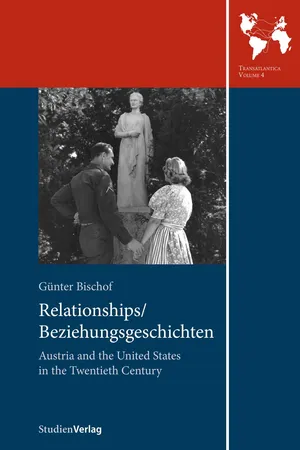
Relationships/Beziehungsgeschichten. Austria and the United States in the Twentieth Century
- 274 pages
- English
- ePUB (mobile friendly)
- Available on iOS & Android
eBook - ePub
Relationships/Beziehungsgeschichten. Austria and the United States in the Twentieth Century
About this book
Information
This essay was written during the fall/winter 2012/13 as the introduction for the most recent volume of Contemporary Austrian Studies entitled “Austria’s International Position after the End of the Cold War.” It attempts to suggest a framework of how to think about the twenty-plus years of U.S.–Austrian relations after the end of the Cold War. While the archives are not open yet, historians have access to a lot of online sources, which allow them to undertake such a first assessment. With the fall of the Iron Curtain, Austria’s international position on the margins of the Western world has changed dramatically. Austria found itself back in the center of Europe. At the same time, the country moved westward when it joined the European Union in 1995. This paper was presented in a UNO CenterAustria luncheon talk in the fall of 2012 and before an expert audience at the Amerika Haus in Vienna in May of 2013. This is a traditional assessment of diplomatic relations between the two nations in a larger U.S.–European framework; however, it excludes the vast areas of economic and cultural ties.
Of Dwarfs and Giants
From Cold War Mediator to Bad Boy of Europe—Austria and the U.S. in the Transatlantic Arena (1990–2013)1
Introduction
During the Cold War, Austria was the superpowers’ “darling” of sorts and saw itself playing a “special role”: As a Cold War neutral state, it played a crucial role as a mediator and “bridge builder” between East and West. Vienna was the site of important summit meetings (Kennedy–Khrushchev in 1961, Carter–Brezhnev in 1979) and long-running arms-control conferences (Conventional Force Reduction Talks), as well as the third host (with New York and Geneva) of important United Nations agencies like the International Atomic Energy Agency (IAEA). Austria was an important player among the Neutral & Non-Aligned states in the preparation and execution of the Conference of Security and Cooperation in Europe, culminating in the Helsinki meeting in 1975 that cemented European détente, and its follow-up meetings. Politically, Washington has respected Austrian neutrality since Foreign Minister and then Chancellor Bruno Kreisky defined his “active neutrality” policy as very pro-Western. Economically, Austria continued to profit from the counterpart funds left over from the Marshall Plan. In 1961, the American government handed over the entire counterpart account to the government of Julius Raab, who initiated the “ERP-Fonds” as an important permanent, long-term, low-interest investment vehicle for the Austrian economy.2 Austrians perceived their status as a “special case” during its four-power occupation (1945–55) and then as a Cold War neutral as a “Sonderfall”—call it “Austro-exceptionalism”.
The U.S. tolerated Austria’s growing trade relationship with Eastern Europe in the 1970s but looked askance at Austrian high-tech exports to the Communist Bloc during the 1980s under Reagan. Culturally, widespread Americanization defined Austria’s young generation, which rendered the U.S. a quasi-“cultural superpower.”3 Austria made up its failure to integrate into the European Economic Community by closely aligning itself with the West German economy; while serving as a “secret ally” of the West during the occupation decade and beyond, it kept its defense expenditures to a minimum. Austrian defense spending during the Cold War never amounted to a credible defense of its neutral status in case of attack. Austrian neutrality was incompatible with joining NATO and the transatlantic structures and networks emanating from it.4
The end of the Cold War (1989–1991) dramatically changed both the U.S.’s and Austria’s international positions. The United States transmuted into a hegemonic giant (what the French Foreign Minister Hubert Védrine termed “hyperpower”)5, while Austria joined the European Union and remained a small player (in the EU and in the world at large). Since the presidency of George H.W. Bush, Austria has figured less significantly in U.S. geopolitics. The Bush administration virtually ignored Austria during the dramatic events of 1989/90.6 On the mental map of American policy makers, Austria moved from Central to Western Europe (the European Economic Communities, NATO), while formerly communist “Eastern Europe” became “Central Europe”, namely the new post-communist countries of East Central Europe that were rushing towards NATO and the EU.7
In 1989, when the Iron Curtain came down, Austria redirected its foreign policy both towards Central and Western Europe. It rebuilt traditional ties with its East Central European and Western Balkans neighbors, building stronger trading and banking ties and investing enormously in the new markets of formerly communist Eastern Europe while completing its economic integration into the European Economic Community. In 1995, Austria joined the European Union and both its developing “Common Foreign and Security Policy” and (later under the Lisbon Treaty) “European Security and Defense Policy.”8 Becoming part of the ever-deepening European political, military and economic integration process, Vienna realigned its foreign policy with Brussels and abandoned Washington’s embrace, which had been loosening since the Reagan years anyway.9 Austria moved toward full political and economic integration with Western Europe but never fully aligned its security policy with the Atlantic community—thus it never fully arrived in the West.
On March 1, 2007, the Austrian Foreign Ministry was renamed “Federal Ministry for European and International Affairs.” This name change reflects the growing importance of “EUropean [=EU-European] affairs” and the relative decline of all other foreign-policy priorities. It also reflects a fear of the conservative People’s Party to lose EU competencies to the Social Democratic Chancellor. Yet after 1995, Austria aligned itself with EU foreign policy, which made Austria a part of the transatlantic-structures-sans-NATO-membership, including the dramatic ups and downs during the Clinton and Bush II years.10 Once it embraced EU integration, Austria lost its “special” Cold War international standing, its “Austro-exceptional” status.
During the Cold War, the Austrian embassies in Washington and Moscow served as the most important missions abroad; after 1995, the Brussels Representation received highest priority on the Austrian government. Moreover, the Lisbon Treaty (2009) established the “European External Action Service,” which marks the beginning of a EUropean diplomatic service that is bound to further absorb Austrian foreign policy into the common EUropean foreign policy agenda. On their stopovers in Europe these days, American presidents visit Prague and Warsaw rather than Vienna. While bilateral economic and cultural relations are holding their own, political relations are weakening between Austria and the U.S.
During the first half of the Cold War, Washington regularly posted top-notch professional foreign-service officers such as Llewellyn “Tommy” Thompson as ambassadors to Vienna.11 On Washington’s foreign policy priority list small nations like Austria have become less important. American presidents since Richard Nixon have dispatched political appointees to Vienna. After the end of the Cold War, all U.S. ambassadors to Austria have been wealthy political appointees, big campaign contributors and “bundlers” in successful presidential campaigns but rarely experts on Austrian affairs.12 Ambassadorial appointments have been important indicators of Austria’s relative standing on the Washington totem pole of global significance. Meanwhile, the Austrian governments consistently have been posting top diplomats as ambassadors to Washington, signaling the continued importance of Washington for Austria.13
Frauen-Power asserted itself both on the Ballhausplatz/Minoritenplatz in Vienna and in Washington’s Foggy Bottom. For the first time in history, women became principal diplomatic actors on both sides of the U.S.–Austrian relationship. Prominent women ambassadors were appointed on both sides (Nowotny, Hunt, Hall, McCaw, Wesner) as were the first female secretaries of state/foreign ministers. President Bill Clinton promoted Madeleine Albright, his U.N. ambassador (1993–1997), to become the first female Secretary of State (1997–2001). President George W. Bush appointed his NSC-adviser Condoleezza Rice (2001–2005) as his secretary of state (2005–2009) during his second term. President Obama made his rival in the 2008 campaign, Hillary Clinton, his secretary of state (2009–2013). Chancellor Wolfgang Schüssel promoted two career diplomats to the position of foreign minister: Benita Ferrero-Waldner (2000–2004)14 and his former chief-of-staff Ursula Plassnik (2004–2008). However, foreign policies did not markedly change or soften under female leadership, maybe because the foreign ministry staffs continued to remain largely male bastions of power.15 Particularly Albright and Rice were as militant in their conduct of U.S. foreign policy as their male counterparts, if not more so. Ferrero-Waldner and Plassnik were often overshadowed by Schüssel’s dominant role in foreign policy, especially vis-à-vis the EU.16
The U.S.–Austrian relationship, a small cog in the wheels of EUropean–American relations, became part of the growing transatlantic turmoil. U.S.–European relations since the end of the Cold War were a story of “divergence, disagreement, and at times overt hostility.”17 The everyday flow of bilateral U.S.–Austrian relations during the presidencies of George H.W. Bush (“Bush I...
Table of contents
- Cover
- Titel
- Impressum
- Widmung
- Table of Contents
- Preface
- Introduction
- I. Longue Durée, Anschluss and World War II
- II. Cold War
- III. Post-Cold War
- Bibliography
- Picture Credits
- Index
Trusted by 375,005 students
Access to over 1.5 million titles for a fair monthly price.
Study more efficiently using our study tools.
Frequently asked questions
Yes, you can cancel anytime from the Subscription tab in your account settings on the Perlego website. Your subscription will stay active until the end of your current billing period. Learn how to cancel your subscription
No, books cannot be downloaded as external files, such as PDFs, for use outside of Perlego. However, you can download books within the Perlego app for offline reading on mobile or tablet. Learn how to download books offline
Perlego offers two plans: Essential and Complete
- Essential is ideal for learners and professionals who enjoy exploring a wide range of subjects. Access the Essential Library with 800,000+ trusted titles and best-sellers across business, personal growth, and the humanities. Includes unlimited reading time and Standard Read Aloud voice.
- Complete: Perfect for advanced learners and researchers needing full, unrestricted access. Unlock 1.5M+ books across hundreds of subjects, including academic and specialized titles. The Complete Plan also includes advanced features like Premium Read Aloud and Research Assistant.
We are an online textbook subscription service, where you can get access to an entire online library for less than the price of a single book per month. With over 1.5 million books across 990+ topics, we’ve got you covered! Learn about our mission
Look out for the read-aloud symbol on your next book to see if you can listen to it. The read-aloud tool reads text aloud for you, highlighting the text as it is being read. You can pause it, speed it up and slow it down. Learn more about Read Aloud
Yes! You can use the Perlego app on both iOS and Android devices to read anytime, anywhere — even offline. Perfect for commutes or when you’re on the go.
Please note we cannot support devices running on iOS 13 and Android 7 or earlier. Learn more about using the app
Please note we cannot support devices running on iOS 13 and Android 7 or earlier. Learn more about using the app
Yes, you can access Relationships/Beziehungsgeschichten. Austria and the United States in the Twentieth Century by Günter Bischof in PDF and/or ePUB format, as well as other popular books in History & Historical Theory & Criticism. We have over 1.5 million books available in our catalogue for you to explore.