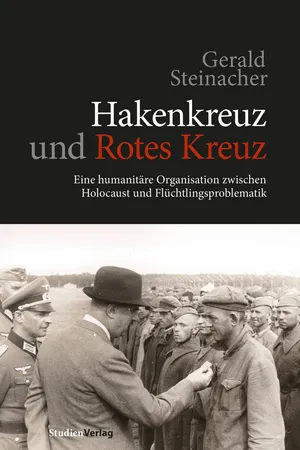
Mit seiner 150-jährigen Geschichte gehört das Internationale Komitee vom Roten Kreuz (IKRK) besonders in Kriegszeiten zu den ältesten und aktivsten Hilfsorganisationen. Die wertvolle Hilfeleistung des IKRK für Millionen Verwundete und Kriegsgefangene im Zweiten Weltkrieg steht außer Zweifel, das Schweigen zum Holocaust wird dem Roten Kreuz aber bis heute zum Vorwurf gemacht. Nicht zuletzt diese Kritik führte in den ersten Nachkriegsjahren zu einer schweren institutionellen Krise der traditionsreichen Genfer Organisation. Mitten in dieser tiefen Imagekrise verhalf das IKRK gleichzeitig Kriegsverbrechern zur Flucht. So konnten sich Adolf Eichmann und viele andere Täter mit neuer oder alter Identität und Papieren des Roten Kreuzes der Justiz entziehen. Gerald Steinacher legt in diesem Buch die Haltung der Hilfsorganisation zum Nazi-Regime, die Hintergründe des Schweigens und die Gründe der späten Hilfsmaßnahmen dar, beschreibt die institutionelle Krise und ihre Überwindung und stellt mit seinen Forschungsergebnissen erstmals die Nazi-Fluchthilfe nach 1945 und das Handeln des IKRK während des Holocaust in einen größeren Kontext.
eBook - ePub
Hakenkreuz und Rotes Kreuz
Eine humanitäre Organisation zwischen Holocaust und Flüchtlingsproblematik
- 212 pages
- English
- ePUB (mobile friendly)
- Available on iOS & Android
eBook - ePub
Hakenkreuz und Rotes Kreuz
Eine humanitäre Organisation zwischen Holocaust und Flüchtlingsproblematik
About this book
Information
Anmerkungen
1Humanitarians (englisch) – „Humanitarier“ – sind Einzelpersonen oder Organisationen, die sich die Milderung von menschlichem Leid und die Achtung der Menschenwürde zum Ziel gesetzt haben. In der deutschen Sprache gibt es keine adäquate Entsprechung und daher wird der Begriff hier in der „buchstäblichen“ Übersetzung verwendet.
2„Does help hurt?“, in: The Economist, 10. 9. 1998, 6.
3Andreas Heller, „Gratwanderungen“, in: NZZ Folio. Die Zeitschrift der Neuen Zürcher Zeitung, Nr. 2, Februar 1995, Themennummer „Das Rote Kreuz“, 5.
4Gerald Steinacher, Nazis auf der Flucht. Wie Kriegsverbrecher über Italien nach Übersee entkamen, Innsbruck 2008. Die Taschenbuchausgabe ist bei S. Fischer erschienen: Nazis auf der Flucht. Wie Kriegsverbrecher über Italien nach Übersee entkamen, Frankfurt a. M. 2010. Im Folgenden wird nach der Taschenbuchausgabe zitiert. Vgl. Gerald Steinacher, Nazis on the run. How Hitler’s henchmen fled justice, Oxford 2011. Vgl. Gerald Steinacher, „Berufsangabe: Mechaniker. Die Flucht von Gestapo-Beamten nach Übersee“, in: Klaus Michael Mallmann, Andrej Angrick (Hg.), Die Gestapo nach 1945. Karrieren, Konflikte, Konstruktionen, Darmstadt 2009, 56–70. Vgl. Gerald Steinacher, „Argentinien als NS-Fluchtziel. Die Emigration von Kriegsverbrechern und Nationalsozialisten durch Italien an den Rio de la Plata 1946–1955. Mythos und Wirklichkeit“, in: Holger Meding (Hg.), Argentinien und das Dritte Reich. Mediale und reale Präsenz, Ideologietransfer, Folgewirkungen, Berlin 2008, 231–253. Vgl. Gerald Steinacher, „The Cape of Last Hope. The Postwar Flight of Nazi War Criminals through Italy/South Tyrol to South America“, in: Klaus Eisterer, Günter Bischof (Hg.), Transatlantic Relations. Austria and Latin America in the 19th and 20th Century (Transatlantica 1), Innsbruck 2006, 203–224.
5Vgl. dazu Lynn Hunt, Inventing Human Rights. A History, New York 2008.
6David P. Forsythe, The Humanitarians. The International Committee of the Red Cross, Cambridge 2005, 2.
7Eugen Th. Rimli (Hg.), Das Buch vom Roten Kreuz. Das Rote Kreuz von den Anfängen bis heute, Zürich 1944, 6.
8Jean-Luc Blondel, „The Fundamental Principles of the Red Cross and Red Crescent: Their origin and development“, in: International Review of the Red Cross, 31/283 (1991), 349–357, 349.
9„impartiality, action independent of any political, religious or economic consideration, the universality of the Red Cross and the equality of its constituent members.“ Blondel, The Fundamental Principles of the Red Cross, 351.
10„The principle which has always been recognized and proclaimed by all the Societies united under its banner is that of universal charity in the service of suffering humanity, without regard to religion, race or nationality. Charity and universality, along with independence and impartiality, are the essential and distinctive characteristics of the Red Cross.“ Blondel, The Fundamental Principles of the Red Cross, 353.
11Michel Veuthey, „Assessing Humanitarian Law“, in: Thomas G. Weiss, Larry Minear (Hg.), Humanitarianism Across Borders. Sustaining Civilians in Times of War, London 1993, 125–149, 129. Vgl. François Bugnion, The International Committee of the Red Cross and the Protection of War Victims, Oxford 2003, 351 ff.
12Hans Haug, Rotes Kreuz. Werden, Gestalt, Wirken, Bern 1966, 76.
13Jean-Claude Favez, Warum schwieg das Rote Kreuz? Eine internationale Organisation und das Dritte Reich, München 1994, 62.
14Haug, Rotes Kreuz, 78.
15„Still further, it is part of a universal movement stressing global humanity, but that movement is rent by nationalism, and the ICRC itself has not been immune to the siren call of Swiss nationalism.“ Forsythe, The Humanitarians, 2.
16„To engage in humanitarian protection is to be ‚other-oriented‘ for the benefit of persons of concern. National authorities (and those that seek to replace them) tend to be primarily ‚self-oriented‘ in the sense of pursuing egoistic interests that supposedly benefit the nation, or maybe only the ruling group. States (and non-State parties) strongly tend to prioritize strategic and partisan goals, doing only those things that fit in with perceived egoistic interest and preferred power structures. By contrast, humanitarian protectors have social liberal goals […]“ David P. Forsythe, „Humanitarian Protection: The International Committee of the Red Cross and the United Nations High Commissioner for Refugees“, in: International Review of the Red Cross 83/843 (2001), 675–697, 680.
17Michael Ignatieff, „Die Ehre des Kriegers I“, in: Krieger ohne Waffen. Das Internationale Komitee vom Roten Kreuz, zusammengestellt von Hans Magnus Enzensberger, Frankfurt a. M. 2001, 9–25, 20 f.
18Bernd Biege, Helfer unter Hitler. Das Rote Kreuz im Dritten Reich, Reinbek bei Hamburg 2000, 20.
19David P. Forsythe, „The ICRC. A unique humanitarian protagonist“, in: International Review of the Red Cross, 89/865 (2007), 63–96, 85 ff.
20Robert Dempfer, Das Rote Kreuz. Von Helden im Rampenlicht und diskreten Helfern, Wien 2009, 47.
21„[…] on a world basis, it is essential to dwell for a time on this part of the Reds Cross story, as too many red Cross adherents and supporters, in the 80 member countries, as well as the public, have generally little knowledge of the international movement. They therefore tend to think of the Red Cross as a national institution, confined to their particular country. Others, again, wonder why there should be two Red Cross headquarters in Geneva […]“ James Avery Joyce, Red Cross International and the Strategy of Peace, London 1959, 112.
22Daniel Hitzig, „Das Kreuz mit dem Kreuz. Das IKRK, die Föderation und die Nati...
Table of contents
- Cover
- Titel
- Impressum
- Inhaltsverzeichnis
- Vorwort
- Einleitung
- Idee und Praxis des Roten Kreuzes
- Das Rote Kreuz und das „Dritte Reich“
- Das Schweigen des IKRK
- Kurz bevor der Vorhang fällt
- Der Wettstreit der Wohltäter
- Das Rote Kreuz in der Krise
- Nazi-Fluchthilfe wider Willen
- Abbildungen
- Fazit
- Anmerkungen
- Bibliographie und Quellenverzeichnis
- Personenregister
Trusted by 375,005 students
Access to over 1.5 million titles for a fair monthly price.
Study more efficiently using our study tools.
Frequently asked questions
Yes, you can cancel anytime from the Subscription tab in your account settings on the Perlego website. Your subscription will stay active until the end of your current billing period. Learn how to cancel your subscription
No, books cannot be downloaded as external files, such as PDFs, for use outside of Perlego. However, you can download books within the Perlego app for offline reading on mobile or tablet. Learn how to download books offline
Perlego offers two plans: Essential and Complete
- Essential is ideal for learners and professionals who enjoy exploring a wide range of subjects. Access the Essential Library with 800,000+ trusted titles and best-sellers across business, personal growth, and the humanities. Includes unlimited reading time and Standard Read Aloud voice.
- Complete: Perfect for advanced learners and researchers needing full, unrestricted access. Unlock 1.5M+ books across hundreds of subjects, including academic and specialized titles. The Complete Plan also includes advanced features like Premium Read Aloud and Research Assistant.
We are an online textbook subscription service, where you can get access to an entire online library for less than the price of a single book per month. With over 1.5 million books across 990+ topics, we’ve got you covered! Learn about our mission
Look out for the read-aloud symbol on your next book to see if you can listen to it. The read-aloud tool reads text aloud for you, highlighting the text as it is being read. You can pause it, speed it up and slow it down. Learn more about Read Aloud
Yes! You can use the Perlego app on both iOS and Android devices to read anytime, anywhere — even offline. Perfect for commutes or when you’re on the go.
Please note we cannot support devices running on iOS 13 and Android 7 or earlier. Learn more about using the app
Please note we cannot support devices running on iOS 13 and Android 7 or earlier. Learn more about using the app
Yes, you can access Hakenkreuz und Rotes Kreuz by Gerald Steinacher in PDF and/or ePUB format, as well as other popular books in History & Holocaust History. We have over 1.5 million books available in our catalogue for you to explore.