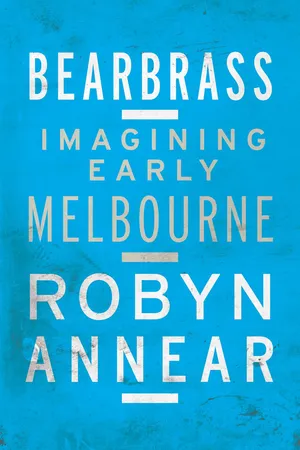
Just a little way down Collins Street, beside Henry Buck's, is a perpetually dark but sheltered laneway called Equitable Place. Here you'll find a number of places to eat and drink. Settle yourself in the window of one, shut your eyes, and picture this scene of yore … In this much-loved book, Robyn Annear resurrects the village that was early Melbourne – from the arrival of white settlers in 1835 until the first gold rushes shook the town – and brings it to life in vivid colour. Bearbrass was one of the local names by which Melbourne was known and Annear provides a fascinating living portrait of the streetlife of this town. In a lively and engaging style, she overlays her reinvention of Bearbrass with her own impressions and experiences of the modern city, enabling Melburnians and visitors to imagine the early township and remind themselves of the rich history that lies beneath today's modern metropolis.The original Bearbrass won the A.A. Phillips Award for Australian Studies in the 1995 Victorian Premier's Literary Awards.'... [Annear] writes with an historian's eye for detail and a flair for ironic observation. An affectionate journey, rich in detail and character.' — The Age Robyn Annear is an ex-typist who lives in country Victoria with somebody else's husband. She is the author of A City Lost and Found, Bearbrass, Nothing But Gold, The Man Who Lost Himself, and Fly a Rebel Flag. She has also written several pieces for The Monthly magazine.
- 272 pages
- English
- ePUB (mobile friendly)
- Available on iOS & Android
eBook - ePub
About this book
Information

1. Batman’s Hill
2. Mooring place of the Enterprise, August 1835
3. Yarra Falls
4. Site of Enterprise settlers’ first huts
CHAPTER 1
Founders and Shapers
Dreams of a noseless man
Transport yourself, in imagination or actuality, to Collins Street west of Spencer. Brave new city! Not till now – well, recently – did Melbourne’s premier street break through the barrier of Spencer Street. Now its westward extension carries Collins Street over the railyards to Docklands, mimicking the long-lost Batman’s Hill in the process.
Sit yourself in one of the tram shelters at the peak of the Collins Street hump. Eastward offers a new, elevated view of the city, while Docklands takes amazing shape to the west. Hunched atop a tall plinth, riverwards, a grey-white sculpted eagle – Bunjul, the ancestral creator spirit – watches over traffic on Wurundjeri Way. Trains grunting underfoot make your hollow hill shudder. Inbound or out-, they pass beneath the spectacularly seasick roof of the Southern Cross (née Spencer Street) railway station. With the new station unfinished at time of writing, it remains to be seen whether the traditional patrons – country train-travellers and chain-smokers in stretch denim – really will be displaced by well-heeled sophisticates, as the developers’ concept drawings suggest.
This has long been a part of town that most people disregard, passing through in haste, if at all. The glamorisation of Docklands promises to change that, but I’m betting the seedy spirit of the station and its environs will prevail.
Up aloft on Batman’s (reconstituted) Hill, though, it’s not so hard to imagine a place that was – and might be – different. Well, good: that’s why you’re here.
In January 1838, you’d be loafing against the trunk of a sheoak near the foot of Batman’s Hill,* looking across to the government camp and with a fair view of the whole western end of the township. To your right swells Batman’s Hill, a grassy flat spreads out to Burial Hill on your left-hand side, and a vast swamp (called the Lagoon or Batman’s Swamp) stretches away behind you. The wood of the sheoaks that grace the summit and flanks of Batman’s Hill is not much favoured by the settlers for fuel and building timber – a lucky thing for idlers like yourself. The trees’ lush, rounded canopies cast welcome shade and their verdure relieves the otherwise uniform pale wheat-brown and dun of the settlement on a hot afternoon. Your drink would be a bottle of porter, the thermos being as yet undreamt of and a billy fire not worth the risk, what with that crusty wind from the north and nearly the whole town built of wood.
* The Collins Street extension bridge, where you’re sitting, rises to the north of the original hillock.
Batman’s Hill (or hillock – only eighteen metres or so in height) peaks just south-west of the intersection of Spencer and Collins streets, whence it slopes down to meet the Yarra. On that southern side of the hill stands the home of John and Eliza Batman, their seven daughters and one Bearbrass-born son. You can’t see it from here, but it’s a substantial house, about the homeliest in the settlement, built of logs (of Van Diemen’s Land timber, not the native sheoak) and mud, neatly white-washed with lime. The big sash-windows that face the river are hung with claret-coloured drapes, and a creeping rose vine twines about the front door. A sizeable orchard spreads out from the township side of the house.
Just as you’re thinking of moving off to Jemmy Connell’s for another of those black bottles and some shade within walls, the sound of metal wheels, accompanied not by horses’ hooves but by human grunts and footfalls, alerts you to the approach of John Batman himself, from the direction of his orchard. Four Aboriginal servants, pushing and pulling, easing and trundling, bear Batman over the uneven ground in a makeshift perambulator of woven bamboo on an iron frame. This is not Batman’s idea of travelling in style; syphilis has made an invalid of him. Constant pain in his feet and legs has made him dependent on this wickerwork Batmobile, and the bandage around his face (such a noble profile in his centenary portrait) hides the fact that his nose is decaying. The disease’s recommended treatment is mercury, taken internally. It’s one of those remedies that kills or cures, and Batman doesn’t strike you as one of its success stories. His entourage is now making rough progress towards the hut of Captain George Smyth, opposite your ‘window’, where he’ll join the captain in a slug or two of brandy, the usual speculation about land prices and horse flesh, and a few discreet hands of cards. Well, good luck to the poor noseless bugger.
Batman died the following year, aged just thirty-nine. A parson named Dredge, recording the event in his journal, thundered to an imaginary congregation that ‘his death from disease induced by loose and profligate habits ought to be regarded by the living as an admonitory instance of the truth of the sacred Scripture: The wages of sin is death.’ But Batman continued to pay, posthumously.
Back in 1835, when he thought that he’d bought all the land hereabouts from the local Aborigines in exchange for a small consignment of geegaws, Batman had surveyed his new domain and declared: ‘All I can see is my own, and all I can’t see is my son’s.’ Well, as it turned out, to say that he must have had his eyes closed when he spoke would be an understatement. At that time, Batman had no son. When John junior was born at Bearbrass in 1836, it must have seemed like a blessing to Batman, who was already losing his nose and health. At least he now had an heir. But not for long. Young John was fishing at the Yarra falls one day, six years after his father’s death, when he slipped into the river and drowned.
Even had both John Batmans lived to old age, Batman senior’s All I can see … pronouncement would not have been realised. The colonial government refused to recognise his ‘purchase’ from the Aborigines. Land at Bearbrass was sold piecemeal, with Batman just another bidder.
His family was left poorly-off after his death. His daughters were dispersed to the care of various protectors and guardians and within a couple of years his widow, Eliza, married her late husband’s former overseer, William Willoughby. After the death of her son, Eliza left Willoughby and vanished from the town. In 1852, as ‘Sarah Willoughby of somewhat abandoned character’, the woman for whom Mt Eliza had been named was murdered in Geelong.
For a time, the Batmans’ house on Batman’s Hill was used as a government office. In the early 1840s it was suggested that the house should be preserved as a museum and library and the hill made the site for the botanic gardens. Neither suggestion was heeded. Not only was the Batmans’ house not preserved, the hill itself was razed in 1863 to accommodate railway yards. Its earth and stones were carted off by horse and dray and dumped on the banks of the Yarra. So a walker along the river’s northern side today can be said to tread the scattered peak of Batman’s former hill.
Who was Melbourne’s founder? Who cares?
John Batman is popularly regarded as Melbourne’s founder, though his claim to that title was vigorously challenged by his rival, John Pascoe Fawkner. The two contestants are long since wormsmeat, but the squabbling and barracking goes on. Batman’s cause had its heyday during the Melbourne centenary celebrations in 1935, when he was reinvented (or an earlier reinvention burnished) to suit the public tastes of that period: he was handsome, bold, decent – and tragic. You see, Batman did a clever thing: he died young. This practically assured him the status of tragic hero, from which the progression to glorious founder was a virtual formality. But let’s give credit where it’s due: Batman’s elevation to founder was largely thanks to the unpopularity and relative longevity of his rival, Johnny Fawkner. If John Batman had never existed, Fawkner’s detractors (and they were many) would have had to invent a John Batman; they couldn’t bear to concede that the man who has been called ‘the Derryn Hinch of his time’* could be the founder of their fine city. Batman was (mainly by dint of his being defunct) modest, agreeable, uninsistent; in short, a gentleman. Fawkner, on the other hand, was inescapable, vulgar, and managed to raise hackles by the mere act of drawing breath.†
* By former State Historian, Bernard Barrett.
† This is how R.A. Balbirnie described Fawkner (not by name, mind you) in a letter to the Gazette in 1839: ‘His face was not one easily to be forgotten, it bore the stamp of disgusting sensuality – petty tyranny – brutish ignorance – and idiotic self-sufficiency branded on its every line. He was grossly vulgar in his speech, and wore upon his whole person the character of a doubly convicted scoundrel.’
But look – for the purposes of this book, the issue of who-was-founder? doesn’t matter a toss. I don’t really care whether Batman said, ‘This will be the place for a village’, or what he meant by it if he did (his map showed he had reserved Port Melbourne as the site for the township). Much is written about that elsewhere. This book is about Bearbrass – not about who found it or founded it, but about the place and what was made of it. And the thing is, Fawkner was Bearbrass personified. The spirit of poor Batman is confined to his former hill; a bambooey creak and a whiff of gauze bandage, and he’s gone. You’ll find Fawkner everywhere.
Don’t grimace: a somewhat conventional historical narrative
So far I’ve avoided launching into the conventional historical narrative, but I feel that, to introduce you properly to Fawkner and Bearbrass, some background is necessary. Now, don’t grimace. Just think of it as a backdrop upon which to cast your Bearbrass shadow plays.
What is now the State of Victoria was, in 1835, the southernmost part of the colony of New South Wales, and was known as the Port Phillip District or Australia Felix. Tentative overland forays had been made to the district in search of pastoral land for the growing flocks of the colony’s settled regions. Two attempts, both short-lived, had been made at establishing convict settlements on the south coast of Port Phillip. And the area around Port Fairy and Portland had begun to see some settlement by whalers and sealers working the waters of Bass Strait, and by the pastoral Henty family from Van Diemen’s Land. But the colonial government had so far opposed settlement of the Port Phillip District because there was no official presence to orchestrate such development. Part of the Sydney government’s concern was that unauthorised settlement would lead to clashes with local Aborigines.
John Batman was a sheep farmer of some influence in the north of Van Diemen’s Land, near Launceston. He’d had his eye on Port Phillip pastures since the 1820s, but his overtures had so far met with government resistance. Eventually he formed the Port Phillip Association, a syndicate of fellow pastoralists and business types, and, in mid-1835, he sailed for Port Phillip with a contract to ‘buy’ nearly a quarter of a million hectares from the local Aborigines. In payment, he was to offer an assortment of blankets, knives, tomahawks, clothing, mirrors, scissors and flour – about £200 worth. He transacted his business with those whom he took to be the tribal leaders, the ‘owners’ of the land he wished to buy, and had the ‘chiefs’ sign the contract of sale. The purpose of this transaction was to show the Sydney government that his Association would deal fairly with the Aboriginal people of Port Phillip.
Batman left a party of men at Indented Head to protect his purchase, and sailed for Launceston. Upon arriving he made straight for his local watering-hole, the Cornwall Arms Hotel, and shouted the bar. At Batman’s insistence (‘and one for yourself’) the publican, Johnny Fawkner, helped himself to a tot of cold tea and listened as Batman declared himself ‘the greatest landowner in the world’. Within a month, Fawkner had himself got up a party of investors and plans for his own expedition to Port Phillip were well underway.
Fawkner was London-born but, as an eleven-year-old, had accompanied his convict father to Australia in 1803. This was Johnny Fawkner’s first taste of a pioneering expedition, he and his family being among those sent to found a new convict settlement at Sorrento, at the entrance to Port Phillip Bay. A more exposed site would be hard to imagine and there was no fresh water in the area, so the experiment was soon abandoned. The Fawkners were removed to the brand-new settlement of Hobart Town where, after three years’ labour, Fawkner senior was granted land for farming. Young Johnny worked for a time as a shepherd, then, at the age of twenty-two, took charge of the family’s bakery in Hobart. Fawkner was, even then, quick to perceive and act on an injustice. With his earnings, he had a boat built so that his convict employees, whom he believed to be ill-used by officialdom, might escape by sea. Their attempt failed however and Fawkner’s part in the plot earned him five hundred lashes and two years’ hard labour at the miserable Coal River penal colony.
When he returned to Hobart in 1816, he carried on with his baker’s shop but began also to sell liquor without a licence – the first manifestation of Fawkner’s most striking hypocrisy: he spurned alcohol and despised drunkenness in others, yet he never flinched from selling the stuff. In 1819 he moved north to Launceston with his de facto wife, Eliza Cobb. Nineteen-year-old Eliza had been transported from England a year earlier for the crime of child-stealing. She was granted her certificate of freedom in 1825 and was later referred to as Fawkner’s ‘one-eyed, genteel wife’ (they married in 1822). By 1828 Fawkner had ...
Table of contents
- Front Cover
- About the author
- BEARBRASS
- Copyright
- Dedication
- Contents
- Preface to the new edition
- Introduction
- Map 1
- Chapter 1: Founders and Shapers
- Map 2
- Chapter 2: The Shaping of Bearbrass
- Map 3
- Chapter 3: Past Lives of City Streets
- Map 4
- Chapter 4: Law and Order
- Map 5
- Chapter 5: Bearbrass People
- Map 6
- Chapter 6: A Land of Chops and Steak
- Map 7
- Chapter 7: The Colonial Vice
- Map 8
- Chapter 8: Bearbrass at Play
- Epilogue: The End of Bearbrass
- Further Reading
- Acknowledgements
- Index
Trusted by 375,005 students
Access to over 1.5 million titles for a fair monthly price.
Study more efficiently using our study tools.
Frequently asked questions
Yes, you can cancel anytime from the Subscription tab in your account settings on the Perlego website. Your subscription will stay active until the end of your current billing period. Learn how to cancel your subscription
No, books cannot be downloaded as external files, such as PDFs, for use outside of Perlego. However, you can download books within the Perlego app for offline reading on mobile or tablet. Learn how to download books offline
Perlego offers two plans: Essential and Complete
- Essential is ideal for learners and professionals who enjoy exploring a wide range of subjects. Access the Essential Library with 800,000+ trusted titles and best-sellers across business, personal growth, and the humanities. Includes unlimited reading time and Standard Read Aloud voice.
- Complete: Perfect for advanced learners and researchers needing full, unrestricted access. Unlock 1.5M+ books across hundreds of subjects, including academic and specialized titles. The Complete Plan also includes advanced features like Premium Read Aloud and Research Assistant.
We are an online textbook subscription service, where you can get access to an entire online library for less than the price of a single book per month. With over 1.5 million books across 990+ topics, we’ve got you covered! Learn about our mission
Look out for the read-aloud symbol on your next book to see if you can listen to it. The read-aloud tool reads text aloud for you, highlighting the text as it is being read. You can pause it, speed it up and slow it down. Learn more about Read Aloud
Yes! You can use the Perlego app on both iOS and Android devices to read anytime, anywhere — even offline. Perfect for commutes or when you’re on the go.
Please note we cannot support devices running on iOS 13 and Android 7 or earlier. Learn more about using the app
Please note we cannot support devices running on iOS 13 and Android 7 or earlier. Learn more about using the app
Yes, you can access Bearbrass by Robyn Annear in PDF and/or ePUB format, as well as other popular books in History & Australian & Oceanian History. We have over 1.5 million books available in our catalogue for you to explore.