Edkins' account of Chinese Buddhism is one of the most extensive ever written. In far more than 20 chapters he covers everything there is to know about about Chinese Buddhism.Contents: 1. Joshu's Dog2. Hyakujo's Fox3. Gutei's Finger4. A Beardless Foreigner5. Kyogen Mounts The Tree6. Buddha Twirls A Flower7. Joshu Washes The Bowl8. Keichu's Wheel9. A Buddha Before History10. Seizei Alone And Poor11. Joshu Examines A Monk In Meditation12. Zuigan Calls His Own Master13. Tokusan Holds His Bowl14. Nansen Cuts The Cat In Two15. Tozan's Three Blows16. Bells And Robes17. The Three Calls Of The Emperor's Teacher18. Tozan's Three Pounds19. Everyday Life Is The Path20. The Enlightened Man21. Dried Dung22. Kashapa's Preaching Sign23. Do Not Think Good, Do Not Think Not-Good24. Without Words, Without Silence25. Preaching From The Third Seat26. Two Monks Roll Up The Screen27. It Is Not Mind, It Is Not Buddha, It Is Not Things28. Blow Out The Candle29. Not The Wind, Not The Flag30. This Mind Is Buddha31. Joshu Investigates32. A Philosopher Asks Buddha33. This Mind Is Not Buddha34. Learning Is Not The Path35. Two Souls36. Meeting A Zen Master On The Road37. A Buffalo Passes Through The Enclosure38. An Oak Tree In The Garden39. Ummon's Sidetrack40. Tipping Over A Water Vase41. Bodhidharma Pacifies The Mind42. The Girl Comes Out From Meditation43. Shuzan's Short Staff44. Basho's Staff45. Who Is He?46. Proceed From The Top Of The Pole47. Three Gates Of Tosotsu48. One Road Of Kembo49. Amban's Addition
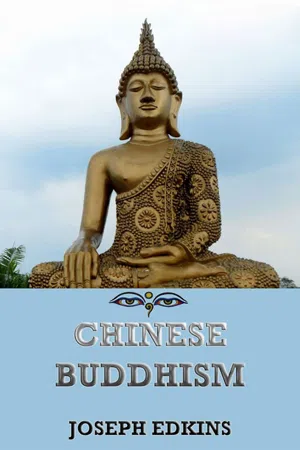
- 398 pages
- English
- ePUB (mobile friendly)
- Available on iOS & Android
eBook - ePub
Chinese Buddhism
About this book
Information
Topic
Theology & ReligionSubtopic
Eastern PhilosophyChinese Buddhism
Joseph Edkins
Contents:
Buddhism
Chinese Buddhism
Preface To Second Edition.
Preface.
Introduction.
Chapter I. Life Of Shakyamuni Till His Appearance At Benares As A Teacher.
Chapter Ii. Life Of Buddha From His Appearance As A Teacher At Benares To The Conversion Of Rahula.
Chapter Iii. From The Commencement Of Rahula's Religious Life Till The Near Approach Of The Nirvana.
Chapter Iv. Last Discourses And Death Of Buddha.
Chapter V. The Patriarchs Of The Northern Buddhists.
Chapter Vi. Sketch Of The History Of Buddhism In China.
Chapter Vii. The Schools Of Chinese Buddhism.
Chapter Viii. On Chi-K'ai And The T'ien-T'ai School Of Buddhism.
Chapter Ix. The Buddhist Moral System.
Chapter X. The Buddhist Calendar.
Chapter Xi. Relation Of Buddhism To The Older Hindoo Mythology.
Chapter Xii. The Buddhist Universe.
Chapter Xiii. The Extended Universe Of The Northern Buddhists.
Chapter Xiv. Buddhist Images And Image Worship.
Chapter Xv. Monasteries At P'u-To.
Chapter Xvi. Buddhist Processions, Associations, Pilgrimages, And Ceremonies For The Dead.
Chapter Xvii. Buddhist Literature.
Chapter Xviii. The Leng-Yen-King.--First Chapter.
Chapter Xix. The Ekashloka Shastra.
Chapter Xx. Effect Of Buddhism On The Philosophy Of The Sung Dynasty.
Chapter Xxi. Feng-Shui; Or, The Wind And Water Superstition Of The Chinese.
Chapter Xxii. Buddhist Phraseology In Relation To Christian Teaching.
Chapter Xxiii. Notice Of The Wu-Wei-Kiau, A Reformed Buddhist Sect.
Chapter Xxiv. Buddhism And Tauism In Their Popular Aspects.
Chapter Xxvi. Books And Papers That May Be Consulted For The Study Of Chinese Buddhism.
Chinese Buddhism, J. Edkins
Jazzybee Verlag Jürgen Beck
86450 Altenmünster, Germany
ISBN: 9783849622046
www.jazzybee-verlag.de
BUDDHISM
The religion held by the followers of the Buddha, and covering a large area in India and east and central Asia.
Essential Doctrines.—We are fortunate in having preserved for us the official report of the Buddha's discourse, in which he expounded what he considered the main features of his system to the five men he first tried to win over to his new-found faith. There is no reason to doubt its substantial accuracy, not as to words, but as to purport. In any case it is what the compilers of the oldest extant documents believed their teacher to have regarded as the most important points in his teaching. Such a summary must be better than any that could now be made. It is incorporated into two divisions of their sacred books, first among the suttas containing the doctrine, and again in the rules of the society or order he founded (Samyutta, v. 421 = Vinaya, i. 10). The gist of it, omitting a few repetitions, is as follows:—
"There are two aims which he who has given up the world ought not to follow after—devotion, on the one hand, to those things whose attractions depend upon the passions, a low and pagan ideal, fit only for the worldly-minded, ignoble, unprofitable, and the practice on the other hand of asceticism, which is painful, ignoble, unprofitable. There is a Middle Path discovered by the Tathāgata—a path which opens the eyes, and bestows understanding, which leads to peace, to insight, to the higher wisdom, to Nirvāna. Verily! it is this Noble Eightfold Path; that is to say, Right Views, Right Aspirations, Right Speech, Right Conduct, Right Mode of Livelihood, Right Effort, Right Mindfulness, and Right Rapture.
"Now this is the Noble Truth as to suffering. Birth is attended with pain, decay is painful, disease is painful, death is painful. Union with the unpleasant is painful, painful is separation from the pleasant; and any craving unsatisfied, that too is painful. In brief, the five aggregates of clinging (that is, the conditions of individuality) are painful.
"Now this is the Noble Truth as to the origin of suffering. Verily! it is the craving thirst that causes the renewal of becomings, that is accompanied by sensual delights, and seeks satisfaction now here, now there—that is to say, the craving for the gratification of the senses, or the craving for a future life, or the craving for prosperity.
"Now this is the Noble Truth as to the passing away of pain. Verily! it is the passing away so that no passion remains, the giving up, the getting rid of, the being emancipated from, the harbouring no longer of this craving thirst.
"Now this is the Noble Truth as to the way that leads to the passing away of pain. Verily! it is this Noble Eightfold Path, that is to say, Right Views, Right Aspirations, Right speech, conduct and mode of livelihood, Right Effort, Right Mindfulness and Right Rapture."
A few words follow as to the threefold way in which the speaker claimed to have grasped each of these Four Truths. That is all. There is not a word about God or the soul, not a word about the Buddha or Buddhism. It seems simple, almost jejune; so thin and weak that one wonders how it can have formed the foundation for a system so mighty in its historical results. But the simple words are pregnant with meaning. Their implications were clear enough to the hearers to whom they were addressed. They were not intended, however, to answer the questionings of a 20th-century European questioner, and are liable now to be misunderstood. Fortunately each word, each clause, each idea in the discourse is repeated, commented on, enlarged upon, almost ad nauseam, in the suttas, and a short comment in the light of those explanations may bring out the meaning that was meant.
The passing away of pain or suffering is said to depend on an emancipation. And the Buddha is elsewhere (Vinaya ii. 239) made to declare: "Just as the great ocean has one taste only, the taste of salt, just so have this doctrine and discipline but one flavour only, the flavour of emancipation"; and again, "When a brother has, by himself, known and realized, and continues to abide, here in this visible world, in that emancipation of mind, in that emancipation of heart, which is Arahatship; that is a condition higher still and sweeter still, for the sake of which the brethren lead the religious life under me." The emancipation is found in a habit of mind, in the being free from a specified sort of craving that is said to be the origin of certain specified sorts of pain. In some European books this is completely spoiled by being represented as the doctrine that existence is misery, and that desire is to be suppressed. Nothing of the kind is said in the text. The description of suffering or pain is, in fact, a string of truisms, quite plain and indisputable until the last clause. That clause declares that the Upādāna Skandhas, the five groups of the constituent parts of every individual, involve pain. Put into modern language this is that the conditions necessary to make an individual are also the conditions that necessarily give rise to sorrow. No sooner has an individual become separate, become an individual, than disease and decay begin to act upon it. Individuality involves limitation, limitation in its turn involves ignorance, and ignorance is the source of sorrow. Union with the unpleasant, separation from the pleasant, unsatisfied craving, are each a result of individuality. This is a deeper generalization than that which says, "A man is born to trouble as the sparks fly upward." But it is put forward as a mere statement of fact. And the previous history of religious belief in India would tend to show that emphasis was laid on the fact, less as an explanation of the origin of evil, than as a protest against a then current pessimistic idea that salvation could not be reached on earth, and must therefore be sought for in a rebirth in heaven, in the Brahmaloka. For if the fact—the fact that the conditions of individuality are the conditions, also, of pain—were admitted, then the individual there would still not have escaped from sorrow. If the five ascetics to whom the words were addressed once admitted this implication, logic would drive them also to admit all that followed.
The threefold division of craving at the end of the second truth might be rendered "the lust of the flesh, the lust of life and the love of this present world." The two last are said elsewhere to be directed against two sets of thinkers called the Eternalists and the Annihilationists, who held respectively the everlasting-life-heresy and the let-us-eat-and-drink-for-tomorrow-we-die-heresy. This may be so, but in any case the division of craving would have appealed to the five hearers as correct.
The word translated "noble" in Noble Path, Noble Truth, is ariya, which also means Aryan. The negative, un-Aryan, is used of each of the two low aims. It is possible that this rendering should have been introduced into the translation; but the ethical meaning, though still associated with the tribal meaning, had probably already become predominant in the language of the time.
The details of the Path include several terms whose meaning and implication are by no means apparent at first sight. Right Views, for instance, means mainly right views as to the Four Truths and the Three Signs. Of the latter, one is identical, or nearly so, with the First Truth. The others are Impermanence and Non-soul (the absence of a soul)—both declared to be "signs" of every individual, whether god, animal or man. Of these two again the Impermanence has become an Indian rather than a Buddhist idea, and we are to a certain extent familiar with it also in the West. There is no Being, there is only a Becoming. The state of every individual is unstable, temporary, sure to pass away. Even in the lowest class of things, we find, in each individual, form and material qualities. In the higher classes there is a continually rising series of mental qualities also. It is the union of these that makes the individual. Every person, or thing, or god, is therefore a putting together, a compound; and in each individual, without any exception, the relation of its component parts is ever changing, is never the same for two consecutive moments. It follows that no sooner has separateness, individuality, begun, than dissolution, disintegration, also begins. There can be no individuality without a putting together: there can be no putting together without a becoming: there can be no becoming without a becoming different: and there can be no becoming different without a dissolution, a passing away, which sooner or later will inevitably be complete.
Heracleitus, who was a generation or two later than the Buddha, had very similar ideas; and similar ideas are found in post-Buddhistic Indian works. But in neither case are they worked out in the same uncompromising way. Both in Europe, and in all Indian thought except the Buddhist, souls, and the gods who are made in imitation of souls, are considered as exceptions. To these spirits is attributed a Being without Becoming, an individuality without change, a beginning without an end. To hold any such view would, according to the doctrine of the Noble (or Aryan) Path, be erroneous, and the error would block the way against the very entrance on the Path.
So important is this position in Buddhism that it is put in the forefront of Buddhist expositions of Buddhism. The Buddha himself is stated in the books to have devoted to it the very first discourse he addressed to the first converts. The first in the collection of the Dialogues of Gotama discusses, and completely, categorically, and systematically rejects, all the current theories about "souls." Later books follow these precedents. Thus the Kathā Vatthu, the latest book included in the canon, discusses points of disagreement that had arisen in the community. It places this question of "soul" at the head of all the points it deals with, and devotes to it an amount of space quite overshadowing all the rest. So also in the earliest Buddhist book later than the canon—the very interesting and suggestive series of conversations between the Greek king Menander and the Buddhist teacher Nāgasena. It is precisely this question of the "soul" that the unknown author takes up first, describing how Nāgasena convinces the king that ther...
Table of contents
- BUDDHISM
Trusted by 375,005 students
Access to over 1.5 million titles for a fair monthly price.
Study more efficiently using our study tools.
Frequently asked questions
Yes, you can cancel anytime from the Subscription tab in your account settings on the Perlego website. Your subscription will stay active until the end of your current billing period. Learn how to cancel your subscription
No, books cannot be downloaded as external files, such as PDFs, for use outside of Perlego. However, you can download books within the Perlego app for offline reading on mobile or tablet. Learn how to download books offline
Perlego offers two plans: Essential and Complete
- Essential is ideal for learners and professionals who enjoy exploring a wide range of subjects. Access the Essential Library with 800,000+ trusted titles and best-sellers across business, personal growth, and the humanities. Includes unlimited reading time and Standard Read Aloud voice.
- Complete: Perfect for advanced learners and researchers needing full, unrestricted access. Unlock 1.5M+ books across hundreds of subjects, including academic and specialized titles. The Complete Plan also includes advanced features like Premium Read Aloud and Research Assistant.
We are an online textbook subscription service, where you can get access to an entire online library for less than the price of a single book per month. With over 1.5 million books across 990+ topics, we’ve got you covered! Learn about our mission
Look out for the read-aloud symbol on your next book to see if you can listen to it. The read-aloud tool reads text aloud for you, highlighting the text as it is being read. You can pause it, speed it up and slow it down. Learn more about Read Aloud
Yes! You can use the Perlego app on both iOS and Android devices to read anytime, anywhere — even offline. Perfect for commutes or when you’re on the go.
Please note we cannot support devices running on iOS 13 and Android 7 or earlier. Learn more about using the app
Please note we cannot support devices running on iOS 13 and Android 7 or earlier. Learn more about using the app
Yes, you can access Chinese Buddhism by Joseph Edkins in PDF and/or ePUB format, as well as other popular books in Theology & Religion & Eastern Philosophy. We have over 1.5 million books available in our catalogue for you to explore.