ARE the narratives of Genesis history or legend? For the modern historian this is no longer an open question; nevertheless it is important to get a clear notion of the bases of this modern position.Contents: I. The Significance And Scope Of The Legends. Criteria For Legend And History.Different Spheres Of Interest.Eye-Witness And Reporter.The Criterion Of Incredibility.Waning Anthropomorphism.Legend Is Poetry. II. The Varieties Of Legends In Genesis. Some Legends Are Faded Myths.Monotheism Hostile To Myths.The Significance Of Myths.The Legends Of The Patriarchs.Patriarchs Represent Tribes.Antiquity Of The Legends.Classification Of Legends.Aetiological Legends.Ethnological Legends.Etymological Legends.Ceremonial Legends.Geological And Other Legends.Mixed Legends.Origin Of The Legends. III. The Literary Form Of The Legends. Genesis Is Prose.Genesis A Folk-Book.The Contents Of Genesis In Primitive Form.The Real Unit In Genesis.Legend Cycles.Length Of Legends.Simplicity And Clearness Of Primitive Literary Art.Chief And Subordinate Personages.Description Of Characters.Popular Legends Treat Men As Types.Methods Of The Narrators.Thought Expressed By Actions.Soul-Life Not Ignored.Laconism Of The Legend Writers.No Nature-Love In Genesis.Economy Of Details.Unity And Coherence Of Parts.Variations On A Given Theme.Plausibility Demanded.Sustained Interest.Legends Not Pure Invention.Etymologies Subordinate Features.Summary.An Early Israelitish RomanceDevices For Uniting Several Stories.Epic Discursiveness.Interest In Soul-Life. IV. History Of The Development Of The Legends Of Genesis In Oral Tradition.
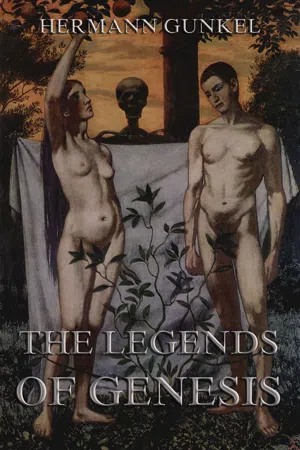
- 490 pages
- English
- ePUB (mobile friendly)
- Available on iOS & Android
eBook - ePub
The Legends of Genesis
About this book
Information
Topic
Theology & ReligionSubtopic
Biblical StudiesThe Legends of Genesis
Hermann Gunkel
Contents:
The History of The Bible
The Legends of Genesis
I. The Significance And Scope Of The Legends.
Criteria For Legend And History.
Different Spheres Of Interest.
Eye-Witness And Reporter.
The Criterion Of Incredibility.
Waning Anthropomorphism.
Legend Is Poetry.
Ii. The Varieties Of Legends In Genesis.
Some Legends Are Faded Myths.
Monotheism Hostile To Myths.
The Significance Of Myths.
The Legends Of The Patriarchs.
Patriarchs Represent Tribes.
Antiquity Of The Legends.
Classification Of Legends.
Ætiological Legends.
Ethnological Legends.
Etymological Legends.
Ceremonial Legends.
Geological And Other Legends.
Mixed Legends.
Origin Of The Legends.
Iii. The Literary Form Of The Legends.
Genesis Is Prose.
Genesis A Folk-Book.
The Contents Of Genesis In Primitive Form.
The Real Unit In Genesis.
Legend Cycles.
Length Of Legends.
Simplicity And Clearness Of Primitive Literary Art.
Chief And Subordinate Personages.
Description Of Characters.
Popular Legends Treat Men As Types.
Methods Of The Narrators.
Thought Expressed By Actions.
Soul-Life Not Ignored.
Laconism Of The Legend Writers.
No Nature-Love In Genesis.
Economy Of Details.
Unity And Coherence Of Parts.
Variations On A Given Theme.
Plausibility Demanded.
Sustained Interest.
Legends Not Pure Invention.
Etymologies Subordinate Features.
Summary.
An Early Israelitish Romance
Devices For Uniting Several Stories.
Epic Discursiveness.
Interest In Soul-Life.
Iv. History Of The Development Of The Legends Of Genesis In Oral Tradition.
Foreign Influences.
Babylonian Influences.
Egyptian And Phoenician Influences.
Religious Legends Not Israelitic.
Greek Parallels.
The Adaptation Of The Legends.
Mode Of Amalgamation.
Fidelity Of Transmission.
Value Of The Variants.
Judgment Of Individual Narratives.
Changes Wrought By Time In The Legends.
Light On The History Of Religion.
Modification Of The Theophany.
The Divinity And The Sanctuary.
God's Relation To Man.
Not Merely A Tribal God.
Religious And Profane Motives Mingled.
Ethical Notions In The Legends.
The Patriarchs Not Saints.
Criteria Of The Age Of The Legends.
Tribal Legends.
Patriarchs Disguised Divinities.
Caution Needed In Interpretation.
V.Jahvist, Elohist, Jehovist, The Later Collections.
"Jahvist" And "Elohist" Collectors, Not Authors.
The Jahvist's Sources.
The Process Of Collection.
Relation Of The Collectors To Their Sources.
Relation Of Jahvist To Elohist.
The Age Of The Jahvist And Elohist Schools.
Re-Modeling Of The Legends.
Relation Of The Collections To The Prophets.
The Jehovist Redactor.
Vi. Priestly Codex And Final Redaction.
Importance Attached To Chronology.
The Religious Views Of The Priestly Codex.
The Age Of The Priestly Codex.
The Final Redactor.
Summary.
How Genesis Came To Be Attributed To Moses.
The Legends of Genesis, Hermann Gunkel
Jazzybee Verlag Jürgen Beck
86450 Altenmünster, Germany
ISBN: 9783849621827
www.jazzybee-verlag.de
The History of The Bible
Bible (Gr. βιβλία, books), the name applied by Chrysostom in the 4th century to the books of the Old and New Testaments, which had been called the "Scripture." The ancient plural has been transformed into a singular noun, in view of the recognized unity of the books of the Bible, which is thus called The Book by way of eminence. The Bible has two general divisions, the Old Testament and the New; the Greek διαθήkn meaning disposition by will, is used both in the Septuagint and in the Greek New Testament for the "covenant" or compact between God and man. The Old Testament was divided by the Jews into three parts, viz., the law, the prophets, and the sacred writings. The law comprised the five books of Moses. The prophets comprised the earlier prophets, so called - the books of Joshua, Judges, 1 and 2 Samuel, 1 and 2 Kings; and the later prophets - three major, Isaiah, Jeremiah, and Ezekiel, and 12 minor, Hosea to Malachi. Under the sacred writings were included the poetical books, Psalms, Proverbs, Job; the "Five Rolls," Canticles, Ruth, Lamentations, Ecclesiastes, Esther; also the books of Daniel, Ezra, Nehemiah, and 1 and 2 Chronicles. The number of the books and their grouping have varied in different versions.
Our English Bible gives 39. Jerome counted the same books so as to equal the 22 letters of the Hebrew alphabet; Judges and Ruth, the two books of Samuel, two of Kings, two of Chronicles and the 12 minor prophets making five books. The later Jews of Palestine counted these 24. As to their order, the Masoretic arrangement, which is that of our present Hebrew Bibles, is very ancient. The Greek-speaking Jews, however, varied from those of Palestine, and their arrangement is preserved in the Septuagint, which is followed in the Vulgate and in our English Bibles; an order not according to chronological succession, but made with a view to grouping similar classes of composition together, the historical being placed first, the poetical next, and the prophetical last. The historical division opens in the book of Genesis with an account of the creation of all things, then takes up the history of the Hebrews as a matter of central interest, showing the separation of the family of Abraham from other nations and their prosperous settlement in Egypt. Exodus describes the escape of the Israelites from Egypt and their organization as a nation under the Mosaic law. Leviticus contains the more special laws of Israel, chiefly those relating to the public worship, festivals, and similar topics.
Numbers, with a supplement to the laws, narrates the weary march through the desert, and the opening of the contest for the land of Canaan. In Deuteronomy Moses, drawing near death, reminds the people of the experience they have gone through and the laws they have received, and exhorts them to obedience to God; then appoints a successor, and, taking a first and last look at the land not yet entered, dies. The book of Joshua describes the conquest and partition of Canaan, and the leader's farewell exhortation and death. In the next book, Judges, we read of anarchy and apostasy, and the consequent subjugation of the Israelites by their heathen neighbors, and the exploits of heroes raised up to deliver them. The books of Samuel give his history as prophet and judge, and the story of Saul and David. The books of Kings tell of David's death, the brilliant reign of Solomon, and the subsequent decline, the revolt of the ten tribes, the overthrow of the seceded kingdom of Israel and the fall of the kingdom of Judah into captivity, and the fate of the remnant left in Judea while their brethren were carried away captive. These books tell also of those prophets who testified for God in the face of wicked kings and a degenerate people.
The Chronicles are a supplementary work, and are accompanied by the book of Ruth, an episode in the time of the judges, narrating with exquisite grace the marriage of Ruth the Moabitess and Boaz the great-grandfather of David. The Old Testament history closes in the books of Ezra and Nehemiah, which describe the return of the Jewish nation from exile and the restoration of Jerusalem and the temple worship. The book of Esther records events of the Persian captivity. - While the historical books show the development of those religious ideas which underlie the Hebrew national life, the prophetic books show these ideas inspiring the people in their conflicts with unbelief and apostasy, and animating the nation with bright hopes of the future. In all literature there are no books like these, in severe morality, high religious tone, sublime conception, grand diction, and rich imagery. Covering a great extent of time, these prophetic writings vary in style, but they show the struggles of the nation's heart and its foreign relations in a way that lights up the historical books. - The poetical books express the same ideas with the prophetic, but in a more quiet didactic and lyric form.
The didactic portion of them consists of the Proverbs, a collection of sententious maxims and wise discourses; Ecclesiastes, an eloquent wail over the transientness of earthly things; and the book of Job, a philosophical poem upon Providence, wonderfully rich in thought and diction, and full of the doctrine of resignation to the mysterious will of God. The Psalms are a collection of devotional lyrics. Lamentations are elegiac patriotic verses. The Song of Solomon is an amatory idyll, which has been explained by many scholars as an allegory. - The New Testament gives the only original account of the origin and early spread of Christianity. It is composed of 27 books. Four contain the memoirs of Jesus; one (Acts) gives the actions of the apostles, especially of Peter and Paul; 21 are apostolical letters; and the collection closes with the Apocalypse. The Gospels of Matthew and John are held to be the work of the apostles whose names they bear. Mark was a disciple of Peter, and Luke a companion of Paul. The book of Acts is also ascribed to Luke. The Epistles are letters called forth by various exigencies, and contain incidental information, throwing much light upon the early constitution and spread of the Christian church, and the development of its doctrines.
The Apocalypse is the only book in the New Testament of a strictly prophetic character. It was written shortly after the death of Nero, and strengthened the hearts of Christians against a threatening persecution by giving hope of the approaching kingdom of Christ. - For 1,000 years learned men have been studying the authenticity and arrangement of the constituent parts of the Bible. The history of this work will be found under the title Canon. Far greater study, however, has been given to the original text of Scripture. The Hebrew text of the Old Testament as we have it has already passed through many revisions. Of the primitive text we have little positive information. The books were first written on skins or linen cloth or papyrus, and preserved in rolls. The letter used was the old Hebrew character, which is found on the coins of the Maccabees, and was probably of Phoenician origin. There were no accents nor vowel points, the consonants only being written, and the vowel sounds supplied by the usage of the living speech; and the words were generally run together in a continuous line. Not until the Hebrew became a dead language was its vowel system perfected, to take the place of the familiar usage which was passing away.
After the return from the Babylonish exile, the sacred books were subjected to a careful and critical examination. About the same time the written character of the ancient Hebrew was modified by the Aramaic...
Table of contents
- The History of The Bible
- IV. HISTORY OF THE DEVELOPMENT OF THE LEGENDS OF GENESIS IN ORAL TRADITION.
Trusted by 375,005 students
Access to over 1.5 million titles for a fair monthly price.
Study more efficiently using our study tools.
Frequently asked questions
Yes, you can cancel anytime from the Subscription tab in your account settings on the Perlego website. Your subscription will stay active until the end of your current billing period. Learn how to cancel your subscription
No, books cannot be downloaded as external files, such as PDFs, for use outside of Perlego. However, you can download books within the Perlego app for offline reading on mobile or tablet. Learn how to download books offline
Perlego offers two plans: Essential and Complete
- Essential is ideal for learners and professionals who enjoy exploring a wide range of subjects. Access the Essential Library with 800,000+ trusted titles and best-sellers across business, personal growth, and the humanities. Includes unlimited reading time and Standard Read Aloud voice.
- Complete: Perfect for advanced learners and researchers needing full, unrestricted access. Unlock 1.5M+ books across hundreds of subjects, including academic and specialized titles. The Complete Plan also includes advanced features like Premium Read Aloud and Research Assistant.
We are an online textbook subscription service, where you can get access to an entire online library for less than the price of a single book per month. With over 1.5 million books across 990+ topics, we’ve got you covered! Learn about our mission
Look out for the read-aloud symbol on your next book to see if you can listen to it. The read-aloud tool reads text aloud for you, highlighting the text as it is being read. You can pause it, speed it up and slow it down. Learn more about Read Aloud
Yes! You can use the Perlego app on both iOS and Android devices to read anytime, anywhere — even offline. Perfect for commutes or when you’re on the go.
Please note we cannot support devices running on iOS 13 and Android 7 or earlier. Learn more about using the app
Please note we cannot support devices running on iOS 13 and Android 7 or earlier. Learn more about using the app
Yes, you can access The Legends of Genesis by Hermann Gunkel, William Carruth in PDF and/or ePUB format, as well as other popular books in Theology & Religion & Biblical Studies. We have over 1.5 million books available in our catalogue for you to explore.