Lowell was founded by the 'Merrimac Manufacturing Company' in 1822, and named after Francis C. Lowell. The village grew very rapidly from the first. In 1820 it was incorporated as a town and ten years later was chartered as a city. This book tells the story of this very important textile center from the beginning until the 1870s.
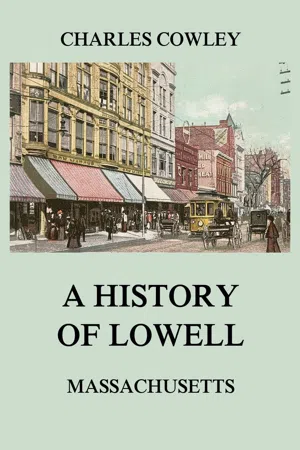
- 284 pages
- English
- ePUB (mobile friendly)
- Available on iOS & Android
eBook - ePub
A history of Lowell, Massachusetts
About this book
Information
Subtopic
North American HistoryIndex
HistoryPREFACE.
In an age so prolific in works of local history as ours, no apology need be offered for publishing this History of Lowell.
Successors of the Pawtucket and Wamesit Indians, — heirs of the founders of American Manufactures, — contemporaries of the men of the "Legion of Honor," who went hence to defend the Nationality of America, and who, dying on the field of battle, have risen to enduring renown; — the people of Lowell are to-day in possession of a certain body of memories and traditions, not current elsewhere, but kept alive here by local associations, by the presence of historical objects, and by the local press.
Of these memories and traditions Lowell is justly proud.
From them her people receive an educational stimulus not to be despised. She would no more part with these local reminiscences than Plymouth would part with her Pilgrim history, or than New York would forget those Knickerbocker memories, among which the genius of Irving is enshrined forever.
To gather and embalm all that seemed most valuable in this heritage of memories and traditions, has been the object of the present work, which covers the whole period from the discovery of the Merrimack River by De Monts, in 1605, to the year of Grace 1868.
The first edition, or rather the original germ, of this work, was published in 1856. With the aid of a mass of materials laboriously gathered during the last twelve years, I may hope that the value of the work has been greatly increased. The narrative has been thoroughly revised, and very much enlarged.
Several engravers of established reputation were employed to execute illustrative cuts. Many of these are well done, but some are so badly executed that, perhaps, an apology is due for their insertion in these pages; and others have been rejected altogether.
Materials were at hand for a much larger volume, or even for several volumes; but I have aimed to be concise, — considering Moses, who, in two lines, chronicled the creation of a world, (pace Colenso,) a much better model for the local annalist than he who filled several volumes with the burning of a Brunswick Theatre.
How far I have succeeded in the accomplishment of this self-imposed task, my readers must judge; and they will form the most charitable judgments, who best appreciate the great difficulties under which such a task must be prosecuted. If I have not wholly failed of my purpose, the work will possess attractions for all who are identified with Lowell, and perchance may descend to the Lowellians of the Future, and be read with interest hereafter, when he who wrote it shall have passed away.
The Author.
March, 1868.
CHAPTER I.
FROM THE DISCOVERY OF THE MERRIMACK TO THE INTRODUCTION OF MANUFACTURES.
Herodotus, with fine felicity, calls Egypt a gift from the Nile. In a similar sense, Lowell may be called a gift from the Merrimack. Her history, also, may be well begun with that noble artery of nature, the waters of which move the great wheels of her industry.
Long after America was upheaved from the bosom of the Atlantic, a chain of lakes occupied the valleys of the Merrimack and its tributaries, from the mountains to the sea.
Proofs of this appear in the alluvial formation of these valleys, the shapes of their basins, their outlets, their different levels, and the stratified character of the soil. One of these lakes extended westward from Pawtucket Palls; and the limits of several others may be easily defined. But long before the dawn of history, and probably long before man appeared on the earth, the attrition of the waters in the channels of these lakes, by widening and deepening their outlets, gradually diminished their depth, and at length left their basins dry.
The draining of these lakes increased the volume of water which the Merrimack rolled down to the main.
The head of the Merrimack is at Franklin in New Hampshire, where the Winnepesawkee, the outlet of the lake of that name, unites with the Pemigewasset, an artery of the White Mountains. Like all the great rivers on the Atlantic slope, the Merrimack pursues a southerly course. But after following this course from Franklin to Tyngsborough, a distance of eighty miles, the Merrimack, unlike any other stream on the Atlantic, makes a detour to the north-east, and even runs a part of the way north-west. It is obviously unnatural that, after approaching within twenty miles of the head-waters of the Saugus, as the Merrimack does on entering Massachusetts, it should suddenly change its course, and pursue a circuitous route of more than forty miles to the sea. If the history of by-gone ages could be restored, we should probably find the Merrimack discharging its burden at Lynn, and not at Newburyport.
Changes like this, however, are not unfamiliar to geologists.
Sometimes they have been caused by earthquakes, but more often, in these latitudes, by ice-gorges. 0 Whether this deflection in the course of the Merrimack was caused by subterranean convulsions, or by the formation in the old channel of an ice-blockade, cannot now be known; but the fact of the change is unquestionable.
The discovery of the Merrimack took place under the auspices of Henry the Fourth, commonly called Henry the Great, whose reign forms one of the most brilliant eras in the annals of France. In 1603, Pierre Du Gua, Sieur de Monts, one of the ablest of the Huguenot chiefs, obtained a patent from this king, creating him Lieutenant-General and Vice-Admiral, and vesting in him the government of New France, which embraced all our Eastern and Middle States, together with the Dominion of Canada. On the seventh of March, 1604, De Monts sailed from Havre with an expedition for colonizing "Acadia," as his new dominions were called. He arrived on the sixth of April, and began at once the great work of exploration and settlement. While talking with the Indians on the banks of the river St. Lawrence, in the ensuing summer, he was told by them that there was a beautiful river lying far to the south, which they called the Merrimack. The following winter De Monts spent with his fellow-pioneers on the island of St. Croix, in Passamaquoddy Bay, amid hardships as severe as those which, sixteen years later, beset the Pilgrims at Plymouth.
On the eighteenth of June, 1605, in a bark of fifteen tons, — having with him the Sieur de Champlain, several other French gentlemen, twenty sailors, and an Indian with his squaw, — De Monts sailed from the St. Croix, and standing to the south examined the coast as far as Cape Cod. In the course of this cruise, on the seventeenth of July, 1605, he entered the bay on which the city of Newburyport has since arisen, and discovered the Merrimack at its mouth. The Sieur de Champlain, the faithful pilot of De Monts, and chronicler of his voyages, has left a notice of this discovery in a work which ranks among the most romantic in the literature of the sea.
Inclosing this notice Champlain says: "Moreover, there is in this bay a river of considerable magnitude, which we have called Gua's River."|
Thus De Monts named the Merrimack from himself; but the compliment was not accepted. Regardless of the name with which it was baptized by its discoverer, the Merrimack clung, with poetic justice, to the name which it received from the Indians long before the flag of the Vice-Admiral floated over Newburyport Bay. The visit of Admiral De Monts, like that of Capt. John Smith in 1614, was attended with no result.
Other renowned names were yet to be inscribed on the list of the visitors of the Merrimack. But its song was the song of Tennyson's brook: —
"For men may come and men may go,
But I roll on forever."
The King had stipulated, in his patent of New France, that De Monts should establish in Acadia the Roman Catholic creed, ("la foy catholique, apostoliqite et romaine ;") a singular condition indeed, considering that De Monts was a Protestant, and that Henry himself was only a "political Catholic."
The expenses of the three expeditions which he sent to New France were ruinous to De Monts. Cabals were formed by his enemies; neither the loftiest motives nor the finest abilities could save him; and the tragic death of Henry by the dagger by Ravaillac, in 1610, completed his ruin as a public man.
He died about the year 1620.0 In 1635, thirty years after the discovery of the Merrimack, the Concord, which the Indians called the Musketaquid, assumed a place in civilized history; the fame of its grassy meadows and of the fish that swarmed in its waters attracting settlers from England, who established themselves at Concord. From a period too remote to be determined by either history or tradition, until after the great Indian Blague of 1617, Pawtucket Falls on the Merrimack, and Wamesit Falls on the Concord, were the sites of populous villages of Pawtucket or Pennacook Indians, who, indeed, remained, though with greatly diminished numbers, in the present territory of Lowell, forty years after the plague. Here, in spring-time, from all the circumjacent region, came thousands of the dusky sons and daughters of the forest, catching, with rude stratagem, their winter's store of fish. Here they sat in conclave round the council fire. Here they threaded the fantastic mazes of the dance. "Here was the war-whoop sounded, and the death-song sung; and when the tiger strife was over, here curled the smoke of peace."
The Pawtuckets, or Pennacooks, were among the most powerful tribes in New England, numbering, after the plague, several thousand souls. Their territory stretched almost from the Penobscot to the Connecticut, and included the whole of New Hampshire, a part of Massachusetts, and a part of Maine.
At the head of this tribe, the first English settlers found the sagacious and wary Passaconaway, who, in 1644, after more than twenty years' observation of the progress of the English settlements, signed an agreement which is still preserved, renouncing his authority as an independent chief, and placing himself and his tribe under the colonial authorities. In 1647, the Rev. John Eliot, "the Apostle of the Indians," began a series of missionary visits to this place, which were continued by him till the villages of Wamesit and Pawtucket ceased to be. In 1656, Major-General Daniel Gookin was appointed Superintendent of all the Indians under the jurisdiction of the Colony, among whom were the Indians living here.
Thus a sort of Indian Bureau was established, not unlike the Freedmen's Bureau of a later day. The Apostle Eliot and Judge Gookin won the entire confidence of the Indians, being about the only white men that came among them who did not come to rob them.
In 1652, Captain Simon Willard and Captain Edward Johnson, under a commission from the colonial government, ascended the Merrimack in a boat, and surveyed the valley as far as Lake Winnepesawkee. A new impetus was given to the work of settlement, which, as early as 1653, reached the vicinity of Lowell. On the twenty-ninth of May, 1655, the General Court incorporated the town of Chelmsford, and also the town of Billerica. To secure the Indians from being dispossessed of their lands, on which they had erected substantial wigwams, made enclosures, and begun the business of agriculture, Eliot, in 1653, procured the passage of an act by the General Court, reserving a good part of the land on which Lowell now stands to the exclusive use of the Indians. The bounds of Chelmsford, and also of this "Wamesit Indian Preservation, were modified and enlarged by the General Court in 1656 and in 1660. About 1665, a ditch, traces of which are still visible, was cut to mark the bounds of the Indian reservation; beginning on the bank of the Merrimack, above the Falls, and running thence southerly, easterly, and northerly, in a semi-circular line, including about twenty-five hundred acres, and terminating on the bank of the Merrimack, about a mile below the mouth of the Concord.
The year 1660 was signalized by an event claiming notice in this narrative, though it is uncertain whether it took place here or where Manchester now stands: the retirement of Passaconaway. Burdened with the weight of about four score years, this veteran chief gave a grand though rude banquet, which was attended by a vast concourse of chiefs, braves, and other Indians of every degree, together with a representation of the new race that was now claiming the ancient abode of the red man. Transferring his sachemship to his son, Wannalancet, the old chief made a farewell address, of which we have the following report, — which is, perhaps, as trustworthy as the reports of speeches in the pictured pages of Livy: —
"I am now going the way of all the earth; I am ready to die, and not likely to see you ever met together any more. I will now leave this word of counsel with you: Take heed how you quarrel with the English. Harken to the last words of your father and friend. The white men are the sons of the morning. The Great Spirit is their father. His sun shines bright about them. Never make war with them. Sure as you light the fires, the breath of heaven will turn the flame upon you and destroy you."
The local sachem of this place during several succeeding years was Numphow, who was married to one of Passaconaway's daughters. But in 1669, Wannalancet and the Indians of Concord, New Hampshire, fearing an attack from the Mohawks, came down the Merrimack in canoes, took up their abode at Wamesit, and built a fort for their protection on the hill in Belvidere, ever since called Fort Hill, which they surrounded with palisades. The white settlers of the vicinity, participating in this dread of the Mohawks, shut themselves up in garrison houses.
In 1674, Gookin computed the Christian Indians then in Wamesit at fifteen families, or seventy-five souls, and the adherents of the old faith, or no-faith, at nearly two hundred more. At this time, the Indian magistrate, Numphow, the archetype of Judge Locke and Judge Crosby, held a monthly court, taking cognizance of petty offences, in a log cabin, near the Boott Canal. An Indian preacher, Samuel, imparted to his clansmen his own crude views of Christianity at weekly meetings in a log chapel near the west end of Appleton street.
In May of each year came Eliot and Gookin, who held a court having jurisdiction of higher offences, and gave direction in all matters affecting the interests of the village. Numphow's cabin was Gookin's court-house, and Samuel's chapel wasEliot's church. Wannalancet held his court as chief in a log cabin near Pawtucket Falls.
In 1675, came King Phillip's War, during which Wannalancet and our local Indians, faithful to the counsels of Passaconaway, either took part with the whites, or remained neutral.
Their sufferings in consequence of this were most severe.
Some of them were put to death by Phillip for exposing his designs; some of them were put to death by the colonists as Phillip's accomplices; some fell in battle in behalf' of the whites; while others fell victims to the undiscriminating hatred of the low whites, whose passions, on the least provocation, broke out with hellish fury against ...
Table of contents
- PREFACE.
- CHAPTER I.
- CHAPTER II.
- CHAPTER III.
- CHAPTER IV.
- CHAPTER V.
- CHAPTER VI.
- CHAPTER VII.
- CHAPTER VIII.
- CHAPTER IX.
- CHAPTER X.
- CHAPTER XI.
- CHAPTER XII.
- CHAPTER XIII.
Trusted by 375,005 students
Access to over 1.5 million titles for a fair monthly price.
Study more efficiently using our study tools.
Frequently asked questions
Yes, you can cancel anytime from the Subscription tab in your account settings on the Perlego website. Your subscription will stay active until the end of your current billing period. Learn how to cancel your subscription
No, books cannot be downloaded as external files, such as PDFs, for use outside of Perlego. However, you can download books within the Perlego app for offline reading on mobile or tablet. Learn how to download books offline
Perlego offers two plans: Essential and Complete
- Essential is ideal for learners and professionals who enjoy exploring a wide range of subjects. Access the Essential Library with 800,000+ trusted titles and best-sellers across business, personal growth, and the humanities. Includes unlimited reading time and Standard Read Aloud voice.
- Complete: Perfect for advanced learners and researchers needing full, unrestricted access. Unlock 1.5M+ books across hundreds of subjects, including academic and specialized titles. The Complete Plan also includes advanced features like Premium Read Aloud and Research Assistant.
We are an online textbook subscription service, where you can get access to an entire online library for less than the price of a single book per month. With over 1.5 million books across 990+ topics, we’ve got you covered! Learn about our mission
Look out for the read-aloud symbol on your next book to see if you can listen to it. The read-aloud tool reads text aloud for you, highlighting the text as it is being read. You can pause it, speed it up and slow it down. Learn more about Read Aloud
Yes! You can use the Perlego app on both iOS and Android devices to read anytime, anywhere — even offline. Perfect for commutes or when you’re on the go.
Please note we cannot support devices running on iOS 13 and Android 7 or earlier. Learn more about using the app
Please note we cannot support devices running on iOS 13 and Android 7 or earlier. Learn more about using the app
Yes, you can access A history of Lowell, Massachusetts by Charles Cowley in PDF and/or ePUB format, as well as other popular books in History & North American History. We have over 1.5 million books available in our catalogue for you to explore.