This is the annotated edition including* an extensive annotation of more than 10.000 words about the history and basics of Buddhism, written by Thomas William Rhys Davids Contents: Part I: Seven Initiation Rituals Of The Tibetan Tantra Chapter One - The Initiation Ritual Of The Fierce GuruChapter Two - The Initiation Ritual Of The Fierce Guru With PhurbaChapter Three - The Initiation Ritual Of The All-Merciful OneChapter Four - The Initiation Ritual Of Hayagriva Buddha. The Green Rta-Mgrin's Initiation Ceremony From The Treasury Of PercipienceChapter Five - The Initiation Ritual Of The Red Gshin-RjeChapter Six - The Superb Initiation Ritual Of Ahm Gtsug VajrapaniChapter Seven - A Compendium Of The Initiation Rituals Of Performance Or All-Accomplishing Wisdom Presided Over By Amoghasiddhi Part Ii - The Six Yogas Of Naropa [In Tsong-Kha-Pa's Commentary] PrologueChapter One - IntroductionChapter Two - Special PreparationsChapter Three - The Arising And Perfecting YogaChapter Four - The Steps Of Practice In The PathChapter Five - The Art Of Gtum-Mo Or Heat YogaChapter Six - The Practice Of The Illusory Body Or Dream Yoga, Depending On Foregoing Heat YogaChapter Seven - On The Bardo RealmChapter Eight - The Yoga Of The LightChapter Nine - The Transformation YogaChapter Ten - How To Improve The Practice In The PathChapter Eleven - Tsong Khopa's Summary Of SourcesEpilogue Appendix - The Vow Of Mahamudra Translator's IntroductionEditor's NoteThe Vow Of Mahamudra
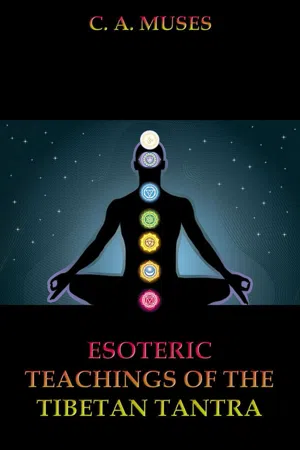
- 326 pages
- English
- ePUB (mobile friendly)
- Available on iOS & Android
eBook - ePub
Esoteric Teachings Of The Tibetan Tantra
About this book
Information
Topic
Theology & ReligionSubtopic
BuddhismEsoteric Teachings Of The Tibetan Tantra
C. A. Muses
Contents:
Buddhism
Esoteric Teachings Of The Tibetan Tantra
Part I: Seven Initiation Rituals Of The Tibetan Tantra
Chapter One - The Initiation Ritual Of The Fierce Guru
Chapter Two - The Initiation Ritual Of The Fierce Guru With Phurba
Chapter Three - The Initiation Ritual Of The All-Merciful One
Chapter Four - The Initiation Ritual Of Hayagriva Buddha. The Green Rta-Mgrin's Initiation Ceremony From The Treasury Of Percipience
Chapter Five - The Initiation Ritual Of The Red Gshin-Rje
Chapter Six - The Superb Initiation Ritual Of Ahm Gtsug Vajrapani
Chapter Seven - A Compendium Of The Initiation Rituals Of Performance Or All-Accomplishing Wisdom Presided Over By Amoghasiddhi
Part Ii - The Six Yogas Of Naropa [In Tsong-Kha-Pa's Commentary]
Prologue
Chapter One - Introduction
Chapter Two - Special Preparations
Chapter Three - The Arising And Perfecting Yoga
Chapter Four - The Steps Of Practice In The Path
Chapter Five - The Art Of Gtum-Mo Or Heat Yoga
Chapter Six - The Practice Of The Illusory Body Or Dream Yoga, Depending On Foregoing Heat Yoga
Chapter Seven - On The Bardo Realm
Chapter Eight - The Yoga Of The Light
Chapter Nine - The Transformation Yoga
Chapter Ten - How To Improve The Practice In The Path
Chapter Eleven - Tsong Khopa's Summary Of Sources
Epilogue
Appendix - The Vow Of Mahamudra
Translator's Introduction
Editor's Note
The Vow Of Mahamudra
Esoteric Teachings Of The Tibetan Tantra, C. A. Muses
Jazzybee Verlag Jürgen Beck
86450 Altenmünster, Germany
ISBN: 9783849621940
www.jazzybee-verlag.de
Cover Design: © sweet_caramel - Fotolia.com
BUDDHISM
The religion held by the followers of the Buddha, and covering a large area in India and east and central Asia.
Essential Doctrines.—We are fortunate in having preserved for us the official report of the Buddha's discourse, in which he expounded what he considered the main features of his system to the five men he first tried to win over to his new-found faith. There is no reason to doubt its substantial accuracy, not as to words, but as to purport. In any case it is what the compilers of the oldest extant documents believed their teacher to have regarded as the most important points in his teaching. Such a summary must be better than any that could now be made. It is incorporated into two divisions of their sacred books, first among the suttas containing the doctrine, and again in the rules of the society or order he founded (Samyutta, v. 421 = Vinaya, i. 10). The gist of it, omitting a few repetitions, is as follows:—
"There are two aims which he who has given up the world ought not to follow after—devotion, on the one hand, to those things whose attractions depend upon the passions, a low and pagan ideal, fit only for the worldly-minded, ignoble, unprofitable, and the practice on the other hand of asceticism, which is painful, ignoble, unprofitable. There is a Middle Path discovered by the Tathāgata—a path which opens the eyes, and bestows understanding, which leads to peace, to insight, to the higher wisdom, to Nirvāna. Verily! it is this Noble Eightfold Path; that is to say, Right Views, Right Aspirations, Right Speech, Right Conduct, Right Mode of Livelihood, Right Effort, Right Mindfulness, and Right Rapture.
"Now this is the Noble Truth as to suffering. Birth is attended with pain, decay is painful, disease is painful, death is painful. Union with the unpleasant is painful, painful is separation from the pleasant; and any craving unsatisfied, that too is painful. In brief, the five aggregates of clinging (that is, the conditions of individuality) are painful.
"Now this is the Noble Truth as to the origin of suffering. Verily! it is the craving thirst that causes the renewal of becomings, that is accompanied by sensual delights, and seeks satisfaction now here, now there—that is to say, the craving for the gratification of the senses, or the craving for a future life, or the craving for prosperity.
"Now this is the Noble Truth as to the passing away of pain. Verily! it is the passing away so that no passion remains, the giving up, the getting rid of, the being emancipated from, the harbouring no longer of this craving thirst.
"Now this is the Noble Truth as to the way that leads to the passing away of pain. Verily! it is this Noble Eightfold Path, that is to say, Right Views, Right Aspirations, Right speech, conduct and mode of livelihood, Right Effort, Right Mindfulness and Right Rapture."
A few words follow as to the threefold way in which the speaker claimed to have grasped each of these Four Truths. That is all. There is not a word about God or the soul, not a word about the Buddha or Buddhism. It seems simple, almost jejune; so thin and weak that one wonders how it can have formed...
Table of contents
- BUDDHISM
- PART II - THE SIX YOGAS OF NAROPA [IN TSONG-KHA-PA'S COMMENTARY]
- APPENDIX - THE VOW OF MAHAMUDRA
Trusted by 375,005 students
Access to over 1.5 million titles for a fair monthly price.
Study more efficiently using our study tools.
Frequently asked questions
Yes, you can cancel anytime from the Subscription tab in your account settings on the Perlego website. Your subscription will stay active until the end of your current billing period. Learn how to cancel your subscription
No, books cannot be downloaded as external files, such as PDFs, for use outside of Perlego. However, you can download books within the Perlego app for offline reading on mobile or tablet. Learn how to download books offline
Perlego offers two plans: Essential and Complete
- Essential is ideal for learners and professionals who enjoy exploring a wide range of subjects. Access the Essential Library with 800,000+ trusted titles and best-sellers across business, personal growth, and the humanities. Includes unlimited reading time and Standard Read Aloud voice.
- Complete: Perfect for advanced learners and researchers needing full, unrestricted access. Unlock 1.5M+ books across hundreds of subjects, including academic and specialized titles. The Complete Plan also includes advanced features like Premium Read Aloud and Research Assistant.
We are an online textbook subscription service, where you can get access to an entire online library for less than the price of a single book per month. With over 1.5 million books across 990+ topics, we’ve got you covered! Learn about our mission
Look out for the read-aloud symbol on your next book to see if you can listen to it. The read-aloud tool reads text aloud for you, highlighting the text as it is being read. You can pause it, speed it up and slow it down. Learn more about Read Aloud
Yes! You can use the Perlego app on both iOS and Android devices to read anytime, anywhere — even offline. Perfect for commutes or when you’re on the go.
Please note we cannot support devices running on iOS 13 and Android 7 or earlier. Learn more about using the app
Please note we cannot support devices running on iOS 13 and Android 7 or earlier. Learn more about using the app
Yes, you can access Esoteric Teachings Of The Tibetan Tantra by C. A. Muses in PDF and/or ePUB format, as well as other popular books in Theology & Religion & Buddhism. We have over 1.5 million books available in our catalogue for you to explore.