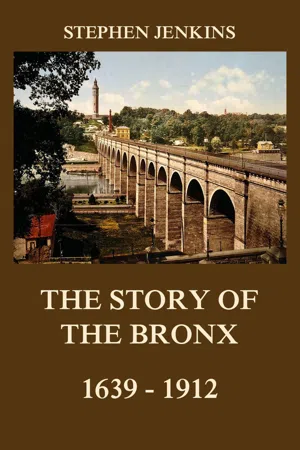
The romantic history of the northern section of Greater New York from the days of Jonas Bronk, after whom the Bronx was named, through the centuries crowded with events that have issued into the present. The geographical landmarks acquire a new significance as around them this accurate historian of local events and conditions weaves the substantial fabric of fact and more sparingly the lighter web of tradition. Among his most interesting chapters are those touching on colonial manners and customs, the Bronx during the Revolution, the churches, early and later means of communication, and ferries and bridges.
- 536 pages
- English
- ePUB (mobile friendly)
- Available on iOS & Android
eBook - ePub
The Story of the Bronx
About this book
Trusted by 375,005 students
Access to over 1.5 million titles for a fair monthly price.
Study more efficiently using our study tools.
Information
Subtopic
North American HistoryIndex
HistoryCHAPTER I. THE POLITICAL FORMATION OF THE BOROUGH, AND ITS TOPOGRAPHY
THE city of New York is divided for administrative purposes into five boroughs: Manhattan, the original city of New York upon the island of Manhattan; Brooklyn, the old city of that name in the county of Kings; Queens, in the county of the same name, adjoining Brooklyn; Richmond, or Staten Island; The Bronx, the Borough lying north of the Harlem River.
November 1, 1683, the county of Westchester was formed. Its western boundary was the Hudson River; its northern, Dutchess (now Putnam) County; its eastern, the Connecticut Colony and Long Island Sound; its southern, the East and Harlem rivers and Spuyten Duyvil Creek. The Borough of The Bronx was included within the county of Westchester until 1874 for the western part of the Borough, and until 1895 for the eastern part. Its history is until these dates that of the county. The county also included the islands contiguous to its shores.
By act of the State Legislature, March 7, 1788, all the counties were divided into townships. There were twenty-one of these in Westchester County, following very closely the lines of the ancient manors and patents. The section under consideration was formerly within the towns of Yonkers, Morrisania, Eastchester, Pelham, and Westchester.
Yonkers was a part of the Philipsburgh Manor, sequestrated by the State in 1779, on account of the disloyalty of its owner, Colonel Frederick Philipse. The part of the township within the Borough was known as Lower Yonkers; and it remained a part of the original township until June 1, 1872, when the city of Yonkers was incorporated. At the same time, the portion of the township lying south of a line drawn from the northwest corner of the land belonging to the Sisters of Charity, known as St. Vincent de Paul, due east to the Bronx River, was set off as a new township under the name of Kingsbridge. It remained a part of the Yonkers township until December sixteenth of the same year, when the selection of town officers was perfected. Its northern boundary was the line given above, from the Hudson River to the Bronx; its southern, the northern line of the ancient manor of Fordham, from the Harlem River at East 230th Street to a point on the Bronx River between First and Second avenues, Williamsbridge, and Spuyten Duyvil Creek; its western, the Hudson River.
Morrisania was the most sparsely settled section of the whole county; and why it should have been made into a township is not clear, unless it was by reason of the influence and prominence of its owner, Lewis Morris, the signer of the Declaration of Independence. The new Constitutional government had gone into effect in New York in 1789, but the site of the permanent capital of the nation was a matter of considerable discussion. Morris believed his manor to be an ideal spot for it; hence, its formation into a township. On October 1, 1790, the Congress in session at New York was to determine the location of the new capital, and Morris memorialized it in favor of Morrisania. He states:
"that the said manor is more advantageously situated for their [Congress's] residence than any other place that has hitherto been proposed to them, and much better accommodated with the necessary requisites of convenience of access, health, and security"; "that vessels from the four Eastern States may arrive at Morrisania through the Sound, in the course of a few hours, and that ships from the Carolinas and Georgia may perform voyages to Morrisania with much more safety and dispatch than they can to the ports of Philadelphia and Annapolis, not being incommoded with tedious passages of two hundred miles each up Bays and Rivers which often consume a fortnight or three weeks — passages rendered hazardous by rocks and shoals, and annually obstructed by ice"; "that Morrisania is so situated that vessels may arrive from, or proceed to sea, sometimes in six hours . . . and that this passage, from the quantity and saltness of the water, has never been totally impeded by ice"; "that Morrisania has always been noted for this particular [health and salubrity], that the fever and ague is unknown, and that persons from other places, emaciated by sickness and disease, there shortly recover and are speedily reinforced in health and vigor"; and further, "that Morrisania is perfectly secure from any dangers either from foreign invasion or internal insurrection"; "that Morrisania being distant only twenty miles from the State of Connecticut, and eight miles from the City of New York, that it therefore can be amply protected by the hardy sons of New England on the one side and the inhabitants of the populous City of New York on the other; that as the chief defense of this country in future must be by its militia . . . there are more fighting men within a sweep of thirty miles around Morrisania than perhaps within the same distance around any other place in America, as there are many populous places which contain large proportions of inhabitants who are principled by religion against bearing arms, and other places which contain negro inhabitants who not only do not fight themselves, but by keeping their masters at home, prevent them from fighting also."
As a real-estate broker, Morris was not a success, and the capital went to the banks of the Potomac; while by act of the Legislature of February 2, 1791, Morrisania ceased to be a separate township and became a part of the township of Westchester, and later, of West Farms; it remained so until December 7, 1855, when it again became a separate township. Previous to 1848, there were few settlers; but the revolutions that occurred in Europe at that time sent a stream of immigrants to the land of liberty; and many of them settled in Morrisania, converting its fields and farms into thriving, active villages, and giving it that Teutonic appearance of names and occupations which it maintained for forty years afterwards, and which has not yet wholly disappeared under the later Celtic, Italian, and Semitic invasions.
The bounds of the township at both creations, 1788 and 1855, were the same as those of the ancient manor. The northerly line, which was also the southerly line of Fordham Manor, began at the Harlem River immediately south of the present High Bridge, and extended east to Union Avenue between East 170th and 171st streets; its eastern boundary was practically Union Avenue to Bungay Creek (Intervale Avenue), which it followed to the East River; its other boundaries were the East River, Bronx Kills, and Harlem River.
The township of Eastchester (1788) had for its western boundary the Bronx River; on the north, Scarsdale; on the east, Hutchinson's River; on the south, Black Dog Brook and a line drawn from the head of the brook on the line of 229th Street to the Bronx River. When the city of Mount Vernon was incorporated in 1892, the township of Eastchester was divided into two parts, entirely separated from each other by the newly formed, intervening city. The southern piece was the smaller; and when the question of annexation was submitted to the people in 1894, the inhabitants voted to be taken into the city of New York.
Pelham township was what remained of Pelham Manor; it was triangular in form, New Rochelle being its base or northerly line, and the two sides being the Sound and Hutchinson's River. It also included Hunter, Twin, Hart, High, and City islands. The portion taken for the city of New York is almost entirely within Pelham Bay Park. The part annexed to New York was the ancient Annes Hoeck, or Pell's Neck, and Rodman's Neck, as well as the islands mentioned above.
The township of Westchester (1788) included all the rest of the land now within the limits of the Borough; the ancient manor of Fordham, the West Farms tract, and all the land between the Hutchinson River, the Bronx River, and the Sound, with a northerly boundary at the Eastchester line from Black Dog Brook to the Bronx River. This included about one half the Borough. The town was further increased by the accession of Morrisania, February 22, 1791. It remained intact until May 13, 1846, when the township of West Farms was formed out of its territory.
West Farms (1846) comprised all the land west of the Bronx River as far as the Harlem River, lying south of Yonkers, until December 7, 1855, when the township of Morrisania was once more formed from its territory. It thus included the manors of Morrisania and Fordham and the West Farms patent of 1663.
The annexation of a part of Westchester County to the city of New York was a question that arose long before any formal action was taken by the authorities. As early as 1864, it was proposed to unite the townships of Morrisania and West Farms under a special city charter; but the objections of the inhabitants of West Farms defeated the project. In 1869, one of the Tweed members of the Legislature from Mount Vernon proposed the annexation of a large portion of the county to the city; but as the action was taken without any reference to the wishes of the inhabitants or their immediate representative, Senator Cauldwell, he arose in his place and announced that, in a few days, he would introduce a bill "to annex the city of New York to Morrisania," a piece of sarcasm which defeated the movement at that time. Yet Senator Cauldwell was, later, one of the foremost in advocating annexation and in bringing it about.
In the autumn of 1872, the people of West Farms and Morrisania came together; and the following year, the bill referring the question of annexation to the people was enacted. Owing to disputes among the officials, the bill provided that the streets should be placed under the Park Department, a scheme that worked more harm than good to the newly annexed district until the streets were put under a special Department of Street Improvements of the Twenty-third and Twenty fourth wards, January 1, 1891.
On January 1, 1874, by act of the Legislature mentioned above, the townships of Kingsbridge, West Farms, and Morrisania became a part of the (old) city of New York, and were formed into the Twenty-third and Twenty-fourth wards. The new wards were also spoken of as the Annexed District; they constitute that part of the Borough lying west of the Bronx River and comprise 12,317 acres.
At the election of November 6, 1894, the question of the Greater New York was submitted to the inhabitants of the localities affected, including Westchester, Eastchester, Pelham, and the city of Mount Vernon. The result of the referendum showed good majorities for annexation in Eastchester and Pelham, while Mount Vernon and Westchester voted against, the former by a large majority, and the latter by a majority of one. The adverse majority in Westchester was so small that it was ignored by the annexationists; and July 1, 1895, the whole section east of the Bronx River became a part of the city of New York, forming part of the Twenty-fourth Ward. It comprises nearly 14,000 acres, making the total area taken from Westchester County by the two annexations 26,017 acres, or about 39! square miles.
January 1, 1898, the charter of the Greater New York went into effect, and the whole annexed section north of the Harlem River became officially known as the Borough of The Bronx, though united in educational and some other official matters with the Borough of Manhattan.
January 1, 1902, the revised charter of the Greater New York went into effect. It gives a certain amount of autonomy to the different boroughs, especially in the matter of local improvements, though many acts of the local boards are subject to the Board of Aldermen or Board of Estimate and Apportionment, or both, when the outlay authorized by the local board exceeds two thousand dollars. The local boards of The Bronx are composed of the Borough president and the aldermen of the local improvement districts. There are four such districts in the Borough; the Twenty-second, or Morrisania; the Twenty-third, or Chester; the Twenty-fourth, or Crotona; and the Twenty-fifth, or Van Courtlandt.
When the two annexations took place, the sections ceased to be parts of Westchester County and became parts of New York County. In the matter of congressional, senate, assembly, and judicial representation, however, portions of the Borough were at first attached to Westchester County; though there is now separation. The Borough constitutes the eighteenth congressional district; but on the basis of population as shown by the last Federal Census, it is entitled to two congressmen. There are eight aldermanic districts, and four local school districts, each having its own board. The Borough is allowed two municipal courts where civil cases may be tried in which the value in controversy does not exceed two hundred and fifty dollars. There are also two police magistrate's courts for the settlement of minor cases of crimes and misdemeanors and for preliminary hearings in cases of felony. For police protection, the Borough is divided into nine precincts with 756 men. For protection from fire, there are twenty engines and nine hook and ladder trucks, while in the Harlem River is stationed a fire tug. There are fifty public elementary schools and the Gouverneur Morris High School on the Boston Road, while, owing to the rapidly increasing population, new sites are being selected and buildings erected, though not half fast enough to keep up with the growth of school population. Most of these school buildings are modern in every respect; and while built for utilitarian purposes, the aesthetic side has not been neglected; and, as the sites are often on high ground, these fine examples of school architecture tower above their neighbors and attract the attention of the wayfarer.
Many of the natural features of the Borough are rapidly disappearing before the march of modern improvements; and the authorities are filling in creeks, swamps, and lowlands, laying out and grading streets, and establishing water mains and sewers for the immense population of the future. In the spring of 1903, a plan of opening and grading 420 miles of streets in the district east of the Bronx River was submitted to the Board of Estimate and approved by them on May 29, 1903. In this plan, ample provision is made for several small parks and for a larger one at Seton's Falls; but little or no attention is paid to the preservation of old landmarks, except in the way of some of the more prominent of the ancient highways.
By the Federal Census of 1900, the Borough had a population of 200,507; and by the Census of 1910, a population of 430,980, an increase of nearly 115 per cent., more than that of any other borough of the city. The great increase in population and the consequent erection of buildings to accommodate the inhabitants, with the transfers of property and other matters of record in relation to real estate, became so great in volume that, on April 28, 1903, a committee was appointed by the North Side Board of Trade to bring before the State Legislature the formation of a new county to be called Bronx County. In January following, a bill to form such a county was introduced, but it failed to pass. It was introduced in every subsequent Legislature, but it was defeated, so it is stated, because, if such a county were created, Tammany and the other political machines would lose their power in the Borough. Extraordinary meetings and agitations took place in the autumn of 1911, with the result that an act passed by the Legislature of 1912 authorizes the formation of Bronx County, the matter to be decided by a referendum to the voters of the Borough at the election of November, 1912.
The construction and opening of the subway in 1904 caused a great boom in real estate; and the operations have run into many millions of dollars, as many farm lands and estates have been brought into the market and have found ready purchasers for actual building.
On January 16, 1904, the Bronx Free Library, which had been in existence for several years, surrendered its separate existence to the New York Library, and thus brought itself within the scope of the Carnegie Library Fund; and, in consequence, the corner-stone of a new building was laid on January 21, 1904, at Washington Avenue and East 176th Street. Other branches of the New York Public Library are located in Morrisania, Mott Haven, Highbridgeville, and Kingsbridge.
The only regular military organization in the Borough is the Second Battery of the State National Guard, which prides itself on being the pioneer company of the Borough. It was organized February 4, 1833, in the city of New York and moved to temporary quarters on Bathgate Avenue near East 177th Street on October 25, 1902. It occupied its new armory on Franklin Avenue and East 166th Street on June 1, 1910. The ground and building cost $57,200. The battery, which is now officially Battery A, First Battalion, Field Artillery, N. G., N. Y., consists of six officers and one hundred and eleven men. The battery is equipped with four three-inch breech-loading field guns, four Colt rapid-firing guns, and four Gatling guns. In addition, there are forty-four horses, the property of the battery, and the necessary equipment of harness, small arms, caissons...
Table of contents
- TO THE BRONX
- INTRODUCTION
- CHAPTER I. THE POLITICAL FORMATION OF THE BOROUGH, AND ITS TOPOGRAPHY
- CHAPTER II. UNDER THE DUTCH
- CHAPTER III. UNDER THE LORD PROPRIETOR, 1664-1685
- CHAPTER IV. AS A ROYAL PROVINCE. 1685-1776
- CHAPTER V. MANNERS AND CUSTOMS IN COLONIAL DAYS
- CHAPTER VI. THE REVOLUTION TO SEPTEMBER, 1776
- CHAPTER VII. THE REVOLUTION, FROM SEPTEMBER 1776, TO NOVEMBER 1776.
- CHAPTER VIII. THE REVOLUTION FROM NOVEMBER 1776, TO END OF WAR
- CHAPTER IX. FERRIES AND BRIDGES
- CHAPTER X. EARLY MEANS OF COMMUNICATION
- CHAPTER XI. LATER MEANS OF COMMUNICATION
- CHAPTER XII. THE CHURCHES
- CHAPTER XIV. THE PARKS AND CEMETERIES
- CHAPTER XIV. KINGSBRIDGE
- CHAPTER XV. FORDHAM MANOR
- CHAPTER XVI. MORRISANIA
- CHAPTER XVII. WEST FARMS
- CHAPTER XVIII. WESTCHESTER
- CHAPTER XIX. EASTCHESTER AND PELHAM
Frequently asked questions
Yes, you can cancel anytime from the Subscription tab in your account settings on the Perlego website. Your subscription will stay active until the end of your current billing period. Learn how to cancel your subscription
No, books cannot be downloaded as external files, such as PDFs, for use outside of Perlego. However, you can download books within the Perlego app for offline reading on mobile or tablet. Learn how to download books offline
Perlego offers two plans: Essential and Complete
- Essential is ideal for learners and professionals who enjoy exploring a wide range of subjects. Access the Essential Library with 800,000+ trusted titles and best-sellers across business, personal growth, and the humanities. Includes unlimited reading time and Standard Read Aloud voice.
- Complete: Perfect for advanced learners and researchers needing full, unrestricted access. Unlock 1.5M+ books across hundreds of subjects, including academic and specialized titles. The Complete Plan also includes advanced features like Premium Read Aloud and Research Assistant.
We are an online textbook subscription service, where you can get access to an entire online library for less than the price of a single book per month. With over 1.5 million books across 990+ topics, we’ve got you covered! Learn about our mission
Look out for the read-aloud symbol on your next book to see if you can listen to it. The read-aloud tool reads text aloud for you, highlighting the text as it is being read. You can pause it, speed it up and slow it down. Learn more about Read Aloud
Yes! You can use the Perlego app on both iOS and Android devices to read anytime, anywhere — even offline. Perfect for commutes or when you’re on the go.
Please note we cannot support devices running on iOS 13 and Android 7 or earlier. Learn more about using the app
Please note we cannot support devices running on iOS 13 and Android 7 or earlier. Learn more about using the app
Yes, you can access The Story of the Bronx by Stephen Jenkins in PDF and/or ePUB format, as well as other popular books in History & North American History. We have over 1.5 million books available in our catalogue for you to explore.