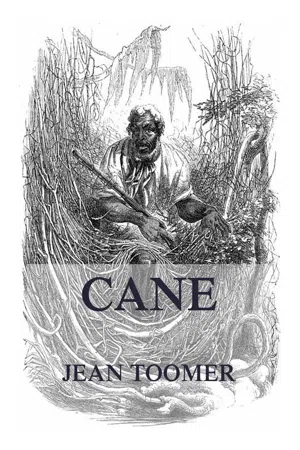
'Cane' is a novel and possibly the best-known work by Jean Toomer. The novel is built up in a series of vignettes that deal with the origins and experiences of African Americans in the United States. The vignettes picture the South in sketches, short stories and poems by. A book whose tap roots run deep in the Southern soil, and whose music sways our emotions as only primitive desires can.
eBook - ePub
Cane
About this book
Information
Topic
LiteraturSubtopic
AltertumswissenschaftenKABNIS
1
RALPH KABNIS, propped in his bed, tries to read. To read himself to sleep. An oil lamp on a chair near his elbow burns unsteadily. The cabin room is spaced fantastically about it. Whitewashed hearth and chimney, black with sooty saw-teeth. Ceiling, patterned by the fringed globe of the lamp. The walls, unpain'ted, are seasoned a rosin yellow. And cracks between the boards are black. These cracks are the lips the night winds use for whispering. Night winds in Georgia are vagrant poets, whispering. Kabnis, against his will, lets his book slip down, and listens to them. The warm whiteness of his bed, the lamp-light, do not protect him from the weird chill of their song:
— White-man’s land.
Niggers, sing.
Burn, bear black children
Till poor rivers bring
Rest, and sweet glory
In Camp Ground.
Kabnis’ thin hair is streaked on the pillow. His hand strokes the slim silk of his mustache. His thumb, pressed under his chin, seems to be trying to give squareness and projection to it. Brown eyes stare from a lemon face. Moisture gathers beneath his arm-pits. He slides down beneath the cover, seeking release.
Kabnis: Near me. Now. Whoever you are, my warm glowing sweetheart, do not think that the face that rests beside you is the real Kabnis. Ralph Kabnis is a dream. And dreams are faces with large eyes and weak chins and broad brows that get smashed by the fists of square faces. The body of the world is bull-necked. A dream is a soft face that fits uncertainly upon it. . . God, if I could develop that in words. Give what I know a bull-neck and a heaving body, all would go well with me, wouldn't it, sweetheart? If I could feel that I came to the South to face it. If I, the dream (not what is weak and afraid in me) could become the face of the South. How my lips would sing for it, my songs being the lips of its soul. Soul. Soul hell. There ain't no such thing. What in hell was that?
A rat had run across the thin boards of the ceiling. Kabnis thrusts his head out from the covers. Through the cracks, a powdery faded red dust sprays down on him. Dust of slave-fields, dried, scattered. . . No use to read. Christ, if he only could drink himself to sleep. Something as sure as fate was going to happen. He couldn't stand this thing much longer. A hen, perched on a shelf in the adjoining room begins to tread. Her nails scrape the soft wood. Her feathers ruffle.
“Get out of that, you egg-laying bitch.”
Kabnis hurls a slipper against the wall. The hen flies from her perch and cackles as if a skunk were after her.
“Now cut out that racket or I’ll wring your neck for you.”
Answering cackles arise in the chicken yard.
“Why in Christ’s hell can't you leave me alone? Damn it, I wish your cackle would choke you. Choke every mother’s son of them in this God-forsaken hole. Go away. By God I’ll wring your neck for you if you don't. Hell of a mess I’ve got in: even the poultry is hostile. Go way. Go way. By God, I’ll . . . ”
Kabnis jumps from his bed. His eyes are wild. He makes for the door. Bursts through it. The hen, driving blindly at the windowpane, screams. Then flies and flops around trying to elude him. Kabnis catches her.
“Got you now, you she-bitch.”
With his fingers about her neck, he thrusts open the outside door and steps out into the serene loveliness of Georgian autumn moonlight. Some distance off, down in the valley, a band of pine-smoke, silvered gauze, drifts steadily. The half-moon is a white child that sleeps upon the tree-tops of the forest. White winds croon its sleep-song:
rock a-by baby . .
Black mother sways, holding a white child on her bosom.
when the bough bends . .
Her breath hums through pine-cones, cradle will fall . .
Teat moon-children at your breasts, down will come baby . .
Black mother.
Kabnis whirls the chicken by its neck and throws the head away. Picks up the hopping body, warm, sticky, and hides it in a clump of bushes. He wipes blood from his hands onto the coarse scant grass.
Kabnis: That's done. Old Chromo in the big house there will wonder what's become of her pet hen. Well, it’ll teach her a lesson: not to make a hen-coop of my quarters. Quarters. Hell of a fine quarters, I’ve got. Five years ago; look at me now. Earth’s child. The earth my mother. God is a profligate red-nosed man about town. Bastardy; me. A bastard son has got a right to curse his maker. God. . .
Kabnis is about to shake his fists heavenward. He looks up, and the night’s beauty strikes him dumb. He falls to his knees. Sharp stones cut through his thin pajamas. The shock sends a shiver over him. He quivers. Tears mist his eyes. He writhes.
“God Almighty, dear God, dear Jesus, do not torture me with beauty. Take it away. Give me an ugly world. Ha, ugly. Stinking like unwashed niggers. Dear Jesus, do not chain me to myself and set these hills and valleys, heaving with folk-songs, so close to me that I cannot reach them. There is a radiant beauty in the night that touches and . . . tortures me. Ugh. Hell. Get up, you damn fool. Look around. What's beautiful there? Hog pens and chicken yards. Dirty red mud. Stinking outhouse. What's beauty anyway but ugliness if it hurts you? God, he doesn't exist, but nevertheless He is ugly. Hence, what comes from Him is ugly. Lynchers and business men, and that cockroach Hanby, especially. How come that he gets to be principal of a school? Of the school I’m driven to teach in? God’s handiwork, doubtless. God and Hanby, they belong together. Two godam moral-spouters. Oh, no, I won't let that emotion come up in me. Stay down. Stay down, I tell you. O Jesus, Thou art beautiful. . . Come, Ralph, pull yourself together. Curses and adoration don't come from what is sane. This loneliness, dumbness, awful, intangible oppression is enough to drive a man insane. Miles from nowhere. A speck on a Georgia hillside. Jesus, can you imagine it — an atom of dust in agony on a hillside? That's a spectacle for you. Come, Ralph, old man, pull yourself together.”
Kabnis has stiffened. He is conscious now of the night wind, and of how it chills him. He rises. He totters as a man would who for the first time uses artificial limbs. As a completely artificial man would. The large frame house, squatting on brick pillars, where the principal of the school, his wife, and the boarding girls sleep, seems a curious shadow of his mind. He tries but cannot convince himself of its reality. His gaze drifts down into the vale, across the swamp, up over the solid dusk bank of pines, and rests, bewildered-like, on the court-house tower. It is dull silver in the moonlight. White child that sleeps upon the top of pines. Kabnis’ mind clears. He sees himself yanked beneath that tower. He sees white minds, with indolent assumption, juggle justice and a nigger. . . Somewhere, far off in the straight line of his sight, is Augusta. Christ, how cut off from everything he is. And hours, hours north, why not say a lifetime north? Washington sleeps. Its still, peaceful streets, how desirable they are. Its people whom he had always halfway despised. New York? Impossible. It was a fiction. He had dreamed it. An impotent nostalgia grips him. It becomes intolerable. He forces himself to narrow to a cabin silhouetted on a knoll about a mile away. Peace. Negroes within it are content. They farm. They sing. They love. They sleep. Kabnis wonders if perhaps they can feel him. If perhaps he gives them bad dreams. Things are so immediate in Georgia.
Thinking that now he can go to sleep, he reenters his room. He builds a fire in the open hearth. The room dances to the tongues of flames and sings to the crackling and spurting of the logs. Wind comes up between the floor boards, through the black cracks of the walls.
Kabnis: Can't sleep. Light a cigarette. If that old bastard comes over here and smells smoke, I’m done for. Hell of a note, can't even smoke. The stillness of it: where they burn and hang men, you can't smoke. Can't take a swig of licker. What do they think this is, anyway, some sort of temperance school? How did I ever land in such a hole? Ugh. One might just as well be in his grave. Still as a grave. Jesus, how still everything is. Does the world know how still it is? People make noise. They are afraid of silence. Of what lives, and God, of what dies in silence. There must be many dead things moving in silence. They come here to touch me. I swear I feel their fingers. . . Come, Ralph, pull yourself together. What in hell was that? Only the rustle of leaves, I guess. You know, Ralph, old man, it wouldn't surprise me at all to see a ghost. People don't think there are such things. They rationalize their fear and call their cowardi...
Table of contents
- FOREWORD
- KARINTHA
- REAPERS
- NOVEMBER COTTON FLOWER
- BECKY
- FACE
- COTTON SONG
- CARMA
- SONG OF THE SON
- GEORGIA DUSK
- FERN
- NULLO
- EVENING SONG
- ESTHER
- CONVERSION
- PORTRAIT IN GEORGIA
- BLOOD-BURNING MOON
- SEVENTH STREET
- RHOBERT
- AVEY
- BEEHIVE
- STORM ENDING
- THEATER
- HER LIPS ARE COPPER WIRE
- CALLING JESUS
- BOX SEAT
- PRAYER
- HARVEST SONG
- BONA AND PAUL
- KABNIS
Trusted by 375,005 students
Access to over 1.5 million titles for a fair monthly price.
Study more efficiently using our study tools.
Frequently asked questions
Yes, you can cancel anytime from the Subscription tab in your account settings on the Perlego website. Your subscription will stay active until the end of your current billing period. Learn how to cancel your subscription
No, books cannot be downloaded as external files, such as PDFs, for use outside of Perlego. However, you can download books within the Perlego app for offline reading on mobile or tablet. Learn how to download books offline
Perlego offers two plans: Essential and Complete
- Essential is ideal for learners and professionals who enjoy exploring a wide range of subjects. Access the Essential Library with 800,000+ trusted titles and best-sellers across business, personal growth, and the humanities. Includes unlimited reading time and Standard Read Aloud voice.
- Complete: Perfect for advanced learners and researchers needing full, unrestricted access. Unlock 1.5M+ books across hundreds of subjects, including academic and specialized titles. The Complete Plan also includes advanced features like Premium Read Aloud and Research Assistant.
We are an online textbook subscription service, where you can get access to an entire online library for less than the price of a single book per month. With over 1.5 million books across 990+ topics, we’ve got you covered! Learn about our mission
Look out for the read-aloud symbol on your next book to see if you can listen to it. The read-aloud tool reads text aloud for you, highlighting the text as it is being read. You can pause it, speed it up and slow it down. Learn more about Read Aloud
Yes! You can use the Perlego app on both iOS and Android devices to read anytime, anywhere — even offline. Perfect for commutes or when you’re on the go.
Please note we cannot support devices running on iOS 13 and Android 7 or earlier. Learn more about using the app
Please note we cannot support devices running on iOS 13 and Android 7 or earlier. Learn more about using the app
Yes, you can access Cane by Jean Toomer in PDF and/or ePUB format, as well as other popular books in Literatur & Altertumswissenschaften. We have over 1.5 million books available in our catalogue for you to explore.