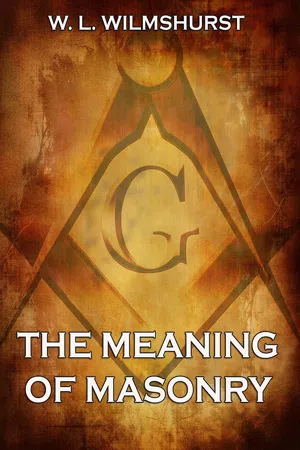
This most interesting and illuminative work is worthy a place on every Mason's bookshelf. '' It seems taken for granted, " says the author, "that reception into the Order will automatically be accompanied by an ability to appreciate forthwith and at its full value all that one there finds. The contrary is the case, for Masonry is a veiled and cryptic expression of the difficult science of spiritual life, and the understanding of it calls for special and informed guidance on the one hand, and on the other a genuine and earnest desire for knowledge and no small capacity for spiritual perception on the part of those seeking to be instructed." In Freemasonry, as in all phases of life, many are called but few are chosen. Masonry is not a mere formalism but a life to be lived. If you do not live the life you cannot know the doctrine. Masonry is an effort to perpetuate the essential doctrines of the Ancient Mysteries, but, alas, it does so in a very perfunctory manner. So veiled are its allegories and symbols that it is almost impossible to penetrate into the Holy of Holies.
- 202 pages
- English
- ePUB (mobile friendly)
- Available on iOS & Android
eBook - ePub
The Meaning Of Masonry
About this book
Information
Subtopic
SociologyIndex
Social SciencesVII. Outer work of Freemasonry
its achievements, purposes and methods
The outer work of Freemasonry, though uniform in its fundamental character and its general lines, varies considerably in different countries and different Masonic symbols. "Charitable"or "philanthropic" purposes are chiefly pursued by English, German, and American Masonry, while practically at least, they are neglected by Masons in the Latin countries, who are absorbed by political activity. But even in England, where relatively the largest sums are spent for charitable purposes, Masonic philanthropy does not seem to be inspired by very high ideals of generosity and disinterestedness, at least with respect to the great mass of the brethren; the principal contributions are made by a few very wealthy brethren and the rest by such as are well-to-do.
Moreover, in all countries it is almost exclusively Masons and their families that profit by Masonic charity. Masonic beneficence towards the "profane" world is little more than figurative, consisting in the propagation and application of Masonic principles by which Masons pretend to promote the welfare of mankind; and if Masons, particularly in Catholic countries, occasionally devote themselves to charitable works as ordinarily understood, their aim is to gain sympathy and thereby further their real purposes. In North America, especially in the United States a characteristic feature of the outer work is the tendency toward display in the construction of sumptuous Masonic "temples", in Masonic processions, at the laying of cornerstones and the dedication of public buildings and even of Christian churches. This tendency has frequently been rebuked by Masonic writers. "The Masonry of this continent has gone mad after high degreeism and grand titleism. We tell the brethren, that if they do not pay more attention to the pure, simple, beautiful symbolism of the Lodge and less to the tinsel, furbelow, fire and feathers of Scotch Ritism and Templarism, the Craft will yet be shaken to its very foundations!" "Let the tocsin be sounded". [145] "Many masons have passed through the ceremony without any inspiration; but, in public parades of the Lodges (also in England) they may generally be found in the front rank and at the masonic banquets they can neither be equalled nor excelled". [146]
Even with regard to the most recent Turkish Revolution, it seems certain that the Young Turkish party, which made and directed the Revolution, was guided by Masons, and that Masonry, especially the Grand Orients of Italy and France, had a preponderant rôle in this Revolution. [153] In conducting this work Freemasonry propagates principles which, logically developed, as shown above, are essentially revolutionary and serve as a basis for all kinds of revolutionary movements. Directing Masons to find out for themselves practical reforms in conformity with Masonic ideals and to work for their realization, it fosters in its members and through them in society at large the spirit of innovation. As an apparently harmless and even beneficent association, which in reality is, through its secrecy and ambiguous symbolism, subject to the most different influences, it furnishes in critical times a shelter for conspiracy, and, even when its lodges themselves are not transformed into conspiracy clubs, Masons are trained and encouraged to found new associations for such purposes or to make use of existing associations.
Thus, Freemasonry in the eighteenth century, as a powerful ally of infidelity, prepared the French Revolution. The alliance of Freemasonry with philosophy was publicly sealed by the solemn initiation of Voltaire, the chief of these philosophers, 7 February, 1778, and his reception of the Masonic garb from the famous materialist Bro. Helvetius. [154] Prior to the Revolution various conspiratory societies arose in connection with Freemasonry from which they borrowed its forms and methods; Illuminati, clubs of Jacobins, etc. A relatively large number of the leading revolutionists were members of Masonic lodges, trained by lodge life for their political career. Even the programme of the Revolution expressed in the "rights of man" was, as shown above, drawn from Masonic principles, and its device: "Liberty, Equality, Fraternity" is the very device of Freemasonry. Similarly, Freemasonry, together with the Carbonari, cooperated in the Italian revolutionary movement of the nineteenth century. Nearly all the prominent leaders and among them Mazzini and Garibaldi, are extolled by Masonry as its most distinguished members. In Germany and Austria, Freemasonry during the eighteenth century was a powerful ally of the so-called party, of "Enlightenment" (Aufklaerung), and of Josephinism; in the nineteenth century of the pseudo-Liberal and of the anti-clerical party.
In order to appreciate rightly the activity of Freemasonry in Germany, Sweden, Denmark and England, and in France under the Napoleonic regime, the special relations between Freemasonry and the reigning dynasties must not be overlooked. In Germany two-thirds of the Masons are members of the old Prussian Grand Lodges under the protectorship of a member of the Royal Dynasty, which implies a severe control of all lodge activity in conformity with the aims of the Government. Hence German Freemasons are scarcely capable of independent action. But they certainly furthered the movement by which Prussia gradually became the leading state of Germany, considered by them as the "representative and the protector of modern evolution" against "Ultramontanism", "bigotry", and "Papal usurpations". They also instigated the "Kulturkampf". The celebrated jurisconsult and Mason, Grandmaster Bluntschli, was one of the foremost agitators in this conflict; he also stirred up the Swiss "Kulturkampf". At his instigation the assembly of the "Federation of the German Grand Lodges", in order to increase lodge activity in the sense of the "Kulturkampf", declared, 24 May, 1874: "It is a professional duty for the lodges to see to it, that the brethren become fully conscious of the relations of Freemasonry to the sphere of ethical life and cultural purposes. Freemasons are obliged to put into effect the principles of Freemasonry in practical life and to defend the ethical foundations of human society, whensoever these are assailed. The Federation of the German Grand Lodges will provide, that every year questions of actuality be proposed to all lodges for discussion and uniform action". [155] German Freemasons put forth untiring efforts to exert a decisive influence on the whole life of the nation in keeping with Masonic principles, thus maintaining a perpetual silent "Kulturkampf". The principal means which they employ are popular libraries, conferences, the affiliation of kindred associations and institutions, the creation, where necessary, of new institutions, through which the Masonic spirit permeates the nation. [156] A similar activity is displayed by the Austrian Freemasons.
The chief organization which in France secured the success of Freemasonry was the famous "League of instruction" founded in 1867 by Bro. F. Macé, later a member of the Senate. This league affiliated and implied with its spirit many other associations. French Masonry and above all the Grand Orient of France has displayed the most systematic activity as the dominating political element in the French "Kulturkampf" since 1877. [157] From the official documents of French Masonry contained principally in the official "Bulletin" and "Compte-rendu" of the Grand Orient it has been proved that all the anti-clerical measures passed in the French Parliament were decreed beforehand in the Masonic lodges and executed under the direction of the Grand Orient, whose avowed aim is to control everything and everybody in France. [158] "I said in the assembly of 1898", states the deputy Massé, the official orator of the Assembly of 1903, "that it is the supreme duty of Freemasonry to interfere each day more and more in political and profane struggles". "Success (in the anti-clerical combat) is in a large measure due to Freemasonry; for it is its spirit, its programme, its methods, that have triumphed." "If the Bloc has been established, this is owing to Freemasonry and to the discipline learned in the lodges. The measures we have now to urge are the separation of Church and State and a law concerning instruction. Let us put our trust in the word of our Bro. Combes". "For a long time Freemasonry has been simply the republic in disguise", i.e., the secret parliament and government of Freemasonry in reality rule France; the profane State, Parliament, and Government merely execute its decrees. "We are the conscience of the country"; "we are each year the funeral bell announcing the death of a cabinet that has not done its duty but has betrayed the Republic; or we are its support, encouraging it by saying in a solemn hour: I present you the word of the country . . . its satisfecit which is wanted by you, or its reproach that to-morrow will be sealed by your fall". "We need vigilance and above all mutual confidence, if we are to accomplish our work, as yet unfinished. This work, you know . . . the anti-clerical combat, is going on. The Republic must rid itself of the religious congregations, sweeping them off by a vigorous stroke. The system of half measures is everywhere dangerous; the adversary must be crushed with a single blow". [159] "It is beyond doubt", declared the President of the Assembly of 1902, Bro. Blatin, with respect to the French elections of 1902, "that we would have been defeated by our well-organized opponents, if Freemasonry had not spread over the whole country". [160]
Along with this political activity Freemasonry employed against its adversaries, whether real or supposed, a system of spying and false accusation, the exposure of which brought about the downfall of the masonic cabinet of Combes. In truth all the "anti-clerical" Masonic reforms carried out in France since 1877, such as the secularization of education, measures against private Christian schools and charitable establishments, the suppression of the religious orders and the spoliation of the Church, professedly culminate in an anti-Christian and irreligious reorganization of human society, not only in France but throughout the world. Thus French Freemasonry, as the standard-bearer of all Freemasonry, pretends to inaugurate the golden era of the Masonic universal republic, comprising in Masonic brotherhood all men and all nations. "The triumph of the Galilean", said the president of the Grand Orient, Senator Delpech, on 20 September, 1902, "has lasted twenty centuries. But now he dies in his turn. The mysterious voice, announcing (to Julian the Apostate) the death of Pan, today announces the death of the impostor God who promised an era of justice and peace to those who believe in him. The illusion has lasted a long time. The mendacious God is now disappearing in his turn; he passes away to join in the dust of ages the divinities of India, Egypt, Greece, and Rome, who saw so many creatures prostrate before their altars. Bro. Masons, we rejoice to state that we are not without our share in this overthrow of the false prophets. The Romish Church, founded on the Galilean myth, began to decay rapidly from the very day on which the Masonic Association was established". [161]
The assertion of the French Masons: "We are the conscience of the country", was not true. By the official statistics it was ascertained, that in all elections till 1906 the majority of the votes were against the Masonic Bloc, and even the result in 1906 does not prove that the Bloc, or Masonry, in its anti-clerical measures and purposes represents the will of the nation, since the contrary is evident from many other facts. Much less does it represent the "conscience" of the nation. The fact is, that the Bloc in 1906 secured a majority only because the greater part of this majority voted against their "conscience". No doubt the claims of Freemasonry in France are highly exaggerated, and such success as they have had is due chiefly to the lowering of the moral tone in private and public life, facilitated by the disunion existing among Catholics and by the serious political blunders which they committed. Quite similar is the outer work of the Grand Orient of Italy which likewise pretends to be the standard-bearer of Freemasonry in the secular struggle of Masonic light and freedom against the powers of "spiritual darkness and bondage", alluding of course to the papacy, and dreams of the establishment of a new and universal republican empire with a Masonic Rome, supplanting the papal and Cæsarean as metropolis. The Grand Orient of Italy has often declared that it is enthusiastically followed in this struggle by the Freemasonry of the entire world and especially by the Masonic centres at Paris, Berlin, London, Madrid, Calcutta, Washington. [162] It has not been contradicted by a single Grand Lodge in any country, nor did the German and other Grand Lodges break off their relations with it on account of it shameful political and anti-religious activity. But though the aims of Italian Masons are perhaps more radical and their methods more cunning than those of the French, their political influence, owing to the difference of the surrounding social conditions, is less powerful. The same is to be said of the Belgian and the Hungarian Grand Lodges, which also consider the Grand Orient of France as their political model.
Since 1889, the date of the international Masonic congress, assembled at Paris, 16 and 17 July, 1889, by the Grand Orient of France, systematic and incessant efforts have been made to bring about a closer union of universal Freemasonry in order to realize efficaciously and rapidly the Masonic ideals. The special allies of the Grand Orient in this undertaking are: the Supreme Council and the Symbolical Grand Lodge of France and the Masonic Grand Lodges of Switzerland, Belgium, Italy, Spain, Hungary, Portugal, Greece; the Grand Lodges of Massachusetts and of Brazil were also represented at the congress. The programme pursued by the Grand Orient of France, in its main lines, runs thus: "Masonry, which prepared the Revolution of 1789, has the duty to continue its work". [163] This task is to be accomplished by the thoroughly and rigidly consistent application of the principles of the Revolution to all the departments of the religious, moral, judicial, legal, political, and social order. The necessary political reforms being realized in most of their essential points, henceforth the consistent application of the revolutionary principles to the social conditions of mankind is the main task of Masonry. The universal social republic, in which, after the overthrow of every kind of spiritual and political tyranny", of "theocratical" and dynastical powers and class privileges, reigns the greatest possible individual liberty and social and economical equality conformably to French Masonic ideals, the real ultimate aims of this social work.
The following are deemed the principal means: (1) To destroy radically by open persecution of the Church or by a hypocritical fraudulent system of separation between State and Church, all social influence of the Church and of religion, insidiously called "clericalism", and, as far as possible, to destroy the Church and all true, i.e., superhuman religion, which is more than a vague cult of fatherland and of humanity; (2) To laicize, or secularize, by a likewise hypocritical fraudulent system of "unsectarianism", all public and private life and, above all, popular instruction and education. "Unsectarianism" as understood by the Grand Orient ...
Table of contents
- Freemasonry – Its Origin And History
- The Meaning Of Masonry
Trusted by 375,005 students
Access to over 1.5 million titles for a fair monthly price.
Study more efficiently using our study tools.
Frequently asked questions
Yes, you can cancel anytime from the Subscription tab in your account settings on the Perlego website. Your subscription will stay active until the end of your current billing period. Learn how to cancel your subscription
No, books cannot be downloaded as external files, such as PDFs, for use outside of Perlego. However, you can download books within the Perlego app for offline reading on mobile or tablet. Learn how to download books offline
Perlego offers two plans: Essential and Complete
- Essential is ideal for learners and professionals who enjoy exploring a wide range of subjects. Access the Essential Library with 800,000+ trusted titles and best-sellers across business, personal growth, and the humanities. Includes unlimited reading time and Standard Read Aloud voice.
- Complete: Perfect for advanced learners and researchers needing full, unrestricted access. Unlock 1.5M+ books across hundreds of subjects, including academic and specialized titles. The Complete Plan also includes advanced features like Premium Read Aloud and Research Assistant.
We are an online textbook subscription service, where you can get access to an entire online library for less than the price of a single book per month. With over 1.5 million books across 990+ topics, we’ve got you covered! Learn about our mission
Look out for the read-aloud symbol on your next book to see if you can listen to it. The read-aloud tool reads text aloud for you, highlighting the text as it is being read. You can pause it, speed it up and slow it down. Learn more about Read Aloud
Yes! You can use the Perlego app on both iOS and Android devices to read anytime, anywhere — even offline. Perfect for commutes or when you’re on the go.
Please note we cannot support devices running on iOS 13 and Android 7 or earlier. Learn more about using the app
Please note we cannot support devices running on iOS 13 and Android 7 or earlier. Learn more about using the app
Yes, you can access The Meaning Of Masonry by W. L. Wilmshurst in PDF and/or ePUB format, as well as other popular books in Social Sciences & Sociology. We have over 1.5 million books available in our catalogue for you to explore.