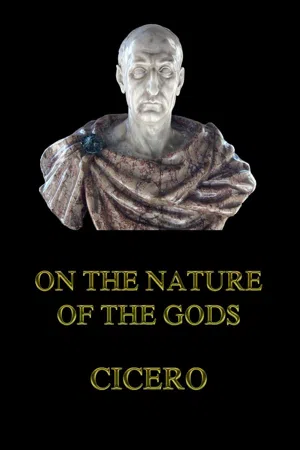
Cicero's religious belief, so far as we can gather it, was rather negative than positive. In the speculative treatise 'On the Nature of the Gods, ' he examines all the current creeds of the day, but leaves his own quite undefined. The treatise takes the form of an imaginary conversation. This is supposed to have taken place at the house of Aurelius Cotta, then Pontifex Maximus—an office which answered nearly to that of Minister of religion. The other speakers are Balbus, Velleius, and Cicero himself, — who acts, however, rather in the character of moderator than of disputant. The debate is still, as in the more strictly philosophical dialogues, between the different schools.
- 236 pages
- English
- ePUB (mobile friendly)
- Available on iOS & Android
eBook - ePub
On the Nature of the Gods
About this book
Information
Topic
PhilosophySubtopic
Philosophy of ReligionBOOK II.
I. When Cotta had thus concluded, Velleius replied: I certainly was inconsiderate to engage in argument with an Academician who is likewise a rhetorician. I should not have feared an Academician without eloquence, nor a rhetorician without that philosophy, however eloquent he might be; for I am never puzzled by an empty flow of words, nor by the most subtle reasonings delivered without any grace of oratory. But you, Cotta, have excelled in both. You only wanted the assembly and the judges. However, enough of this at present. Now, let us hear what Lucilius has to say, if it is agreeable to him.
I had much rather, says Balbus, hear Cotta resume his discourse, and demonstrate the true Gods with the same eloquence which he made use of to explode the false; for, on such a subject, the loose, unsettled doctrine of the Academy does not become a philosopher, a priest, a Cotta, whose opinions should be, like those we hold, firm and certain. Epicurus has been more than sufficiently refuted; but I would willingly hear your own sentiments, Cotta.
Do you forget, replies Cotta, what I at first said—that it is easier for me, especially on this point, to explain what opinions those are which I do not hold, rather than what those are which I do? Nay, even if I did feel some certainty on any particular point, yet, after having been so diffuse myself already, I would prefer now hearing you speak in your turn. I submit, says Balbus, and will be as brief as I possibly can; for as you have confuted the errors of Epicurus, my part in the dispute will be the shorter. Our sect divide the whole question concerning the immortal Gods into four parts. First, they prove that there are Gods; secondly, of what character and nature they are; thirdly, that the universe is governed by them; and, lastly, that they exercise a superintendence over human affairs. But in this present discussion let us confine ourselves to the first two articles, and defer the third and fourth till another opportunity, as they require more time to discuss. By no means, says Cotta, for we have time enough on our hands; besides that, we are now discussing a subject which should be preferred even to serious business.
II. The first point, then, says Lucilius, I think needs no discourse to prove it; for what can be so plain and evident, when we behold the heavens and contemplate the celestial bodies, as the existence of some supreme, divine intelligence, by which all these things are governed? Were it otherwise, Ennius would not, with a universal approbation, have said,
Look up to the refulgent heaven above,
Which all men call, unanimously, Jove.
This is Jupiter, the governor of the world, who rules all things with his nod, and is, as the same Ennius adds,
——of Gods and men the sire,104
an omnipresent and omnipotent God. And if any one doubts this, I really do not understand why the same man may not also doubt whether there is a sun or not. For what can possibly be more evident than this? And if it were not a truth universally impressed on the minds of men, the belief in it would never have been so firm; nor would it have been, as it is, increased by length of years, nor would it have gathered strength and stability through every age. And, in truth, we see that other opinions, being false and groundless, have already fallen into oblivion by lapse of time. Who now believes in Hippocentaurs and Chimæras? Or what old woman is now to be found so weak and ignorant as to stand in fear of those infernal monsters which once so terrified mankind? For time destroys the fictions of error and opinion, while it confirms the determinations of nature and of truth. And therefore it is that, both among us and among other nations, sacred institutions and the divine worship of the Gods have been strengthened and improved from time to time. And this is not to be imputed to chance or folly, but to the frequent appearance of the Gods themselves. In the war with the Latins, when A. Posthumius, the dictator, attacked Octavius Mamilius, the Tusculan, at Regillus, Castor and Pollux were seen fighting in our army on horseback; and since that the same offspring of Tyndarus gave notice of the defeat of Perses; for as P. Vatienus, the grandfather of the present young man of that name, was coming in the night to Rome from his government of Reate, two young men on white horses appeared to him, and told him that King105 Perses was that day taken prisoner. This news he carried to the senate, who immediately threw him into prison for speaking inconsiderately on a state affair; but when it was confirmed by letters from Paullus, he was recompensed by the senate with land and immunities.106 Nor do we forget when the Locrians defeated the people of Crotone, in a great battle on the banks of the river Sagra, that it was known the same day at the Olympic Games. The voices of the Fauns have been often heard, and Deities have appeared in forms so visible that they have compelled every one who is not senseless, or hardened in impiety, to confess the presence of the Gods.
III. What do predictions and foreknowledge of future events indicate, but that such future events are shown, pointed out, portended, and foretold to men? From whence they are called omens, signs, portents, prodigies. But though we should esteem fabulous what is said of Mopsus,107 Tiresias,108 Amphiaraus,109 Calchas,110 and Helenus111 (who would not have been delivered down to us as augurs even in fable if their art had been despised), may we not be sufficiently apprised of the power of the Gods by domestic examples? Will not the temerity of P. Claudius, in the first Punic war, affect us? who, when the poultry were let out of the coop and would not feed, ordered them to be thrown into the water, and, joking even upon the Gods, said, with a sneer, “Let them drink, since they will not eat;” which piece of ridicule, being followed by a victory over his fleet, cost him many tears, and brought great calamity on the Roman people. Did not his colleague Junius, in the same war, lose his fleet in a tempest by disregarding the auspices? Claudius, therefore, was condemned by the people, and Junius killed himself. Cœlius says that P. Flaminius, from his neglect of religion, fell at Thrasimenus; a loss which the public severely felt. By these instances of calamity we may be assured that Rome owes her grandeur and success to the conduct of those who were tenacious of their religious duties; and if we compare ourselves to our neighbors, we shall find that we are infinitely distinguished above foreign nations by our zeal for religious ceremonies, though in other things we may be only equal to them, and in other respects even inferior to them.
Ought we to contemn Attius Navius’s staff, with which he divided the regions of the vine to find his sow?112 I should despise it, if I were not aware that King Hostilius had carried on most important wars in deference to his auguries; but by the negligence of our nobility the discipline of the augury is now omitted, the truth of the auspices despised, and only a mere form observed; so that the most important affairs of the commonwealth, even the wars, on which the public safety depends, are conducted without any auspices; the Peremnia113 are discussed; no part of the Acumina114 performed; no select men are called to witness to the military testaments;115 our generals now begin their wars as soon as they have arranged the Auspicia. The force of religion was so great among our ancestors that some of their commanders have, with their faces veiled, and with the solemn, formal expressions of religion, sacrificed themselves to the immortal Gods to save their country.116 I could mention many of the Sibylline prophecies, and many answers of the haruspices, to confirm those things, which ought not to be doubted.
IV. For example: our augurs and the Etrurian haruspices saw the truth of their art established when P. Scipio and C. Figulus were consuls; for as Tiberius Gracchus, who was a second time consul, wished to proceed to a fresh election, the first Rogator,117 as he was collecting the suffrages, fell down dead on the spot. Gracchus nevertheless went on with the assembly, but perceiving that this accident had a religious influence on the people, he brought the affair before the senate. The senate thought fit to refer it to those who usually took cognizance of such things. The haruspices were called, and declared that the man who had acted as Rogator of the assembly had no right to do so; to which, as I have heard my father say, he replied with great warmth, Have I no right, who am consul, and augur, and favored by the Auspicia? And shall you, who are Tuscans and Barbarians, pretend that you have authority over the Roman Auspicia, and a right to give judgment in matters respecting the formality of our assemblies? Therefore, he then commanded them to withdraw; but not long afterward he wrote from his province118 to the college of augurs, acknowledging that in reading the books119 he remembered that he had illegally chosen a place for his tent in the gardens of Scipio, and had afterward entered the Pomœrium, in order to hold a senate, but that in repassing the same Pomœrium he had forgotten to take the auspices; and that, therefore, the consuls had been created informally. The augurs laid the case before the senate. The senate decreed that they should resign their charge, and so they accordingly abdicated. What greater example need we seek for? The wisest, perhaps the most excellent of men, chose to confess his fault, which he might have concealed, rather than leave the public the least atom of religious guilt; and the consuls chose to quit the highest office in the State, rather than fill it for a moment in defiance of religion. How great is the reputation of the augurs!
And is not the art of the soothsayers divine? And must not every one who sees what innumerable instances of the same kind there are confess the existence of the Gods? For they who have interpreters must certainly exist themselves; now, there are interpreters of the Gods; therefore we must allow there are Gods. But it may be said, perhaps, that all predictions are not accomplished. We may as well conclude there is no art of physic, because all sick persons do not recover. The Gods show us signs of future events; if we are occasionally deceived in the results, it is not to be imputed to the nature of the Gods, but to the conjectures of men. All nations agree that there are Gods; the opinion is innate, and, as it were, engraved in the minds of all men. The only point in dispute among us is, what they are.
V. Their existence no one denies. Cleanthes, one of our sect, imputes the way in which the idea of the Gods is implanted in the minds of men to four causes. The first is that which I just now mentioned—the foreknowledge of future things. The second is the great advantages which we enjoy from the temperature of the air, the fertility of the earth, and the abundance of various benefits of other kinds. The third cause is deduced from the terror with which the mind is affected by thunder, tempests, storms, snow, hail, devastation, pestilence, earthquakes often attended with hideous noises, showers of stones, and rain like drops of blood; by rocks and sudden openings of the earth; by monstrous births of men and beasts; by meteors in the air, and blazing stars, by the Greeks called cometæ, by us crinitæ, the appearance of which, in the late Octavian war,120 were foreboders of great calamities; by two suns, which, as I have heard my father...
Table of contents
- BOOK I.
- BOOK II.
- BOOK III.
- Footnotes:
Trusted by 375,005 students
Access to over 1.5 million titles for a fair monthly price.
Study more efficiently using our study tools.
Frequently asked questions
Yes, you can cancel anytime from the Subscription tab in your account settings on the Perlego website. Your subscription will stay active until the end of your current billing period. Learn how to cancel your subscription
No, books cannot be downloaded as external files, such as PDFs, for use outside of Perlego. However, you can download books within the Perlego app for offline reading on mobile or tablet. Learn how to download books offline
Perlego offers two plans: Essential and Complete
- Essential is ideal for learners and professionals who enjoy exploring a wide range of subjects. Access the Essential Library with 800,000+ trusted titles and best-sellers across business, personal growth, and the humanities. Includes unlimited reading time and Standard Read Aloud voice.
- Complete: Perfect for advanced learners and researchers needing full, unrestricted access. Unlock 1.5M+ books across hundreds of subjects, including academic and specialized titles. The Complete Plan also includes advanced features like Premium Read Aloud and Research Assistant.
We are an online textbook subscription service, where you can get access to an entire online library for less than the price of a single book per month. With over 1.5 million books across 990+ topics, we’ve got you covered! Learn about our mission
Look out for the read-aloud symbol on your next book to see if you can listen to it. The read-aloud tool reads text aloud for you, highlighting the text as it is being read. You can pause it, speed it up and slow it down. Learn more about Read Aloud
Yes! You can use the Perlego app on both iOS and Android devices to read anytime, anywhere — even offline. Perfect for commutes or when you’re on the go.
Please note we cannot support devices running on iOS 13 and Android 7 or earlier. Learn more about using the app
Please note we cannot support devices running on iOS 13 and Android 7 or earlier. Learn more about using the app
Yes, you can access On the Nature of the Gods by Cicero, Charles Duke Yonge in PDF and/or ePUB format, as well as other popular books in Philosophy & Philosophy of Religion. We have over 1.5 million books available in our catalogue for you to explore.