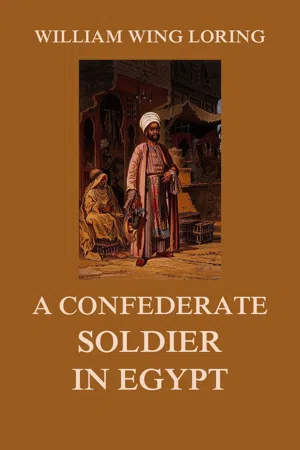
General Loring was one of many Confederate officers who after the close of the War of the Rebellion offered their services to foreign rulers. A number of these officers took their way to Egypt, and the author of this book was one of the most successful ot them all. He was made Pasha by the Khedive, and he rendered that ruler honorable and efficient service. It was natural that Loring Pasha should have been led to give his Egyptian experiences durable shape, and his book gives a clear and agreeably written account of the country. Such a writer has much more authority than the mere traveler. General Loring lived long in the country, and in intimate relations with persons at the centre of affairs; being withal a man of thought and intelligence he could not, with his opportunities, fail to acquire and retain impressions and facts of interest and value.
- 604 pages
- English
- ePUB (mobile friendly)
- Available on iOS & Android
eBook - ePub
A Confederate Soldier in Egypt
About this book
Information
Subtopic
Middle Eastern HistoryIndex
HistoryPART I. EGYPT.
CHAPTER I. ALEXANDRIA.
The mysterious past of Egypt—The Nile in the religious symbolism of the country—The colossal ruins and strange political mutations of Egypt— The traveller's first impressions—Mariette Bey and the Boulac Museum —Recent changes in Egyptian character—Alexandria and its surroundings —An Egyptian funeral—The ruin wrought by English policy in the past and present—How Christian England is completing the evil work of Mahometan misrule.
THE first impression of every traveller who lands in Egypt is that the country is strangely unlike any other in the world; and he who tarries long, making Egypt his home for years, as the present writer did, finds that impression strengthened with every day's increased knowledge. No other country has a history so ancient or so remarkable. Thousands of years before any other nation had civilized existence, Egypt was the scene of great events, the records of which have come down to us in stone. Babylon and Nineveh, Greece and Rome, copied their religion and borrowed their science and their learning from this ancient and mysterious land. Here was the primeval repository of learning and civilization. From this source all other ancient peoples drew the inspiration of advancement and gathered strength for great achievements. There is reason to believe that the very earliest civilization that mankind knew had its centre in the rich valley of the Nile.
That great river, deified by the early Egyptians in sheer wonder at its fertilizing power, cleaves in its course five thousand miles of desert. Without its miracle-working alluvium, the valley lands which are now a garden of marvellous fruitfulness would speedily become an arid waste. The bounty of the Nile lands is the wonder of every traveller; and this fruitfulness is guarded by the Mokattum and Libyan hills as by nature's sentries. On those hills the desert winds are broken, and the valley is thus preserved from the choking drift of sand which would otherwise cover its fair surface, converting it—in spite of the inundations— into a desolate plain.
To the primitive Egyptians water was the obvious source of life, the necessary agent of the earth's fruitfulness; the Nile was their benefactor and the chief of their divinities. Their conception of it gave to the great river a human form, in which the characteristics of both sexes were combined. To make it still more typical of observed facts, they covered this figure with the leaves of various plants in the form of a great rainbow. The office of this Nile numca was to make offerings to the great gods of Egypt, in the name and behalf of the Pharaohs. Before this Nile god were set four vases containing the sacred water, each separated from its fellows by a sceptre. By every fact of life and every device of symbolism the people were taught reverence for the Nile, and it taxed their imaginations very little to invest the river with so holy a character that a person drowned in its waters was held to be sacred. The corpse, in such a case, could be touched and embalmed only by the priests at the expense of the temple specially dedicated to the god of the Nile.
Standing on the main heights of the Libyan and Mokattum hills and surveying the seemingly boundless desert through which the Nile courses, the spectator is impressed with the awful grandeur and solitude of the scene. In contemplating, too, the great ruins beneath these hills which fringe the silver thread of the river from the Pyramids to Isamboul, the mind is still more awed by the stupendous structures which the genius of man has raised there. The wealth of the Nile waters and the aridity of the deserts bordering the stream gave rise to the beautiful fable of the ancients that Osiris—that was the river, the greatest of all the Egyptian gods—had for his spouse the sweet and lovely Isis, who represented the fruitful Earth. The desert they embodied in Nepthis, another interesting divinity, whom they made the sterile spouse of Typhon, the god of rain. They held, further, that Nepthis could only be made beneficent through the power of Osiris.
Amrou, the Mussulman conqueror of Egypt, in a letter written twelve hundred years ago to Omar the Khalif, well described the extraordinary changes wrought by the inundations: “To the most abundant harvest succeeds sudden sterility. It is thus that Egypt offers successively, O Prince of the Faithful, the image of an arid and sandy desert, of a liquid and silvered plain, of a marsh covered with black and thick soil, of a green and undulating prairie, of a parterre ornamented with flowers the most varied, and of a vast field covered with a golden harvest. Blessed be the name of the Creator of so many marvels!”
More than twenty years since, after visiting the different kingdoms of Europe and while in the interior of Russia, where intercourse between the people of Asia and Europe is constant, the writer became specially interested in the peculiar habits, customs, and dress of the Eastern nations. He then determined, before returning home, to visit Constantinople, Damascus, and, Cairo, where the Oriental can be seen and studied better perhaps than in any of the other great capitals of the East. The interest engendered more than twenty years ago has been more recently deepened and intensified by a long official residence in Egypt; and the experience thus gained may, it is hoped, interest the reader.
The traveller landing in Alexandria looks on a city of which Ampère graphically says: “It was founded by Alexander, defended by Cæsar, and taken by Napoleon.” Embellished by Ptolemy, it became the most famous city of its day; but, suffered to fall into decay under Christian and Mussulman rule, it is only in these latter days that it has again arisen from its dejection under the inspiration of Mehemet Ali and his successors, but more especially under his grandson, Ismail Pacha.
The last twenty years had done wonders for Alexandria, until recent Christian diplomacy laid the fairest portions of the city in black and unsightly ruins. Entering the port, formerly an open roadstead, a beautiful revolving light, on the site of the ancient Pharos, guides the seafarer into one of the finest harbors in the Levant. To Ismail Pacha the country is indebted for this surprising change. He it was who constructed the grand and costly breakwater which incloses numerous solidly built quays. The harbor is filled with shipping which anchors in perfect safety, thanks to the energy of the late Khedive. At the landing the familiar Oriental scenes are encountered. That very questionable product of modern civilization, the tide waiter, is here. The guttural tones of the Arab, intent on his piastre, drowns all other noises, and the traveller is but too glad to get under the patronizing protection of his dragoman, a nondescript and objectionable but necessary person, who pushes him into a carriage.
Though amused with his first impressions of the picturesque Oriental scene, the traveller, unaccustomed to the din of a people unlike any he has ever encountered before, is delighted to get away from the noise and turmoil. He congratulates himself on this, his first visit to Egypt, on having made his way safely through the greatest confusion of tongues and the most dissonant screeching and yelling with which his ear has ever been assailed. Proceeding further his amusement increases as he passes through the narrow Arab streets lined with small shops, and his joy is complete when he finds himself quietly seated at his fine European hotel, where he can breathe freely and leisurely retemper his nerves for another essay among these people.
It does not take him long to gain a realizing sense of the fact that he is in the East, in the midst of a race totally different from his own in customs, color, dress, and religion. Having fought his first battle and won it by a masterly retreat, he finds his new acquaintances harmless and amiable, extremely anxious to serve him, always provided the piastre is at once forthcoming. This understood, he sallies forth with renewed energy to new scenes and encounters, and is greatly delighted that the fates have guided him to this distant land. Next he is astonished at the broad, well-paved streets of the new city, with its colossal statue of Mehemet Ali in the grand square, and its stone buildings which would beautify any European city. There is one nuisance which meets him at every turn— namely, the traditional beggar, whose cry for backsheesh is agonizing and whose deformity—which the Arab petitioner thinks a blessing—is painfully obtruded upon attention. Soon, however, one learns the magic Arab expression “Rue al Allah” (“Go to the Lord”), which acts like a charm and sends the beggar flying as though the Khedive himself were after him with uplifted kourbash.
It is difficult to convey an idea of the impressions made upon one by early experiences in this strange land. One is haunted by a persistent but indefinable sense of the greatness of the race that inhabited it ages ago, whose works on every hand attest their prodigious energy, industry, and skill.
As painters differ in the chosen subjects of their art—one being enamored of the human face or form, another of beauty in landscape—so the visitors to such a land as Egypt differ in the choice of objects upon which to bestow their attention. Human kind in the present, the evidences of what was done by human kind in the remote past, the phenomena of nature, the monuments of art—all these and other subjects of interest are there, and each visitor is affected by one or another of them according to his mood.
I have seen one in love with nature absorbed in the peculiarities of a desert flower, or forgetful of all else in contemplation of a nest of ants in the very shadow of the Pyramids. In a land so rich in interest of every kind, no one mind can hope to grasp all or do justice to all. Each must see as it is given him to see, and each must submit to his limitations In recording the observations made during a long and intimate acquaintance with Oriental and especially with Egyptian life, therefore, I ask the reader's indulgence not only for the infelicities of a hand better used to the sword than the pen, but also for any apparent slighting of matters in which the individual reader may feel special interest. Seeing with but one pair of eyes and led by but one set of sympathies, the writer can scarcely hope that his observations have always taken precisely the direction which each reader could wish.
Most noteworthy are the changes wrought in Egypt during the last ten years, and they are all in favor of the traveller and the student. Ismail turned modern science to account in working improvements almost as wonderful as those wrought in fable by Eastern magic. He beautified the villages and made the cities wonders of splendor and magnificence. He brought the ruins that lie scattered for hundreds of miles along the Nile within easy accessibility by dahabeeyah and steamer, making the journey even to the remotest of them easy and speedy. He stayed the hand of prying chippers and mutilators and relichunters, and instituted scientific excavation and investigation in the stead of mere idle curiosity. In his devotion to this purpose and his zeal for knowledge, the late Khedive appointed as sole conservator of the ruins of Egypt, Mariette Bey, a man of world-wide reputation as a scientific and single-minded archaeologist. Under his care the Museum at Boulac, near Cairo, has been filled with objects of the rarest interest, selected and arranged with such care and skill that the intelligent student may there read the records of the human race, on stone and papyrus, almost from the earliest dawn of history. But of the museum and of Mariette Bey's work we shall have occasion to write more fully hereafter.
Among the changes wrought by Ismail's policy, not the least interesting is the improvement in the character of the fellah. In his former estate he submitted to kicks and cuffs without a whimper, accepting ill-treatment as his due. Long ages of oppression had effectually crushed the manhood out of him. The change in this respect has been great. The Arabs have begun to feel their manhood and to assert themselves in various ways—mostly noisy, as the traveller is reminded every day. They do not talk, they scream. Seeing a pair of them in apparent altercation, swinging their arms, seeming to threaten each other with immediate destruction, yelling, screaming, with distorted faces and snapping eyes, the bystander fancies their fury to be such that nothing but blood can appease their wrath. Upon inquiry he finds that all this is a harmless harangue preliminary to a bargain. Among themselves all these Eastern people are given to loud talking. Of late they have gone so far as to assert their rights by boxing-matches with Europeans, when refused the piastre agreed upon, where before they were ready to take a kicking as a settlement in full of all claims.
Other changes of a less pleasing character have been made in Egypt, however, by one of which our own country has profited in a questionable way. In former times the so-called Cleopatra's Needle was the first object of interest to the traveller landing at Alexandria; but now the land that knew it for three thousand years will know the great obelisk no more. It seems a sad desecration to have removed from the land where it had significance to a park where it has none, a shaft written of by Herodotus, which had looked down upon the achievements of Alexander, Cassar, and the great modern captain, Napoleon. One of England's poets bitterly rebuked his countrymen for plundering Greece of her marbles in gratification of a selfish vanity; and now even America “violates a saddened shrine,” and bears to her shores one of Egypt's altars.
Pompey's Pillar, the only monument now left standing to link Alexandria with the past, was not named after the great warrior, but after a Prefect of Alexandria, who erected it by order of the people in honor of Diocletian's clemency. The destruction of Alexandria had been ordered, but the Emperor's horse stumbled on a hill, and, anxious to save the city, he seized upon this omen as an excuse. This magnificent monument of red granite, one hundred feet high, was erected on this sole commanding eminence in or near the city.
Alexander, who conquered all the country east of the Mediterranean Sea, turned to account the advantages of the bay, where stood the ancient fishing-village of Racotis. He conceived the idea of a new and splendid city at the mouths of the mud-choked Nile, to be the great mart between the Greek mainland and archipelago and the ancient kingdom of the Pharaohs. This was to be the crowning of his plan of a great Greek empire. The legend runs that in 323 B.C. the oracle of Ammon-Ra informed the Macedonian madman that he was the son of the gods, and that in the future, as in the past, he would be invincible. Enchanted, he returned from his visit to the shrine determined to build a great city on this site and to give it his own name. It will be recollected that there is another legend of a venerable old man appearing to the Macedonian in a dream and repeating the lines of Homer (Od. w. 545):
“One of the islands lies in the far-foaming waves of the sea, Opposite Egypt's river, and its name is Pharos.”
There is but little left of the past grandeur of the mighty city, only here and there the fragment of a column deeply imbedded in the earth; while the modern city, with its stately structures and teeming population, covers the ground where stood the temples, palaces, and museums of the Ptolemies and Cæsars. Not being a city of the earlier Pharaohs, Alexandria has scarcely anything within its borders to remind you of the ancient people. A few stones among its débris tell you in hieroglyphics that they came from the Delta of the Nile to aid in the construction of the museums and seats of learning of a later day. The imagination readily carries one back to the days of the city's splendor described by the earlier writers, and sees the bold Origen mingling with the Egyptian priests and distributing palms near the gates of the temple of Serapis to Pagan and Christian while exclaiming, “Receive them not in the name of the gods, but of the one and only true God”; the myrmidons of Julian dragging the Christians to the altar and immolating them for refusing to worship the god Serapis; and then again the Christians under Theodosius breaking the mosaic doors, overturning and destroying beautiful objects of art because they were called idols. The temple, with its hundred steps, was a noble specimen of Greek art. It was destroyed in the year 389 A.D. by Theophilus, Patriarch of Alexandria, in a frenzy of religious fanaticism. The god to whom the temple was dedicated was an invention of the Greek Ptolemies. In this god the wrangling Greek and Egyptian priests had a divinity at whose shrine they could forget their quarrels in a common worship. Serapis was a compound of the Pluto of the Greeks and the Osiris of the Egyptians, and as both of those personages were inhabitants of the infernal regions, the religious zeal of the wranglers was satisfied.
A picturesque structure built by Mehemet Ali, though devoid of much architectural beauty, stands on a small island once surrounded by the sea but now a part of the mainland. It is called the Ras el Tin (Head of the Fig), because of its resemblance to that fruit. Part of it was destroyed by English cannon shot in the recent war. It is the first object observed on entering the harbor, and stands upon the island of Pharos, the same upon which stood the ancient lighthouse of that name.
There is another palace west of the city known as Gabara, beautifully situated on a neck of land between the sea and Lake Mareotis, which commands a fine view. It is picturesque because of its massive rotunda, domes, and marble mosaic terraces. Erected for the summer palace of Saïd Pacha, the former Viceroy, its large rooms and galleries were expensively decorated, and its façade was of wonderful beauty. The surroundings were embellished with fountains and gardens, and planted with rare flowers, exotics, and fruit trees. This prodigal man covered several acres of ground in front of this palace with an iron pavement, in order that he might escape the dust on his elevated terrace while watching the drill of his favorite Nubians. It was here, when in command of Alexandria, that for a long time I had my headquarters.
This palace to the south-west of Alexandria was the ancient site of the Necropolis of the Ptolemies. They, like the ancient Egyptians, embalmed their dead. Time and modern improvements have swept away from this interesting locality the last vestige of the past, and the Arab has not the slightest idea of its former use. I recollect one night conversing on the subject with an intelligent Arab, who had never before heard that this was the resting-place of countless dead. Just then an owl on one of the huge acacias near by gave an ominous screech, and my companion trembled with fear while his dilated eyes expressed great agony of spirit. He insisted that the owl was a genius embodying the spirit of Saïd, the Viceroy who had lived here. At the next screech my companion fled, upsetting chairs and tables and smashing my astral lamp. This accelerated his speed, convincing him that the evil spirit was pursuing him. I tried to overtake him, but he was soon lost to sight, and the only sound disturbing the stillness of the night was the clattering of his heels over the iron pavement which the folly of the earthly Viceroy had put there for his comfort. The Arabs believe that they are surrounded by good and bad genii, and darkness is a terror to them. They never sleep alone, if they can help it, and always burn a light at night. They even burn torches in their stables to protect the animals. An Arab never enters a solitary or dark place without supplicating the presiding genius to guard him against the spirits under his orders. The ancient Egyptians, Mariette Bey writes, always had their city of the dead close by the side of their city of the living, and it was uniformly situated to the west. In speaking of the ruins of ancient Egypt which I have visited, I shall enlarge more fully upon this interesting theme, as well as upon their religion, so intimately connected with it. This custom rested on a very sacred belief, as they placed in the region where the sun sets the dwelling-place of their souls after death, expressing both by the word Amenti.
Driving out through the Rosetta Gate, on the road which leads to the famous old city of Canopus, you come to comparatively high hills, formed to a great extent by the débris of the ancient city. On one of these heights, about three miles out, there are two new palaces, beautifully situated immediately on the sea and commanding a picturesque view of the surrounding country.
These palaces, adorned with lavish magnificence, surrounded by luxuriant gardens, and fanned by refreshing breezes from the sea, are the most desirable summer residences in Egypt. The first season, about 1875, that the Khedive occupied them with his numerous harem, a great affliction overwhelmed him and his family in the death of his daughter, Zaneeb, a most interesting and beautiful young lady who was just married. Cairo being the mausoleum for Egyptian royalty, every preparation was made to vacate these palaces at once. The corpse was carried in great state to a train to be conveyed to the tomb at Cairo. It was preceded by numbers of men called the “Yemeneeyah,” who recited the profession of faith to a melancholy strain, “There...
Table of contents
- PREFACE.
- PART I. EGYPT.
- PART II. MILITARY EXPERIENCES IN ABYSSINIA
Trusted by 375,005 students
Access to over 1.5 million titles for a fair monthly price.
Study more efficiently using our study tools.
Frequently asked questions
Yes, you can cancel anytime from the Subscription tab in your account settings on the Perlego website. Your subscription will stay active until the end of your current billing period. Learn how to cancel your subscription
No, books cannot be downloaded as external files, such as PDFs, for use outside of Perlego. However, you can download books within the Perlego app for offline reading on mobile or tablet. Learn how to download books offline
Perlego offers two plans: Essential and Complete
- Essential is ideal for learners and professionals who enjoy exploring a wide range of subjects. Access the Essential Library with 800,000+ trusted titles and best-sellers across business, personal growth, and the humanities. Includes unlimited reading time and Standard Read Aloud voice.
- Complete: Perfect for advanced learners and researchers needing full, unrestricted access. Unlock 1.5M+ books across hundreds of subjects, including academic and specialized titles. The Complete Plan also includes advanced features like Premium Read Aloud and Research Assistant.
We are an online textbook subscription service, where you can get access to an entire online library for less than the price of a single book per month. With over 1.5 million books across 990+ topics, we’ve got you covered! Learn about our mission
Look out for the read-aloud symbol on your next book to see if you can listen to it. The read-aloud tool reads text aloud for you, highlighting the text as it is being read. You can pause it, speed it up and slow it down. Learn more about Read Aloud
Yes! You can use the Perlego app on both iOS and Android devices to read anytime, anywhere — even offline. Perfect for commutes or when you’re on the go.
Please note we cannot support devices running on iOS 13 and Android 7 or earlier. Learn more about using the app
Please note we cannot support devices running on iOS 13 and Android 7 or earlier. Learn more about using the app
Yes, you can access A Confederate Soldier in Egypt by William Wing Loring in PDF and/or ePUB format, as well as other popular books in History & Middle Eastern History. We have over 1.5 million books available in our catalogue for you to explore.