John Sebastian Marlow Ward was deeply involved with the subjects of Freemasonry and occultism. His handbooks about the Degrees of Freemasonry can still be found in today's Lodges and libraries.This edition contains his works: The Fellow Craft's HandbookThe Master Mason's HandbookThe Higher Degrees' Handbook
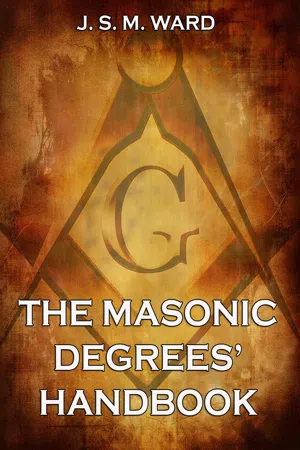
- 198 pages
- English
- ePUB (mobile friendly)
- Available on iOS & Android
eBook - ePub
The Masonic Degrees' Handbook
About this book
Information
Subtopic
SociologyIndex
Social SciencesINTRODUCTION BY THE HON. SIR JOHN A. COCKBURN
In this little volume W. Bro. Ward justly emphasizes the importance of the 2 degree. In former times it was no mere passing stage of a Mason's career. In the Fellowship of the Craft lay the whole body of Masonry. An Apprentice was regarded as a brother but not as a member of the Lodge; while a Master Mason was merely, as we still state in the ritual, an experienced Craftsman selected to preside over the Lodge in the capacity of Master.
The ceremony of Admission to the Fellowship of the Craft has been abbreviated and shorn of some of its characteristic features; for example a "Mark," which, placed on the stones wrought by a Craftsman, entitled him to his wages, is now no longer allotted to him. Nevertheless it is in the 2 degree that the essential elements of the Craft are revealed. The degree is founded on that symbol which is the basis of Masonry, and is regarded as the test of rectangularity in the material, as well as of rectitude in the moral, world. The candidate is now enlightened as to the meaning of the "Hieroglyphic bright which none but craftsmen ever saw." He learns that it represents the ineffable names of the elements of the Craft are revealed. The degree is founded on that symbol which is the basis of Masonry, and is regarded as the test of rectangularity in the material, as well as of rectitude in the moral, world. The candidate is now enlightened as to the meaning of the "Hieroglyphic bright which none but craftsmen ever saw." He learns that it represents the ineffable names of the G.G. as written in the four letters of the Hebrew Alphabet, to which attention was specially directed in the M. Ch.. It is as a craftsman that he becomes cognizant of the second P...r placed at the porch way of the Temple and he is taught that stability can only be attained by the significance of both p....... rs being conjoined. Herein is contained the Mystery not only of Masonry but of all the religions; viz., the Union of Heaven and Earth and the Mediation between God and man. As an Apprentice he has been taught to walk uprightly in the sight of God: his mind has become imbued with moral Principles: he now has to address himself to the much more difficult task of applying these principles in his everyday relationship with his fellows. The lesson of the J.W.'s plumb has now to be blended with that of the S.W.'s level. Spirit and Matter, theory and practice, with their innumerable analogies, have to be reconciled in solving the problems which are constantly encountered in life. In the tables of the law one column contains the commandments relating to our duty to God, the other our duty to our fellow men. The Fatherhood of God involves as a corollary the Brotherhood of man. Therefore it is manifest that a stage in the progress of a Mason that lays stress on applied religion demands close attention. Although on the surface the ceremony of passing may appear less attractive than that which precedes and that which follows it, a close study will convince the reader that the 2 degree contains many lessons of priceless value which will well repay the labours of investigation.
CHAPTER I - PREPARATION, P.W., AND OPENING CEREMONY
The questions which are put to the C. are really a test of the lectures, which today, unfortunately, are hardly ever given in open Lodge. The system as codified at the beginning of the 19th Century was really a most efficient method of educating the c., and had been carefully arranged so as to make sure that only when he was properly prepared should he come forward to be passed to the second. degree. After having passed through the ceremony of initiation a summary of its main tenets, illustrated as it were on the blackboard, was given to him in the form of a lecture on the Tracing Board.
The Tracing Boards were originally drawn in sand on the floor of the L., and therefore correspond closely with the pictures and diagrams used among primitive savages in the initiatory rites of a boy into manhood. These primitive tracing boards are still drawn on the earth by means of specially prepared and consecrated flour, and are an essential part of the ceremony. To-day the Masonic tracing board has degenerated into a somewhat crude painting on canvas stretched on a wooden frame, and its original purpose is therefore apt to be overlooked by the C.. This is peculiarly so in the case of the first degree tracing board, since the lecture on it is very seldom given. In the second degree, as will be shown later, the tracing board still plays a very important part, and we shall have occasion presently to consider it in full, but the connection of the tracing board with the questions must be grasped-hence this short preamble. Under the old system, at the next meeting of the L. the W.M. went through the lecture proper. He asked the S.W. a sort of catechism, which the latter had to answer. This would take well over an hour, or, in other words, as long as the ceremony of initiation. This catechism gave the exoteric meaning of most of the ceremony, together with a fair amount of traditional history of real interest. Undoubtedly much of it was allegorical, and although the bulk of it was 18th Century work, nevertheless it contained several very striking reminiscences of the Ancient Wisdom. For example, the question " Whence come you ? " A.-" From the W." Q.-"Whither directing your feet?". A.-"To the E. in search of a M." Here we have something of deep symbolical meaning, and of peculiar significance in view of a slightly different, though cognate, phrase in a later degree. be overlooked by the C.. This is peculiarly so in the case of the first degree tracing board, since the lecture on it is very seldom given. In the second degree, as will be shown later, the tracing board still plays a very important part, and we shall have occasion presently to consider it in full, but the connection of the tracing board with the questions must be grasped-hence this short preamble. Under the old system, at the next meeting of the L. the W.M. went through the lecture proper. He asked the S.W. a sort of catechism, which the latter had to answer. This would take well over an hour, or, in other words, as long as the ceremony of initiation. This catechism gave the exoteric meaning of most of the ceremony, together with a fair amount of traditional history of real interest. Undoubtedly much of it was allegorical, and although the bulk of it was 18th Century work, nevertheless it contained several very striking reminiscences of the Ancient Wisdom. For example, the question " Whence come you ? " A.-" From the W." Q.-"Whither directing your feet?". A.-"To the E. in search of a M." Here we have something of deep symbolical meaning, and of peculiar significance in view of a slightly different, though cognate, phrase in a later degree.
As, however, we are not attempting to interpret the meaning of these lectures in this book, we must pass the matter by, with the hope that our readers will make a point of obtaining a copy of them (purchasable at any Masonic furnishers) and study them at their leisure.
But the point which must be realized is that, while the tracing board is a summary of the first degree lecture, the questions asked of a C. are on that lecture itself. In short, the C. has to pass an oral examination, and the last question, namely, " These are the usual questions, I will put others, etc.," although to-day practically meaningless, had originally an excellent object. It indicated that the C., and also the other members of the L., had heard the full lecture and that the former must be prepared to answer any question on it.
In the North of England it is very usual, in addition to these questions, to ask the C. to repeat the whole of his O., and if he is unable to do so his passing is deferred until he can.
Turning to the questions themselves, it will be noticed that great stress is laid on the fact that the C. must be properly prepared. It is probably little known to most brethren, but well worth bearing in mind, that the Ancient Kabalists had a secret interpretation of the Old Testament, and one of the keys was to read backwards the Proper Names contained in those books. Now, if the words dedicated to the first and second degrees are read backwards, instead of the official interpretation given, they produce the phrase " Being fortified by the practice of every moral virtue, we are properly prepared." The significance of this in relation to what has gone before, and also to what will follow, is self-evident.
The inner meaning of the manner of preparation having been given in the E.A.. s Handbook, it is unnecessary to write further on the subject, but of course if any of our readers have not seen that book they should certainly get it, as otherwise they will fail to understand the importance of these early questions. they will fail to understand the importance of these early questions.
We now come to the question which is rigidly termed a paradox. The explanation thereof, though ingenious, is obviously somewhat Jesuitical. The truth of the matter is that in Operative days lodges were held at mid-day, and probably on a Saturday, which has always been the time when the workmen receive their wages. The Speculatives, for their own convenience, changed the time to the evening, a fact which was resented by the old Operative members. In the first quarter of the 18th Century, at York, Operative Lodges continued to meet at mid-day, while the Speculatives met in the evening. To-day, with the disappearance of the Operatives, a Bro. may well wonder why this untrue statement is still left in the ritual.
The fact that it is there warns the careful student that some deep symbolical meaning must be attached to the time. The full significance of the phrase is only revealed towards the end of a Brother's symbolical career in the Craft, and a detailed discussion must therefore be postponed to another book, but it is permissible to point out the following facts :-The sun is at its full strength at Noon; in his open pomp and glory; vested, as it were, with his full regal powers. What more suitable time then for a solar cult to hold its meetings? And we must remember that Freemas...
Table of contents
- Freemasonry – Its Origin And History
- THE MASTER MASON'S HANDBOOK
- THE HIGHER DEGREES' HANDBOOK
Trusted by 375,005 students
Access to over 1.5 million titles for a fair monthly price.
Study more efficiently using our study tools.
Frequently asked questions
Yes, you can cancel anytime from the Subscription tab in your account settings on the Perlego website. Your subscription will stay active until the end of your current billing period. Learn how to cancel your subscription
No, books cannot be downloaded as external files, such as PDFs, for use outside of Perlego. However, you can download books within the Perlego app for offline reading on mobile or tablet. Learn how to download books offline
Perlego offers two plans: Essential and Complete
- Essential is ideal for learners and professionals who enjoy exploring a wide range of subjects. Access the Essential Library with 800,000+ trusted titles and best-sellers across business, personal growth, and the humanities. Includes unlimited reading time and Standard Read Aloud voice.
- Complete: Perfect for advanced learners and researchers needing full, unrestricted access. Unlock 1.5M+ books across hundreds of subjects, including academic and specialized titles. The Complete Plan also includes advanced features like Premium Read Aloud and Research Assistant.
We are an online textbook subscription service, where you can get access to an entire online library for less than the price of a single book per month. With over 1.5 million books across 990+ topics, we’ve got you covered! Learn about our mission
Look out for the read-aloud symbol on your next book to see if you can listen to it. The read-aloud tool reads text aloud for you, highlighting the text as it is being read. You can pause it, speed it up and slow it down. Learn more about Read Aloud
Yes! You can use the Perlego app on both iOS and Android devices to read anytime, anywhere — even offline. Perfect for commutes or when you’re on the go.
Please note we cannot support devices running on iOS 13 and Android 7 or earlier. Learn more about using the app
Please note we cannot support devices running on iOS 13 and Android 7 or earlier. Learn more about using the app
Yes, you can access The Masonic Degrees' Handbook by J. S. M. Ward in PDF and/or ePUB format, as well as other popular books in Social Sciences & Sociology. We have over 1.5 million books available in our catalogue for you to explore.