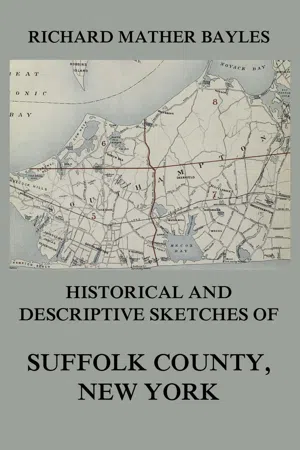
Suffolk County was an original county of the Province of New York, one of twelve created in 1683. From 1664 until 1683 it had been the East Riding of Yorkshire. Its boundaries were essentially the same as at present, with only minor changes in the boundary with its western neighbor, which was originally Queens County but has been Nassau County since the separation of Nassau from Queens in 1899. This historical narrative provides a thorough account of the history of the county, as well as the development of places like East Hampton, Shelter Island, Southold, Southampton, Riverhead and many more.
- 480 pages
- English
- ePUB (mobile friendly)
- Available on iOS & Android
eBook - ePub
Historical and descriptive sketches of Suffolk County, New York
About this book
Information
Subtopic
North American HistoryIndex
HistoryCHAPTER I.
THE DISCOVERY OF LONG ISLAND BY THE DUTCH—THE SETTLEMENT OF THE WESTERN TOWNS—THE DUTCH GOVERNMENT—AND THE GENERAL DISCONTENT—FROM 1609 TO 1664.
In the early part of September, 1609, Henry Hudson, an Englishman, employed by the Dutch East India Company, in the vain search for a Northwest passage to India, discovered the West end of Long Island, at the time he explored New York Bay and the river which bears his name. He had been fitted out by the said Company in the early part of the same year, with a crew of twenty picked men, with a vessel called the "Half Moon." This expedition sailed from Amsterdam on the 25th of March.
While exploring the neighborhood of New York Bay, a party of men went ashore from the "Half Moon," and landed on that strand now known as Coney Island, being the southwestern extremity of Long Island. Hero, we are told, they found plum trees and grape vines growing and bearing fruit in the midst of the untutored wilderness.
Thus it appears, Coney Island was the spot where the first white man ever set foot upon Long Island.
The members of this expedition also reported, that they found great numbers of birds of different kinds on the shores, and multitudes of fishes in the waters. A day or two later, as a party of Hudson's men were out in a small boat fishing, they were attacked by Indians and one of their number, John Coleman by name, was killed by an arrow from the latter. Hudson ordered him taken ashore and buried. The spot of his interment was called Coleman's Point, to commemorate the event. This place is supposed by some to have been on Coney Island, but by others it is located on the opposite or New Jersey shore.
The first discovery of Long Island; having thus been made under the auspices of the Dutch, they laid claim to its ownership, as they did also of the island of Manhattan, or Manhattoes, as it was then called by the Indians.
In 1611, Dutch merchants came over and established a trading post with the Indians, upon the latter island.
In 1614 they erected a fort on Manhattan Island, which they named New Amsterdam, and refused to acknowledge the superior claims of the English to the neighboring territory.
The same year Adrian Block sailed down the Sound, on a voyage to Cape Cod, and was the first to discover that Long Island was entirely surrounded by water. On this voyage he also discovered and gave name to Block Island.
Four years later Thomas Dermer sailed up the Sound from New England, on his way to Virginia, and in describing his passage through Hell Gate he says:—" We found a most dangerous cataract amongst small rocky islands, occasioned by two unequal tides, the one ebbing and flowing two hours before the other."
The Dutch East India Company, under whose employ Hudson had discovered this part of the American Continent, was in 1621 merged into the Great West India Company, and to this organization the "States General" granted the exclusive monopoly of trading with the natives in the province of New Netherlands, for a term of twenty-four years.
In the year 1623, or 4, this Company appointed Peter Minuit to the office of director general, or governor of New Netherlands, under them. Previous to that time a few houses had been erected, and were occupied by the Dutch temporary settlers, on Manhattan Island.
It is evident that the matter of establishing permanent settlements here by the Dutch, received at first but little attention. The main objects which they sought, were the pecuniary benefits arising from a trade with the Indians.
The principal articles exchanged were guns, ammunition and mm, for which they received furs. In this way the early Dutch speculators enriched themselves, by placing in the hands of the Indians the instruments and destructive elements, which a few years later were turned with such fatal and distressing consequences upon the innocent white settlers.
The first settlements under the Dutch on the west end of Long Island were made by individuals, in a hap-hazard manner, just as circumstances might suggest, without any associated attempts at government.
The first white settler upon Long Island of which history gives any account, was one George Jansen de Rapalje, a Frenchman, who established himself during the administration of Peter Minuit, in the vicinity of Wallabout Bay, in the spring of the year 1625. His daughter Sarah Rapalje, born June 9th, of the same year, was the first child of European parentage born upon the Island. Permanent settlements were commenced on both ends of the Island nearly at the same time: on the west end by the Dutch, and on the east end by the English. Thus it will be seen Long Island was virtually claimed by three different powers,—the Indians, the Dutch and the English; though no very fierce measures were taken to establish the supreme rights of either in opposition to the others. The English allowed the Dutch to hold authority over the western part, and the Dutch allowed the English to hold authority over the eastern part. Both powers admitted the superior claims of the Indians to the lands, and neither attempted to force them away, but in all cases purchased their lands of them, at prices which seem to have been perfectly satisfactory. On the west J end large tracts were purchased by the governor, and by him 'sold to individuals or companies of settlers.
The first regular settlement of the Dutch towns was made about the year 1636 or soon after.
Slaves were introduced by the Dutch very soon after their first arrival.
The towns settled by the Dutch are as follows, with the date of their settlement as near as can be learned:—Brooklyn, at first called Breuck-landt, meaning broken land, settled in 1636; Flatlands, originally called New Amesfort, after a place in Holland from which it is probable the first settlers came, settled in 1636; Flushing, named by the Dutch Vlissengen, after a place in Holland, first settled in 1645; Flatbush, first named Midwont or Mid-wood, probably signifying middle of the woods, settled in 1651; New Utrecht in 1657; and Bushwick, meaning Woodtown, in 1660. The following towns though in the Dutch territory and under the Dutch jurisdiction, were settled by the English.
Hempstead in 1643, Gravesend in 1645, Oysterbay in 1653, Jamaica in 1655, and Newtown in 1656. The territory of Oysterbay, though at first claimed by the Dutch, remained for many years in a sort of neutral position, and finally camo under the dominion of Connecticut. The other four towns were under the control of the government of New Amsterdam, until the conquest of 1664. The original name of Newtown was Middleburgh; and that of Jamaica, Rustdorpe.
The Dutch allowed English immigrants to settle within their borders, on taking the oath of allegiance to the States General and the West India Company.
The English settlers on Dutch territory purchased their lands of the Indians, having first obtained license from the governor to do so. These lands were generally purchased by companies in large tracts, which were afterwards divided up among the individual proprietors.
The inhabitants of the English towns in the Dutch limits, were allowed to elect their own local officers and magistrates, which elections however were subject to the approbation or rejection of the governor. The common method seems to have been for the people to elect double the number of candidates required, and from these the governor made his choice of which should act. They had their town-meetings, and managed their own affairs, as near after the model of the towns on the east end of the Island as their circumstances would allow.
Unlike the English towns of Suffolk County, where the voice of the people was the sovereign power, the Dutch towns of the west end were, subjected to the whimsical domination of a bigoted tyrant, who held the prerogatives of granting lands to settlers—of making laws by which they were to be governed—appointing the officers to enforce and execute those laws—hearing and deciding such cases of disagreement as he chose to call from the hands of subordinate magistrates— ordering churches to be built—installing ministers, and dictating where and when they should preach—and in fact exercising unlimited authority over the people in all their characters— corporate and individual—civil, military, social and ecclesiastical. He employed the assistance of a council, but that body of professed associates, were simply his tools, among which as elsewhere in the province of New Netherlands, his own word was the highest law. The governor appointed magistrates and constables in each of the Dutch towns, and delegated to them power to act, subject to his discretion and pleasure. In some cases the people were allowed the privilege of suggesting measures, which if approved by the governor were carried into effect.
The Dutch government at New Amsterdam was thus but little less than an absolute monarchy. This burden of tyranny in addition to the perils of the wilderness, to which they were exposed, and the otherwise unfavorable circumstances with which they were surrounded, in a wild, new country, far removed from the advantages of civilization, rendered the situation of the settlers under the Dutch jurisdiction, peculiarly unpleasant and discouraging. Discontent arose, and the pioneers sighed for the blessings of a more secure and liberal government. September 19th, 1650, four commissioners, two from the Dutch government, and two from the United Colonies of New England, met at Hartford, to settle if possible the disputes which had risen between the Dutch and English, respecting the boundary between the two powers on Long Island. They decided upon a line which should commence at the "westernmost part of Oysterbay" on the north side, and extend southward to the sea, as a proper division of the territory. This line however was not wholly regarded, for the Dutch governor still persisted in his claim of authority over the town of Oysterbay, which by that treaty belonged to the English.
In the Dutch settlements, the management of church affairs, like all other matters, was more or less subject to the pleasure of the governor. In 1654 he ordered the erection of a house for public worship at Flatbush. This was the first one erected under the Dutch rule on Long Island. Its dimensions were thirty-five by sixty feet, and twelve or fourteen feet high. In 1655 the governor directed the people of neighboring towns to assist in getting out timber for the church. It was probably completed some four or five years later, at a total cost of 4,637 guilders. A guilder was equal to forty cents of our money. The necessary funds for the erection of this church were raised by contributions from the people of Flatbush, and neighboring towns who were united with them in church relations. Assistance in the enterprise was also received from the settlements of Fort Orange (Albany), and New Amsterdam. Governor Stuyvesant himself contributed 400 guilders.
The Dutch settlers, as would appear most natural, brought with them the religious inclinations of the Fatherland. The churches they established were under the care of the sissup of Amsterdam, and so continued for more than a century, before an independent union on the same model was organized in America.
The popular discontent which seemed all the time to be on the increase, was at last ventilated by a meeting of nineteen delegates, representing the people of New York, Brooklyn, Flushing, Newtown, Hempstead, Flatlands, Flatbush, and Gravesend, who met at New Amsterdam, December 11th, 1653.
They then drew up a remonstrance against the arbitrary measures and action of the government, in which they set forth their grievances, and prayed for a relief from the oppression I under which they groaned. This remonstrance was respectfully submitted to the governor and council, but they made no reply to it, beyond disputing the right of some of the towns to be represented in the delegation, and protesting against the meeting. Two days later the delegates presented a further remonstrance, in which they intimated an intention of appealing to the highest powers of the Netherlands, if they could not obtain redress for their troubles here. At this suggestion Gov. Stuyvesant became so indignant, that he peremptorily ordered the delegates to go home and never to assemble again on such an errand.
Thus the situation was made worse if possible than before.
No attempt appears to have been made to carry out the hinted intention of appealing to the Dutch authorities at home.
To fill the cup of discouragements and hardships under which the settlers labored, their dominion about this time was infested by "land pirates" and thieves, against whose incursions the government offered but a very feeble protection.
These parties were supposed to be wandering exiles, who had been banished from the colonies of New England for some misdemeanor or other.
In some of the towns, the people took the matter into their own hands, and organized military companies to protect their villages against the approach of these marauding vagabonds.
George Baxter and James Hubbard were the two delegates from Gravesend to the meeting of 1653, which presented the offensive remonstrances, and it was to the former that Gov.
Stuyvesant ascribed the authorship of those documents.
These two gentlemen were leading spirits, and charter members of the town of Gravesend. Baxter had been employed as private secretary to Gov. Kieft, and had also been appointed by Gov. Stuyvesant as a commissioner to the treaty of 1650 which denned the bounds between the English and Dutch jurisdiction on Long Island. In 1654 these m...
Table of contents
- PREFACE.
- CHAPTER I.
- CHAPTER II.
- CHAPTER III.
- CHAPTER IV.
- CHAPTER V.
- CHAPTER VI.
- CHAPTER VII.
- CHAPTER VIII.
- CHAPTER IX.
- CHAPTER X.
- CHAPTER XI.
- CHAPTER XII.
- CHAPTER XIII.
- CHAPTER XIV.
- CHAPTER XV.
- CHAPTER XVI.
- CHAPTER XVII.
Trusted by 375,005 students
Access to over 1.5 million titles for a fair monthly price.
Study more efficiently using our study tools.
Frequently asked questions
Yes, you can cancel anytime from the Subscription tab in your account settings on the Perlego website. Your subscription will stay active until the end of your current billing period. Learn how to cancel your subscription
No, books cannot be downloaded as external files, such as PDFs, for use outside of Perlego. However, you can download books within the Perlego app for offline reading on mobile or tablet. Learn how to download books offline
Perlego offers two plans: Essential and Complete
- Essential is ideal for learners and professionals who enjoy exploring a wide range of subjects. Access the Essential Library with 800,000+ trusted titles and best-sellers across business, personal growth, and the humanities. Includes unlimited reading time and Standard Read Aloud voice.
- Complete: Perfect for advanced learners and researchers needing full, unrestricted access. Unlock 1.5M+ books across hundreds of subjects, including academic and specialized titles. The Complete Plan also includes advanced features like Premium Read Aloud and Research Assistant.
We are an online textbook subscription service, where you can get access to an entire online library for less than the price of a single book per month. With over 1.5 million books across 990+ topics, we’ve got you covered! Learn about our mission
Look out for the read-aloud symbol on your next book to see if you can listen to it. The read-aloud tool reads text aloud for you, highlighting the text as it is being read. You can pause it, speed it up and slow it down. Learn more about Read Aloud
Yes! You can use the Perlego app on both iOS and Android devices to read anytime, anywhere — even offline. Perfect for commutes or when you’re on the go.
Please note we cannot support devices running on iOS 13 and Android 7 or earlier. Learn more about using the app
Please note we cannot support devices running on iOS 13 and Android 7 or earlier. Learn more about using the app
Yes, you can access Historical and descriptive sketches of Suffolk County, New York by Richard Mather Bayles in PDF and/or ePUB format, as well as other popular books in History & North American History. We have over 1.5 million books available in our catalogue for you to explore.