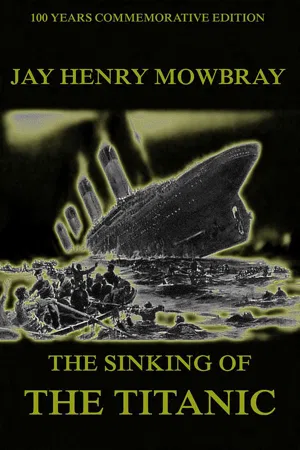
The human imagination is unequal to the reconstruction of the appalling scene of the disaster in the North Atlantic. No picture of the pen or of the painter's brush can adequately represent the magnitude of the calamity that has made the whole world kin. How trivial in such an hour seem the ordinary affairs of civilized mankind--the minor ramifications of politics, the frenetic rivalry of candidates, the haggle of stock speculators. We are suddenly, by an awful visitation, made to see our human transactions in their true perspective, as small as they really are. Man's pride is profoundly humbled: he must confess that the victory this time has gone to the blind, inexorable forces of nature, except in so far as the manifestation of the heroic virtues is concerned.The ship that went to her final resting place two miles below the placid, unconfessing level of the sea represented all that science and art knew how to contribute to the expedition of traffic, to the comfort and enjoyment of voyagers. She had 15 watertight steel compartments supposed to render her unsinkable. She was possessed of submarine signals with micro-phones, to tell the bridge by means of wires when shore or ship or any other object was at hand.There was a collision bulkhead to safeguard the ship against the invasion of water amidships should the bow be torn away. In a word, the boat was as safe and sound as the shipbuilder could make it. It was the pride of the owners and the commander that what has happened could not possibly occur.And yet the Titanic went down, and carried to their doom hundreds of passengers and men who intimately knew the sea and had faced every peril that the navigator meets.
- 310 pages
- English
- ePUB (mobile friendly)
- Available on iOS & Android
eBook - ePub
The Sinking Of The Titanic
About this book
Information
Subtopic
20th Century HistoryIndex
HistoryThe Sinking of The Titanic
Jay Henry Mowbray
Table of Contents:
Steamships and Steamship Lines
The Sinking of The Titanic
Preface
Introduction
Chapter I - From A Day Of Delight To Death
Chapter II - Heart-Rending Scenes On Carpathia
Chapter III - Band Played To The Last
Chapter IV - Neglect Caused Disaster
Chapter V - Believed Ship Unsinkable
Chapter VI - How Survivors Escaped
Chapter VII - Woman's Thrilling Narrative
Chapter VIII - Survivors' Stirring Stories
Chapter IX - How Astor Went To Death
Chapter X - Notable Woman Saved
Chapter XI - Major Butt, Martyr To Duty
Chapter XII - Mrs. Astor's Bravery
Chapter XIII - Lifeboats Bunglingly Handled
Chapter XIV - Not Like Bourgogne Disaster
Chapter XV - Boy's Desperate Fight For Life
Chapter XVI - Carpathia To The Rescue
Chapter XVII - Refused To Leave Husband
Chapter XVIII - Lady Duff-Gordon's Experiences
Chapter XIX - Senators Hear Startling Stories
Chapter XX - Surviving Operator's Experiences
Chapter XXI - The Funeral Ship And Its Dead
Chapter XXII - Inquiry By United States Senate
Hymn For The Survivors Of The Titanic
Great Marine Disasters From 1866 To 1911
The Sinking Of The Titanic, A. Gracie
Jazzybee Verlag Jürgen Beck
86450 Altenmünster, Germany
ISBN: 9783849621674
www.jazzybee-verlag.de
Steamships and Steamship Lines
It appears that self-moving vessels were first imagined by Roger Bacon, a learned monk of the Middle Ages. Though the application of steam-power to the propulsion of steam-vessels was once claimed for a Spaniard, Blasco de Garay, about 1540, it is now known that what he exhibited to Charles V. was simply a vessel with a paddle-wheel, worked by man-power. Papin's practical exhibit of a steam-vessel at Cassel (1707), was a success, but the vessel was only a model. It was the work of Newcomen and Hills in England, and Henry and others. In America, which furnished Fulton with the idea that earned him fame as the inventor of the "steam-boat." All these, with others besides, were experimenters of the latter part of the eighteenth century. In addition there was Runsey in Maryland and Fitch on the Delaware, the latter using on his boat both paddle-wheels and propeller. Symington built a steam towboat as early as 1801. Fulton's first experiments, made in France, were unsuccessful, and it was not until he secured a backer in Chancellor Livingston of New York, then American Ambassador to England, that he was able to buy a Boulton and Watt Engine in England to equip his "Clermont."
John Stevens of New York, was making even earlier attempts in this field, and it was not long after that first trip up the Hudson that the river and sound were covered with a fleet of steamboats. The first steamboat in British waters was the "Comet" on the Clyde, 1812. The first steam-vessel to cross the Atlantic was the "Savannah," 1819. She was a sailing vessel using steam as an auxiliary power, and she made the passage to Liverpool in 31 days, 8 of which were under steam. In 1825, one Captain Johnson, was awarded £10,000 ($50,000) in England for taking the first steam-vessel to India. About this time, the "Royal William," of Quebec crossed the ocean under steam in 21 days. In 1837, Ericsson (q. v.), later the builder of the "Monitor." Constructed in England the first screw-propeller. Regular transatlantic traffic by steamships was inaugurated by the " Sirius" which made the voyage from Queenstown to New York in 1838. The Cunard Line, the first regular line, was started in 1840: the same year the first war steamer was built. The Collins Line, a rival of the Cunard, was organized in 1848. and the following year, 1853, the Inman and the Allan Lines. The Guion Line began business in 1864. The Cunard Line still flourishes, though most of its old time rivals are gone. The principal lines in the transatlantic service of the early 20th century were the Hamburg American, founded 1847: Anchor. 1852: North German Lloyd, 1857: French Line, 1800; White Star, 1870; Holland American, 1872; Red Star, 1873; Scandinavian American, 1879; Atlantic Transport and the American Line, 1892.
The following shows the size of some of these leviathans of their time: "Olympic," of the White Star Line, 45,000 gross tons: "Mauretania" and "Lusitania," Cunarders, 32,500 tons each; "Kaiserin Augusta Victoria," Hamburg American Line, 24,581 tons; the "George Washington," North German Lloyd Line. 27.000 tons. The "Great Eastern," built in 1859. Was 692 feet long of 80 feet beam and 22.800 tons displacement; the "Olympic" of was 882 feet long, 92 ½ feet beam and 45,000 tons. In 1856 when the "Persia" made the passage from New York to Queenstown in 9 days, 10 hours, and 45 minutes, it was considered extraordinary. In 1910 the "Mauretania" made the trip from Queenstown to New York in 4 days, 10 hours and 41 minutes. The "Deutschland" ran out from New York to Naples in 7 days, 16 hours and 44 minutes, and the "City of New York" of the Pacific Mail Steamship Co., with Commander Philip of the Navy to navigate her, made the run from New York to San Francisco, 13.533 miles, without a stop in 54 days, 14 hours. The progress of ocean shipbuilding for size, speed and luxury was one of the extraordinary accomplishments of the age. In 60 years the speed of Atlantic steamships has increased from 8 to 25 knots: the power of marine engines from 700 to 70,000 horse power; length of vessels from 250 to 882 feet; boiler steam pressure from 13 to 250 pounds; gross tonnage from 1.200 to 45.000; while the length of time required for the passage has decreased from 15 days to less than five. Though not built for speed, the "Olympic's" time across the Atlantic is 5 days, 16 hours, 42 minutes. Some facts about this vessel are interesting. Largest plates employed in the hull were 36 feet long. Rudder, operated electrically, weighed 100 tons. There were more than 2,000 windows. There were 3,000.000 rivets, weighing 1,200 tons. There was an eighteen-hole g...
Table of contents
- Steamships and Steamship Lines
- The Sinking of The Titanic
Trusted by 375,005 students
Access to over 1.5 million titles for a fair monthly price.
Study more efficiently using our study tools.
Frequently asked questions
Yes, you can cancel anytime from the Subscription tab in your account settings on the Perlego website. Your subscription will stay active until the end of your current billing period. Learn how to cancel your subscription
No, books cannot be downloaded as external files, such as PDFs, for use outside of Perlego. However, you can download books within the Perlego app for offline reading on mobile or tablet. Learn how to download books offline
Perlego offers two plans: Essential and Complete
- Essential is ideal for learners and professionals who enjoy exploring a wide range of subjects. Access the Essential Library with 800,000+ trusted titles and best-sellers across business, personal growth, and the humanities. Includes unlimited reading time and Standard Read Aloud voice.
- Complete: Perfect for advanced learners and researchers needing full, unrestricted access. Unlock 1.5M+ books across hundreds of subjects, including academic and specialized titles. The Complete Plan also includes advanced features like Premium Read Aloud and Research Assistant.
We are an online textbook subscription service, where you can get access to an entire online library for less than the price of a single book per month. With over 1.5 million books across 990+ topics, we’ve got you covered! Learn about our mission
Look out for the read-aloud symbol on your next book to see if you can listen to it. The read-aloud tool reads text aloud for you, highlighting the text as it is being read. You can pause it, speed it up and slow it down. Learn more about Read Aloud
Yes! You can use the Perlego app on both iOS and Android devices to read anytime, anywhere — even offline. Perfect for commutes or when you’re on the go.
Please note we cannot support devices running on iOS 13 and Android 7 or earlier. Learn more about using the app
Please note we cannot support devices running on iOS 13 and Android 7 or earlier. Learn more about using the app
Yes, you can access The Sinking Of The Titanic by Jay Henry Mowbray in PDF and/or ePUB format, as well as other popular books in History & 20th Century History. We have over 1.5 million books available in our catalogue for you to explore.