The writings of Dr. Mines ("Felix Oldboy") are well known to New Yorkers. This volume is a series of papers published years ago in the Trinity Record, and is replete with historical reminiscences of those who were prominent in public and private life and now rest in the churchyards of Trinity Parish.
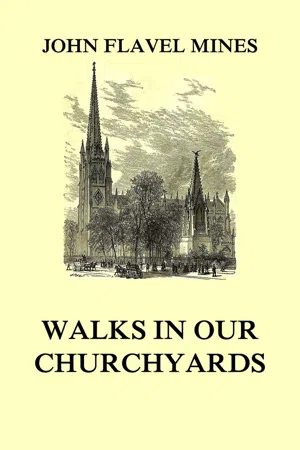
- 148 pages
- English
- ePUB (mobile friendly)
- Available on iOS & Android
eBook - ePub
Walks in our Churchyards
About this book
Information
Subtopic
North American HistoryIndex
HistoryI.
An English gentleman, Mr. John Lambert, who visited New York in 1807, when the entire city lay below Canal Street, was severely critical in regard to the churchyards on Broadway. In his diary, after speaking of Trinity Church and St. Paul's as " both handsome structures," he added: "The adjoining churchyards, which occupy a large space of ground railed in from the street and crowded with tombstones, are far from being agreeable spectacles in such a populous city." The population of New York in that year, as he gives it, was 83,530, and in our more modern eyes would betoken rather an overgrown village than a metropolis.
In still another part of his journal, Mr. Lambert returns again to the assault on the churchyards, and insists that they are " unsightly exhibitions." " One would think," he says, " there was a scarcity of land in America to see such large pieces of ground in one of the finest streets of New York occupied by the dead. The continual view of such a crowd of white and brown tombstones and monuments as is exhibited in the Broadway must tend very much to depress the spirits." Now, if it is well to see ourselves as others see us, we have here a very plain-spoken opinion about our city graveyards from the pen of a traveled Englishman, who generally spoke in terms of nothing but praise concerning the young metropolis, its inhabitants and their customs. But it is a poor rule that will not work both ways, and the fastidious critic might have found it profitable to carry a mirror in his trunk.
As a citizen, and not a stranger, I find few so attractive spots as these churchyards on Broadway. People write sentimentally about sleeping under the grasses and daisies of the country, and one good Bishop years ago dropped into poetry and requested to be so interred. But it has always struck me that the rural cemetery is intolerably lonesome. Even if the sleepers there do not need the comradeship of the living, it is undeniable that the grass is as green, the sunshine as golden, and the flowers as fragrant in the glebe around St. Paul's and Trinity, as where no piles of brick and mortar have blotted out the fields.
The dead have company here. The feet of the living pass up and down the street hard by, and among these footfalls are those of descendants of the quiet ones — of men who admire their record and women who love their memory. They are sleeping, too, in the shadows of the homes in which they lived and were happy. The roar of business is around them as they knew it in life, and once a week comes the quiet of the Sunday they observed. If no longer the waves of the river break against the pebbly beach that at first bounded St. Paul's churchyard, and through the bluff which looked down into the waters of the Hudson back of old Trinity, a street now passes, with two more streets of artificial make beyond, the burial place of the dead is there unchanged.
I have long believed that Trinity Parish has done New York no one greater benefit than in leaving the breathless dead to be companions to the thoughtless living. It is true, O eminent philanthropist, that these acres might have been sold for many pence and the money given to the poor; equally true, Sir Speculator, that the dust of the dead could not have resented being carted away to other dust heaps, but something would have been lost to the living that no power of earth could restore. I never pass these colonies of tombstones without thanking the men who have stood sentinel over them and kept them in place. As they stand in their impressive silence, tall shaft and crumbling slab, they are more eloquent than any sermons, more full of tears and pathos than any print can create, more prompt to teach faith and hope than so many volumes of dogmatic theology. They who sleep beneath are not the dead, but the living. We know about them; have read of their faults and their virtues; have been told how they dared and endured; have looked into their eyes in galleries of old portraits, touched the hem of their garments still cherished by their grandchildren, held in our hands the little battered spoon in which their childish teeth made dents so many years ago. Go to! We are the dreamers and they are the folk of action. You shall be passing any night when the moon is shining on these grasses and look through the iron rails that keep out a disturbing world, and every stone shall cry out to you from its sculpturings and make you long to know the story of the ashes that was once a man or woman of your world, and then you shall turn away and gaze upon the painted names of men that gleam from the walls of buildings across the way and that eagerly announce their business to the world, and you shall feel no such throb of sympathy nor sense of weird comradeship as when your face was set towards the dead. Did I not say that we are the dreamers?
There is no pleasanter spot in New York than the churchyard of old Trinity on a quiet Sunday morning in the Summer. There are flowers and grasses, the shade of graceful elms, fresh air and the twittering of birds — even the oriole and the robin still come back there every year in spite of the aggressive sparrow — and there is no end of companionship. It is a companionship which I like, because it is open and free. Here every man, woman and child, except the unquiet prowlers above ground, presents to our eyes a card of granite or marble, gravely telling his or her name, age and a few other particulars set forth, more or less elaborately — a quaint custom, but not a bad one for the living to adopt, if they would be equally frank about it.
Even in the days when the present church building was new — more than forty years ago by the calendar — I found no more pleasant place in which to pass a half hour as a boy. It was a more unkempt place then, than now, and bluebirds and thrushes were more frequent visitors. I found an endless pleasure in tracing the inscriptions on the tombstones, and it was not long before I had familiar acquaintances, heroes and heroines, in every corner. Huge was my delight, too, when, with two or three companions, we could escape the eye of old David Lyon, the sexton, and lie down into the crypt beneath the chancel. There we saw yawning mouths of vaults, revealing to our exploring gaze bits of ancient coffins and forgotten mortality, and we poked about these subterranean corridors with dusty jackets and whispered words, finding its atmosphere of mold and mystery a strange delight. For somehow the unknown sleepers, then who seemed to have no means of making themselves known — unless it was through the musty tomes of Trinity's burial records — took strongest hold upon our sympathies, to say nothing of our curiosity.
Everybody who passes old St. Paul's can read for himself the patriotism of General Montgomery, the civic virtues of Thomas Addis Emmet and the eminence of Dr. McNevin, for monument and shaft tell the story. So all visitors to the churchyard of old Trinity easily learn which are the tombstones of Alexander Hamilton, Captain Lawrence, of the Chesapeake, or William Bradford, the first Colonial printer, and where rest the bones of quiet Robert Fulton, the inventor, or dashing Phil Kearney; but there is no herald of the ordinary dead — of those who were simply upright men and good women in their day, and there could be none of the unknown dead who are said to far outnumber the lucky minority, the front doors to whose graves still stand and yet preserve their door plate, though the latch-key is gone.
The unknown dead! Perhaps I dwell upon them because in their ranks is the only one of my own family who sleeps beneath the spire of Trinity Church. So often, when I have slipped into the churchyard for a little respite from the world and the company of those who shall be my companions in the to-morrow, I think of my little uncle, Oscar, who died in the homestead of his mother's family in Catharine Street nearly ninety years ago and was buried in this churchyard. Eldest born of the children, at five years of age his little feet went bravely climbing the hills of Beulah all alone. So often there comes to me a glimpse of a little golden head, a quaint little figure in old-time coat edged with lace — you ought to see his miniature for yourself and smile back into its sweet, serious baby eyes — and I wonder under which sod lies his tiny mite of dust and whether he knows that I am thinking of him as I pass. Sometimes I wonder if he ever regrets that he did not live to grow gray and scarred or whether he is not glad that he went to sleep just as the sun rose over the hilltop of his life, blessed by his mother's tears and his father's kiss. These things come to my thought even in the most unquiet hour of the day, after I have passed the iron gates that keep the sordid outside life away from me, and they do me good, I know. So much does one little grave, that blossoms all unknown in this garden of God, have power to teach things lovely and of good report. Even for the grasses that grow unidentified over my own dead I bless the church that has witnessed to a good profession in the fight with mammon and that has kept God's acre green in city streets, that it might preach to men's withered hearts of sunshine, the soft dews and eternal peace.
Everybody knows the story of Alexander Hamilton's tragic death, and almost every stranger who enters Trinity Church yard asks to have his grave pointed out. But few know the tragedy that sent his eldest son to his death at nineteen, or ask to know which is his tomb. It was in 1801 that George L. Eacker, a brilliant young member of the New York bar and ardent friend of Aaron Burr, delivered the Fourth of July oration, and during the political campaign in the Fall his eloquence was derided by young Philip Hamilton, in the presence of a lady, and a duel followed. It was the fashion of the day to fight, and while the famous actor, Thomas Apthorpe Cooper, was second to Eacker, David S. Jones, private secretary to Governor Jay, did the same friendly office for young Hamilton. The latter fell mortally wounded, dying the next morning, and was buried in Trinity churchyard. Young Eacker died of consumption before three years had passed — before the elder Hamilton had also fallen victim to the hideous custom he had sanctioned in behalf of his son — and is buried in St. Paul's churchyard, on the Vesey Street side. There is no difference between the blades of grass that blossom out from their dust in either churchyard every spring.
Statistics are a pet abhorrence of mine in age, as arithmetic used to be in youth, so it shall be sufficient to say just here that Trinity Church was first opened for worship in 1697, and that the original building was enlarged in 1735-36 and burnt down in 1776. The burial ground was granted by the city in 1703, on condition that it be neatly fenced and that the fees of burial be limited to 3s. 6d. for grown persons and is. 6d. for those under twelve years of age. It was the choice spot of burial for the English population of the city up to the time of the Revolution and afterwards.
I love to read in the newspapers of the period, the story of those who were interred here during this period. The names are but a sound in our ears, and they are among the unknown, but if the quaint obituaries are to be credited, they have risen to royal rank beyond the fogs and mists of Jordan. On the 19th of May, 1740, died Mrs. Clarke, wife of the Lieutenant-Governor of the province, and it is worthwhile to listen to her praises, as told by the newspapers of the day: " She was a most Affectionate and Dutiful Wife, a Tender and Indulgent Parent, a Kind Mistress and sincere Friend; she was a fine, graceful Person, a most agreeable companion and of that Sweetness and Calmness of Temper that nothing could ruffle it or draw a hard Expression from her. She never failed of attending on the Public Worship of her Maker, when her Health would permit, and she died with that Calmness, Serenity and Resignation, that showed her truly Christian." The language is stilted, but is it not a sweet and satisfying picture? One could wish to have been present at her funeral. It was a rare spectacle for the little city. " On Thursday evening she was interred in a Vault in Trinity Church, with Remains of her Mother and the late Lady Cornbury, in the most handsome and decent manner; her Pall being supported by part of His Majesty's counsel for this Province, and some of the Ministers of the General Assembly, and attended by all the Ministers and most of the Principal Inhabitants of the city (minute guns being fired from the Fort and sundry Vessels in the Harbor, during the Solemnity). And as it was a pleasure to Her in her Life to feed the Hungry, so on the day of the Funeral, a Loaf of Bread was given to every Poor Person that would receive it."
Side by side with this sweet portraiture of " a perfect woman nobly planned," should be placed the notice of the death of " the Worshipful and worthy John Cruger, Esq., Mayor of this City, whose affable, humane and most obliging Temper and Deportment justly gained him the Respect and esteem of all." He died in August, 1744, and was " very decently interred " in Trinity churchyard. Says the Weekly Post Boy: " He was a most tender and indulgent Parent, a kind Master, an upright Magistrate and a good Friend; and those to whom he was known, must acknowledge that he had and practiced many excellent qualities, worthy of imitation; and as he always lived a sober, religious, good Life, so he died with great Calmness and Resignation."
There was another notable funeral in old Trinity when Sir Henry Moore, the only native American who was ever appointed governor of the Province, was buried with great pomp " in the chancel." This took place in January, 1768, while the stamp act disturbances were at their li eight. A visitor to the city about ten years previously says, that "the church stands very pleasantly upon the banks of Hudson's River and has a large cemetery on each side, enclosed in the front by a painted paled fence." Exteriorly it was a fine edifice, 148 feet in length, including tower and chancel, and 72 feet in width, with a steeple 175 feet high. The inscription which now stands over the great door opening upon Broadway was then placed over the door facing the river. A glimpse within shows a noteworthy structure for a little city of 15,000 inhabitants. "The church," says the visitor just quoted, "is, within, ornamented beyond any other place of public worship among us. The head of the chancel is adorned with an altarpiece, and opposite to it, at the other end of the building, is the organ. The tops of the pillars, which support the galleries, are decked with the gilt busts of angels winged. From the ceiling are suspended two glass branches, on the walls hang the arms of some of its principal benefactors. The aisles are paved with flat stones." A funeral service of state, with all the pomp and trappings of such ceremonial, must have been a most impressive sight, especially when, as was often the case, the burial took place by night. Yet the choice dust thus pompously and carefully put away on the stone shelf of a vault did not rest in more secure faith and hope than the more common dust around, which the roots of the elm entwined and from which the rose bushes and early violets drew their nourishment.
ns I close this article the bells of Easter week are still speaking of resurrection and from the sod of the churchyard a myriad fresh buds reach up eagerly to add their witness, and a robin on the brown branch of an old elm is twittering to its swelling tips, all ripe with a wealth of green leaves. In my veins the blood of youth is coursing as delightedly as if I had not long since flung a half century of life behind me. And pausing as I passed out of the churchyard, at the border line of sod and flagging, I look up through the sunshine to see the shining faces of my friends who have been so long sleeping in this enclosure, and I know that their hearts are not older than mine, while their bodies have been dipped in the river of eternal youth.
II.
APRIL showers have brought May flowers. All through the land the woods are filled with the fragrance of wild honeysuckle and violets, and through the overarching sky of green leaves the blossoms of the dogwood shine in their whiteness like so many stars. In narrow city gardens the lilacs have begun to bloom, and the wistaria vines droop with their burdens of clustering flowers here, in the sleeping places of the dead, Spring has also put on her resurrection robes. Upon the elms the saffron buds have shot out tiny taper fingers of living green, as if the trees were ready to clap their hands and rejoice that the sunshine of Summer is coming again, while the grasses beneath their shadows, which cover quiet hearts that were restless enough in life, are eloquent with the lesson of seed-time and harvest. The seed-time of earth is the best pledge of the harvest of heaven, outside of a divine revelation. Surely the remembrance or earth's loves and losses, its songs and its tears, its laughter and its prayers, its fire-side circles and its happy homes, is proof that all is not ended here, but that in the hereafter the broken household group shall be made complete, and that we shall repeat in heaven all of earth but its tears and its graves.
This is a very democratic congregation which sleeps outside the walls of old Trinity. Death, like politics, makes strange bed-fellows. Within the church rises up daily the prayer for all sorts and conditions of men, and beneath t...
Table of contents
- I.
- XII.
Trusted by 375,005 students
Access to over 1.5 million titles for a fair monthly price.
Study more efficiently using our study tools.
Frequently asked questions
Yes, you can cancel anytime from the Subscription tab in your account settings on the Perlego website. Your subscription will stay active until the end of your current billing period. Learn how to cancel your subscription
No, books cannot be downloaded as external files, such as PDFs, for use outside of Perlego. However, you can download books within the Perlego app for offline reading on mobile or tablet. Learn how to download books offline
Perlego offers two plans: Essential and Complete
- Essential is ideal for learners and professionals who enjoy exploring a wide range of subjects. Access the Essential Library with 800,000+ trusted titles and best-sellers across business, personal growth, and the humanities. Includes unlimited reading time and Standard Read Aloud voice.
- Complete: Perfect for advanced learners and researchers needing full, unrestricted access. Unlock 1.5M+ books across hundreds of subjects, including academic and specialized titles. The Complete Plan also includes advanced features like Premium Read Aloud and Research Assistant.
We are an online textbook subscription service, where you can get access to an entire online library for less than the price of a single book per month. With over 1.5 million books across 990+ topics, we’ve got you covered! Learn about our mission
Look out for the read-aloud symbol on your next book to see if you can listen to it. The read-aloud tool reads text aloud for you, highlighting the text as it is being read. You can pause it, speed it up and slow it down. Learn more about Read Aloud
Yes! You can use the Perlego app on both iOS and Android devices to read anytime, anywhere — even offline. Perfect for commutes or when you’re on the go.
Please note we cannot support devices running on iOS 13 and Android 7 or earlier. Learn more about using the app
Please note we cannot support devices running on iOS 13 and Android 7 or earlier. Learn more about using the app
Yes, you can access Walks in our Churchyards by John Flavel Mines in PDF and/or ePUB format, as well as other popular books in History & North American History. We have over 1.5 million books available in our catalogue for you to explore.