In order to read the Gospel of St. John with some intelligence, it is necessary to understand its purpose and its plan. For in the whole range of literature there is no composition which is a more perfect work of art, or which more rigidly excludes whatever does not subserve its main end. From the first word to the last there is no paragraph, sentence, or expression which is out of its place, or with which we could dispense. Part hangs together with part in perfect balance. The sequence may at times be obscure, but sequence there always is. The relevancy of this or that remark may not at first sight be apparent, but irrelevancy is impossible to this writer.This book is one of the best interpretations of St. John's words. From the incarnation to the restauration of Peter, Dods leads the reader through fifty chapters full of new sights on this important book of the Bible.
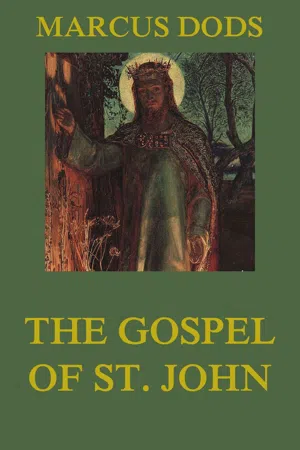
- 544 pages
- English
- ePUB (mobile friendly)
- Available on iOS & Android
eBook - ePub
The Gospel of St. John
About this book
Information
The Gospel Of St. John
Marcus Dods, D.D.,
Contents.
The Gospel Of St. John
Part 1
Introductory Note.
The Divisions Of St. John’s Gospel.
I. The Incarnation.
Ii. Reception Christ Met With.
Iii. The Baptist’s Testimony.
Iv. The First Disciples.
V. The First Sign—The Marriage In Cana.
Vi. The Cleansing Of The Temple.
Vii. Nicodemus.
Viii. The Brazen Serpent.
Ix. The Woman Of Samaria.
X. Jesus Declares Himself.
Xi. The Second Sign In Galilee.
Xii. Sabbath Cure At Bethesda.
Xiii. Jesus Life-Giver And Judge.
Xiv. Jesus The Bread Of Life.
Xv. The Crisis In Galilee.
Xvi. Jesus Discussed In Jerusalem.
Xvii. The Woman Taken In Adultery.
Xviii. Christ The Light Of The World.
Xix. Jesus Rejected In Jerusalem.
Xx. Sight Given To The Blind.
Xxi. Jesus The Good Shepherd.
Xxii. Jesus, Son Of God.
Xxiii. Jesus The Resurrection And Life.
Xxiv. Jesus The Scapegoat.
Note On Chap. Vi., Vers. 37, 44, 45.
Part II
I. The Anointing Of Jesus.
Ii. The Entry Into Jerusalem.
Iii. The Corn Of Wheat.
Iv. The Attractive Force Of The Cross.
V. Results Of Christ’s Manifestation.
Vi. The Foot-Washing.
Vii. Judas.
Viii. Jesus Announces His Departure.
Ix. The Way, The Truth, And The Life.
X. The Father Seen In Christ.
Xi. The Bequest Of Peace.
Xii. The Vine And The Branches.
Xiii. Not Servants, But Friends.
Xiv. The Spirit Christ’s Witness.
Xv. Last Words.
Xvi. Christ’s Intercessory Prayer.
Xvii. The Arrest.
Xviii. Peter’s Denial And Repentance.
Xix. Jesus Before Pilate.
Xx. Mary At The Cross.
Xxi. The Crucifixion.
Xxii. The Resurrection.
Xxiii. Thomas’ Test.
Xxiv. Appearance At Sea Of Galilee.
Xxv. Restoration Of Peter.
Xxvi. Conclusion.
The Gospel Of St. John, M. Dods
Jazzybee Verlag Jürgen Beck
86450 Altenmünster, Loschberg 9
Germany
ISBN: 9783849644253
www.jazzybee-verlag.de
www.facebook.com/jazzybeeverlag
The Gospel Of St. John
Part 1
Introductory Note.
In order to read the Gospel of St. John with some intelligence, it is necessary to understand its purpose and its plan. For in the whole range of literature there is no composition which is a more perfect work of art, or which more rigidly excludes whatever does not subserve its main end. From the first word to the last there is no paragraph, sentence, or expression which is out of its place, or with which we could dispense. Part hangs together with part in perfect balance. The sequence may at times be obscure, but sequence there always is. The relevancy of this or that remark may not at first sight be apparent, but irrelevancy is impossible to this writer.
The object which the Evangelist had in view in writing this Gospel we are not left to find out for ourselves. He explicitly says that his purpose in writing was to promote the belief that “Jesus is the Christ, the Son of God” (chap. xx. 31). This purpose, he judges, he will best accomplish, not by writing an essay, nor by framing an abstract argument in advocacy of the claims of Jesus, but by reproducing in his Gospel those manifestations of His glory which elicited faith in the first disciples and in others. That which had produced faith in his own case and in that of his fellow-disciples, will, he thinks, if fairly set before men, produce faith in them also. He relates, therefore, with the utmost simplicity of language, the scenes in which Jesus seemed to him most significantly to have revealed His power and His goodness, and most forcibly to have demonstrated that the Father was in Him. At the same time he keeps steadily in view the circumstance that these manifestations had not always produced faith, but that alongside of a growing faith there ran an increasing unbelief which at length assumed the form of hostility and outrage. This unbelief he feels called upon to account for. He feels called upon to demonstrate that its true reason lay, not in the inadequacy of Christ’s manifestations, but in the unreasonable and unspiritual requirements of the unbelieving, and in their alienation from God. The Gospel thus forms the primary apologetic, which by its very simplicity and closeness to reality touches at every point the underlying causes and principles of faith and unbelief.
The object of the Gospel being kept in view, the plan is at once perceived. Apart from the Prologue (chap. i. 1–18) and the Appendix (chap. xxi.), the body of the work falls into two nearly equal parts, chaps. i. 19–xii., and xiii.–xx. In the former part the Evangelist relates, with a singular felicity of selection, the scenes in which Jesus made those self-revelations which it was most important that men should understand, and the discussions in which their full significance was brought out. Thus he shows how the glory of Christ was manifested at the marriage in Cana, in the cleansing of the Temple, in the conversation with the Samaritans, in the healing of the impotent man, in the feeding of the five thousand, in the cure of the man born blind; and how, through these various signs or object-lessons, Jesus makes Himself known as the Life, the Light, the Judge of men, or, in one word, as the Son doing the Father’s works, manifesting the Father’s presence, disclosing in His various words and deeds “the glory as of the only begotten of the Father, full of grace and truth.”
These manifestations culminate in the raising of Lazarus, recorded in the eleventh chapter. This final sign, while in “many of the Jews” (xi. 45) it produced faith, aggravated at the same time the unbelief of the authorities, who “from that day forth took counsel together for to put Him to death” (xi. 53). The twelfth chapter, therefore, holds a place by itself. In it we have three incidents related, and all related for the same purpose, namely, to demonstrate that there was now no further need of such manifestations of the glory of Jesus as had already been given, and that all things were now ripe for the catastrophe. The incidents in which this became apparent were Mary’s anointing of Jesus, His triumphal entry into Jerusalem, and the enquiry of the Greeks. By introducing these three incidents together at this point, John wishes to show (1) that Jesus was now embalmed in the love of His intimate friends, (2) that He had found in the untutored instincts of the people a response to His claim, and (3) that even in the still wider circle of the outlying nations His name was known. He may, therefore, now safely finish His self-revelation. It has done its work. And the completeness of its result is seen, not only in this widely-extended impression and firmly-rooted attachment, but also in the maturity of unbelief which now took active steps to take Jesus and put Him to death.
This part of the Gospel therefore appropriately closes with the words: “These things spake Jesus and departed, and did hide Himself from them” (xii. 36). The public manifestation of Jesus is closed.
Between the first and the second part of the Gospel there is interposed a paragraph (xii. 37–50), in which John briefly points out that the rejection of Jesus by the Jews was no more than had been predicted by the prophet Isaiah, and that it reflects no suspicion on the manifestations of His relation to the Father which Jesus had made. He then sums up in one or two sentences the significance and consequences of receiving and of rejecting Jesus.
In the second part of the Gospel the writer is still guided by the same purpose of showing how Jesus manifested His glory. This is obvious not merely from the contents of this second part, but also from the fact that in the language of John the death of Jesus is constantly referred to as His glorification, being the “lifting up” which was an essential step to, or part of, His glorification. Before entering upon the last scenes, which are described in chaps. xiii.–xix., Jesus is assured that in His death the Father is to glorify His Name (xii. 28); and in the prayer recorded in the seventeenth chapter, which closes the explanations which our Lord Himself made of His work, it is still the manifestation of His glory that is in His thoughts. The characteristic which distinguishes this second part of the Gospel is, that Jesus no longer manifests His glory to the people in signs of manifest power, but now, in chapters xiii.–xvii., further discloses His glory privately to the Twelve; and in chapters xviii. and xix. passes triumphantly through the ultimate trial which still lay between Him and the final consummation of His glory. That this final glory has been achieved is witnessed by the Resurrection, the record of which, and of its results in faith, occupies the twentieth chapter. De Wette has the credit of being the first to discern that the entire Gospel is held together by this idea of the manifestation of Christ’s glory, and that “the glory of our Lord appears in all its brightness in the second part of the narrative (xiii.–xx.), and that (a) inwardly and morally in His sufferings and death (xiii.–xix.), and (b) outwardly and sensibly, in the triumphant event of the Resurrection.”
The best tabulated division of the Gospel with which I am acquainted is that which the Rev. A. Halliday Douglas, M.A., of Huntly, has printed for private circulation. By the kindness of the author I am allowed to publish it here.
The Divisions Of St. John’s Gospel.
The Prologue or Introduction. Chap. i. 1–18.
Part I. The Manifestation of Christ’s Glory in Life and Power. Chap. i. 19–xii. 36.
1. Christ’s Announcement of Himself, and the Beginnings of Faith and Unbelief. Chap. i. 19–iv.
2. The Period of Conflict. Chap. v.–xii. 36.
The Evangelist’s Pause for Reflection, and Review of Christ’s Teaching. Chaps. xii. 36–50.
Part II. The Manifestation of Christ’s Glory in Suffering and Death. Chaps. xiii.–xx.
1. Moral Victory in Suffering:—
a. In Anticipation. Chaps. xiii.–xvii.
b. In the Actual Struggle. Chaps. xviii., xix.
2. Actual Victory over Death. Chap. xx.
The Epilogue or Appendix. Chap. xxi.
I. The Incarnation.
“In the beginning was the Word, and the Word was with God, and the Word was God. The same was in the beginning with God. All things were made by Him; and without Him was not any thing made that hath been made. In Him was life; and the life was the light of men. And the light shineth in the darkness; and the darkness apprehended it not. There came a man, sent from God, whose name was John. The same came for witness, that he might bear witness of the light, that all might believe through him. He was not the light, but came that he might bear witness of the light. There was the true light, even the light which lighteth every man, coming into the world. He was in the world, and the world was made by Him, and the world knew Him not. He came unto His own, and they that were His own received Him not. But as many as received Him, to them gave He the right to become children of God, even to them that believe on His name: which were born, not of blood, nor of the will of the flesh, nor of the will of man, but of God. And the Word became flesh, and dwelt among us (and we beheld His glory, glory as of the only begotten from the Father), full of grace and truth. John beareth witness of Him, and crieth, saying, This was He of whom I said, He that cometh after me is preferred before me: for He was before me. For of His fulness we all received, and grace for grace. For the law was given by Moses; grace and truth came by Jesus Christ. No man hath seen God at any time; the only begotten Son, which is in the bosom of the Father, He hath declared Him.”—John i. 1–18.
In this brief introduction to his Gospel John summarises its contents, and presents an abstract of the history he is about to relate in detail. That the Eternal Word, in whom was the life of all things, became flesh and was manifested among men; that some ignored while others recognised Him, that some received while others rejected Him,—this is what John desires to exhibit at large in his Gospel, and this is what he summarily states in this compact and pregnant introductory passage. He briefly describes a Being whom he names “The Word;” he explains the connection of this Being with God and with created things; he tells how He came to the world and dwelt among men, and he remarks upon the reception He met with. What is summed up in these propositions is unfolded in the Gospel. It narrates in detail the history of the manifestation of the Incarnate Word, and of the faith and unbelief which this manifestation evoked.
John at once introduces us to a Being whom he speaks of as “The Word.” He uses the term without apology, as if already it were familiar to his readers; and yet he adds a brief description of it, as if possibly they might attach to it ideas incompatible with his own. He uses it without apology, because in point of fact it already had circulation both among Greek and Jewish thinkers. In the Old Testament we meet with a Being called “The Angel of the Lord,” who is at once closely related, if not equivalent, to Jehovah, and at the same time manifested to men. Thus when the Angel of the Lord had appeared to Jacob and wrestled with him, Jacob called the name of the place Peniel, for, said he, “I have seen God face to face.” In the apocryphal books of the Old Testament the Wisdom and the Word of God are poetically personified, and occupy the same relation to God on the one hand, and to man on the other, which was filled by the Angel of the Lord. And in the time of Christ “the Word of the Lord” had become the current designation by which Jewish teachers denoted the manifested Jehovah. In explaining the Scriptures, to make them more intelligible to the people, it was customary to substitute for the name of the infinitely exalted Jehovah the name of Jehovah’s manifestation, “the Word of the Lord.”
Beyond Jewish circles of thought the expression would also be readily understood. For not among the Jews only, but everywhere, men have keenly felt the difficulty of arriving at any certain and definite knowledge of the Eternal One. The most rudimentary definition of God, by declaring Him to be a Spirit, at once and for ever dissipates the hope that we can ever see Him, as we see one another, with the bodily eye. This depresses and disturbs the soul. Other objects which invite our thought and feeling we easily apprehend, and our intercourse with them is level to our faculties. It is, indeed, the unseen and intangible spirit of our friends which we value, not the outward appearance. But we scarcely separate the two; and as we reach and know and enjoy our friends through the bodily features with which we are familiar, and the words that strike upon our ear, we instinctively lon...
Table of contents
- The Gospel Of St. John
- Part II
Trusted by 375,005 students
Access to over 1.5 million titles for a fair monthly price.
Study more efficiently using our study tools.
Frequently asked questions
Yes, you can cancel anytime from the Subscription tab in your account settings on the Perlego website. Your subscription will stay active until the end of your current billing period. Learn how to cancel your subscription
No, books cannot be downloaded as external files, such as PDFs, for use outside of Perlego. However, you can download books within the Perlego app for offline reading on mobile or tablet. Learn how to download books offline
Perlego offers two plans: Essential and Complete
- Essential is ideal for learners and professionals who enjoy exploring a wide range of subjects. Access the Essential Library with 800,000+ trusted titles and best-sellers across business, personal growth, and the humanities. Includes unlimited reading time and Standard Read Aloud voice.
- Complete: Perfect for advanced learners and researchers needing full, unrestricted access. Unlock 1.5M+ books across hundreds of subjects, including academic and specialized titles. The Complete Plan also includes advanced features like Premium Read Aloud and Research Assistant.
We are an online textbook subscription service, where you can get access to an entire online library for less than the price of a single book per month. With over 1.5 million books across 990+ topics, we’ve got you covered! Learn about our mission
Look out for the read-aloud symbol on your next book to see if you can listen to it. The read-aloud tool reads text aloud for you, highlighting the text as it is being read. You can pause it, speed it up and slow it down. Learn more about Read Aloud
Yes! You can use the Perlego app on both iOS and Android devices to read anytime, anywhere — even offline. Perfect for commutes or when you’re on the go.
Please note we cannot support devices running on iOS 13 and Android 7 or earlier. Learn more about using the app
Please note we cannot support devices running on iOS 13 and Android 7 or earlier. Learn more about using the app
Yes, you can access The Gospel of St. John by Marcus Dods in PDF and/or ePUB format, as well as other popular books in Theology & Religion & Biblical Criticism & Interpretation. We have over 1.5 million books available in our catalogue for you to explore.